
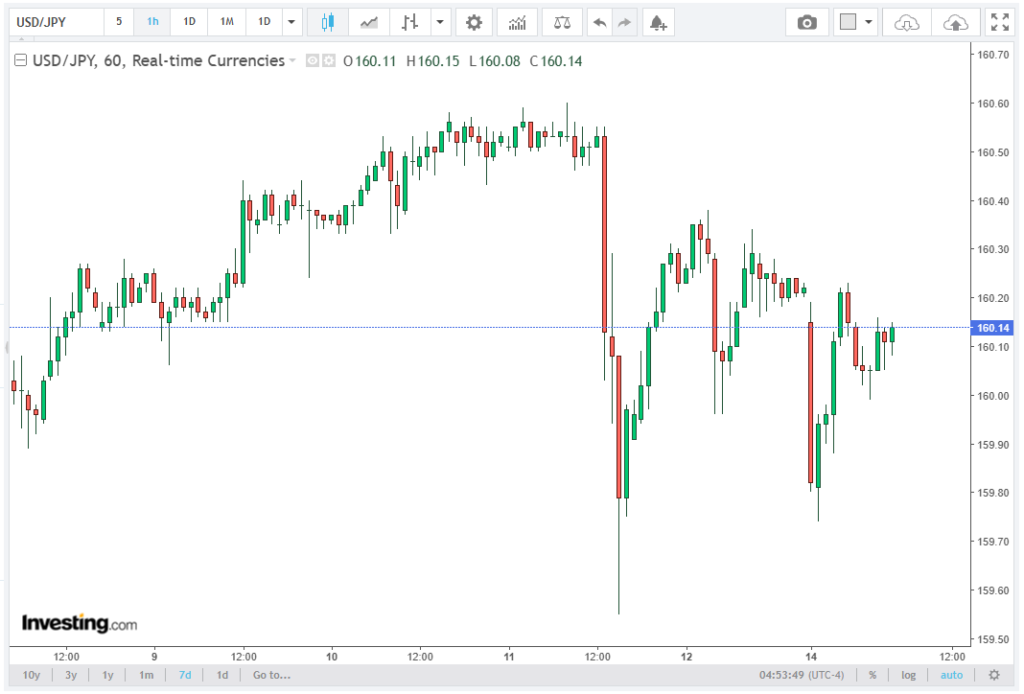
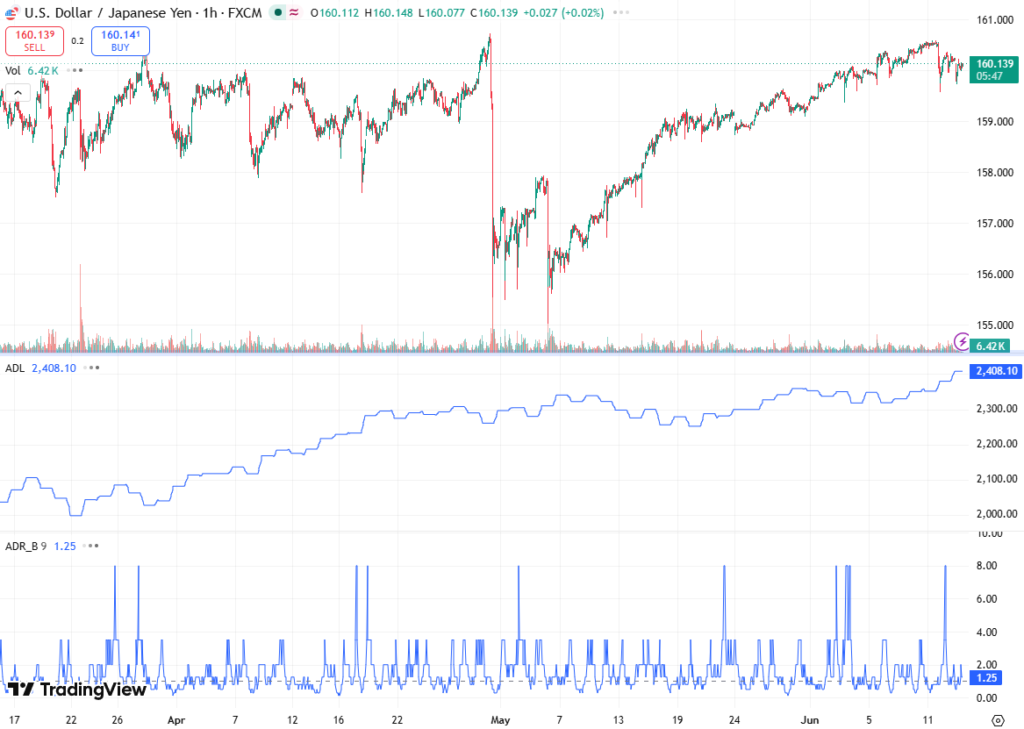
The USD/JPY pair is trading around 160.10 during Asian hours on Monday, after briefly oscillating between 159.70 and 160.45 in intraday flows. Despite a modest pullback, the pair remains firmly in positive daily territory, with price action still anchored in a regime of elevated volatility compression above 160.00. Vidasana Group’s experts provide a clear and structured breakdown of this topic in the article.
From a microstructure perspective, the move reflects a combination of USD softening on rate repricing and JPY stabilization driven by energy deflation, while the dominant structural driver remains the interest rate differential exceeding ~500 basis points across front-end instruments.
Yield Spread at ~500–550 Bps Continues to Dominate FX Fair Value
The core valuation driver for USD/JPY remains the US–Japan policy and yield differential, which currently stands at approximately 525–550 basis points on a nominal basis when comparing the Fed funds upper bound at 5.25%–5.50% against the BoJ policy rate at 0.00%–0.10%.
In forward markets, the 12-month implied carry differential remains near 480–520 bps, depending on funding currency and cross-currency basis adjustments. This creates a persistent positive carry environment for USD longs, reinforcing structural demand for USD-denominated assets.
From a quantitative carry perspective, holding USD/JPY long positions generates an annualized yield pickup of approximately 4.8%–5.2%, excluding hedging costs. This continues to suppress sustained JPY appreciation even during macro risk-off phases.
USD Weakens as Oil-Driven Inflation Expectations Collapse
The US dollar has softened modestly due to a rapid compression in global inflation expectations, driven by a sharp decline in crude oil prices. Brent crude has fallen approximately 8.5% week-on-week, while WTI is down roughly 9%, both trading near two-month lows in the $72–$75 per barrel range.
This decline follows the normalization of geopolitical risk premiums and the reopening of key maritime supply routes. The impact on macro pricing has been significant, with US 5-year breakeven inflation rates declining by roughly 12–15 basis points over the past week.
Lower energy input costs reduce headline inflation volatility, which in turn reduces demand for USD as a hedging instrument. The DXY index has consequently eased by approximately 0.4%–0.6% from recent highs, contributing to USD/JPY consolidation rather than continuation.
Fed pricing shifts: December hold probability jumps to 47%
Interest rate derivatives have repriced aggressively. According to CME FedWatch-implied probabilities, the market assigns a 47% probability to a policy rate hold at the December meeting, compared with 28% just one week earlier, representing a 19 percentage point shift in expectations.
This repricing has been driven by a decline in expected inflation rather than growth deterioration. US 2-year Treasury yields have declined approximately 18–22 basis points over the past 5 trading sessions, reflecting reduced expectations for additional tightening.
The US yield curve has also flattened modestly, with the 2s10s spread tightening by around 6–9 basis points, indicating reduced term premium pressure. However, even after this adjustment, US real yields remain significantly above Japanese equivalents, preserving USD attractiveness.
JPY supported by energy deflation but constrained by ultra-low rates
The Japanese yen has benefited from a decline in imported energy costs. Given Japan’s energy import dependency of approximately 85%+ for crude oil, a sustained 10% decline in oil prices typically reduces Japan’s annual import bill by an estimated 0.3%–0.5% of GDP equivalent in nominal terms.
This improves Japan’s external balance and reduces inflation pressure. Japan’s CPI momentum, currently fluctuating around 2.5%–3.0% YoY, is expected to moderate by 20–40 basis points over the next 2–3 quarters if energy prices remain subdued.
However, monetary policy divergence remains extreme. Even under a hypothetical BoJ adjustment, expected tightening remains limited to 10–25 basis points, leaving the policy rate below 0.25% in most forward scenarios. This is insufficient to materially alter USD/JPY equilibrium pricing.
Outlook: structurally range-bound but skewed toward higher levels
The USD/JPY outlook remains defined by a structural upward bias within a broad consolidation band, primarily anchored by the persistent 500+ bps yield differential. Short-term fluctuations are increasingly driven by changes in US inflation expectations, oil price volatility, and front-end yield repricing, rather than Japanese domestic policy shifts.
Key equilibrium dynamics suggest that USD/JPY remains sensitive to US 2-year yields in the 4.7% to 5.0% range, oil prices in the $70 to $80 band, and BoJ policy expectations constrained below 0.25%.
Until there is a material convergence in global rate structures, either via a sustained Fed easing cycle of 75–125 bps or a structurally faster BoJ tightening path, the interest rate differential will continue to dominate FX valuation. In this framework, USD/JPY remains structurally supported above 158.00, with episodic pullbacks unlikely to alter the broader high-yield carry equilibrium.


