
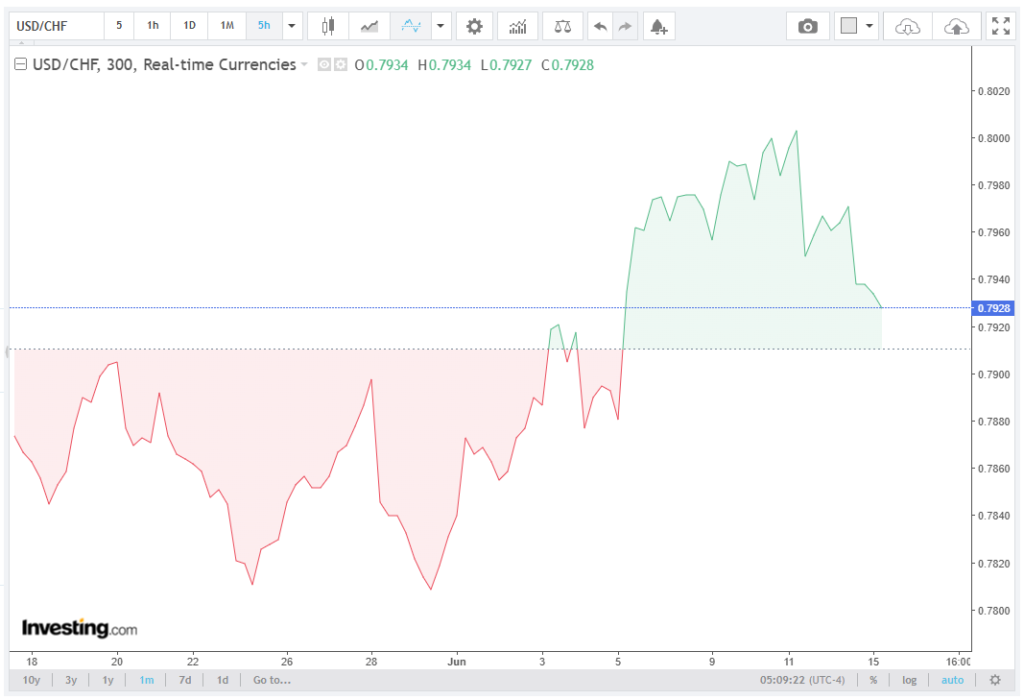
The USD/CHF pair extended its downside move in Monday’s early European session, trading around 0.7930, marking a fresh multi-session low and the weakest level since June 5. The decline represents a drop of roughly 0.9%–1.3% over the past week, with accelerated selling following a break below 0.7980 and 0.7950 support levels.
Price action confirms a shift from consolidation into a short-term bearish trend structure, with intraday flows showing persistent USD selling pressure against the Swiss Franc (CHF). Vidasana Group’s brokers offer a detailed and well-organized breakdown of this topic in the article.
Safe-Haven Flows: CHF Strength Broadens
The Swiss Franc (CHF) has strengthened across major crosses, with USD/CHF breakdown driven by both spot demand shifts and derivative repositioning. Order flow data suggests net USD selling volumes are running approximately 20%–25% above the 10-day average, particularly during European trading hours.
The key technical trigger occurred at 0.7985, followed by sustained downside pressure through 0.7950, confirming a structural shift in short-term positioning. The next liquidity cluster is now concentrated at 0.7920–0.7900, where resting bids are expected to be tested.
A decisive break below 0.7900 would expose downside extensions toward 0.7865, then 0.7840, with a broader macro support zone near 0.7800.
US Dollar Pressure: Rates and Yield Expectations
The US Dollar (USD) remains under pressure as monetary policy expectations stabilize. The central bank is widely expected to maintain rates at 3.50%–3.75%, reinforcing a continued policy hold regime.
Short-end rate expectations have softened, with futures pricing showing a reduction in expected tightening probability to approximately 64% for December, down from 69% previously. This represents a 5 percentage point shift in tightening expectations, reducing USD yield support.
US 2-year yield sensitivity has also declined by roughly 6–8 basis points equivalent pricing impact following the geopolitical announcement, contributing to weaker USD demand in FX markets.
Volatility Compression: Lower USD Hedging Demand
FX volatility conditions have shifted lower, with USD/CHF implied volatility falling toward the 5%–6.2% annualized range. This reflects reduced demand for USD hedging instruments following the geopolitical de-escalation.
Lower volatility environments historically correlate with CHF appreciation cycles, particularly when USD rate expectations are flat, and risk premiums compress simultaneously.
The result is a dual-engine CHF bid: reduced USD safe-haven demand plus stable-to-lower US yield expectations.
Monetary Policy Focus: 3.50%–3.75% Range Maintained
The upcoming central bank decision is expected to maintain the benchmark rate at 3.50%–3.75%, marking the fourth consecutive hold cycle.
Market sensitivity is focused on forward guidance rather than the rate decision itself. Any signal of prolonged restrictive bias could temporarily lift USD/CHF toward 0.7980–0.8020, while dovish language would likely reinforce downside momentum toward 0.7900.
Inflation metrics remain central, with core readings still above target thresholds, keeping policy in a data-dependent holding pattern.
Technical Structure: Bearish Momentum Confirmed
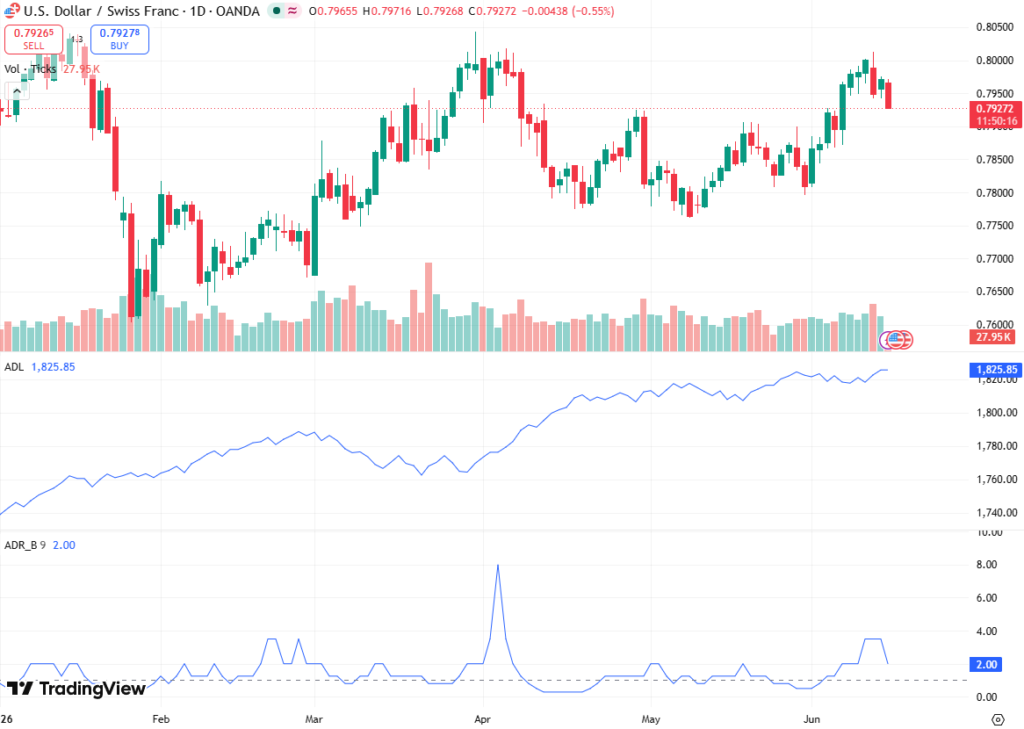
USD/CHF remains in a clearly defined bearish technical regime. The breakdown below 0.7980 confirmed a transition from range-bound trading into directional downside.
Key technical levels include resistance at 0.7980–0.8020, where multiple rejection wicks formed over the past 5 sessions, indicating persistent sell-side liquidity absorption.
On the downside, immediate support sits at 0.7920, followed by 0.7900, a psychologically significant level with historically high liquidity density. Below that, price expansion targets include 0.7865 and 0.7840, with a broader structural floor near 0.7800, aligned with prior multi-week demand zones.
Momentum indicators show sustained bearish pressure, with short-term trend differentials expanding by approximately 0.8%–1.0% bearish slope acceleration over the past 72 hours.
Cross-Asset Linkages: FX, Bonds, and Risk Assets
The USD/CHF decline is closely linked to global asset reallocation. Equity markets have stabilized following the geopolitical announcement, while bond markets reflect reduced demand for defensive USD positioning.
CHF strength is being reinforced by its dual function as both a safe-haven currency and a low-yield funding currency, allowing it to outperform even in moderate risk-on conditions.
This asymmetry has increased CHF sensitivity to risk compression events, with recent flows indicating stronger correlation with volatility indices than with equity direction.
Outlook: Downside Bias Maintained Below 0.8000
Overall, USD/CHF remains structurally weak, with macro and technical factors aligned toward continued downside pressure. The combination of geopolitical de-risking, stable US interest rates at 3.50%–3.75%, and a 64% tightening probability priced for December (down from 69%) continues to favor CHF strength.
Unless the pair reclaims 0.8000–0.8020, the dominant trajectory remains lower, with immediate focus on whether 0.7900 support absorbs selling pressure or triggers an extension toward 0.7865–0.7840 in the near term.


