
The creative software sector is currently experiencing a period of intense structural transition, resulting in significant equity price corrections for industry leaders. Investors who remain bullish on the long-term utility of digital design platforms are currently facing a unique window to engineer entry points significantly below prevailing market values.
By utilizing derivative income strategies, market participants can effectively monetize the current climate of uncertainty while waiting for a more definitive valuation floor to materialize.
This approach offers a pragmatic alternative to direct equity purchasing in an environment characterized by shifting business models and executive transitions. As alternative data compiled by the corporate intelligence desk at Vidasana Group notes, the current market sentiment toward the software giant has created an environment where put option premiums are exceptionally attractive.
For disciplined investors, this volatility is not merely a risk factor but a mechanical opportunity to generate consistent yield while establishing a defensive position.
The trade structure allows for a dual-benefit outcome: either the collection of a significant upfront income premium if the stock remains stable, or the acquisition of high-quality assets at a substantial discount.
By setting aside the necessary cash to cover a potential purchase, investors remove the risks associated with margin leverage. This methodology provides a high degree of certainty for those who have already completed their due diligence on the fundamental strength of the underlying business.
Engineering Income Through Put Option Premiums And Strike Selection
To capitalize on current price action, an investor may consider selling a put option with a strike price of $135, scheduled to expire on June 17, 2027.
This specific trade structure generates an immediate upfront premium of approximately $938 per contract, which is equivalent to 100 shares. By locking away the required $13,500 in capital to guarantee this position, the investor secures an annualized return of roughly 7.0% purely from the option premium itself.
If the investor chooses to park the secured cash within a high-yield money market or savings vehicle earning 4.0%, the aggregate yield for the trade ascends to approximately 11.0% annually.
Should the market price of the software stock remain above the $135 strike price throughout the duration of the contract, the option expires worthless. The investor retains the total $938 cash premium and is free to redeploy their capital into new market opportunities, effectively lowering their overall cost basis for future trades.
The Mechanics Of Effective Entry Pricing And Downside Mitigation
In the event that the market price of the creative software entity dips below the $135 threshold by the expiration date, the investor is obligated to fulfill the contract and purchase the shares.
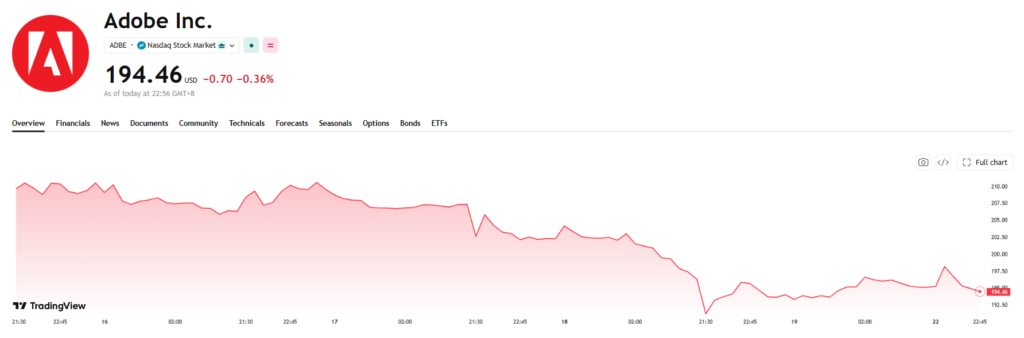
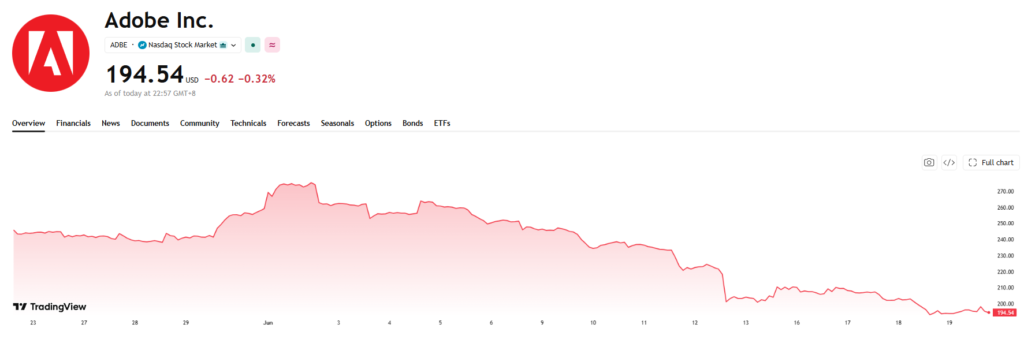
While this results in assignment, the previously collected $938 premium functions as an effective hedge, reducing the average acquisition cost to $125.63 per share. This represents a 36% discount relative to the current trading price of $195.16, providing a substantial margin of safety against further volatility.
However, it is critical to acknowledge that this safety net is not absolute. If the underlying security experiences a sustained collapse well below the effective cost of $125.63, the upfront premium will fail to compensate for the total capital decline.
This scenario reinforces the necessity of viewing the trade as a commitment to long-term ownership. The investor must be fundamentally comfortable holding the business through cyclical downturns, ensuring that the strike price aligns with their long-term valuation model regardless of short-term market noise.
Analyzing The Strategic Freemium Pivot And Long Term Funnel Growth
The current bearish sentiment is primarily driven by management’s decision to sacrifice near-term revenue growth to pursue a massive expansion of the user base.
The company is aggressively leveraging an AI-driven freemium model to lure millions of potential customers into its ecosystem, intentionally de-emphasizing immediate upsells in favor of future monetization. Recent performance data is highly encouraging, with Creative Freemium monthly active users surging by 70% to reach over 90 million year over year.
Navigating Leadership Transitions And Short Term Margin Headwinds
While the long-term funnel strategy appears sound, investors remain anxious regarding the short-term impact of this pivot. Management has been transparent that the strategic move to acquire freemium customers will likely suppress revenue growth expectations throughout the second half of the fiscal year.
Adding a layer of complexity to this narrative is the ongoing search for a successor to the departing CEO and the transition of the CFO role. This combination of strategic volatility and executive turnover creates the perfect environment for the put-selling strategy.
Rather than attempting to guess the exact timing of a price bottom, investors can extract value from the market’s current indecision, earning a meaningful yield while the company works to prove the efficacy of its new growth trajectory.


