
The US Supreme Court has handed down a ruling that significantly widens the door for American companies to pursue legal claims against the Cuban government over property seized more than 60 years ago.
The case centers on ExxonMobil, but its implications stretch far beyond a single company. Aicanx brokers break down what the ruling actually changes and why it matters for businesses still operating around confiscated Cuban assets.
The Legal Force Field Just Got Punctured
To understand the ruling, it helps to understand the legal concept it overturned: sovereign immunity. In plain terms, this is the rule that normally shields foreign governments, and the businesses they own, from being sued in US courts. It functions as a kind of legal force field, making it extremely difficult to drag a foreign government into an American courtroom no matter how legitimate the underlying grievance.
Cuba’s state-owned companies have leaned on that shield for years. This week, the Supreme Court ruled by a 6-3 vote that the shield doesn’t apply in cases like Exxon’s, a decision that everything else in this story flows from.
1960: The Year Cuba Took the Refinery and Never Paid
The dispute traces back to 1960, shortly after Fidel Castro took power, when Cuba’s government seized a large amount of foreign-owned property, including an oil refinery, fuel terminals, and more than 100 service stations belonging to Standard Oil, the company that eventually became ExxonMobil. Cuba never compensated the company for any of it.
Congress eventually responded with the Helms-Burton Act in 1996, giving Americans a legal avenue to sue anyone, including Cuban state-owned firms, that continue profiting from property taken during the revolution. Exxon used that law to sue Corporación CIMEX, a Cuban state-owned company accused of operating Exxon’s former refinery and stations to generate ongoing revenue for the Cuban government.
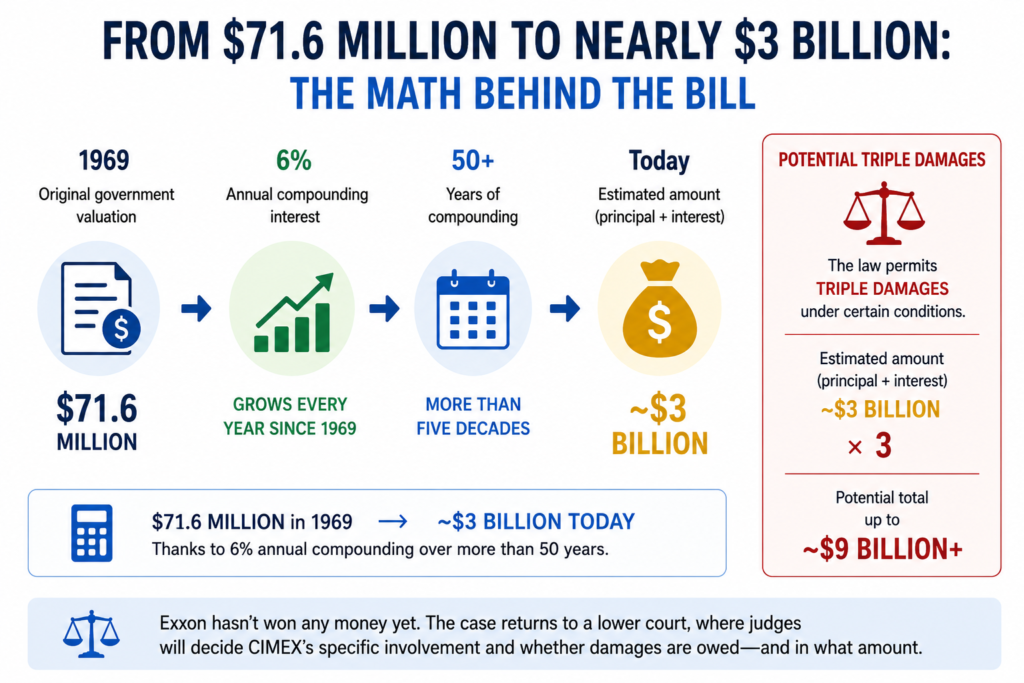
From $71.6 Million to Nearly $3 Billion: The Math Behind the Bill
When the US government first valued what Cuba seized from Exxon back in 1969, it landed on $71.6 million. That number doesn’t sound enormous today, but the law allows it to compound at 6% annually going back to the original seizure. Stretched across more than five decades, that figure grows to somewhere around $3 billion, and the law also permits triple damages under certain conditions, which could push the eventual number even higher.
Frozen for 25 Years, Unlocked in a Single Vote
The Helms-Burton Act has existed since 1996, so the natural question is why this is only playing out now. The answer comes down to a presidential suspension provision built into the law, one that let presidents pause the lawsuit provision to avoid straining relationships with allies like Canada and Spain, whose companies also operate in Cuba. Every president used that suspension for more than 20 years.
That changed in 2019, when the suspension was lifted for good. Exxon filed its lawsuit against CIMEX the same day, but the case immediately ran into the sovereign immunity wall, with lower courts initially siding with CIMEX. This week’s ruling knocks that wall down and sends the case back to a lower court, where the focus now shifts to whether CIMEX is actually liable and, if so, for how much.
Exxon Is Just the First Domino
Exxon’s case is one of roughly 40 similar lawsuits filed since the 2019 suspension was lifted, all targeting Cuban entities accused of profiting from confiscated property. The ruling also follows a related case earlier this year in which Carnival Corporation, Royal Caribbean Group, and Norwegian Cruise Line Holdings were ordered to pay a combined $440 million over their use of seized Havana harbor facilities.
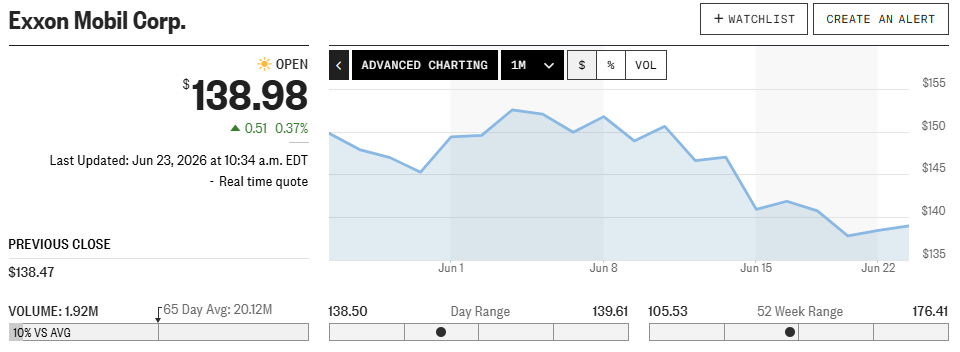
Taken together, these rulings suggest the courthouse door is now considerably wider open for companies and individuals pursuing decades-old Cuban property claims. The timing also lines up with a tense stretch in US-Cuba relations more broadly, including new murder charges filed against Cuba’s former president and rising US pressure on Cuba’s fuel supply and energy infrastructure.
A Win in Court, Not Yet a Check in the Mail
Exxon has not won any damages yet. The recent ruling only grants the company the right to pursue its lawsuit, not victory in the underlying case itself.
The dispute now returns to a lower court, where judges will evaluate CIMEX’s specific role in the case and determine whether damages should be awarded and, if so, how much.
For foreign companies benefiting from Cuban properties confiscated during the revolution, the ruling sends a clear signal: the legal protections many have relied on for decades may be weaker than previously believed. With roughly 40 similar cases still pending, investors and businesses will be watching closely as lower courts begin applying the precedent established by this decision.


