
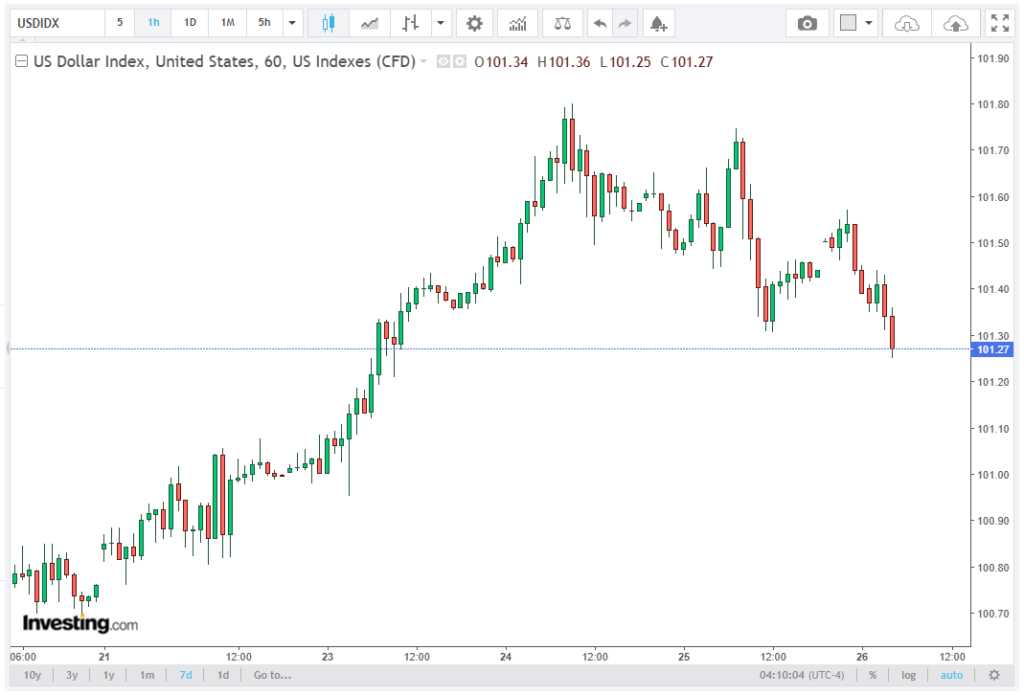
In early Friday trading in Europe, the US Dollar Index (DXY), which measures the dollar against six key global currencies, continued to slide, slipping to around the 101.40 level.
The index has now broken below the 101.50 short-term support zone, reflecting a clear shift in interest rate expectations, real yield dynamics, and macro inflation interpretation following the latest US PCE inflation data.
The move lower in the DXY is tightly linked to a measurable decline in Federal Reserve rate hike probabilities, alongside a marginal cooling in monthly inflation momentum, even as annual inflation remains structurally elevated above target thresholds. The brokers at Aicanx explore this topic in depth throughout this article.
PCE Inflation Data Shows Sticky Annual Inflation but Softer Monthly Dynamics
The latest release from the US Bureau of Economic Analysis (BEA) confirmed that headline PCE inflation accelerated to 4.1% YoY in May, up from 3.8% YoY in April, marking a continued divergence from the Fed’s 2% inflation objective.
At the same time, Core PCE inflation, the Fed’s preferred structural inflation gauge excluding food and energy components, increased to 3.4% YoY, compared with 3.3% YoY previously. This reading represents the highest core PCE level since October 2023, reinforcing the persistence of underlying price rigidity, particularly within services-driven components.
However, the monthly PCE increase of 0.4% MoM came in below consensus expectations of 0.5% MoM, indicating a modest deceleration in short-term inflation velocity. This divergence between elevated YoY inflation and cooling MoM momentum has been central to recent repricing across rate futures markets.
Fed Funds Futures Signal Reduced Tightening Probability
Following the latest CPI inflation release, Fed funds futures (CME FedWatch Tool) reflected a material repricing across the front-end policy path. The implied probability of a 25 bp hike at the July FOMC fell from 34.2% to 28.9% (-5.3 pp), while the September meeting probability declined from 65.7% to 60.1% (-5.6 pp).
The implied policy path shifted lower by ~8–12 bps in expected cumulative tightening across the next two meetings. Concurrently, SOFR OIS curves flattened at the 1–6 month tenor, with front-end yields declining ~4–7 bps.
US real yields at the front end compressed by ~5–8 bps, consistent with easing inflation expectations and a lower policy rate trajectory. The 2Y inflation breakeven edged down ~2–3 bps, while implied terminal rate expectations in OIS shifted ~10 bps lower across the curve.
Overall, the repricing indicates a reduced hawkish skew and a modest decline in the USD yield advantage in the near term across G10 FX markets.
Dollar Index Reacts to Compression in Rate Differential Advantage
The decline in the US Dollar Index to 101.40 is consistent with a narrowing of the US yield advantage versus G10 peers, driven by lower expected terminal Fed policy rates.
Currency valuation models remain highly sensitive to real rate spreads, and even a 30–50 basis point adjustment in expected Fed policy paths can materially alter FX positioning flows.
The recent drop in hike probability from 34.2% to 28.9% represents a statistically meaningful shift in forward rate distribution, particularly for short-dated USD instruments.
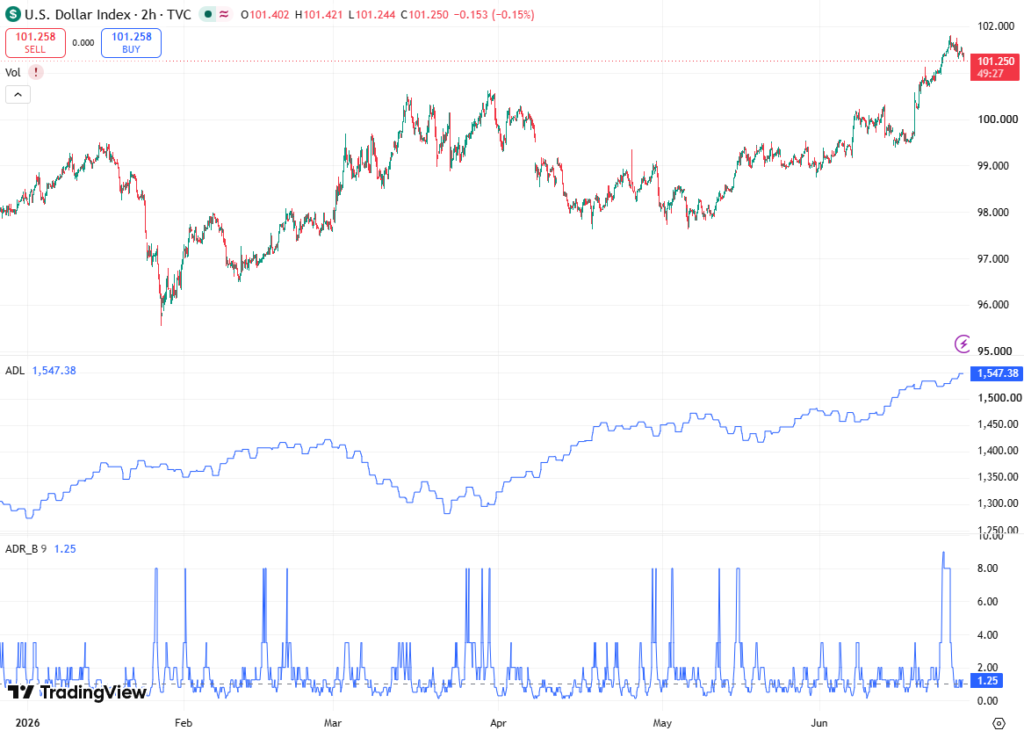
As a result, the USD index trajectory has shifted from consolidation above 102.00 toward a lower equilibrium band near 101.00–101.50, reflecting a recalibration in macro rate expectations rather than pure risk sentiment deterioration.
Macro FX Transmission Mechanism and DXY Sensitivity
The US Dollar Index remains highly sensitive to real yield differentials, particularly through the channel of 2-year Treasury yield expectations, which are closely correlated with Fed funds terminal pricing.
As rate hike expectations decline from 34.2% to 28.9% for July, and from 65.7% to 60.1% for September, the implied path of short-term USD yield advantage compresses, reducing demand for USD carry exposure.
This dynamic is amplified in environments where inflation remains elevated but decelerating at the margin, creating a scenario where policy tightening expectations peak before inflation fully normalizes, typically resulting in USD consolidation or mild depreciation phases.
Outlook: Sentiment Data as Secondary Macro Catalyst
Attention now shifts toward the upcoming US Michigan Consumer Sentiment Index, which functions as a secondary but relevant indicator for inflation expectations, real consumption trajectory, and forward demand conditions.
In the current macro regime, any deterioration in consumer sentiment readings could reinforce the narrative of peaking policy tightness, further compressing USD yield support factors and potentially extending pressure on the DXY below the 101.50–101.00 range.
Conversely, stronger-than-expected sentiment data could temporarily stabilize rate expectations, leading to a short-term repricing in Fed funds futures and limiting further downside in the US Dollar Index.
Overall, the current configuration reflects a market transitioning from aggressive tightening expectations to data-dependent policy uncertainty, with the USD Index reacting primarily through rate differential compression rather than risk-off flows.


