
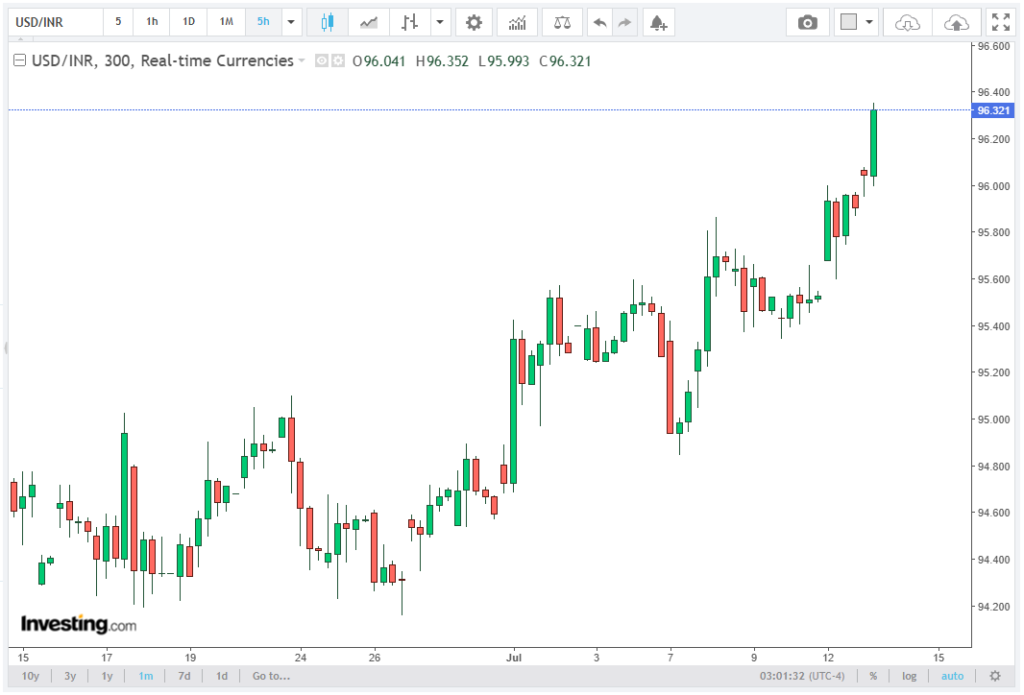
The Indian Rupee (INR) weakened sharply against the US Dollar (USD) on Tuesday, with the USD/INR pair advancing to a fresh seven-week high near 96.13. The currency pair remains supported by a combination of higher crude oil prices, rising US Treasury yields, and renewed geopolitical risk premiums linked to developments around the Strait of Hormuz.
In the article, the brokers at Ellismis offer a comprehensive look into this important topic.
The rupee’s decline reflects India’s sensitivity to external energy shocks. As one of the world’s largest crude oil importers, India faces increased pressure on its current account balance, trade deficit, and inflation outlook when global oil prices rise.
A sustained increase in energy costs typically reduces demand for emerging-market currencies, including the INR, as investors reassess growth and capital flow expectations.
The USD/INR exchange rate has maintained a strong upward structure, with buyers defending key technical support levels while the dollar benefits from higher US yields and safe-haven demand.
Hormuz Fee Claims Trigger Crude Oil and Bond Market Volatility
Global energy markets reacted strongly after the United States announced plans to charge a 20% transit fee on cargo ships passing through the Strait of Hormuz, citing security-related costs associated with protecting the strategic waterway.
The Strait of Hormuz is one of the most important energy corridors globally, with approximately 20% of the worldwide oil supply passing through the region. Any additional cost or disruption risk in this area increases the probability of higher oil risk premiums.
The MCX Crude Oil July futures contract opened 4.24% higher at nearly Rs. 7,673, reaching its strongest level in almost one month. The sharp move in crude prices immediately pressured the currencies of oil-importing economies.
For India, higher oil prices create a negative macroeconomic combination of higher import costs, potential inflation acceleration, and greater demand for foreign currency payments, all of which can weigh on the Indian Rupee.
US Treasury Yields Strengthen Dollar Demand
The rise in geopolitical uncertainty also pushed US Treasury yields higher. The benchmark 10-year Treasury yield climbed 0.3% to around 4.62%, moving closer to its recent 18-month peak of 4.66%.
Higher yields generally support the US Dollar Index (DXY) by improving the attractiveness of dollar-denominated assets. At the same time, elevated yields create pressure on emerging-market currencies because investors may shift capital toward higher-return and lower-risk US assets.
The current market environment combines three negative factors for the rupee: higher crude prices, stronger US yields, and risk aversion in global markets. This combination has allowed USD/INR bulls to maintain control.
US Inflation Data and Fed Policy Expectations in Focus
Market participants are now awaiting the latest US Consumer Price Index (CPI) data for June, along with testimony from Federal Reserve officials, for clues regarding future interest rate policy.
Current forecasts indicate that headline CPI inflation may slow to 3.8% year-on-year in June from 4.2% in May, while core CPI inflation is expected to remain elevated near 2.9%.
The inflation report is critical because a stronger-than-expected reading could reinforce expectations of tighter monetary policy, potentially pushing US Treasury yields higher and supporting further USD appreciation.
Conversely, softer inflation data could reduce dollar demand by increasing expectations of a more accommodative Federal Reserve stance.
Technical Outlook: USD/INR Maintains Positive Trend Above 20-EMA
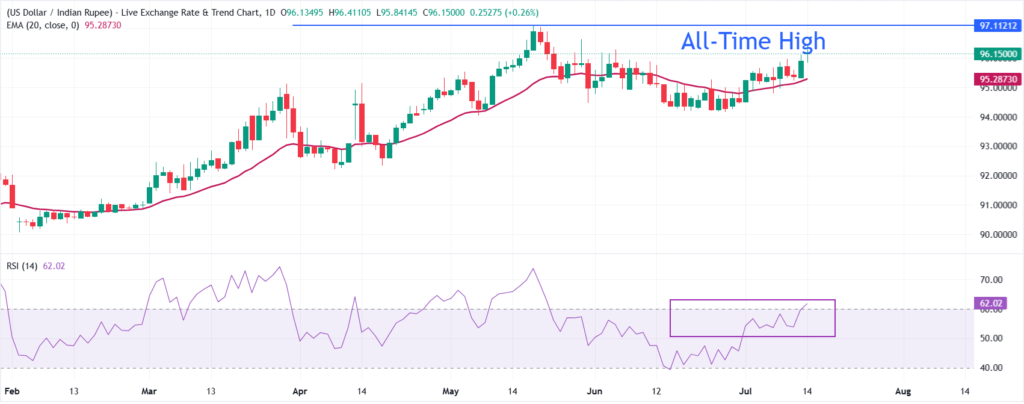
From a technical perspective, USD/INR remains firmly bullish after holding above the 20-period Exponential Moving Average (EMA) at 95.2840. The pair is currently trading near 96.12, indicating continued buying momentum above short-term trend support.
The Relative Strength Index (RSI) stands at 61.69, confirming positive momentum while remaining below the traditional overbought threshold of 70. This suggests that the pair retains upside potential without showing excessive buying pressure.
The immediate downside support zone is located near the 20-EMA at 95.28, followed by the psychological support level of 95.00. A decisive break below these levels could weaken the current bullish setup.
On the upside, traders are monitoring the previous record high near 97.10. A move above this resistance area would confirm further USD/INR strength and could open the path toward additional gains.
Market Outlook: INR Remains Vulnerable to External Shocks
The Indian Rupee outlook remains bearish in the short term as global markets respond to higher energy prices, elevated US bond yields, and geopolitical uncertainty.
The direction of USD/INR will depend heavily on upcoming US inflation data, movements in crude oil prices, changes in Treasury yields, and foreign investor flows.
As long as USD demand remains strong and oil prices stay elevated, the rupee is likely to remain under pressure, with traders watching the 96.13 resistance level and the potential retest of the 97.10 all-time high.


