
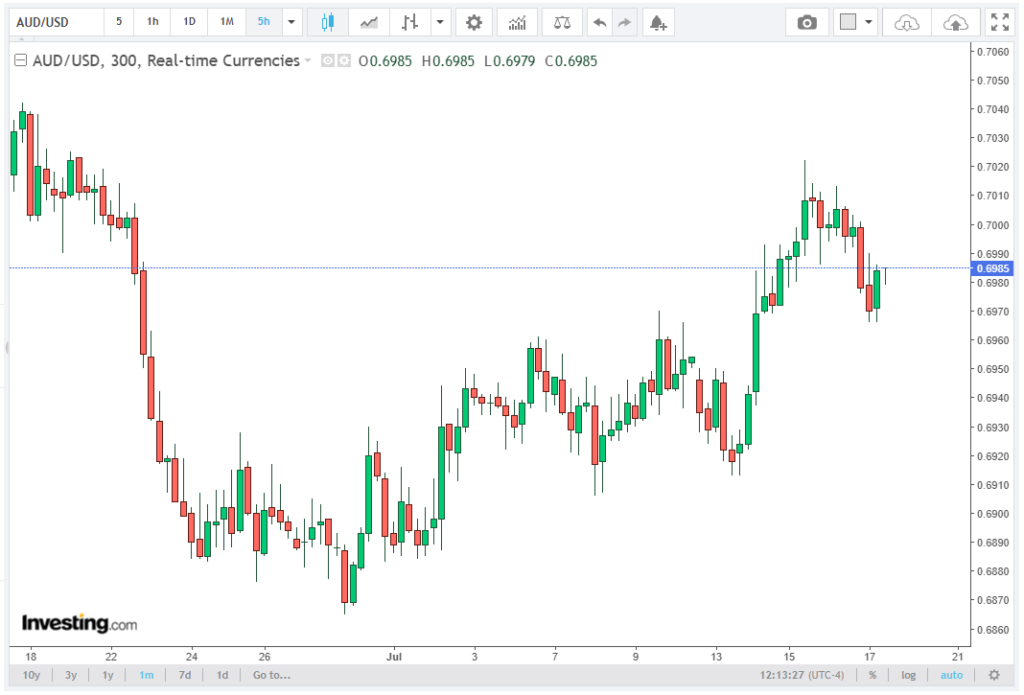
The Australian Dollar (AUD) recovered against the US Dollar (USD) on Friday, with the AUD/USD pair rebounding toward the 0.6980 area after an early session decline. Read on as the specialists at South Quantum Group break down this topic in the article below.
The recovery was driven by broad-based US Dollar weakness following a mixed set of United States economic indicators, which produced conflicting signals regarding economic momentum, inflation risks, and the outlook for Federal Reserve monetary policy.
The AUD/USD exchange rate moved higher toward 0.6982, as stronger-than-expected US Housing Starts and improved Consumer Sentiment were offset by weaker Building Permits and softer Industrial Production data.
The mixed economic picture reduced the probability of a sustained USD rally, allowing the Australian Dollar to regain short-term momentum.
US Economic Data Sends Mixed Signals to Currency Markets
The latest US housing data provided an initial positive signal for economic activity. Housing Starts increased to an annualized 1.43 million units in June, significantly above the market forecast of 1.31 million and higher than the previous reading of 1.20 million.
The monthly improvement indicated stronger residential construction activity and suggested that parts of the housing sector remain resilient despite elevated borrowing costs.
However, the broader housing picture remained uneven as Building Permits weakened. Permits declined to 1.37 million month-over-month, missing expectations of 1.40 million and falling below the previous figure of 1.41 million.
On an annual basis, Building Permits declined 3.0%, signaling a slowdown in future construction activity and limiting the positive impact of the stronger housing starts figure.
The industrial sector also delivered a weaker reading. US Industrial Production increased only 0.1% month-over-month, below the expected 0.2% gain and unchanged from the previous result.
The subdued performance highlighted continued pressure on manufacturing activity and contributed to renewed selling pressure in the US Dollar Index (DXY).
Meanwhile, consumer data showed improving sentiment. The preliminary University of Michigan Consumer Sentiment Index advanced to 54.4 in July from 49.5, exceeding market expectations of 51.0.
The Consumer Expectations Index also improved to 54.0 from 50.7, suggesting households became more optimistic despite ongoing concerns surrounding inflation, interest rates, and economic uncertainty.
Inflation Concerns Remain but Fail to Support USD Demand
Federal Reserve officials maintained a cautious inflation outlook, noting persistent price pressures from energy, insurance, supply-chain issues, and AI-related investment. However, the comments failed to provide lasting support for the US Dollar as markets focused on slowing growth and future rate expectations.
A softer economic outlook could encourage easier Fed policy, weighing on the USD and supporting currencies like the Australian Dollar.
AUD/USD Technical Structure Remains Neutral Above Key Support
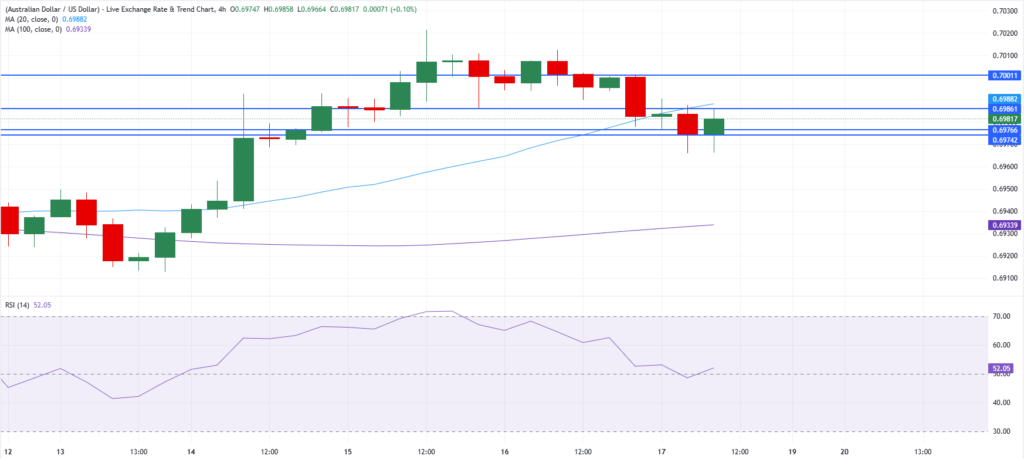
From a technical analysis perspective, the AUD/USD pair is trading near 0.6982 on the 4-hour timeframe, positioned between key moving averages. The pair remains trapped between the 20-period Simple Moving Average (SMA) at 0.6988 and the 100-period SMA at 0.6934, creating a short-term neutral market structure.
The 20-period SMA at 0.6988 represents immediate dynamic resistance. A confirmed breakout above this level would strengthen the short-term bullish bias and expose the next resistance zone near 0.7001. A move above 0.7001 would signal increased buying pressure and potentially extend the recovery toward higher psychological levels.
On the downside, the first support zone is located around 0.6977, followed by 0.6974. These levels represent short-term demand areas where buyers may attempt to defend the recent recovery. A sustained move below these supports would weaken the near-term outlook and shift attention toward the stronger technical floor at the 100-period SMA near 0.6934.
Momentum indicators remain balanced. The 14-period Relative Strength Index (RSI) is positioned near 52, indicating slightly positive momentum but remaining close to the neutral 50 level. The RSI reading suggests that buyers have a modest advantage, although momentum is not strong enough to confirm a decisive bullish breakout.
AUD/USD Outlook: Focus Remains on USD Direction and Technical Breakout
The near-term direction of AUD/USD will depend on whether the pair can overcome the 0.6986–0.6988 resistance zone and maintain trading above the 0.7001 level. A successful breakout could reinforce the recovery trend, while rejection from resistance may trigger renewed selling pressure toward 0.6974 and 0.6934.
The Australian Dollar is currently benefiting from a weaker US Dollar environment, driven by uncertainty following mixed US economic data. However, traders will continue monitoring upcoming economic indicators, inflation developments, and central bank policy expectations for confirmation of the next major move.
With RSI near neutral, price action between the 20-SMA resistance and 100-SMA support remains the key technical focus. Until either level is decisively broken, the AUD/USD outlook remains cautiously balanced with a slight bullish bias.


