
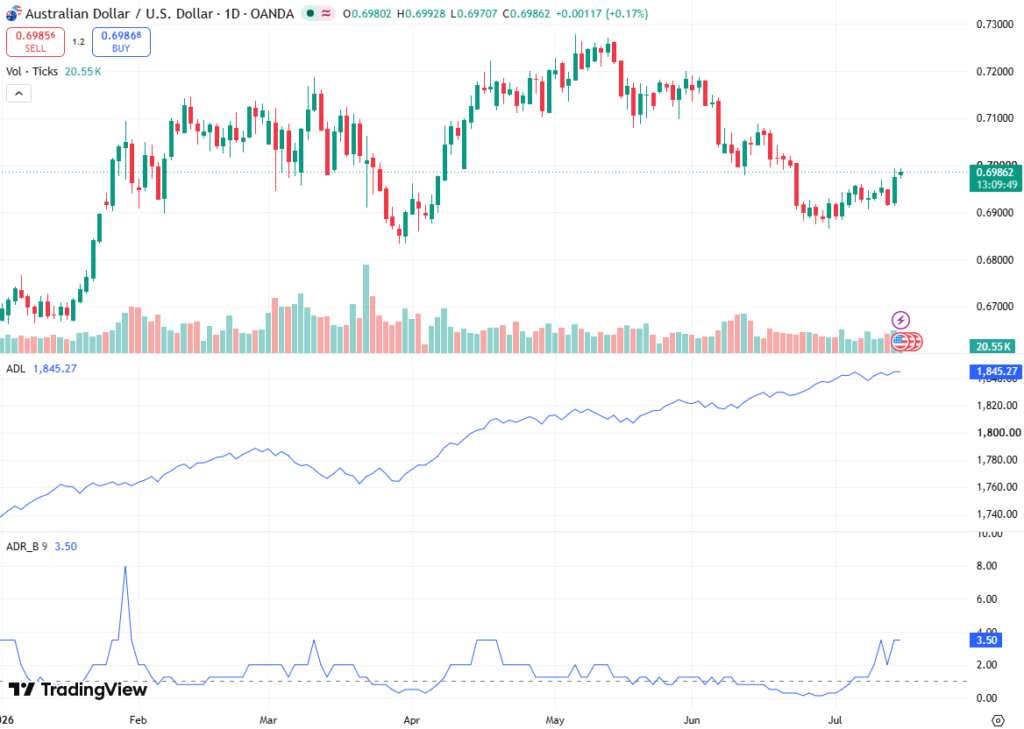
The Australian Dollar (AUD) continued its recovery against the US Dollar (USD) on Wednesday, with the AUD/USD pair trading near 0.6990 during the early European session. The pair’s upward momentum has been driven primarily by broad-based USD weakness after the latest US inflation data showed a faster-than-expected moderation in price pressures.
The analysts at Drexeldev delve deeper into this topic throughout the article below.
The move toward the 0.7000 psychological resistance level reflects a shift in Federal Reserve policy expectations, as traders reduced the probability of additional interest rate increases following the softer June Consumer Price Index (CPI) report.
Lower expectations for US monetary policy tightening have reduced demand for the Greenback, allowing higher-beta currencies such as the Australian Dollar to gain ground.
The market focus now shifts toward the upcoming US Producer Price Index (PPI) release, which could provide further direction for AUD/USD volatility and influence expectations for the next phase of Fed policy normalization.
US Inflation Slows, Weakening the Case for Further Fed Tightening
The latest US CPI data delivered a significant downside surprise, reinforcing expectations that inflation is continuing to cool. The headline CPI rate increased by 3.5% year-over-year in June, declining from 4.2% in May and below the market forecast of 3.8%.
The slowdown in consumer inflation reduced pressure on the Federal Reserve to maintain an aggressive tightening cycle. A lower inflation trajectory suggests that restrictive monetary policy may already be having the desired impact on demand and price growth.
The core CPI measure, which excludes volatile food and energy components, also weakened. Core inflation rose 2.6% YoY in June, compared with 2.9% in May, while economists had expected a smaller decline to approximately 2.8%.
The combination of lower headline inflation and softer core inflation has increased expectations that the Fed may adopt a more cautious approach toward future rate decisions. This has directly affected US Treasury yields, with declining yield expectations reducing the attractiveness of USD-denominated assets.
Market Pricing Shifts Sharply After Inflation Release
The latest inflation data prompted a sharp shift in market expectations, with investors scaling back their forecasts for further Federal Reserve tightening. The CME FedWatch tool now indicates that the odds of a 25-basis-point hike at the Fed’s July 28–29 meeting have fallen to 16.6%, down from roughly 35% prior to the release of the CPI report.
Expectations for a potential move at the September 15-16 meeting have also declined significantly. The probability of a quarter-point hike has fallen to around 60%, compared with more than 90% before the inflation report.
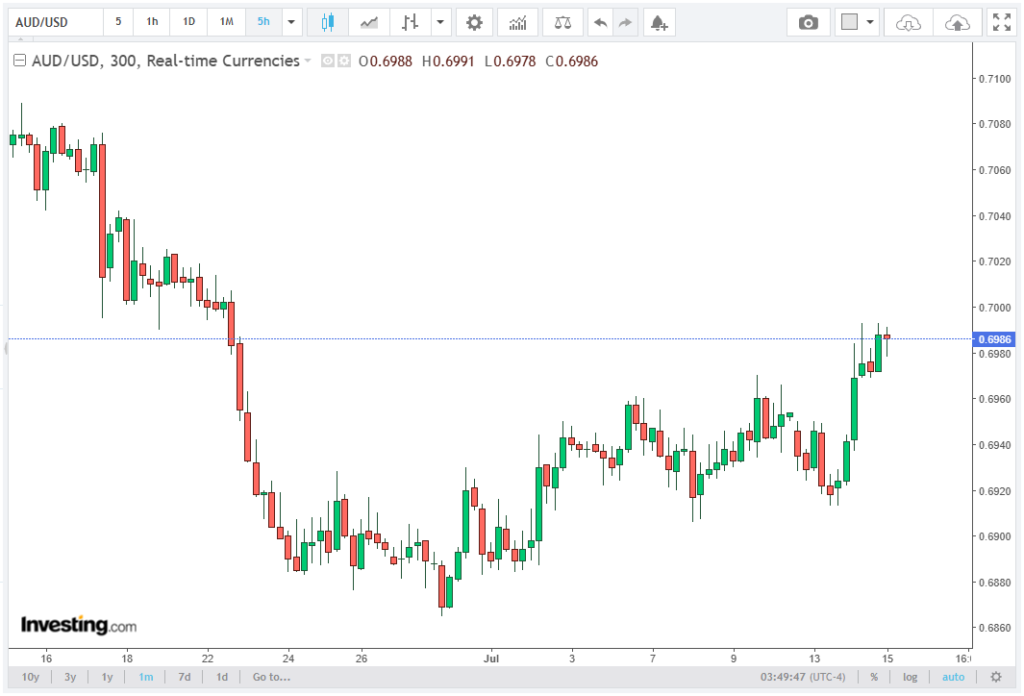
This repricing has created a negative environment for the US Dollar Index (DXY) and provided additional support for the AUD/USD exchange rate. Lower expected US interest rates typically reduce the yield advantage of the Dollar, encouraging capital flows into currencies with stronger exposure to global growth and commodities.
Geopolitical Risk Limits Australian Dollar Upside
Despite the supportive impact of weaker US inflation, AUD/USD gains remain vulnerable to rising geopolitical uncertainty. Escalating Middle East tensions have boosted demand for safe-haven assets, particularly the US Dollar, potentially limiting further upside in the Australian Dollar.
Recent military developments involving US and Iranian targets have raised concerns over broader regional escalation, which could trigger renewed risk aversion. As a risk-sensitive currency, the AUD remains influenced by global sentiment, commodity prices, China’s outlook, and broader market conditions.
Hormuz Developments Increase Market Volatility
Additional uncertainty has emerged around the Strait of Hormuz, one of the world’s most important energy shipping routes. Concerns over potential disruptions have increased volatility across oil markets, raising questions about future energy prices and inflation trends.
A sharp increase in crude oil prices could complicate the global inflation outlook by increasing input costs for businesses and consumers. This could influence future decisions by major central banks and create additional volatility in currency markets.
For the AUD/USD pair, higher commodity prices may provide some support due to Australia’s role as a major exporter of raw materials. However, increased geopolitical risks could offset this benefit by strengthening demand for the US Dollar as a safe-haven currency.
Technical Outlook: AUD/USD Approaches Key 0.7000 Resistance
Additional uncertainty has emerged around the Strait of Hormuz, one of the world’s most important energy shipping routes. Concerns over potential disruptions have increased volatility across oil markets, raising questions about future energy prices and inflation trends.
A sharp increase in crude oil prices could complicate the global inflation outlook by increasing input costs for businesses and consumers. This could influence future decisions by major central banks and create additional volatility in currency markets.
For the AUD/USD pair, higher commodity prices may provide some support due to Australia’s role as a major exporter of raw materials. However, increased geopolitical risks could offset this benefit by strengthening demand for the US Dollar as a safe-haven currency.


