
Canada’s S&P/TSX Composite Index fell to its lowest level in nearly two weeks on Monday as losses in financial, industrial, and consumer shares outweighed support from parts of the energy sector. The index dropped 303.53 points, or 0.9%, to 34,960.32, marking its third consecutive decline.
This analysis from mlgoldcorp.com examines whether the TSX can recover above 35,250, or whether weaker domestic data and cautious global sentiment could extend the pullback.
The Recent High Has Given Way
The TSX reached a record high during the previous week but has struggled to hold those gains.
Monday’s decline pushed the index below 35,000, an important psychological level. Traders will now watch whether buyers return quickly or allow the correction to deepen.
The 20-day Exponential Moving Average is the first technical area to monitor. A recovery above it would suggest the latest weakness remains a normal pullback.
The 50-day EMA carries more weight. Continued trading above it would keep the medium-term structure relatively positive.
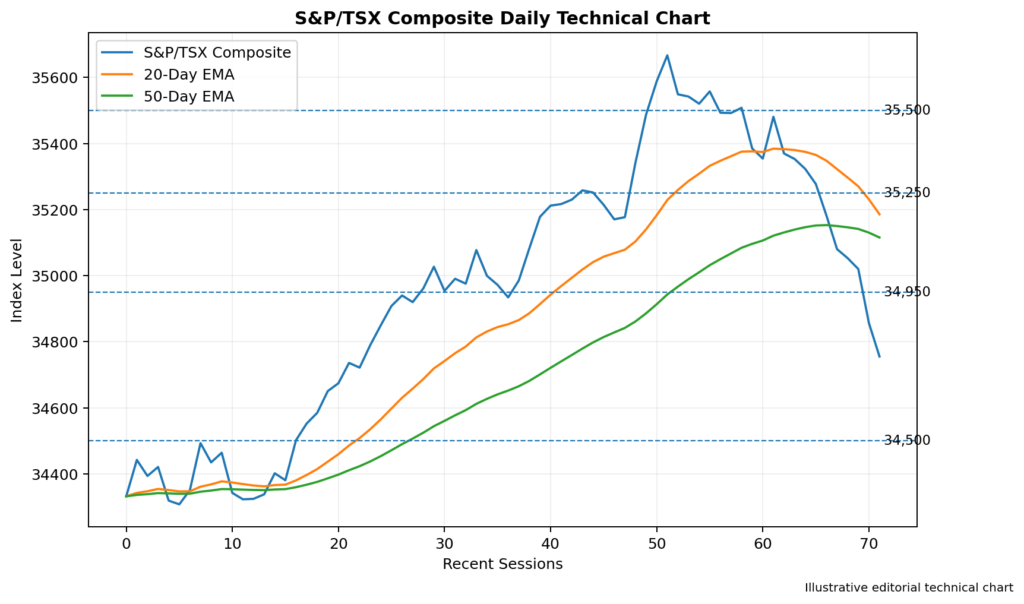
Image 1: S&P/TSX Composite Daily Chart With the 20-Day and 50-Day EMAs, Support at 34,500 and Resistance Near 35,250
RSI Shows Selling Pressure Has Increased
The 14-day Relative Strength Index has weakened as the TSX moved lower.
A fall below 50 would indicate that sellers hold the short-term advantage. If RSI approaches 30, the index would move closer to oversold territory.
A more constructive signal would appear if RSI begins rising while the index holds above support. That would suggest selling pressure is starting to fade.
Support Appears Around 34,950
The first support area sits near 34,950, close to Monday’s closing level.
A break below this region could bring 34,750 into focus. Further weakness may expose 34,500, followed by approximately 34,250.
A daily close below 34,250 would weaken the recent pattern of higher lows and place more pressure on the 50-day EMA.
The main support levels are 34,950, 34,750, 34,500, and 34,250.
Resistance May Limit an Early Recovery
The first barrier is positioned near 35,250.
A move above this level would indicate that buyers are trying to regain control after the three-day decline.
Stronger resistance may appear around 35,500, followed by the recent record region near 35,700.
If the TSX clears that area, the next psychological target could emerge around 36,000.
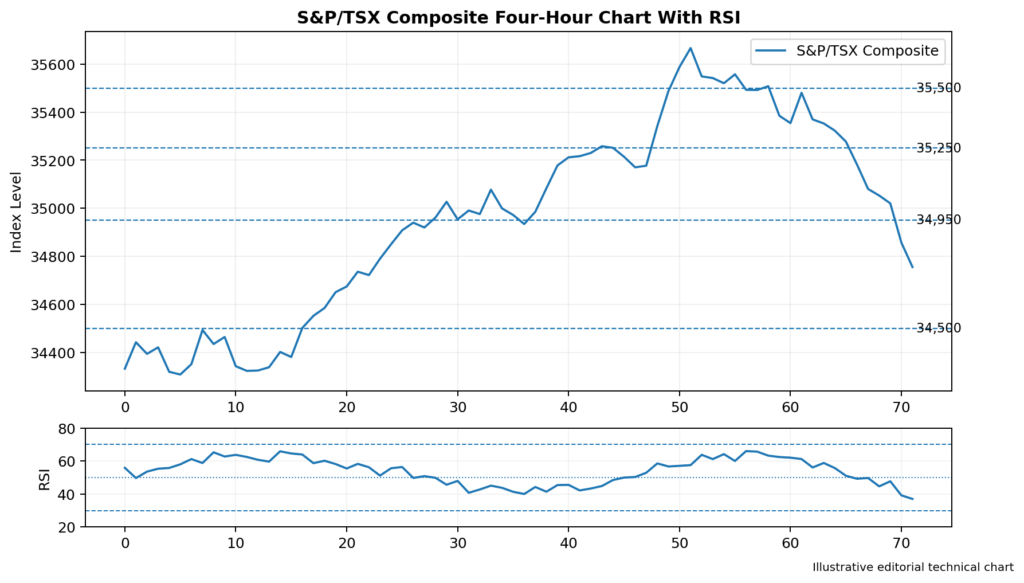
Image 2: S&P/TSX Composite Four-Hour Chart With RSI, Support at 34,950 and 34,500, and Resistance at 35,250 and 35,500
Financial Shares Add Pressure
Financial companies carry a large weighting in the Canadian market, so weakness in the sector can have a substantial effect on the wider index.
Investors have become more cautious about slower economic activity, elevated borrowing costs, and weaker consumer confidence.
Higher interest rates can support lending margins, but they may also increase missed payments and reduce demand for mortgages and business loans.
A recovery in financial shares would therefore be important if the TSX is to return toward its recent high.
Industrial Stocks Also Decline
Industrial companies contributed to Monday’s losses as investors reduced exposure to economically sensitive businesses.
These shares often react to expectations for domestic and global growth. A weaker outlook can affect demand for transportation, construction, equipment, and business services.
Upcoming earnings and company guidance may therefore have a strong influence on the sector’s next move.
Canadian Inflation Cools
Canada’s latest inflation report added another layer to the outlook.
The annual inflation rate cooled more than expected as lower fuel prices reduced headline pressure. Softer inflation may give the Bank of Canada more room to avoid further tightening.
That could support equities by lowering borrowing-cost expectations. However, weaker inflation can also reflect softer demand and slower economic activity.
The market must therefore decide whether cooling inflation is mainly positive for rates or negative for earnings.
Oil Provides Mixed Support
Canada’s equity market often benefits from higher crude prices because energy companies account for a meaningful share of the TSX.
Brent crude recently traded near $89 per barrel after briefly moving above $90.
Elevated oil prices can support producer earnings, but they may also increase inflation and raise costs for transport, manufacturing, and consumer businesses.
This creates an uneven effect across the index.
Trading Implications
The TSX remains vulnerable while trading below 35,250 and the 20-day EMA.
A confirmed recovery above 35,250 could open the way toward 35,500 and the recent record area.
A break below 34,950 would shift attention toward 34,750 and 34,500. Weaker RSI readings would support that downside scenario.
Conclusion
The S&P/TSX Composite has fallen below 35,000 after three consecutive losing sessions.
Support is positioned at 34,950, 34,750, 34,500, and 34,250. Resistance can be found near 35,250, 35,500, 35,700, and 36,000.
The broader trend has not broken completely, but buyers need to regain 35,250 to reduce the risk of a deeper correction.


