
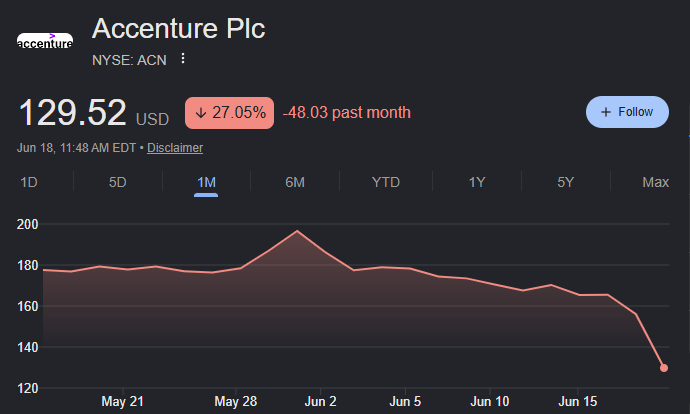
Accenture is undergoing a significant valuation reset after a weaker growth outlook overshadowed an otherwise strong earnings report. While the company delivered results that exceeded expectations, investors focused instead on concerns about future growth, triggering a sharp decline in the stock.
Aicanx‘s economic research team examines the factors behind the selloff, what the latest financial data reveals, and whether the current valuation represents an attractive buying opportunity or a warning of deeper challenges ahead.
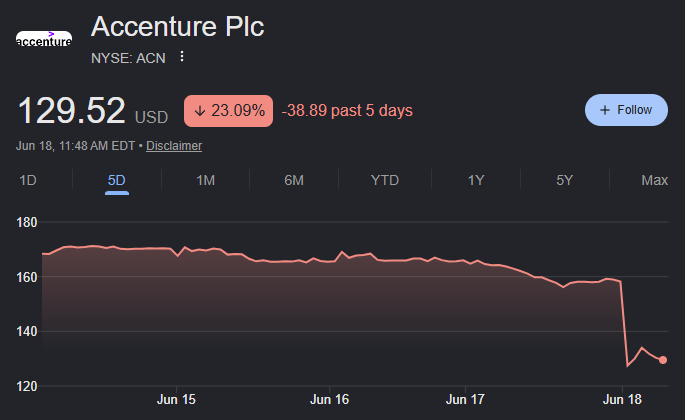
Shares have faced persistent selling pressure in recent weeks, with the downturn accelerating in recent trading sessions.
Analysts remain divided: some view the pullback as a compelling value opportunity, while others see it as a sign of slowing demand and longer-term growth risks, particularly as questions emerge about how quickly large-scale digital transformation and AI-related projects can translate into meaningful revenue growth.
A Beat on Earnings, a Miss on Revenue
For the quarter ended May 31, Accenture reported adjusted EPS of $3.80, beating the Wall Street consensus estimate of $3.72.
Revenue performance was less encouraging. Quarterly revenue increased 6% year over year to $18.7 billion, but came in slightly below analyst expectations of $18.78 billion. Although the miss was relatively small, investors reacted negatively, and the stock faced significant selling pressure as concerns about future growth overshadowed the earnings beat.
Why Management Just Cut the Growth Target
The bigger concern for investors isn’t Accenture’s recent earnings beat, it’s the company’s weaker growth outlook. Management lowered its fiscal 2026 local-currency revenue growth forecast to 3%–4%, down from the previous 3%–5% range.
Even after excluding the estimated 1% headwind from federal government-related business, Accenture is effectively guiding toward a more modest 4%–5% growth trajectory. While the downgrade appears small on paper, it reinforces concerns that enterprise spending remains cautious and that large digital transformation projects are taking longer to convert into revenue.
For investors, the revised guidance signals that growth may remain subdued in the near term, helping explain why the market reacted more strongly to the outlook than to the company’s otherwise solid quarterly results.
The Bookings Keep Coming, But Conversion Is the Problem
Demand for large-scale digital transformation projects remains strong. Accenture has recorded 104 contracts worth $100 million or more this fiscal year, representing a 13% increase in high-value bookings, which indicates that major enterprise clients continue to invest in long-term technology initiatives.
The company also revealed that 1,300 of its approximately 9,000 core clients are actively implementing AI transformation programs, highlighting growing adoption of AI across its customer base.
However, the key challenge is the gap between strong booking activity and slower revenue growth. Many organizations are still dealing with legacy systems, fragmented data infrastructure, and complex operational processes, which are delaying the rollout and scaling of AI projects. While management views these obstacles as temporary, they are currently limiting how quickly new contracts convert into revenue and earnings growth.
Cash Flow and Buybacks Offer a Cushion
Despite a softer growth outlook, Accenture continued to deliver strong profitability and shareholder returns. The company expanded its operating margin by 20 basis points to 17.0%, demonstrating disciplined cost management across its business.
Accenture also generated $3.6 billion in free cash flow during the quarter and returned $2.2 billion to shareholders through dividends and share buybacks.
For the fiscal year so far, total shareholder returns have reached $8.2 billion, providing a measure of defensive support for the stock even as growth concerns persist. Investors are now weighing this strong capital return profile against the risk that slower revenue growth in the technology services sector could continue to pressure valuations.
The $54 Gap Wall Street Can’t Agree On
Valuation models currently estimate Accenture’s fair value at around $210 per share, implying the stock may be roughly 25.7% undervalued compared with its recent closing price of $156.01. That represents a potential gap of more than $54 per share.
However, this is also where analysts disagree most sharply. While valuation models suggest meaningful upside, investor sentiment remains cautious, with the market continuing to discount future growth prospects. As a result, Accenture is caught between attractive valuation metrics and concerns about slowing revenue growth, leaving the stock trapped in a bearish sentiment cycle despite its apparent discount to fair value.
What Would Need to Go Right From Here
Accenture’s next phase of growth may depend on faster expansion in key areas such as cybersecurity and its Industry X business. If these segments grow more quickly than current expectations, the company could justify a higher valuation multiple than the market currently assigns.
For now, investors remain divided. Many portfolio managers are weighing whether Accenture represents an undervalued, high-quality services company or a potential value trap facing longer-term growth challenges.
Ultimately, the investment case hinges on one question: Can Accenture convert its strong project pipeline into faster revenue growth? The answer will depend on how effectively the company navigates slower enterprise decision-making, complex AI implementation cycles, and tighter digital transformation budgets, all of which are currently limiting growth across the industry.


