
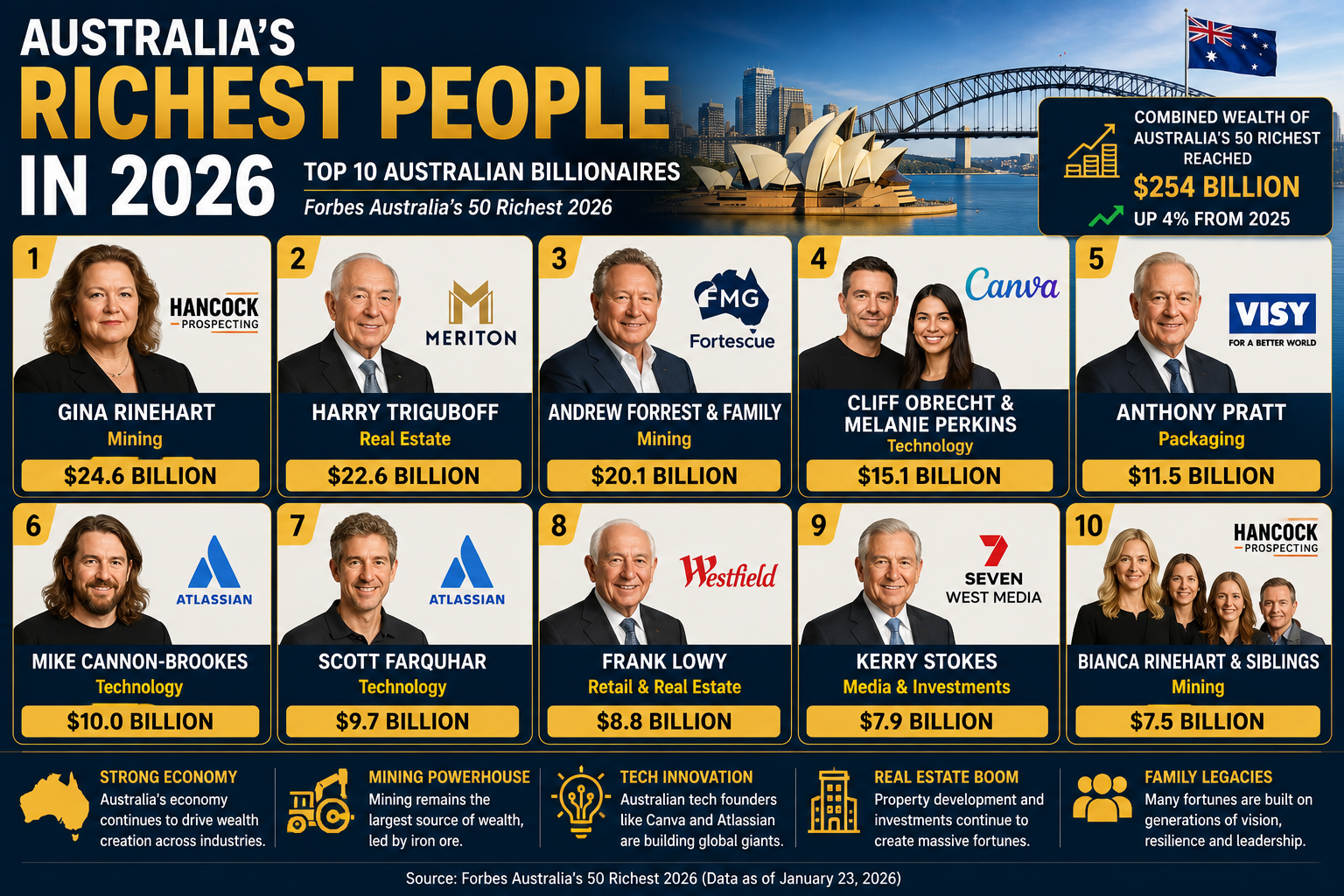
Australia is home to some of the world's most successful entrepreneurs, investors and business families. Its wealthiest people have built fortunes across mining, real estate, technology, retail, manufacturing, media and data centers.
According to Forbes’ 2026 Australia’s 50 Richest ranking, the combined wealth of Australia's 50 richest people and families reached approximately $254 billion, an increase of 4% from the previous year. The ranking was calculated using financial information, shareholdings, stock prices and exchange rates as of January 23, 2026.
At the top of the list is Gina Rinehart, Australia's richest citizen and executive chairwoman of Hancock Prospecting. Her fortune is primarily connected to iron ore mining.
Who Is the Richest Person in Australia in 2026?
Gina Rinehart is Australia's richest person on Forbes' 2026 Australia’s 50 Richest list, with an estimated fortune of $24.6 billion at the time of the annual ranking.
Rinehart controls privately owned Hancock Prospecting, whose biggest asset is the Roy Hill iron ore project. She rebuilt the company after inheriting a financially distressed business from her father, iron ore explorer Lang Hancock.
Her wealth is closely tied to Australia's enormous natural-resources industry, particularly iron ore. Hancock Prospecting has also expanded its interests into rare earth minerals, gas and agriculture.
Top 10 Richest People in Australia in 2026
Forbes' 2026 Australia’s 50 Richest ranking places the following people and families at the top:
Rank | Billionaire / Family | Main Source of Wealth | Net Worth |
|---|---|---|---|
1 | Gina Rinehart | Mining | $24.6B |
2 | Harry Triguboff | Real Estate | $22.6B |
3 | Andrew Forrest & Family | Mining | $20.1B |
4 | Cliff Obrecht & Melanie Perkins | Technology | $15.1B |
5 | Anthony Pratt | Packaging | $11.5B |
6 | Mike Cannon-Brookes | Technology | $10.0B |
7 | Scott Farquhar | Technology | $9.7B |
8 | Frank Lowy | Retail & Real Estate | $8.8B |
9 | Kerry Stokes | Media & Investments | $7.9B |
10 | Bianca Rinehart & Siblings | Mining | $7.5B |
These are Forbes' annual 2026 Australia’s 50 Richest estimates, based on market information through January 23, 2026. Real-time wealth figures can change as share prices and exchange rates move.
1. Gina Rinehart
Gina Rinehart leads Australia's billionaire rankings with an estimated fortune of $24.6 billion in Forbes' 2026 annual list.
She is the executive chairwoman of Hancock Prospecting and built her wealth primarily through Australia's mining industry.
Rinehart's biggest asset is the Roy Hill iron ore project, which began shipments to Asia in 2015. Hancock Prospecting has also developed interests in rare earth minerals and gas, while Rinehart has become one of Australia's major cattle producers.
Her story demonstrates the enormous wealth that Australia's natural resources can generate.
2. Harry Triguboff
Harry Triguboff ranks second with approximately $22.6 billion in Forbes' 2026 annual ranking.
Triguboff built his fortune through real estate and is the founder of Meriton, one of Australia's largest apartment developers.
Nicknamed "High Rise Harry," he recognized the potential for higher-density housing in Sydney at a time when detached houses dominated Australia's residential market. Forbes notes that Meriton has developed more than 79,000 apartments.
His success highlights the enormous value created by Australia's property market, particularly in major cities such as Sydney.
3. Andrew Forrest & Family
Andrew Forrest and family rank third with an estimated fortune of $20.1 billion in Forbes' 2026 Australia ranking.
Forrest founded Fortescue Metals Group in 2003, turning it into one of Australia's major iron ore producers.
His business interests have increasingly expanded beyond traditional mining. Fortescue has been pursuing a transformation toward green energy, while Forrest's privately held Squadron Energy has invested heavily in renewable power.
Forrest's wealth therefore represents both Australia's traditional mining economy and the country's emerging clean-energy sector.
4. Cliff Obrecht & Melanie Perkins
Cliff Obrecht and Melanie Perkins rank fourth with a combined fortune of approximately $15.1 billion.
The couple are the cofounders of Canva, the Australian-founded visual communication and design platform.
Their rise is particularly notable because their fortune was created in the technology sector rather than Australia's traditional mining or property industries.
Canva's global growth demonstrates how an Australian technology company can build an international user base and compete in the global software market.
Their position among Australia's top four richest people also reflects the growing importance of technology and software in Australia's wealth economy.
5. Anthony Pratt
Anthony Pratt ranks fifth with a fortune of approximately $11.5 billion.
Pratt is associated with the Pratt Industries business empire and has built substantial wealth through packaging and manufacturing.
Packaging is a major global industry because products ranging from food and beverages to electronics and consumer goods require transportation and protective materials.
Pratt's fortune demonstrates that Australia's billionaire economy extends well beyond mining and technology.
6. Mike Cannon-Brookes
Mike Cannon-Brookes ranks sixth with an estimated fortune of $10 billion in Forbes' 2026 ranking.
He is the cofounder of Atlassian, the Sydney-based collaboration software company.
Cannon-Brookes and cofounder Scott Farquhar started Atlassian after graduating from university, initially funding the company with credit cards. The business went on to become a major global software company serving customers around the world.
Cannon-Brookes has also become well known for his interest in renewable energy and climate-related investments.
7. Scott Farquhar
Scott Farquhar, the other cofounder of Atlassian, ranks seventh with an estimated fortune of $9.7 billion.
Farquhar and Cannon-Brookes built Atlassian into an international software business, showing how Australia's technology sector can produce multibillion-dollar fortunes.
Farquhar stepped down as Atlassian's co-CEO in 2024 to focus more on family, philanthropy and other activities, while continuing as a board member and adviser.
His story is an example of how technology entrepreneurship has reshaped Australia's billionaire landscape.
8. Frank Lowy
Frank Lowy ranks eighth with an estimated fortune of $8.8 billion.
Lowy is one of Australia's best-known retail and property entrepreneurs and is associated with the business empire built around Westfield.
His career demonstrates the importance of shopping centers, commercial property and retail in Australia's economic development.
Over several decades, Lowy expanded his business interests from Australia into international markets, creating a globally recognized property and retail name.
9. Kerry Stokes
Kerry Stokes ranks ninth with approximately $7.9 billion.
His wealth comes from a diversified collection of business interests, including media, investments and other assets.
Stokes has been one of Australia's most influential media and business figures, demonstrating how ownership of major companies and investment portfolios can create substantial long-term wealth.
10. Bianca Rinehart & Siblings
Bianca Rinehart and her siblings rank tenth with a combined estimated fortune of $7.5 billion.
Their wealth is connected to the Hancock Prospecting family fortune and Australia's mining industry.
The appearance of the Rinehart family in both the first and tenth positions demonstrates the continuing importance of multigenerational wealth in Australia's billionaire economy.
Why Is Australia Home to So Many Billionaires?
Australia's billionaire economy has developed around several powerful industries.
Mining and Natural Resources
Mining remains one of Australia's biggest sources of private wealth. Gina Rinehart and Andrew Forrest are two of the most prominent examples.
Australia has significant reserves of iron ore and other minerals, creating enormous opportunities for mining entrepreneurs.
Real Estate
Property has produced another generation of Australian billionaires. Harry Triguboff's success through apartment development demonstrates the scale of wealth that can be generated by residential real estate.
Technology
Canva and Atlassian have helped establish technology as a major source of Australian billionaire wealth.
The success of Melanie Perkins, Cliff Obrecht, Mike Cannon-Brookes and Scott Farquhar shows that Australia's technology sector can create global companies rather than relying only on domestic markets.
Manufacturing
Anthony Pratt's packaging empire demonstrates the continuing importance of industrial businesses.
Retail and Media
Frank Lowy and Kerry Stokes represent the influence of retail, commercial property and media businesses in Australia's private economy.
Australia's Billionaire Economy in 2026
Forbes reported that the combined wealth of Australia's 50 richest people and families reached $254 billion, up from approximately $243 billion the previous year. The Australian dollar's rise also contributed to the increase in U.S.-dollar wealth figures.
The minimum fortune required to enter the 2026 ranking increased to $1.2 billion, compared with $975 million the previous year.
The list also welcomed several newcomers, including Dennis Bastas, Robin Khuda and brothers Daniel and William Roberts. The rise of data-center businesses was an important factor behind some of the new fortunes.
This suggests that Australia's billionaire economy is gradually becoming more diverse, with technology and digital infrastructure joining mining, property and traditional industries.
The Future of Australia's Richest People
The next generation of Australian billionaire wealth could increasingly come from technology, artificial intelligence, renewable energy, critical minerals, data centers and advanced manufacturing.
Mining will likely remain important, particularly because demand for minerals used in energy and technology infrastructure continues to influence global markets.
At the same time, companies such as Canva and Atlassian demonstrate that Australian entrepreneurs can build global technology businesses capable of creating enormous wealth.
The combination of natural resources, a developed financial system, strong property markets and a growing technology sector gives Australia a diverse foundation for future wealth creation.
Final Thoughts
Australia's richest people in 2026 come from remarkably different backgrounds.
Gina Rinehart leads the country through her mining fortune, while Harry Triguboff built his wealth through property development. Andrew Forrest represents Australia's mining and emerging green-energy industries, while Melanie Perkins, Cliff Obrecht, Mike Cannon-Brookes and Scott Farquhar demonstrate the growing power of Australian technology entrepreneurship.
Forbes' 2026 ranking shows that Australia's 50 richest people and families collectively control approximately $254 billion.
As the Australian economy evolves, mining, technology, renewable energy, property and digital infrastructure are likely to remain major sources of billionaire wealth.
FAQs
Who is the richest person in Australia in 2026?
Gina Rinehart is Australia's richest person on Forbes' 2026 Australia’s 50 Richest list, with an estimated fortune of $24.6 billion.
What is Gina Rinehart's source of wealth?
Rinehart's fortune primarily comes from iron ore mining through Hancock Prospecting. The company also has interests in rare earth minerals, gas and agriculture.
Who is the second-richest person in Australia?
Harry Triguboff ranks second with an estimated fortune of $22.6 billion. His wealth comes primarily from real estate and his Meriton apartment-development business.
Who is Australia's richest technology entrepreneur?
Among the top technology fortunes in Forbes' 2026 Australia ranking are Cliff Obrecht and Melanie Perkins, founders of Canva, and Mike Cannon-Brookes and Scott Farquhar, cofounders of Atlassian.
How much are Australia's 50 richest people worth?
Forbes estimated the combined wealth of Australia's 50 richest people and families at approximately $254 billion in 2026.
Which industries create the most billionaire wealth in Australia?
Major sources include mining, real estate, technology, manufacturing, retail, media and investments.
Is Gina Rinehart still Australia's richest citizen?
Yes. Forbes' 2026 World’s Billionaires list identifies Gina Rinehart as Australia's richest citizen, with a net worth of $25.5 billion as of March 1, 2026.
Can Australia's richest-person ranking change?
Yes. Billionaire wealth can change substantially as stock prices, commodity prices, exchange rates and private-company valuations change. Forbes' annual Australia ranking uses a specific valuation date, while its real-time billionaire figures can move throughout the year.
Who are the richest Australian business families?
Major wealthy Australian families include the Rinehart family, Forrest family, Pratt family and other business families with interests in mining, manufacturing, technology and investments.