
Brent crude moved lower on Tuesday as traders responded to renewed efforts to reduce tensions in the Middle East. Prices fell around 1.1% to $88.26 per barrel, pulling back from a recent one-month high above $90.
This analysis from mlgoldcorp.com examines whether Brent can remain above $88, or whether improving diplomatic expectations could trigger a deeper retreat toward support.
The Rally Has Lost Some Momentum
Oil prices had climbed sharply as attacks and shipping disruptions raised concerns about supplies moving through important regional routes.
The latest decline suggests that some of the immediate risk premium is being removed. Reports of a proposed 10-day ceasefire encouraged traders to reduce bullish positions, although major disagreements remain unresolved.
Brent is still trading well above its early-July level, so the wider recovery has not been completely reversed.
The next few sessions may show whether the move below $90 is a brief correction or the start of a wider decline.
The Daily Chart Remains Positive
Brent continues to trade above its 20-day Exponential Moving Average, which offers the first layer of short-term support.
The 50-day EMA sits lower and provides a broader guide to the trend. As long as the price remains above both averages, the wider structure should stay constructive.
A sustained fall beneath the 20-day EMA would suggest that the recent rally is losing momentum. A move below the 50-day EMA would carry greater significance.
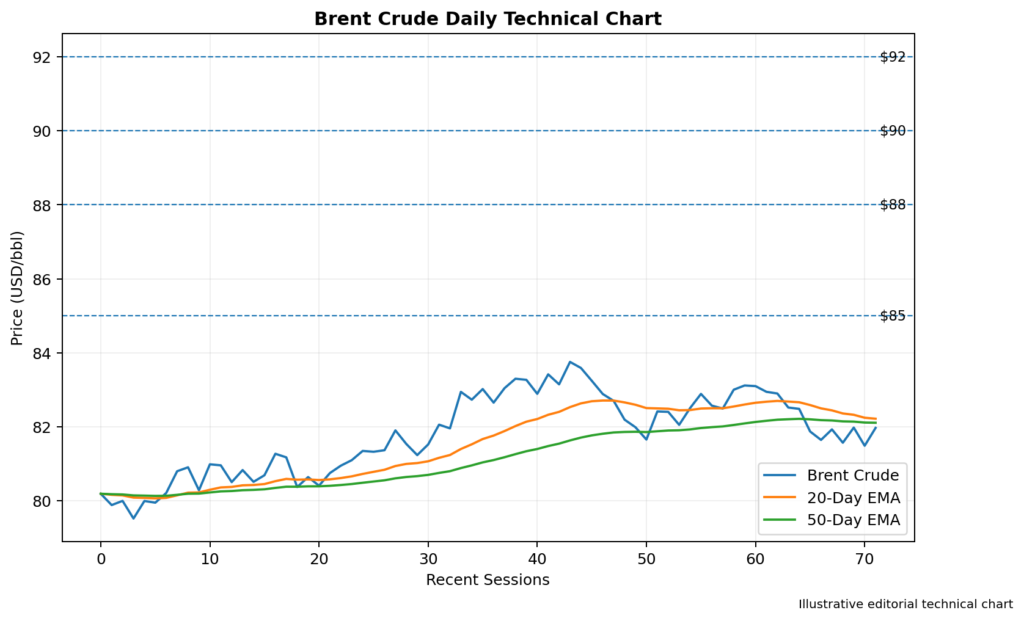
Image 1: Brent Crude Daily Chart With the 20-Day and 50-Day EMAs, Support at $85 and Resistance Near $90
RSI Moves Away From Overbought Levels
The 14-day Relative Strength Index has eased as Brent pulled back from its recent high.
A reading above 50 would indicate that buyers still hold the broader advantage. If RSI falls below 50, short-term momentum would begin to favor sellers.
A move toward 30 would place Brent near oversold territory and could attract bargain buying.
Traders may also watch whether RSI forms a higher low during any further decline. That could suggest selling pressure is weakening.
Resistance Remains Near $90
The first barrier is positioned around $90, which has again become a psychological resistance level.
A daily close above $90 could bring $92 into focus. If Brent clears $92, the next upside areas may appear near $95 and $98.
A move toward these levels would probably require renewed shipping disruption, falling inventories, or reduced expectations of diplomatic progress.
The main resistance levels are $90, $92, $95, and $98.
Support Begins Around $88
Immediate support is located near $88, close to Tuesday’s trading area.
A break below this level could bring $85 into focus. This region may align with the short-term moving averages and earlier resistance.
Further weakness could expose $82.50, followed by the psychological $80 level.
A sustained move below $80 would weaken the recent recovery and suggest that supply concerns are no longer dominating the market.
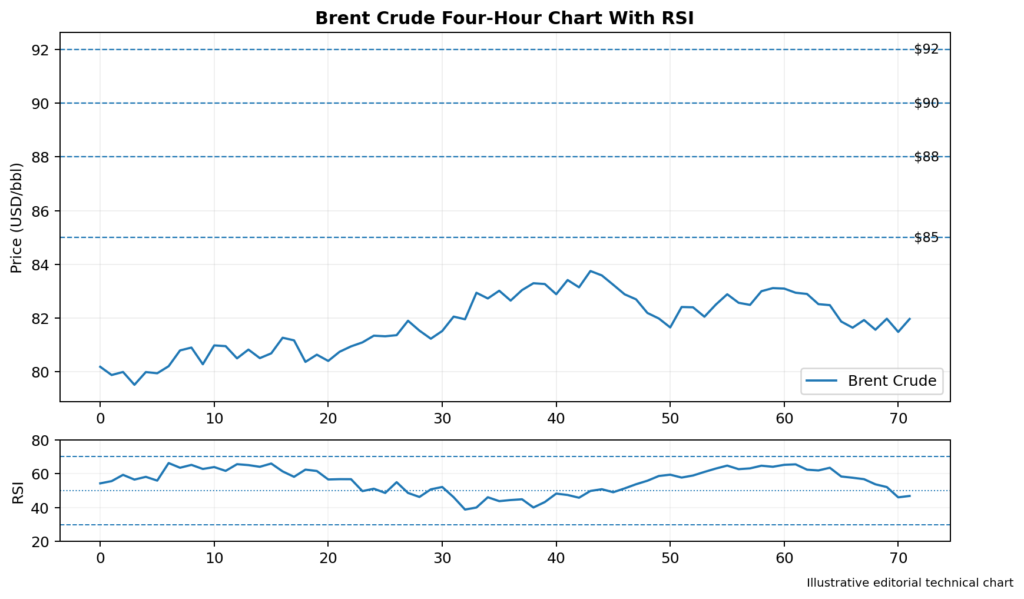
Image 2: Brent Crude Four-Hour Chart With RSI, Support at $88 and $85, and Resistance at $90 and $92
Diplomacy Reduces the Risk Premium
Oil eased after mediators proposed a ceasefire intended to revive an earlier diplomatic framework.
The possibility of talks reduced concern that regional hostilities would cause prolonged supply disruption.
However, the situation remains uncertain. Fresh attacks have continued, a tanker was hit near the Strait of Hormuz, and maritime traffic has been affected.
Threats against Saudi shipping have added another risk. The supply premium could return quickly if negotiations fail.
Supply Has Remained Resilient
Oil prices have not risen as dramatically as some earlier forecasts suggested.
Strong US production, weaker Chinese demand, strategic stock releases, and alternative export routes have helped limit the advance.
US output recently reached approximately 13.93 million barrels per day, helping offset concerns about disrupted Middle Eastern supplies.
Physical availability has also remained more comfortable than expected in some regions. This helps explain why Brent has struggled to hold substantially above $90.
Demand Remains a Key Question
The demand outlook may become more important if supply fears ease.
China has reduced some oil imports and fuel-export activity, while weaker petrochemical demand has affected consumption growth.
Slower global growth would make it harder for Brent to sustain a move toward $95 or $100. Falling inventories or stronger industrial activity could provide fresh support.
The market is balancing near-term disruption risk against a less certain demand outlook.
Trading Implications
Brent retains a cautiously positive bias while trading above $85 and its main moving averages.
A confirmed recovery above $90 could expose $92 and $95. Improving RSI would strengthen that scenario.
A break below $88 would shift attention toward $85. A sustained move beneath $85 could bring $82.50 and $80 back into view.
Conclusion
Brent crude has slipped below $89 as ceasefire hopes reduce some of the immediate supply premium.
Resistance is positioned at $90, $92, $95, and $98. Support can be found near $88, $85, $82.50, and $80.
The technical structure remains positive above $85, but the market is highly sensitive to diplomatic developments. The reaction around $88 and $90 should show whether buyers return or the correction continues.


