Artificial intelligence is changing the way modern businesses operate. Tasks that once required hours of repetitive manual work can increasingly be handled by intelligent software systems that process information, make decisions, and execute workflows automatically.
BullsNext is an AI agency and software studio focused on building practical AI systems for real business problems. Its stated approach is different from simply creating AI demonstrations or prototypes: the company researches real market problems, engineers solutions around those problems, and deploys them as live products.
For businesses considering AI automation, a BullsNext-style approach raises an important question: instead of asking what AI can do, what expensive business problem should AI solve first?
What Is BullsNext?
BullsNext describes itself as an AI agency focused on market intelligence, AI automation, software engineering, and production-ready products.
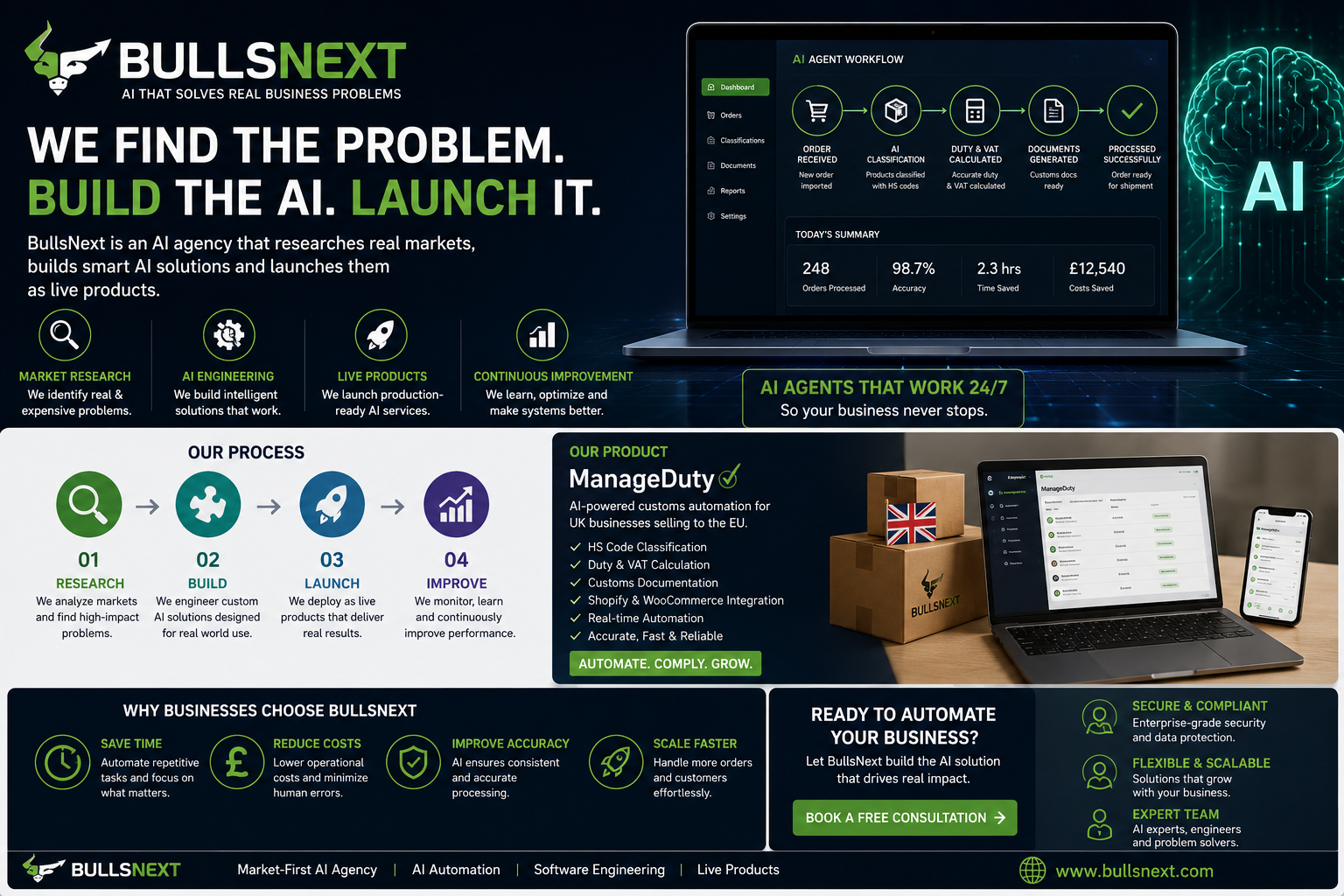
Its philosophy can be summarized in four stages:
Research → Build → Launch → Improve
The company says it starts by studying markets and identifying areas where businesses are losing time, money, or productivity. It then engineers an AI system specifically for that problem and launches it as a live service.
This approach puts the business problem before the technology.
Instead of starting with a generic AI tool and trying to find a customer for it, BullsNext says it looks for a real problem first and then builds the appropriate solution.
Why AI Automation Matters
Many businesses spend a significant amount of time on repetitive processes.
Employees may have to:
Enter information into systems
Respond to repetitive inquiries
Process orders
Classify products
Generate documents
Follow up with customers
Review large amounts of data
Calculate charges
Move information between different platforms
These tasks may be necessary, but they don't always require a person to perform every step manually.
AI automation can potentially handle repetitive workflows while employees concentrate on higher-value work such as strategy, creativity, customer relationships, and decision-making.
BullsNext describes its systems as being designed to operate continuously, with AI agents handling repetitive processes around the clock.
The BullsNext Market-First Approach
One of the central ideas behind BullsNext is market-first AI.
The company says it doesn't build AI products simply because a particular technology is popular. Instead, it researches industries and looks for specific problems that create measurable costs for businesses.
The process begins with questions such as:
Where are businesses losing time?
Which processes are unnecessarily manual?
Where are errors occurring?
Which tasks require repetitive human intervention?
What problems are expensive enough to justify automation?
Can AI solve the problem reliably?
Only after identifying the problem does the engineering process begin.
This can be an important distinction because not every business task should be automated. Good automation starts with understanding the workflow.
From Market Research to AI Product
BullsNext describes its product-development process through three major stages.
1. Research the Market
The first stage is understanding the problem.
This involves examining industries, workflows, friction points, and business costs.
The goal is to determine whether a problem is real and whether businesses would benefit from a solution.
2. Engineer the Solution
Once the problem is understood, BullsNext develops an AI system designed specifically around that workflow.
The company says its products are built and tested against real-world scenarios rather than being presented only as demonstrations.
3. Launch as a Live Service
The final step is deployment.
Instead of stopping at a prototype, the goal is to make the system available as a working product that businesses can actually use.
This creates a simple philosophy:
Find the problem. Build the solution. Put it into production. Measure the results.
ManageDuty: A BullsNext AI Example
One of the products featured by BullsNext is ManageDuty, an automation system aimed at UK businesses shipping orders to customers in the European Union.
According to BullsNext, ManageDuty connects with ecommerce platforms such as Shopify and WooCommerce and automates parts of the customs process, including product classification, duty and VAT calculations, and customs-document generation.
This is a good example of the market-first approach.
Instead of creating a general-purpose AI product, the system focuses on a specific business problem: cross-border ecommerce customs administration.
How ManageDuty Works
The process is designed to happen automatically after an order is received.
A simplified workflow looks like this:
Customer places order → AI receives order data → Products are classified → Duty and VAT are calculated → Customs documentation is generated → Order continues toward shipment
BullsNext says ManageDuty can classify products using HS codes, calculate applicable duty and VAT, and generate customs PDFs. The company also states that the system integrates with Shopify and WooCommerce.
For ecommerce businesses handling many international orders, automation can reduce the amount of repetitive customs administration required from staff.
Why AI Agents Are Different From Simple Automation
Traditional automation usually follows predefined rules.
For example:
If an order arrives → send an email.
AI agents can potentially handle more complex workflows where information needs to be interpreted before an action is taken.
For example:
Read product information → determine classification → calculate applicable charges → prepare documentation → report the result.
This doesn't mean AI can replace human oversight in every situation. Accuracy, validation, compliance, and appropriate escalation remain important, particularly in areas involving financial or regulatory decisions.
BullsNext emphasizes precision and real-world testing as part of its development philosophy.
BullsNext and 24/7 Automation
One of the strongest ideas for a BullsNext promotional video is continuous operation.
Imagine a business closing at 6 PM.
The employees go home, but automated systems continue processing routine tasks.
The next morning, the team returns to find:
Orders processed
Information organized
Documents generated
Routine workflows completed
Exceptions highlighted for human attention
This is the promise behind always-on automation.
BullsNext describes its AI systems as being designed to run 24/7, allowing businesses to automate repetitive work without requiring employees to perform the same processes continuously.
What a BullsNext Video Could Show
A strong BullsNext promotional video could begin with a business overwhelmed by repetitive work.
Scene 1 — The Problem
Show an employee switching between spreadsheets, emails, orders, and documents.
Text:
“How much time does your business lose to repetitive work?”
Scene 2 — The Friction
Show hundreds of tasks appearing on a screen.
Orders.
Emails.
Data.
Documents.
Notifications.
The workload continues growing.
Scene 3 — Introduce BullsNext
The screen becomes cleaner.
Text:
“We find the bottleneck. Then we build the AI that removes it.”
Scene 4 — AI Takes Over the Workflow
Show an AI agent receiving information, analyzing it, making a decision, and completing the appropriate action.
Scene 5 — Real Product
Introduce ManageDuty as an example.
Show an ecommerce order entering the system and being processed automatically.
Scene 6 — 24/7
Show a clock moving from morning to night.
Text:
“Your business doesn't have to stop when your team does.”
Scene 7 — The BullsNext Process
Display:
RESEARCH → BUILD → LAUNCH → IMPROVE
Scene 8 — Final Message
End with:
“BullsNext — AI that solves real business problems.”
AI That Solves Specific Problems
The biggest strength of a focused AI strategy is specificity.
A generic message such as:
“We use artificial intelligence to transform businesses.”
can sound vague.
A more concrete message is:
“We found a costly manual process, built an AI system around it, and deployed it into production.”
That immediately tells a potential customer what the company actually does.
BullsNext's website emphasizes this idea by positioning its work around practical AI systems rather than decorative technology or presentations.
Why Businesses Are Interested in AI Agents
Businesses are increasingly interested in AI because automation can potentially address several challenges at once.
Lower Repetitive Work
Employees can spend less time on routine processes.
Faster Processing
Automated systems can process information continuously.
Consistency
A properly designed workflow can follow the same process repeatedly.
Scalability
Once an automated workflow is working, it can potentially handle a much larger volume without requiring the same increase in manual labor.
Continuous Operation
Software doesn't need traditional working hours.
However, businesses should evaluate automation based on actual results rather than simply adopting AI because it is fashionable.
The Importance of Production-Ready AI
A demonstration can look impressive without being useful.
A production AI system is different.
It needs to work with real data, integrate with business systems, handle errors, protect information, and operate reliably.
BullsNext specifically emphasizes production-ready systems and says its products are intended to run in real-world environments rather than remain prototypes.
This is particularly important for businesses that depend on automation for customer-facing or operational processes.
BullsNext's Focus on Practical AI
BullsNext says its philosophy is based on four principles:
Market-first thinking: Understand the problem before building.
Precision over hype: Focus on execution rather than exaggerated claims.
Real-world AI: Build systems intended for production.
Partnership: Continue improving products after launch.
This creates a different way of thinking about AI.
Instead of asking:
“Where can we add AI?”
businesses can ask:
“Which part of our operation is costing us the most time and money?”
That question can lead to much more useful automation opportunities.
The Future of AI Business Automation
As AI technology continues to develop, businesses are likely to experiment with increasingly sophisticated workflows.
Future AI systems may combine:
Natural-language processing
Computer vision
Data analysis
Business rules
External APIs
Ecommerce platforms
Customer-service systems
Financial tools
Internal databases
The important challenge won't simply be building an intelligent model.
It will be integrating that intelligence into a reliable business workflow.
That's where companies such as BullsNext are positioning themselves: identifying specific problems and turning AI capabilities into working products.
Final Thoughts
BullsNext represents a market-first approach to AI automation, where the business problem comes before the technology.
The company says it researches real market problems, builds purpose-specific AI systems, launches them as live products, and continues improving them.
Its ManageDuty product provides an example of this strategy by focusing on a specific ecommerce problem: automating parts of UK-to-EU customs processing for online stores.
For a BullsNext video, the strongest story is therefore simple:
Businesses have repetitive problems.
BullsNext finds them.
AI solves them.
The system runs continuously.
Businesses become faster and more scalable.
As AI moves further into everyday business operations, the companies that create the most value may not necessarily be those with the most complicated technology. They may be the ones that identify the right problems and build AI systems that solve them reliably.
Frequently Asked Questions
What is BullsNext?
BullsNext is an AI agency and software studio focused on market research, AI automation, software engineering, and production-ready AI products.
What does BullsNext do?
BullsNext says it researches real business problems, engineers AI solutions, launches live products, and works with businesses on automation.
What is ManageDuty?
ManageDuty is a BullsNext product focused on automating customs-related processes for UK ecommerce businesses shipping orders to EU customers.
What is market-first AI?
Market-first AI means identifying a genuine business problem first and then building an AI solution specifically for that problem.
Can AI agents work 24/7?
AI systems can be designed to operate continuously, although businesses should still establish appropriate monitoring, safeguards, and human escalation processes.
Why is AI automation useful?
AI automation can reduce repetitive manual work, process information faster, improve workflow consistency, and help businesses scale certain operations.
Is BullsNext only for large companies?
BullsNext says its live AI solutions are intended to make enterprise-grade AI accessible to businesses more broadly, rather than limiting solutions to companies with very large technology budgets.