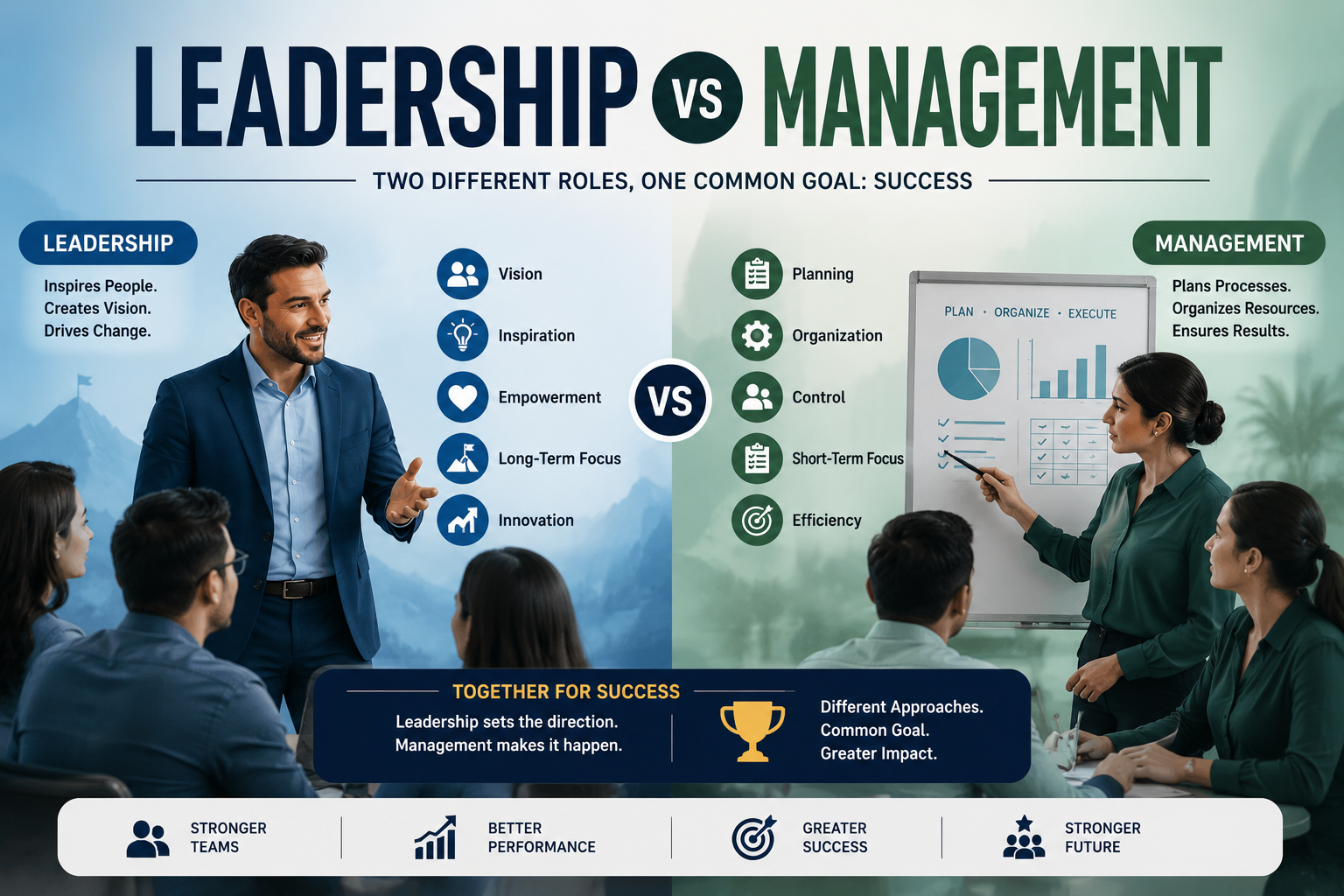
Leadership and management are two of the most important concepts in the business world. While many people use these terms interchangeably, they represent different roles, responsibilities, and approaches to achieving organizational success. Every successful organization needs both effective leaders and skilled managers to operate efficiently and grow sustainably.
A manager focuses on planning, organizing, and controlling daily operations, while a leader inspires, motivates, and guides people toward a shared vision. Both roles are essential, but understanding their differences helps businesses build stronger teams, improve productivity, and create a positive workplace culture.
In today's competitive environment, organizations require individuals who can not only manage resources effectively but also inspire innovation, encourage collaboration, and lead teams through change. This comprehensive guide explores the differences between leadership and management, their importance, key characteristics, similarities, and practical ways to balance both for long-term business success.
What Is Leadership?
Leadership is the ability to inspire, influence, and motivate individuals or teams to achieve common goals. A leader creates a vision, encourages innovation, builds trust, and helps people reach their full potential.
Leadership is based on influence rather than authority. A leader earns respect through integrity, communication, empathy, and the ability to inspire others.
Effective leaders focus on people, relationships, growth, and long-term success rather than simply completing daily tasks.
What Is Management?
Management is the process of planning, organizing, coordinating, and controlling resources to achieve organizational objectives efficiently.
Managers ensure that projects are completed on time, employees follow procedures, budgets remain under control, and business operations run smoothly.
While leadership focuses on inspiration, management focuses on execution and consistency.
Managers play an essential role in maintaining stability, improving efficiency, and achieving operational goals.
Why Both Leadership and Management Matter
Organizations cannot succeed with leadership alone, nor can they rely solely on management.
Leadership provides direction and motivation, while management ensures that plans are executed effectively.
Together they help businesses:
Achieve strategic goals
Improve employee performance
Increase productivity
Encourage innovation
Build strong workplace cultures
Deliver consistent customer satisfaction
Businesses that successfully combine leadership and management often perform better than organizations that emphasize only one approach.
Key Differences Between Leadership and Management
1. Vision vs Planning
Leaders create a long-term vision for the future. They inspire employees by explaining where the organization is heading and why that vision matters.
Managers, on the other hand, develop detailed plans to achieve organizational objectives. They focus on schedules, budgets, resources, and daily operations.
Both vision and planning are necessary for business success.
2. Inspiring People vs Managing Processes
Leaders motivate people through encouragement, trust, and inspiration.
Managers ensure that systems, processes, and workflows operate efficiently.
A leader asks:
"How can we achieve something extraordinary?"
A manager asks:
"How can we complete this project efficiently?"
3. Change vs Stability
Leaders embrace change and encourage innovation.
They help organizations adapt to new technologies, market trends, and customer expectations.
Managers focus on maintaining consistency, reducing risks, and ensuring operational stability.
Both approaches are valuable depending on business needs.
4. Influence vs Authority
Leadership is based primarily on influence.
People follow leaders because they trust and respect them.
Management is based more on formal authority granted by organizational positions.
Managers direct employees according to company policies and responsibilities.
5. Risk-Taking vs Risk Management
Leaders often encourage innovation and calculated risk-taking.
Managers typically focus on minimizing risks through planning, procedures, and performance monitoring.
Successful organizations balance innovation with responsible risk management.
6. Long-Term Goals vs Short-Term Objectives
Leaders concentrate on long-term growth and organizational transformation.
Managers focus on achieving immediate operational goals and meeting deadlines.
Together, these perspectives ensure both present success and future development.
7. Building Relationships vs Supervising Performance
Leaders invest time in developing strong relationships with employees.
They encourage collaboration, trust, and personal growth.
Managers primarily supervise employee performance, assign responsibilities, and monitor productivity.
Strong organizations require both supportive relationships and effective supervision.
Similarities Between Leadership and Management
Although leadership and management differ, they also share several important similarities.
Both require:
Effective communication
Decision-making skills
Problem-solving ability
Accountability
Time management
Teamwork
Professional ethics
Strategic thinking
Both leaders and managers contribute significantly to organizational success.
Essential Leadership Qualities
Successful leaders often demonstrate the following characteristics:
Communication
Clear communication helps leaders inspire teams and explain organizational goals.
Emotional Intelligence
Understanding employees' emotions strengthens relationships and improves teamwork.
Vision
Leaders create meaningful long-term goals that motivate employees.
Integrity
Honesty and ethical behavior build trust throughout the organization.
Adaptability
Great leaders remain flexible during periods of change and uncertainty.
Essential Management Skills
Successful managers require different but equally important skills.
These include:
Planning
Developing effective strategies and schedules for completing projects.
Organization
Managing people, budgets, and resources efficiently.
Performance Monitoring
Tracking progress and ensuring quality standards are maintained.
Problem-Solving
Resolving operational issues quickly and effectively.
Resource Management
Using company resources efficiently while controlling costs.
Can a Manager Be a Leader?
Yes.
The most successful managers also develop strong leadership skills.
A manager who inspires employees, encourages innovation, communicates effectively, and builds trust becomes both an effective manager and an influential leader.
Modern organizations increasingly seek professionals who combine both management expertise and leadership ability.
Can a Leader Be a Manager?
Yes.
Many business owners, executives, and department heads perform both leadership and management responsibilities.
They inspire employees while also planning projects, allocating resources, monitoring performance, and making operational decisions.
Balancing both roles improves organizational effectiveness.
Leadership vs Management in Today's Workplace
Modern workplaces require greater flexibility than ever before.
Remote work, digital transformation, artificial intelligence, and changing employee expectations have increased the importance of leadership.
Today's organizations need leaders who inspire innovation while also requiring managers who ensure operational excellence.
Businesses that successfully combine visionary leadership with efficient management often outperform their competitors.
Common Mistakes Businesses Make
Many organizations struggle because they misunderstand the difference between leadership and management.
Common mistakes include:
Promoting good managers without leadership training
Ignoring employee motivation
Focusing only on short-term results
Resisting organizational change
Poor communication
Lack of strategic vision
Recognizing these mistakes allows organizations to improve overall performance.
How to Develop Both Leadership and Management Skills
Professionals can strengthen both abilities through continuous learning.
Practical strategies include:
Reading business and leadership books
Attending management training programs
Seeking mentorship
Leading workplace projects
Improving communication skills
Practicing emotional intelligence
Learning strategic planning
Requesting constructive feedback
Continuous improvement helps individuals become more effective in both roles.
The Future of Leadership and Management
As technology continues transforming workplaces, leadership and management will evolve together.
Future business professionals will need:
Digital leadership skills
Data-driven decision-making
Cross-cultural communication
Innovation management
Emotional intelligence
Change management
Collaborative leadership
Organizations that invest in leadership and management development will remain more competitive in an increasingly global economy.
Conclusion
Leadership and management are not competing concepts—they are complementary skills that work together to drive organizational success. Leadership focuses on inspiring people, creating vision, and encouraging innovation, while management emphasizes planning, organization, and operational efficiency.
The most successful businesses recognize the importance of balancing both approaches. By developing strong leadership and management skills, professionals can motivate teams, improve productivity, solve challenges effectively, and achieve sustainable long-term growth. Whether you aspire to become a manager, a leader, or both, mastering these essential skills will help you create a positive impact in any organization.
FAQs
Q1. What is the difference between leadership and management?
Leadership focuses on inspiring and guiding people, while management focuses on planning, organizing, and controlling business operations.
Q2. Which is more important: leadership or management?
Both are equally important. Leadership provides vision, while management ensures efficient execution.
Q3. Can someone be both a leader and a manager?
Yes. Many successful professionals combine leadership qualities with strong management skills.
Q4. Why do businesses need both leadership and management?
Businesses need leadership to inspire people and management to ensure tasks, resources, and operations are handled effectively.
Q5. How can I improve my leadership and management skills?
Develop communication, decision-making, emotional intelligence, strategic thinking, and organizational skills through continuous learning and practical experience.