
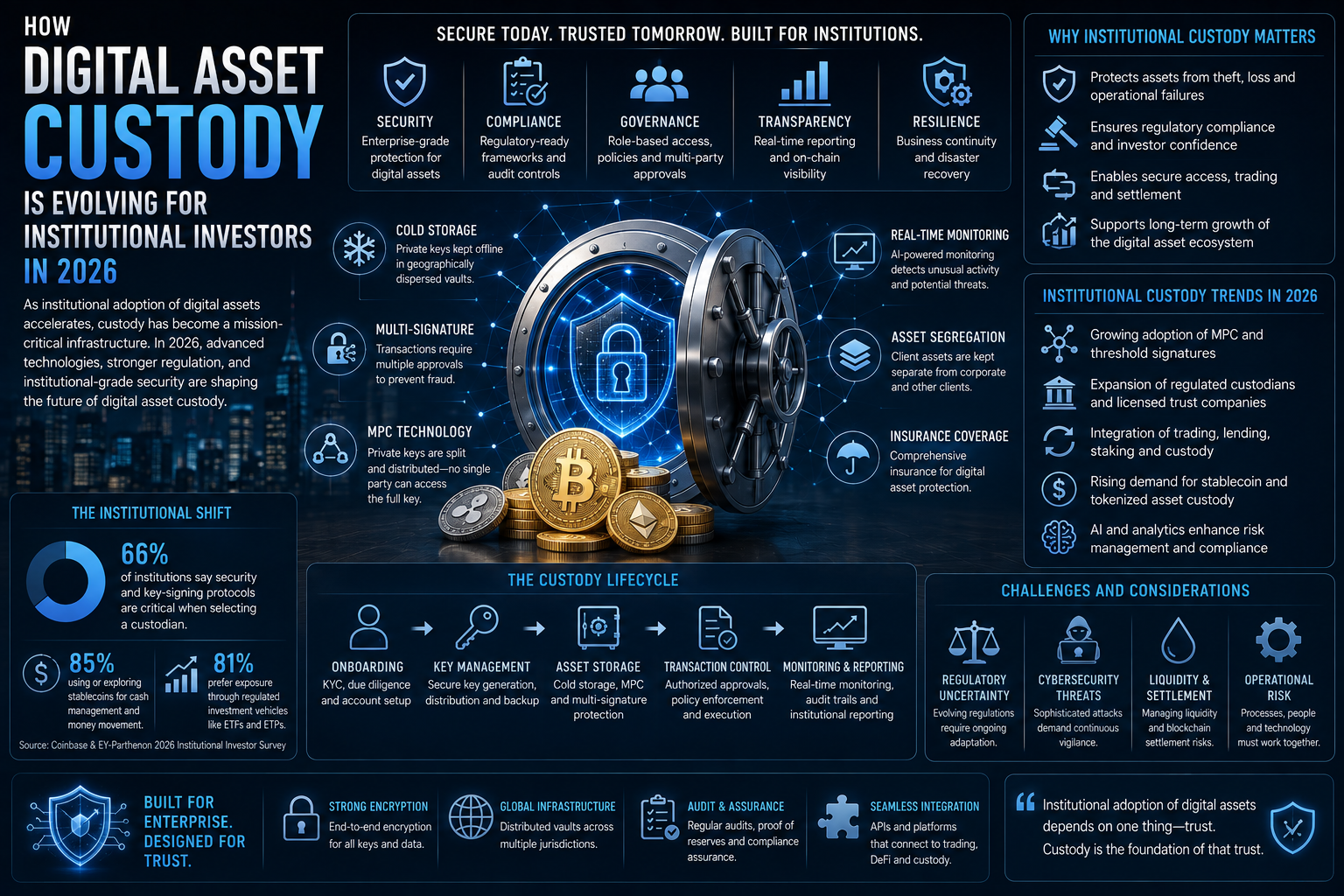
Digital assets are becoming increasingly integrated into institutional investment strategies. Asset managers, banks, family offices, hedge funds, payment companies, and other financial institutions are moving beyond simply exploring cryptocurrencies and are building more structured approaches to digital assets.
As institutional participation grows, one issue has become especially important: custody.
Holding Bitcoin, stablecoins, tokenized securities, and other digital assets requires a fundamentally different security model from holding traditional securities. Instead of relying only on conventional account structures, digital-asset custody must protect private keys, control transaction authorization, manage wallets, monitor blockchain activity, and maintain operational resilience.
The shift is already visible among institutional investors. A 2026 Coinbase and EY-Parthenon survey of 351 institutional investors found that 66% considered regulatory compliance an important factor when selecting a custodian, while 66% also cited security and key-signing protocols.
This suggests that custody is no longer simply a technical service. It is becoming a central component of institutional digital-asset infrastructure.
What Is Digital-Asset Custody?
Digital-asset custody refers to the systems and services used to safeguard crypto assets and control the private keys associated with them.
A custody solution can include:
Secure wallet infrastructure
Private-key management
Cold storage
Multi-signature controls
Multi-party computation
Transaction authorization
Blockchain monitoring
Asset segregation
Compliance systems
Disaster recovery
Audit and reporting tools
The objective is straightforward: ensure that authorized parties can access and transfer assets while unauthorized parties cannot.
For institutional investors, however, custody involves much more than simply storing cryptocurrency.
It also involves governance, compliance, operational controls, reporting, and risk management.
Why Institutional Custody Is Different
Individual investors can often manage their own wallets.
Institutions have much more complicated requirements.
A large asset manager may need multiple employees to approve transactions. A fund may need assets segregated from those of the custodian. A regulated investment vehicle may require independent reporting and documented controls.
Institutional custody therefore needs to answer questions such as:
Who controls the assets?
Who can authorize a transaction?
Where are the private keys stored?
How are assets segregated?
What happens if an employee loses access?
How can regulators and auditors verify controls?
These requirements are pushing digital-asset custody toward increasingly sophisticated infrastructure.
Cold Storage Remains Important
Cold storage involves keeping private keys offline.
Because the keys are not continuously connected to the internet, cold storage can reduce exposure to certain online attacks.
Institutional investment vehicles already use this model. BlackRock's iShares Bitcoin Trust documents, for example, describe Bitcoin held by its custodian in segregated vault balances with private keys maintained in cold storage.
Cold storage is not a complete security solution.
Institutions still need secure key generation, recovery procedures, physical security, access controls, and operational processes.
But offline key storage remains an important layer in institutional digital-asset protection.
Multi-Signature Security
Multi-signature, or multisig, technology requires multiple keys or approvals before a transaction can be completed.
Instead of allowing one person to control an institutional wallet, an organization can require several authorized parties.
For example, a company might establish a policy requiring three of five authorized signers to approve a transfer.
This reduces the risk associated with a single compromised credential.
Multisig can therefore turn custody from an individual responsibility into an organizational control system.
Multi-Party Computation
Multi-party computation, commonly called MPC, takes a different approach.
Instead of maintaining one complete private key in a single location, MPC technology distributes cryptographic control across multiple parties or components.
The complete signing secret does not need to exist in one place.
MPC has become an important institutional custody technology. Industry coverage in 2026 highlights how custody providers have expanded MPC into broader institutional infrastructure for trading, tokenization, and other digital-asset services.
MPC and multisig are not identical technologies.
They solve related security problems through different technical architectures.
Qualified Custodians
Regulation is increasingly influencing institutional custody.
Institutions often prefer custodians that meet applicable regulatory and fiduciary requirements.
For example, SEC filings for major digital-asset investment vehicles identify regulated custody arrangements and describe the role of custodians in safeguarding assets and private keys.
The regulatory status of a custodian can therefore become an important part of an institution's due-diligence process.
The exact requirements vary by jurisdiction and investment structure.
Custody Is Becoming Part of the Investment Strategy
Institutional investors increasingly evaluate custody before committing capital.
This is a significant change.
Previously, custody could be treated as an operational detail.
Now it can influence whether an institution is comfortable holding a digital asset at all.
The 2026 Coinbase/EY-Parthenon survey found that custody security and regulatory compliance had become major decision factors for institutional investors.
This means custody providers increasingly compete on more than storage.
They compete on:
Security
Compliance
Governance
Liquidity access
Trading integration
Reporting
Operational resilience
Trading and Custody Are Converging
Institutional investors do not simply want to store assets.
They also need to trade them.
This has encouraged custody providers to integrate trading, financing, settlement, and portfolio-management capabilities.
Coinbase Prime, for example, combines institutional trading and custody services, illustrating the broader movement toward integrated digital-asset infrastructure.
The institutional workflow is increasingly becoming:
Custody → trading → settlement → reporting → compliance
rather than treating each function as a completely separate system.
Segregated Asset Protection
Asset segregation is another important institutional requirement.
Investors need clarity about which assets belong to the customer and which belong to the custodian.
Institutional custody structures can use separate wallets or accounts to distinguish client assets from corporate assets.
BlackRock's digital-asset documentation describes segregated vault balances where assets are held separately from the custodian's own assets and those of other customers.
This type of structure can provide greater clarity around ownership and asset protection.
Stablecoin Custody
Stablecoins are creating another major custody requirement.
Institutional investors increasingly use stablecoins not only for trading but also for cash management, money movement, and settlement.
The 2026 Coinbase/EY-Parthenon survey found that 85% of institutional respondents were using or interested in using stablecoins for internal cash management and money movement.
That means custody infrastructure needs to support stablecoins alongside other digital assets.
It also needs to account for reserve, redemption, counterparty, and compliance considerations.
Tokenized Asset Custody
Tokenization is expanding the definition of custody.
A tokenized asset may represent:
Bonds
Funds
Real estate
Private credit
Commodities
Other securities
The custodian may need to safeguard the digital token while also maintaining appropriate records around the underlying financial interest.
This creates a bridge between traditional asset servicing and blockchain infrastructure.
Institutional custody providers therefore increasingly need capabilities across both traditional and digital markets.
AI-Powered Custody
Artificial intelligence is beginning to add another layer to custody systems.
AI can monitor transaction activity and identify unusual behavior.
For example, an institution might normally make transfers within a specific range and according to established authorization patterns.
If an unusual transaction suddenly appears, AI can flag it for additional review.
Potential applications include:
Anomaly detection
Transaction monitoring
Fraud detection
Risk scoring
Operational monitoring
Compliance analysis
Automated alerts
AI does not replace cryptographic security.
Instead, it adds an intelligence layer around the custody infrastructure.
Real-Time Transaction Monitoring
Blockchain networks operate continuously.
Transactions can occur 24 hours a day, seven days a week.
Institutional custody systems therefore need continuous monitoring.
A custody platform can potentially detect:
Unusual transfers
Unexpected wallet activity
Large withdrawals
Unauthorized attempts
Suspicious counterparties
Changes in transaction patterns
This can help security teams respond more quickly.
The Importance of Key Management
Private keys remain one of the most important elements of digital-asset security.
If a private key is compromised, an attacker may be able to move the associated assets.
Institutions therefore need detailed key-management policies.
These can include:
Key generation controls
Offline storage
Access restrictions
Multiple approvals
Hardware security
Backup procedures
Recovery processes
Periodic testing
The goal is to ensure that no single failure can compromise the entire asset base.
Disaster Recovery
Institutional custody also requires contingency planning.
What happens if:
A key component becomes unavailable?
A custodian experiences an outage?
A signing system fails?
A key holder loses access?
A blockchain experiences a major disruption?
Organizations need documented recovery procedures.
Disaster recovery is particularly important because digital assets operate continuously.
There may be no traditional market close that gives institutions extra time to respond.
Cybersecurity Risks
Digital-asset custody remains a high-value cybersecurity target.
Attackers may attempt to compromise:
Wallet systems
Private keys
Employee credentials
APIs
Signing infrastructure
Cloud environments
Security therefore needs to operate across technology and people.
Strong identity controls, network security, monitoring, employee training, and incident-response procedures all matter.
Regulatory Developments
Regulatory expectations are also evolving.
In the United States, the SEC Crypto Task Force published a December 2025 submission discussing potential modernization of custody rules for crypto assets and highlighting technologies such as multisignature and MPC as possible components of safeguarding frameworks.
Meanwhile, Coinbase received conditional approval in April 2026 for a national trust company charter for its institutional custody subsidiary, according to reporting on the OCC decision.
These developments demonstrate how custody is becoming increasingly connected to formal financial infrastructure.
The Rise of Multiple Custodians
Institutions may also diversify custody arrangements.
Rather than placing all assets with one provider, an investment vehicle can potentially use multiple custodians.
BlackRock's Bitcoin investment structure, for example, identifies both Coinbase Custody and Anchorage Digital as available custodians.
Multiple custodians can reduce concentration risk.
However, they also introduce additional operational complexity.
Institutions need consistent reporting, reconciliation, security policies, and governance across providers.
Custody and Institutional ETFs
The growth of regulated digital-asset investment products has increased the importance of custody.
Investors purchasing a regulated fund may never personally hold a cryptocurrency wallet.
Instead, the fund structure handles custody on their behalf.
This creates a familiar investment experience while relying on specialized digital-asset infrastructure behind the scenes.
The 2026 institutional survey found that 66% of respondents reported exposure through spot crypto ETFs or ETPs, while 81% preferred spot exposure through a registered vehicle.
This suggests that regulated investment structures can be an important gateway for institutional participation.
The Future of Digital-Asset Custody
The next generation of custody will likely be more integrated.
A single institutional platform could combine:
Custody + trading + settlement + compliance + analytics + reporting
AI could monitor activity continuously.
MPC and multisig could strengthen transaction authorization.
Cold storage could protect long-term holdings.
Tokenization could connect traditional securities with blockchain infrastructure.
Regulated custodians could provide the governance institutions require.
This creates a more mature financial operating environment.
What Institutions Should Evaluate
Before selecting a digital-asset custodian, institutions should examine several areas.
Security
How are private keys protected?
Regulatory Status
What licenses, registrations, or supervisory frameworks apply?
Asset Segregation
Are customer assets clearly separated?
Technology
Does the platform use appropriate MPC, multisig, cold-storage, and signing controls?
Insurance and Risk
What protections and recovery procedures exist?
Liquidity
Can assets be moved efficiently when required?
Reporting
Does the provider offer institutional-grade accounting and audit information?
Business Continuity
What happens if the provider experiences an outage or security incident?
These questions are often more important than simply comparing custody fees.
Conclusion
Digital-asset custody is evolving rapidly as institutional participation in blockchain markets expands.
Custody is no longer simply about storing cryptocurrency.
It is becoming a comprehensive infrastructure layer combining security, governance, compliance, trading, settlement, reporting, and risk management.
Technologies such as cold storage, multisig, MPC, AI-powered monitoring, and segregated wallets are helping institutions build stronger operational controls.
At the same time, regulatory developments are encouraging custody providers to operate more like established financial infrastructure.
The growth of stablecoins, tokenized securities, digital-asset ETFs, and institutional blockchain markets will likely make sophisticated custody even more important.
The institutions that succeed in digital assets will not simply ask which assets to buy.
They will also ask:
Who holds them? How are they protected? Who can move them? How is every transaction governed?
In 2026, those questions are becoming central to institutional digital finance.
As custody infrastructure matures, digital assets could increasingly become integrated into mainstream portfolios without requiring every investor to understand the underlying complexity of private keys, wallets, and blockchain transactions.
The future of institutional digital assets may therefore depend as much on trusted custody infrastructure as on the assets themselves.