
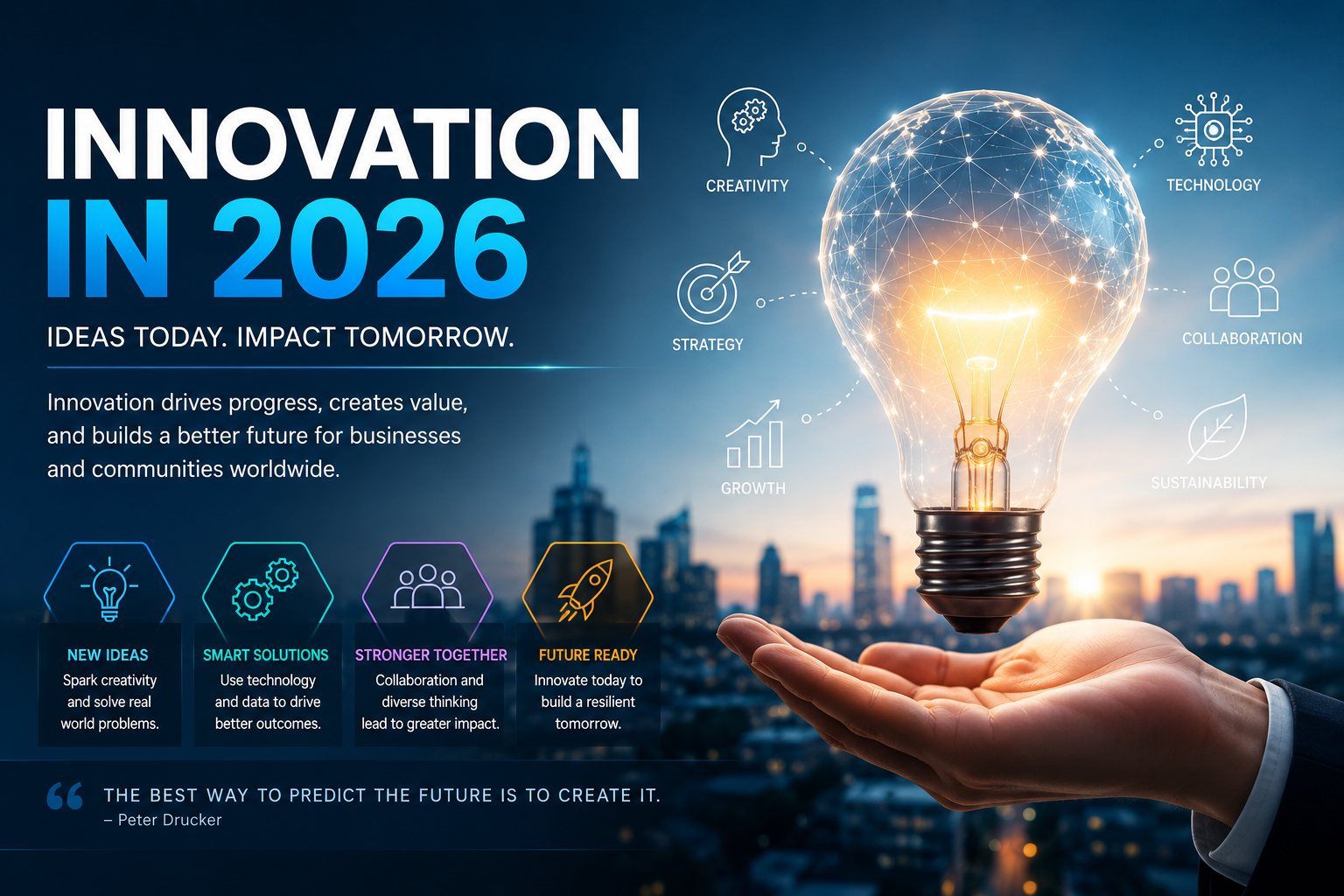
Innovation has become one of the most important drivers of business success in today's competitive marketplace. In 2026, organizations are no longer relying solely on traditional business models to achieve growth. Instead, they are embracing innovation to improve products, streamline operations, enhance customer experiences, and create new opportunities in rapidly changing markets.
From artificial intelligence and automation to sustainable business practices and digital transformation, innovation is reshaping industries across the globe. Companies that invest in innovation are better positioned to adapt to change, outperform competitors, and build long-term resilience.
Innovation is not simply about creating groundbreaking technology. It is a continuous process of finding better ways to solve problems, improve efficiency, and deliver greater value to customers.
What Is Business Innovation?
Business innovation refers to the development and implementation of new ideas, processes, products, services, or business models that create value for customers and organizations. It involves identifying opportunities for improvement and transforming them into practical solutions that drive growth.
Innovation can occur in every area of a business, including:
Product development
Customer service
Marketing strategies
Supply chain management
Human resources
Operations
Digital technologies
Business models
Successful companies understand that innovation is not a one-time project but an ongoing commitment to improvement.
Why Innovation Matters in 2026
The business environment continues to evolve at an unprecedented pace. Customer expectations are changing, new competitors are emerging, and technological advancements are reshaping entire industries.
Innovation enables businesses to:
Stay ahead of competitors
Improve operational efficiency
Increase customer satisfaction
Reduce costs
Discover new revenue streams
Adapt to market changes
Strengthen brand reputation
Organizations that fail to innovate often struggle to remain relevant as markets evolve.
Types of Business Innovation
Product Innovation
Product innovation focuses on creating new products or improving existing ones to better meet customer needs.
Examples include:
Smart consumer devices
AI-powered software
Sustainable packaging
Advanced healthcare solutions
Electric vehicles
Companies that consistently improve their products build stronger customer loyalty and maintain competitive advantages.
Process Innovation
Process innovation improves internal operations by making them faster, more efficient, and cost-effective.
Examples include:
Workflow automation
Robotics
Cloud-based collaboration
AI-driven analytics
Digital document management
Efficient processes reduce expenses while increasing productivity.
Business Model Innovation
Some of the world's most successful companies have transformed industries by changing how they deliver value.
Business model innovation includes:
Subscription services
Platform-based businesses
Direct-to-consumer sales
Digital marketplaces
Freemium pricing models
These approaches create new opportunities while meeting evolving customer expectations.
Marketing Innovation
Modern marketing relies heavily on technology and data.
Marketing innovation includes:
Personalized advertising
AI-powered recommendations
Interactive content
Social commerce
Voice search optimization
Influencer partnerships
Innovative marketing strengthens customer engagement and improves conversion rates.
The Role of Technology in Innovation
Technology has become the foundation of modern innovation.
Businesses increasingly invest in technologies such as:
Artificial Intelligence
AI helps organizations automate repetitive tasks, analyze large datasets, predict customer behavior, and improve decision-making.
Applications include:
Customer support chatbots
Demand forecasting
Fraud detection
Personalized shopping experiences
Predictive maintenance
Cloud Computing
Cloud platforms provide scalability, flexibility, and cost savings while supporting remote work and global collaboration.
Internet of Things (IoT)
Connected devices collect valuable data that helps businesses improve products, monitor equipment, and optimize operations.
Automation
Automation eliminates repetitive work, allowing employees to focus on creativity, strategy, and customer relationships.
Building an Innovation Culture
Innovation begins with organizational culture.
Businesses that encourage experimentation, collaboration, and continuous learning create environments where new ideas thrive.
Characteristics of innovative cultures include:
Open communication
Employee empowerment
Knowledge sharing
Cross-functional teamwork
Learning from failure
Recognition of creativity
Leaders play a crucial role in fostering innovation by encouraging employees to propose new ideas without fear of failure.
Leadership and Innovation
Innovation requires strong leadership.
Innovative leaders:
Inspire creativity
Support experimentation
Invest in employee development
Encourage collaboration
Accept calculated risks
Focus on long-term growth
Rather than controlling every decision, successful leaders empower teams to solve problems independently.
Customer-Centered Innovation
The most successful innovations solve real customer problems.
Businesses should regularly collect customer feedback through:
Surveys
Reviews
Social media
Customer interviews
Support interactions
Usage analytics
Understanding customer needs helps organizations develop products and services that deliver greater value.
Data-Driven Innovation
Business decisions increasingly rely on data rather than assumptions.
Organizations use analytics to understand:
Consumer preferences
Sales performance
Website traffic
Marketing effectiveness
Operational efficiency
Market trends
Data-driven insights reduce uncertainty and improve innovation success rates.
Innovation in Small Businesses
Innovation is not limited to large corporations.
Small businesses can innovate by:
Improving customer service
Adopting affordable digital tools
Automating repetitive tasks
Expanding online sales
Offering personalized experiences
Creating niche products
Agility often allows smaller companies to innovate faster than larger organizations.
Sustainability and Innovation
Environmental responsibility has become a major driver of innovation.
Businesses are investing in:
Renewable energy
Circular economy practices
Sustainable packaging
Waste reduction
Carbon footprint monitoring
Green supply chains
Sustainable innovation benefits both the environment and long-term profitability.
Common Challenges to Innovation
Although innovation creates opportunities, businesses often face obstacles such as:
Resistance to Change
Employees may hesitate to adopt new technologies or processes.
Effective communication and training help overcome resistance.
Limited Resources
Budget constraints can slow innovation.
Organizations should prioritize projects with the highest potential return on investment.
Risk Aversion
Innovation always involves uncertainty.
Successful companies manage risks through testing, pilot programs, and continuous improvement.
Lack of Collaboration
Departments working in isolation often miss valuable opportunities.
Cross-functional collaboration generates stronger ideas and faster implementation.
Measuring Innovation Success
Businesses should track innovation using measurable performance indicators.
Common metrics include:
Revenue from new products
Customer satisfaction
Time-to-market
Productivity improvements
Operational cost savings
Employee engagement
Market share growth
Return on innovation investment
Monitoring these metrics helps organizations continuously refine their innovation strategies.
Emerging Innovation Trends in 2026
Several trends are shaping the future of innovation.
AI-Powered Decision Making
Artificial intelligence provides faster insights and improves strategic planning.
Hyper-Personalization
Businesses increasingly deliver customized products and experiences based on customer behavior.
Digital Transformation
Organizations continue modernizing operations using cloud computing, automation, and advanced analytics.
Collaborative Innovation
Partnerships between businesses, startups, universities, and research organizations accelerate innovation.
Sustainable Innovation
Consumers increasingly support environmentally responsible businesses.
Human-Centered Design
Companies focus on creating solutions that prioritize user experience and accessibility.
Best Practices for Driving Innovation
Organizations seeking continuous innovation should:
Encourage creative thinking.
Invest in employee learning.
Adopt emerging technologies.
Listen to customer feedback.
Test ideas quickly.
Learn from unsuccessful projects.
Promote collaboration.
Reward innovation.
Make data-driven decisions.
Align innovation with business strategy.
These practices create a strong foundation for long-term success.
The Future of Innovation
Innovation will continue to shape every industry over the coming decade.
Emerging technologies such as artificial intelligence, quantum computing, advanced robotics, biotechnology, and extended reality will create entirely new business opportunities.
Organizations that remain flexible, customer-focused, and committed to continuous improvement will be best positioned for future success.
Innovation will increasingly become part of everyday business operations rather than a separate initiative.
Conclusion
Innovation is no longer optional—it is a strategic necessity for businesses aiming to remain competitive in 2026 and beyond. Whether through technological advancements, process improvements, customer-focused solutions, or sustainable practices, innovation enables organizations to adapt to changing markets and unlock new growth opportunities.
Companies that foster a culture of creativity, invest in emerging technologies, and empower employees to experiment are better equipped to navigate uncertainty and deliver lasting value. As industries continue to evolve, continuous innovation will remain the key to resilience, profitability, and long-term business success.
Businesses that embrace innovation today will become the industry leaders of tomorrow.