
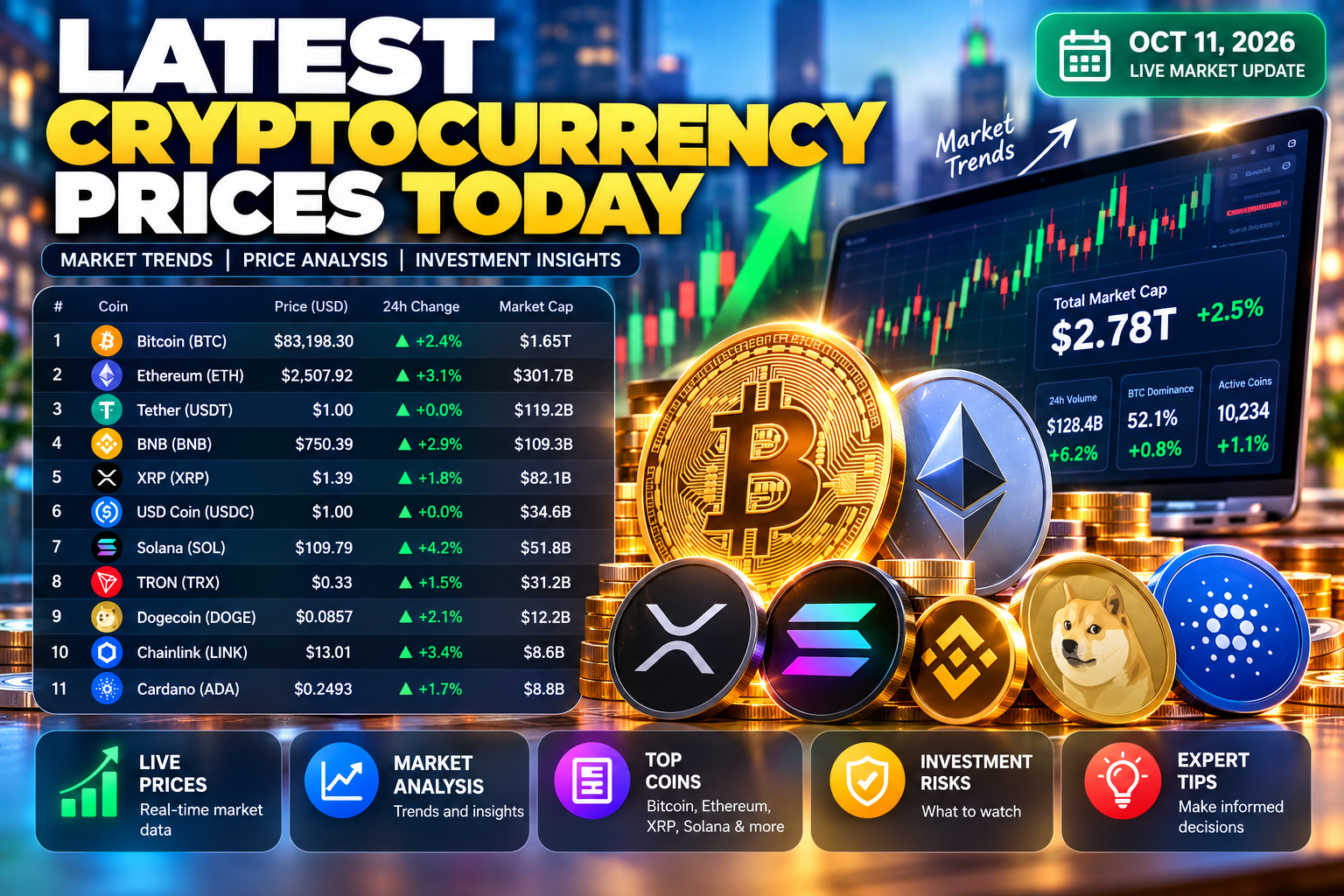
Cryptocurrency prices today remain a major focus for investors as Bitcoin, Ethereum, XRP, Solana, and other digital assets respond to changing market sentiment, global economic conditions, and investor demand. On October 11, 2026, the cryptocurrency market showed mixed movements, with several leading coins trading slightly higher over the previous 24 hours while recent weekly losses continued to influence market sentiment.
Bitcoin was trading around $83,198, while Ethereum was near $2,508 in a market snapshot updated on October 11. Other major cryptocurrencies, including BNB, XRP, Solana, and Dogecoin, also attracted attention as traders assessed short-term price movements and longer-term investment opportunities. Source: cryptocurrency price snapshot
For investors, checking cryptocurrency prices is only the first step. Understanding market capitalization, trading volume, volatility, and the factors behind price changes can help readers make more informed decisions.
This guide covers the latest available cryptocurrency prices, the performance of major digital assets, market trends, the factors that influence crypto prices, and practical steps for researching cryptocurrencies before investing.
Important: Cryptocurrency prices change around the clock. The prices below are an indicative snapshot from October 11, 2026, rather than guaranteed live quotes. Always check a reputable exchange or market-data provider before making a transaction.
Cryptocurrency Prices Today: October 11, 2026
The following table summarizes indicative U.S. dollar prices for selected major cryptocurrencies using a market-data snapshot dated October 11, 2026. Prices and percentage changes can differ across exchanges because of trading activity, liquidity, and the time at which data is recorded.
Cryptocurrency | Symbol | Approximate price (USD) |
|---|---|---|
Bitcoin | BTC | $83,198.30 |
Ethereum | ETH | $2,507.92 |
Tether | USDT | $1.00 |
BNB | BNB | $750.39 |
XRP | XRP | $1.39 |
USD Coin | USDC | $1.00 |
Solana | SOL | $109.79 |
TRON | TRX | $0.33 |
Dogecoin | DOGE | $0.0857 |
Chainlink | LINK | $13.01 |
Cardano | ADA | $0.2493 |
Price references: October 11 cryptocurrency market snapshot and CoinMarketCap historical snapshot for October 10. Figures are rounded for readability and are not investment quotes.
These prices illustrate an important feature of the cryptocurrency market: digital assets can trade at very different nominal prices. One coin may cost thousands of dollars, while another costs less than one dollar. That difference alone does not determine which asset is more valuable or which has greater investment potential.
Market capitalization, circulating supply, liquidity, token distribution, and the project's underlying purpose are all important when comparing cryptocurrencies.
1. Bitcoin Price Today (BTC)
Bitcoin remains the best-known cryptocurrency and is frequently used as a reference point for the wider digital asset market. On October 11, 2026, a market snapshot placed Bitcoin at approximately $83,198 per BTC.
Bitcoin's price attracts attention from individual traders, long-term holders, institutions, and companies that maintain digital assets on their balance sheets. Because of its prominence, significant Bitcoin price movements can influence sentiment across the broader cryptocurrency market.
What influences Bitcoin's price?
Investor demand: When more buyers are willing to purchase Bitcoin than sellers are willing to sell at current prices, its market price can rise. When selling pressure dominates, prices can decline.
Institutional participation: Investment products, corporate purchases, custody services, and institutional trading activity can affect demand and market liquidity.
Macroeconomic conditions: Interest-rate expectations, inflation data, the U.S. dollar, bond yields, and geopolitical uncertainty can influence investors' willingness to hold volatile assets.
Bitcoin supply: Bitcoin has a maximum programmed supply of 21 million coins. However, limited supply does not guarantee price appreciation because demand can also rise or fall.
Market sentiment: Positive news can encourage buying, while security incidents, regulatory uncertainty, or sudden liquidations can intensify selling.
What should Bitcoin investors watch?
Investors following BTC should examine its trading volume, recent support and resistance areas, broader economic developments, and whether a price move is supported by sustained market participation.
A single daily gain does not necessarily indicate a new bull market. Likewise, a temporary decline does not automatically mean the long-term investment case has disappeared.
Bitcoin remains highly volatile, and investors should consider their financial circumstances and risk tolerance before purchasing it.
2. Ethereum Price Today (ETH)
Ethereum was trading around $2,507.92 in the October 11 market snapshot. Ethereum is one of the most important blockchain networks because it supports smart contracts, decentralized applications, token issuance, and numerous decentralized finance services.
Ether, represented by the ticker ETH, is the network's native cryptocurrency. It is used to pay transaction fees and participate in certain network activities.
Why does Ethereum's price change?
Ethereum's price can respond to several factors:
Network usage: Higher demand for transactions and blockchain applications can increase demand for network resources.
Decentralized finance: Activity in lending, trading, and other blockchain-based financial services can affect ecosystem demand.
Staking: Eligible holders can stake ETH through supported methods to help secure the network and receive variable rewards, subject to risks and conditions.
Competition: Other smart-contract networks compete for developers, users, and capital.
Technical developments: Network upgrades and changes to transaction fees or scalability can influence expectations about Ethereum's future use.
Ethereum should not be evaluated solely by comparing its dollar price with Bitcoin. The two assets have different supply mechanisms, technical designs, and potential uses.
Before buying ETH, investors should research network activity, fees, security considerations, staking conditions, and the risks associated with applications built on Ethereum.
3. Tether and USD Coin: Stablecoin Prices
Tether (USDT) and USD Coin (USDC) are stablecoins designed to maintain a value close to one U.S. dollar. In the October 11 market snapshot, both were trading around $1.00.
Stablecoins are widely used to move value between exchanges, facilitate cryptocurrency trades, and provide a dollar-linked unit of account within digital asset markets.
Are stablecoins risk-free?
No. A stablecoin's intended price target is not the same as a guarantee that every token can always be redeemed for one dollar under all circumstances.
Stablecoin users should consider:
The issuer's reserve and redemption arrangements.
The quality and transparency of reserve disclosures.
Whether redemption is available to their type of account.
The possibility of a temporary loss of the dollar peg.
Exchange, wallet, and blockchain risks.
The legal and regulatory environment in the relevant jurisdiction.
Stablecoins can also be affected by the platform or exchange through which they are purchased. A token that trades close to $1 can still expose a user to custody, fraud, or withdrawal risks.
Anyone using stablecoins should understand how the particular token is issued, backed, transferred, and redeemed.
4. BNB Price Today
BNB was trading at approximately $750.39 in the October 11 snapshot.
BNB is associated with the BNB Chain ecosystem and is used for activities such as transaction fees and interactions with supported applications. Its price can be influenced by blockchain usage, token supply mechanisms, exchange-related developments, ecosystem growth, and broader market conditions.
However, a cryptocurrency's association with a large ecosystem does not guarantee future returns.
Before researching BNB, investors should examine its token economics, network activity, security considerations, concentration of ownership, and exposure to changes in the wider crypto market.
5. XRP Price Today
XRP was trading at approximately $1.39 in the October 11 market snapshot.
XRP is a digital asset associated with the XRP Ledger, a blockchain designed to support transfers and other applications. It frequently receives attention because of its payment-related use cases and the regulatory developments affecting the broader digital asset industry.
What can move XRP's price?
XRP's market price can respond to overall crypto sentiment, liquidity, exchange access, developments affecting its ecosystem, and regulatory news.
Payment-related use cases may influence interest in XRP, but the growth of a payment network does not automatically translate into a proportional increase in token price.
Investors should distinguish between the adoption of a technology, demand for the associated token, and the price expectations already reflected in the market.
Research should include the token's circulating supply, distribution, trading liquidity, and current legal or regulatory developments from reliable sources.
6. Solana Price Today (SOL)
Solana was trading near $109.79 in the October 11 snapshot.
Solana is a blockchain network known for supporting smart contracts, decentralized exchanges, digital collectibles, and other applications. Its transaction design aims to support high throughput and comparatively low transaction costs under many conditions.
Why do investors follow Solana?
Market participants often monitor Solana because of activity across decentralized finance, consumer applications, token trading, and its developer ecosystem.
However, network popularity is only one part of an investment assessment. SOL can experience sharp price changes, and network activity may fluctuate considerably.
Potential investors should review:
Network reliability and performance.
Developer and user activity.
Decentralized finance risks.
Token supply and distribution.
Liquidity and trading volume.
The security of the wallets and exchanges they use.
Solana's historical performance cannot guarantee its future price, and competing networks may change the market's expectations.
7. Dogecoin Price Today (DOGE)
Dogecoin was listed near $0.0857 in the October 10 historical market snapshot.
Dogecoin began as a meme-inspired cryptocurrency but developed an active community and became a widely traded digital asset. Its price can be especially sensitive to online discussions, social media attention, celebrity commentary, market speculation, and changes in risk appetite.
Unlike an equity investment, owning DOGE does not provide shareholders' rights to company earnings or assets.
A low nominal price can make Dogecoin appear inexpensive, but the number of coins available and the total market capitalization are more meaningful for comparing its valuation with other assets.
Investors should avoid buying DOGE solely because they expect social media attention to drive a rapid price increase. Sudden reversals can occur, and speculative assets can lose substantial value.
8. Chainlink Price Today (LINK)
Chainlink was listed at approximately $13.01 in the October 10 historical snapshot.
Chainlink provides oracle infrastructure intended to help smart contracts access external data and connect with other systems. This type of infrastructure can be important for applications that need information such as asset prices or other off-chain data.
The LINK token has its own market dynamics and should not be treated as a direct measure of the total value of all applications using Chainlink technology.
Investors researching LINK should consider actual network usage, token utility, supply and distribution, competitive alternatives, and the risks associated with the broader smart-contract sector.
9. Cardano Price Today (ADA)
Cardano was listed at approximately $0.2493 in the October 10 snapshot.
Cardano is a blockchain platform focused on smart contracts, decentralized applications, and network governance. ADA is its native cryptocurrency and is used for functions within the Cardano ecosystem, including staking.
The asset's market price can be influenced by development progress, user adoption, network activity, competing blockchain platforms, and broader crypto sentiment.
Investors should look beyond price charts and examine whether adoption, application usage, developer activity, and token economics support the investment thesis they are considering.
What Is Happening in the Cryptocurrency Market Today?
The October 11 market snapshot showed modest 24-hour gains for several leading assets, including Bitcoin and Ethereum. However, reporting from earlier in the week described pressure on crypto prices amid higher oil prices, rising U.S. Treasury yields, and a stronger dollar. On October 7, Bitcoin, Ethereum, and XRP experienced declines as investors reacted to these macroeconomic pressures. Source: Barron's market report
This contrast highlights why cryptocurrency investors should compare several timeframes instead of relying on a single daily percentage change.
A cryptocurrency may rise over 24 hours while remaining down over seven days. That can indicate a temporary recovery, a change in sentiment, or ordinary market volatility. Additional evidence is needed before concluding that a sustained trend has begun.
24-hour performance versus weekly performance
Daily price changes can be useful for understanding immediate market activity. Weekly and monthly comparisons provide broader context.
For example, a coin that rises 1% today after falling 8% over the previous week is still below its earlier price, assuming those percentages are measured over the relevant consecutive periods.
When examining performance, investors should check the precise reporting time and compare like-for-like periods. Data providers may use different time zones or market aggregation methods, so two reports published on the same date may not show identical figures.
Why market sentiment matters
Cryptocurrency markets trade continuously, and investor sentiment can shift quickly in response to economic announcements, exchange developments, security incidents, and regulatory decisions.
Positive sentiment may encourage buying and increase trading activity. Negative sentiment can trigger selling, reduce liquidity, and amplify price movements.
Sentiment indicators can provide context, but they should not be used alone to predict future prices. A market that appears optimistic can still decline, while a pessimistic market can experience sharp recoveries.
What Factors Affect Cryptocurrency Prices?
Understanding why cryptocurrency prices move is often more useful than simply watching the latest quotes.
1. Supply and demand
Like other traded assets, cryptocurrencies are influenced by the balance between buying interest and selling pressure.
When demand rises relative to available supply, the price may increase. When sellers dominate, the price may decline.
However, supply and demand can change rapidly, and cryptocurrency markets can be affected by leveraged positions, large holders, and thin liquidity.
2. Interest rates and inflation
Monetary policy can affect investor appetite for risky assets. Changes in interest-rate expectations influence the relative attractiveness of cash, bonds, and speculative investments.
When investors expect tighter financial conditions, some may reduce exposure to volatile assets. More favorable liquidity conditions can sometimes support risk-taking, although crypto prices do not respond to macroeconomic news in a predictable way every time.
Inflation data, employment reports, central-bank announcements, and bond yields can therefore matter to cryptocurrency traders.
3. Institutional investment
Institutional participation can affect market liquidity, investor confidence, and access to cryptocurrency exposure.
Products such as exchange-traded funds, where available, may make it easier for some investors to gain exposure without directly managing digital wallets. However, product availability and legal protections vary by jurisdiction and investment structure.
Institutional buying does not eliminate downside risk, and institutional selling can also contribute to price declines.
4. Regulation and government policy
Rules concerning exchanges, stablecoins, custody, taxation, token issuance, and investor protection can influence the cryptocurrency industry.
Clearer rules may improve confidence for some participants, while restrictive policies or enforcement actions can create uncertainty.
Regulatory developments should be checked through official government and financial-regulator publications rather than social media rumors.
5. Technology and security
A blockchain upgrade, major application launch, network outage, exploit, or wallet vulnerability can affect confidence in a particular asset or ecosystem.
Investors should distinguish between a technical development that improves a network and a marketing announcement that has little measurable effect on usage.
Security incidents can also affect platforms beyond the cryptocurrency directly involved, particularly when users lose confidence in exchanges or decentralized finance applications.
6. Market liquidity and leverage
Liquidity describes how easily an asset can be bought or sold without significantly changing its price.
Assets with lower liquidity may experience larger price movements when relatively large orders enter the market. Leveraged trading can magnify these moves because traders may be forced to close positions when prices move against them.
For beginners, understanding liquidation risk is particularly important. Borrowing money to trade cryptocurrencies can increase losses and may result in losing more than the amount initially expected, depending on the product and account terms.
How to Read Cryptocurrency Market Data
Cryptocurrency price tables typically include several metrics. Understanding them helps investors compare assets more carefully.
Price: The current or reported trading value of one unit of a cryptocurrency. It does not show how large the entire project is.
Market capitalization: Generally calculated by multiplying the current price by the circulating supply. It provides an estimate of the market value of circulating tokens, not the amount of cash invested in the project.
Trading volume: The value of transactions recorded over a specified period, often 24 hours. Higher volume can indicate more trading activity, but reported volumes may vary in quality across platforms.
Circulating supply: The number of tokens currently considered to be in circulation under the data provider's methodology.
Fully diluted valuation: An estimate based on price multiplied by the total or maximum token supply specified by the provider. It depends on tokenomics and should not be treated as a guaranteed future market value.
Percentage change: The increase or decrease in price over a defined period. Always check whether the figure refers to one hour, 24 hours, seven days, or another timeframe.
Why a cheaper coin is not necessarily a better investment
Suppose Coin A trades at $0.10 and Coin B trades at $100. The lower price of Coin A does not automatically mean it has more room to grow.
If Coin A has a very large circulating supply, its market capitalization could already be substantial. Its future price also depends on demand, token distribution, utility, liquidity, and investor expectations.
A more useful comparison examines valuation, supply, project fundamentals, competition, and risk rather than the number of dollars required to buy one token.
How to Check Live Cryptocurrency Prices
Because the prices in this article are dated snapshots, readers should verify current quotes before making financial decisions.
Step 1: Use a reputable market-data provider
Platforms such as CoinMarketCap and CoinGecko provide cryptocurrency price tables, market capitalization, trading volume, and historical charts.
Compare more than one source when prices differ significantly. For assets with limited liquidity, the last reported trade may not reflect the price at which a large order could execute.
Step 2: Check the exchange price
The price shown on a market-data website may differ slightly from the quote on a particular exchange.
Before buying or selling, review the exchange's order book, bid and ask prices, trading fees, withdrawal fees, and available trading pairs.
Step 3: Confirm the correct token
Some cryptocurrencies have similar names or symbols. Fraudulent tokens can imitate legitimate projects, particularly on decentralized exchanges.
Verify the official contract address or asset identifier using the project's trusted documentation and the relevant blockchain explorer. Do not rely on a token's name, logo, or social media advertisement alone.
Step 4: Review more than the daily change
Check historical performance, trading volume, circulating supply, liquidity, and relevant project developments.
A sudden increase in price may reflect a genuine development, but it can also result from speculative activity, low liquidity, or a coordinated promotion.
Step 5: Understand the total cost
The displayed token price may not include all transaction costs. Trading fees, network fees, spreads, slippage, and conversion charges can affect the final amount received.
These costs can be particularly significant for small trades or tokens with limited liquidity.
Is Cryptocurrency a Good Investment in 2026?
Cryptocurrency may appeal to investors interested in blockchain technology, digital payments, decentralized applications, or alternative assets. However, whether it is appropriate for an individual depends on financial goals, experience, risk tolerance, and the ability to absorb losses.
Potential benefits
Access to blockchain-based services: Certain tokens are used within digital networks and applications.
Global transfer capabilities: Some cryptocurrencies can be transferred across borders without relying on traditional banking rails, although fees, legal restrictions, and access vary.
Market accessibility: Many crypto markets operate continuously, allowing trading outside conventional stock-market hours.
Diversification potential: Some investors consider digital assets as part of a broader portfolio, although crypto may behave like other risky assets during periods of market stress.
Financial innovation: Blockchain technology supports experimentation with digital ownership, settlement systems, and programmable transactions.
These benefits are potential advantages, not guarantees of investment performance.
Major risks
Price volatility: Cryptocurrency prices can rise or fall sharply over short periods.
Fraud: Fake investment platforms, impersonation, phishing, romance-investment scams, and promises of guaranteed returns can lead to substantial losses.
Custody risk: Users can lose access to assets through compromised accounts, lost recovery phrases, or insecure wallet practices.
Platform risk: An exchange, lender, or other service provider may experience an outage, financial distress, withdrawal restrictions, or a security breach.
Regulatory uncertainty: Laws and protections differ between jurisdictions and can change.
Token-specific risk: Some tokens have weak liquidity, concentrated ownership, limited utility, or supply structures that may disadvantage buyers.
Irreversible transfers: Cryptocurrency transactions may be difficult or impossible to reverse if funds are sent to the wrong address or a scammer.
The U.S. Commodity Futures Trading Commission and Federal Trade Commission have published warnings about virtual-currency trading risks and cryptocurrency-related scams. Readers can review guidance from the CFTC and FTC.
How to Avoid Cryptocurrency Scams
Crypto scams often use urgency, social proof, and promises of unusually high returns to pressure people into acting before they conduct research.
Watch for these warning signs:
Guaranteed profits: No legitimate investment can guarantee high returns without risk.
Pressure to deposit immediately: Scammers may claim an offer expires soon or that a special opportunity is available only to a small group.
Requests for recovery phrases: Never disclose a wallet's seed phrase or private keys to someone claiming to provide support.
Unverified token launches: Check contract addresses, liquidity conditions, ownership permissions, and independent project information.
Fake withdrawal fees: Fraudulent platforms may demand additional payments to release supposed profits.
Celebrity or influencer impersonation: A recognizable name or image does not prove an endorsement is genuine.
Guaranteed recovery services: Be wary of anyone promising to recover lost cryptocurrency for an upfront fee.
Before sending funds, verify the recipient, the platform, the token contract, and the transaction details. If an opportunity depends on secrecy or promises returns that sound unrealistic, stop and investigate.
What Should Investors Watch Next?
Readers following cryptocurrency prices in October 2026 should monitor several developments rather than trying to predict the market from a single chart.
Bitcoin's price direction
Bitcoin's ability to sustain moves above or below recent trading levels may influence market sentiment. However, support and resistance levels are analytical tools, not guarantees that a price will stop or reverse at a particular point.
Ethereum network activity
Transaction activity, application usage, network fees, staking conditions, and technical developments can provide context for Ethereum's market performance.
Economic announcements
Interest-rate expectations, inflation reports, employment data, Treasury yields, and movements in the U.S. dollar can affect investor appetite for risky assets.
Regulatory developments
Changes affecting exchanges, stablecoins, custody, and institutional access may influence trading activity and confidence in particular markets.
Trading volume and liquidity
Price increases accompanied by sustained trading activity may tell a different story from sharp moves in thin markets. Investors should examine liquidity and order-book conditions before making large trades.
Security and token supply
Network exploits, exchange incidents, token unlocks, and changes in circulating supply may influence individual assets even when the overall crypto market is relatively stable.
The most useful approach is to combine verified market data with a clear investment thesis and an understanding of downside risk.
Frequently Asked Questions About Cryptocurrency Prices
What is the Bitcoin price today?
In a market snapshot from October 11, 2026, Bitcoin was trading around $83,198.30. Its current price may differ, so check a live market-data provider or exchange before trading.
What is the Ethereum price today?
Ethereum was listed near $2,507.92 in the October 11 snapshot. Prices change continuously across global trading venues.
Why do cryptocurrency prices change so quickly?
Crypto markets operate around the clock and respond to supply and demand, economic news, investor sentiment, liquidity, regulation, security incidents, and leveraged trading.
Which cryptocurrency has the highest price?
Bitcoin is often among the most expensive widely traded cryptocurrencies on a per-coin basis, but the asset with the highest nominal price is not necessarily the largest by market capitalization or the best investment.
Why are some cryptocurrencies worth less than one dollar?
A low unit price can reflect a large token supply, market demand, or the project's token economics. A low price alone does not mean a cryptocurrency is undervalued.
Can cryptocurrency prices be predicted accurately?
No method can reliably predict cryptocurrency prices with certainty. Charts, technical indicators, market sentiment, and fundamental research may help investors evaluate scenarios, but all involve uncertainty.
Are stablecoins safe?
Stablecoins aim to maintain a target value, often one U.S. dollar, but they still carry issuer, reserve, redemption, custody, platform, and regulatory risks. Their prices can temporarily move away from their intended peg.
Where can I check cryptocurrency prices?
Use reputable market-data platforms such as CoinMarketCap or CoinGecko, then verify the executable price, trading pair, and fees on the exchange you intend to use.
Final Thoughts
The latest available cryptocurrency prices for October 11, 2026, show Bitcoin trading around $83,198 and Ethereum near $2,508, with BNB, XRP, Solana, and other digital assets also drawing investor attention. These figures provide a useful market snapshot, but they should not be mistaken for guaranteed live prices.
For anyone following cryptocurrency markets, the most important habit is to look beyond the headline price. Market capitalization, trading volume, liquidity, token supply, economic conditions, project fundamentals, and security risks all contribute to a more complete picture.
Whether researching Bitcoin, Ethereum, XRP, Solana, or a smaller digital asset, verify the latest data, avoid guaranteed-return claims, and never invest money you cannot afford to lose.
Disclaimer: This article is for educational and informational purposes only. It is not financial, investment, legal, or tax advice. Cryptocurrency investments are highly volatile and can result in the loss of some or all of the money invested. Conduct independent research and consult a qualified professional when appropriate.


