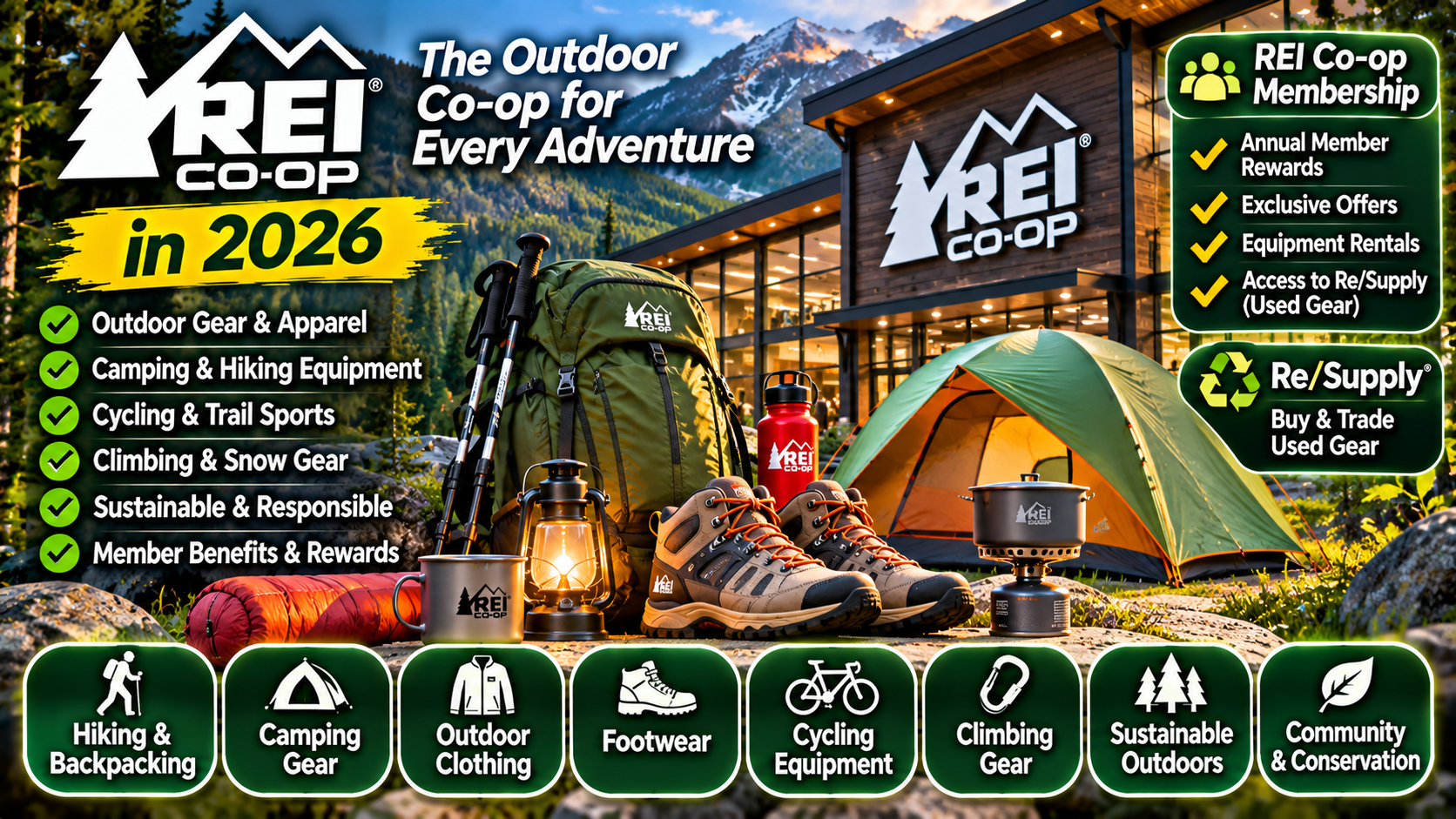
Outdoor recreation has become an important part of modern lifestyles, with millions of people participating in hiking, camping, cycling, climbing, skiing, and other outdoor activities. As interest in outdoor experiences grows, specialized retailers play an important role in helping consumers find reliable equipment, clothing, footwear, and expert guidance.
One of the most recognized names in this industry is REI, officially known as Recreational Equipment, Inc. Unlike many traditional retail chains, REI operates as a consumer-owned cooperative. Its business model combines outdoor retail, membership benefits, community involvement, and environmental responsibility.
Founded in 1938, REI has developed from a small group of outdoor enthusiasts into a major American outdoor retailer. Its product range includes hiking boots, tents, backpacks, camping equipment, cycling accessories, outdoor clothing, climbing gear, and products from leading outdoor brands.
In 2026, REI continues to focus on its cooperative identity, product quality, customer experience, and long-term commitment to outdoor recreation.
This guide explores REI's history, products, membership program, sustainability initiatives, business model, competitors, and future opportunities.
1. What Is REI?
REI stands for Recreational Equipment, Inc. It is an American specialty outdoor retailer headquartered in the Seattle area.
The company operates as a consumer cooperative, meaning its eligible members participate in a membership-based organization rather than simply being customers of a conventional publicly traded retailer.
REI sells products for outdoor activities, including:
Hiking and backpacking
Camping and mountaineering
Cycling and mountain biking
Running and fitness
Climbing and snow sports
Travel and outdoor recreation
Water sports and paddling
Customers can shop through REI's physical stores, website, mobile shopping experience, and other retail services.
REI is particularly recognized for combining outdoor equipment sales with educational resources, community programs, equipment rentals, and used-gear services.
2. The History of REI: From a Small Co-op to a Major Outdoor Retailer
REI was established in 1938 in Seattle, Washington.
Its origins are connected to outdoor enthusiasts Lloyd and Mary Anderson, who wanted access to reliable mountaineering equipment at reasonable prices. Lloyd Anderson had difficulty finding an appropriate ice axe, so he sourced equipment from overseas. The experience helped inspire a cooperative purchasing model.
The original cooperative began with 23 founding members who shared an interest in outdoor recreation.
Early development
During its early years, REI focused on providing quality mountaineering equipment to its members. Its cooperative structure allowed outdoor enthusiasts to combine their purchasing power and access products that were difficult to find locally.
The organization gradually expanded its product selection and customer base.
Expansion into mainstream outdoor retail
As hiking, camping, skiing, and other recreational activities became more popular, REI expanded beyond specialized climbing equipment.
Its stores began offering a broader selection of outdoor clothing, footwear, backpacks, tents, sleeping bags, and accessories.
Digital transformation
Online shopping introduced new opportunities for REI to reach outdoor enthusiasts across the United States.
Its digital platform allows customers to explore products, compare specifications, read reviews, and access information about outdoor activities.
REI in 2026
By 2026, REI had grown into a cooperative community with more than 26 million members, according to its 2025 financial and impact reporting.
The company continues to build its business around outdoor equipment, customer service, membership, and environmental initiatives.
3. Popular REI Products and Categories
REI offers products for beginners, experienced outdoor enthusiasts, athletes, and travelers.
Hiking and backpacking equipment
Hiking and backpacking are central categories within REI's product assortment.
Popular products include:
Hiking boots and trail shoes
Lightweight backpacks
Trekking poles
Hydration systems
Navigation equipment
Technical hiking clothing
Waterproof jackets and trousers
Customers can choose equipment based on trail conditions, weather, distance, and personal experience.
Camping equipment
Camping products are another important part of REI's retail business.
Its selection includes:
Camping tents
Sleeping bags
Sleeping pads
Camping chairs
Portable cooking equipment
Outdoor lighting
Camping cookware
Portable power accessories
The range supports different camping styles, from weekend trips to extended backpacking adventures.
Outdoor clothing
REI sells apparel designed for changing outdoor conditions.
Important clothing categories include:
Waterproof jackets
Insulated coats
Hiking trousers
Base layers
Fleece jackets
Outdoor shirts
Rainwear
Thermal clothing
Layering systems help customers manage temperature, moisture, and changing weather during outdoor activities.
Footwear
Footwear is essential for comfort and safety during outdoor activities.
REI carries different types of footwear, including:
Hiking shoes
Backpacking boots
Trail-running shoes
Climbing shoes
Sandals
Snow boots
Waterproof footwear
Customers should consider fit, grip, cushioning, support, and intended terrain when selecting outdoor footwear.
Cycling equipment
REI also serves cyclists through products and services connected to road cycling, mountain biking, commuting, and recreational riding.
Its cycling categories include bicycles, helmets, cycling apparel, repair equipment, lights, locks, and accessories.
Climbing and snow sports
For more specialized outdoor activities, REI offers equipment such as climbing harnesses, helmets, ropes, carabiners, ski clothing, snowboarding accessories, and winter sports equipment.
Product availability can vary by season and location.
4. REI Co-op Membership: How Does It Work?
One of REI's most distinctive features is its cooperative membership model.
Unlike a standard retail loyalty program, REI membership represents participation in a consumer cooperative.
Anyone can shop at REI, but members receive additional benefits.
Major membership benefits
Depending on current program terms, benefits can include:
Annual Co-op Member Rewards on eligible purchases
Access to member-exclusive offers
Special pricing on selected services and events
Discounts on equipment rentals
Access to the Re/Supply used-gear program
Opportunities to participate in cooperative activities
The exact reward amount and eligibility conditions can change, so customers should review REI's official membership terms before making purchasing decisions.
Why the co-op model matters
The cooperative structure helps REI differentiate itself from conventional sporting goods retailers.
Members are part of a broader community built around outdoor recreation. This creates a relationship that extends beyond individual purchases.
For the business, membership can support customer loyalty, repeat purchases, and long-term engagement.
5. REI Re/Supply: The Used Outdoor Gear Marketplace
Sustainability and product reuse have become increasingly important in the outdoor industry.
REI's Re/Supply program supports a circular economy by allowing eligible members to purchase used gear and, under applicable program conditions, trade in qualifying equipment.
How Re/Supply works
The program helps keep usable products in circulation instead of sending them directly to waste.
Examples of products that may be available include:
Backpacks
Outdoor clothing
Camping equipment
Hiking accessories
Selected sporting goods
Availability and trade-in conditions depend on product category, condition, and current program rules.
Benefits of buying used gear
Used equipment can offer several advantages:
Lower costs: Customers may find products at prices below their original retail value.
Less waste: Reusing equipment can extend product life.
More accessible outdoor recreation: Lower-cost options may help beginners get started.
Resource efficiency: Reuse can reduce demand for some new products.
For outdoor enthusiasts, Re/Supply provides another way to access equipment while supporting product reuse.
6. REI's Sustainability and Environmental Initiatives
Environmental responsibility is closely connected to REI's identity.
Outdoor recreation depends on healthy forests, mountains, rivers, parks, and other natural environments. Protecting these places is therefore relevant to both the company's mission and its customer community.
Sustainable product development
REI works on product standards and material choices intended to reduce environmental and social impacts.
Its initiatives include exploring recycled materials, responsible manufacturing practices, and improved product design.
Circular economy
Programs such as Re/Supply encourage customers to extend the life of outdoor products.
This approach can reduce waste and make outdoor equipment more affordable.
Climate and waste reduction
REI's 2025 Impact Report describes progress in emissions reduction and waste diversion.
The company reported a 15% reduction in emissions compared with its 2019 baseline in 2025.
Protecting outdoor spaces
REI also supports outdoor access, public-land protection, and nonprofit organizations working on environmental and community projects.
These efforts help connect the retailer's business with the broader outdoor recreation community.
7. REI's Financial Performance and Business Position in 2026
REI's cooperative structure makes its financial reporting different from that of a publicly traded retailer.
It reports financial performance to its members and publishes annual financial information.
According to its May 2026 announcement covering fiscal 2025:
Financial and operating measure | Reported result |
|---|---|
Net sales | $3.54 billion |
Gross profit | $1.52 billion |
Net loss | $54.3 million |
Member rewards distributed | $203 million |
Total membership | More than 26 million |
Employees | 12,478 |
New store locations opened | 4 |
Store relocations | 2 |
The financial figures relate to REI's fiscal year ended January 3, 2026, with the company also reporting two profitable quarters toward the end of the year.
These results show the scale of REI's retail operations and the importance of managing costs, inventory, product demand, and membership engagement.
Business priorities
REI's Peak 28 strategic plan focuses on strengthening the business through priorities that include:
Improving product selection
Enhancing customer service
Strengthening the membership experience
Managing inventory and operating costs
Supporting employees and communities
Building a sustainable long-term business
The company faces the challenge of balancing its cooperative mission with the financial discipline required in a competitive retail market.
8. REI's Business Model: What Makes It Different?
REI's business model combines several activities rather than relying exclusively on product sales.
Retail sales
The company earns revenue through outdoor equipment, apparel, footwear, and accessories sold through stores and digital channels.
Private-label products
REI develops products under its own REI Co-op and Co-op Cycles brands.
These products help the retailer offer equipment designed around the needs of outdoor customers.
Third-party brands
REI also carries products from established outdoor and athletic brands.
This provides customers with a broad selection across different budgets and activity levels.
Membership-based relationships
The cooperative model encourages long-term engagement through member rewards, services, and community participation.
Services and experiences
Equipment rentals, repair services, classes, events, and used-gear programs add value beyond traditional shopping.
This combination helps REI build a distinctive position in the outdoor retail market.
9. REI's Competitors in the Outdoor Retail Industry
The outdoor recreation market includes specialist retailers, sporting goods chains, footwear brands, and online marketplaces.
Some important competitors and alternatives include:
Patagonia
Patagonia is known for outdoor clothing, technical apparel, and environmental advocacy. Its brand positioning emphasizes durability and environmental responsibility.
The North Face
The North Face offers outdoor apparel, footwear, backpacks, and equipment for activities such as hiking, climbing, and skiing.
Backcountry
Backcountry is an online-focused outdoor retailer offering equipment and apparel for outdoor sports and adventure activities.
Dick's Sporting Goods
DICK'S Sporting Goods sells athletic footwear, sportswear, fitness equipment, and sporting goods. Its product range serves a broader sports and fitness market.
Bass Pro Shops
Bass Pro Shops focuses on hunting, fishing, boating, camping, and outdoor recreation equipment.
What makes REI different?
REI differentiates itself through its cooperative ownership structure, membership community, outdoor education, equipment services, and focus on outdoor access.
Its combination of retail and community engagement gives it a distinct position within the industry.
10. REI's Online Shopping and Customer Experience
Digital shopping has become an important part of the outdoor retail experience.
REI's website and mobile shopping platform allow customers to explore a wide range of products without visiting a physical store.
Online shopping features
Customers can use the digital platform to:
Browse outdoor product categories
Compare product specifications
Read customer reviews
Explore brand collections
Check product availability
Access membership information
Discover outdoor advice and educational content
The importance of product information
Outdoor equipment often requires more detailed research than ordinary consumer products.
For example, a customer buying a tent may need to compare capacity, weight, weather resistance, setup time, and packed dimensions.
Detailed product information can help customers make more suitable purchasing decisions.
Physical stores and expert advice
REI stores complement online shopping by allowing customers to examine products, ask questions, and access selected services.
This combination of digital convenience and in-person assistance is an important part of the company's retail strategy.
11. REI's Challenges and Business Risks
Despite its strong brand recognition, REI operates in a competitive and changing retail environment.
Increasing competition
Outdoor brands and retailers compete for the same customers through product innovation, pricing, digital marketing, and specialized services.
Changing consumer spending
Outdoor equipment can be expensive. When household budgets become tighter, customers may postpone purchases or choose lower-priced alternatives.
Inventory management
Outdoor products often have seasonal demand. Poor inventory planning can result in excess stock, markdowns, and reduced profitability.
Supply chain pressures
Global manufacturing, shipping costs, sourcing restrictions, and material availability can affect product prices and delivery schedules.
Balancing mission and profitability
REI must maintain its cooperative identity while generating sufficient financial performance to invest in employees, members, stores, and environmental initiatives.
This balance remains an important long-term business challenge.
12. The Future of REI: What to Expect Beyond 2026
The future of REI will likely depend on its ability to adapt to changing outdoor lifestyles, consumer expectations, and retail technology.
Several opportunities could influence its next stage of growth.
Growth in outdoor recreation
Interest in hiking, camping, cycling, and nature-based travel creates opportunities for specialized retailers.
Product innovation
Lightweight materials, improved insulation, advanced footwear, and more versatile camping equipment may influence future product development.
Digital retail improvements
Better product recommendations, personalized shopping experiences, and improved inventory visibility could strengthen online sales.
Circular retail
Used equipment, product repair, and rental services may become increasingly important as consumers look for value and more sustainable purchasing options.
Inclusive outdoor access
Making outdoor activities more accessible to different communities, experience levels, and budgets can help expand the market.
REI's ability to connect these opportunities with its cooperative mission will be important to its long-term position.
13. Is REI Worth Shopping At?
REI can be a useful shopping destination for customers who need outdoor equipment, technical clothing, footwear, or expert product guidance.
It may be particularly attractive to:
Hiking and backpacking enthusiasts
Campers and outdoor travelers
Cyclists and trail runners
Climbers and winter sports participants
Customers interested in equipment rentals
People who value used outdoor gear
Consumers interested in cooperative membership
However, shoppers should compare prices, product specifications, warranty conditions, and return policies before purchasing expensive equipment.
The best choice depends on the activity, budget, product requirements, and expected frequency of use.
Frequently Asked Questions About REI
1. What does REI stand for?
REI stands for Recreational Equipment, Inc. It is an American consumer cooperative specializing in outdoor recreation products and services.
2. When was REI founded?
REI was founded in 1938 in Seattle, Washington, by a group of outdoor enthusiasts led by Lloyd and Mary Anderson.
3. Who owns REI?
REI operates as a consumer cooperative. Its members participate in the cooperative rather than owning shares traded on a public stock exchange.
4. Is REI a publicly traded company?
No. REI is a consumer cooperative, not a publicly traded corporation.
5. What products does REI sell?
REI sells hiking boots, backpacks, tents, sleeping bags, camping equipment, outdoor clothing, cycling products, climbing equipment, and other outdoor accessories.
6. What is REI Co-op membership?
REI Co-op membership is a membership program that provides eligible members with benefits such as member rewards, selected discounts, and access to certain services and programs.
7. What is REI Re/Supply?
Re/Supply is REI's used-gear program. It allows eligible members to shop for used outdoor products and participate in qualifying trade-in opportunities.
8. Is REI environmentally friendly?
REI reports initiatives involving sustainable product standards, circular retail, emissions reduction, waste diversion, and support for outdoor conservation. Its progress and remaining challenges are described in its annual Impact Report.
9. Where is REI headquartered?
REI is headquartered in the Seattle metropolitan area in Washington State, United States.
10. How much revenue did REI generate in 2025?
REI reported $3.54 billion in net sales for fiscal 2025, according to its financial results released in May 2026.
Conclusion
REI has developed from a small cooperative of outdoor enthusiasts into one of America's most recognized specialty outdoor retailers.
Its success is connected to a distinctive business model that combines outdoor equipment, technical apparel, membership benefits, customer services, and environmental initiatives.
In 2026, the company continues to face competition, changing consumer spending patterns, and the challenge of improving profitability while maintaining its cooperative identity.
Its long-standing outdoor focus, broad product selection, membership community, and commitment to expanding access to nature provide a foundation for its future.
As outdoor recreation continues to attract new participants, REI remains an important company to watch in the outdoor retail industry.