
South Korea is famous around the world for its technology companies, automobiles, electronics, entertainment and rapidly growing digital economy.
Behind these industries are some of Asia’s most powerful billionaires.
In 2026, South Korea’s richest people benefited from a remarkable rise in technology and semiconductor stocks. The artificial-intelligence boom has created enormous demand for memory chips and chipmaking equipment, helping some of the country’s largest companies and their shareholders generate significant wealth.
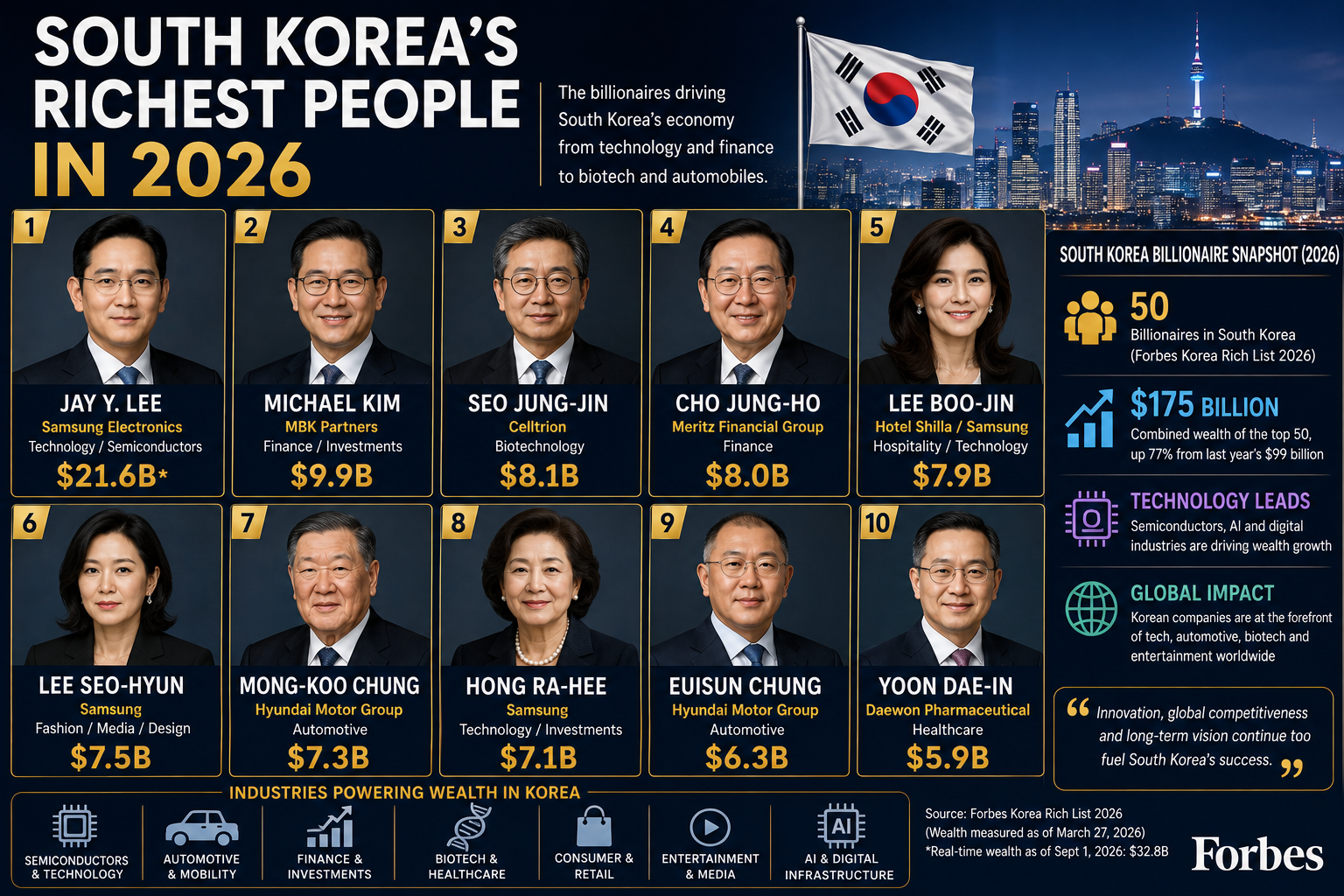
According to Forbes’ Korea’s 50 Richest 2026, the combined fortune of the country’s 50 wealthiest people reached an all-time high of approximately $175 billion, up 77% from $99 billion the previous year. Forbes said 34 of the 50 became wealthier during the period.
At the top of the ranking is Jay Y. Lee, executive chairman of Samsung Electronics, with a Forbes list fortune of $21.6 billion as of March 27, 2026.
However, his wealth continued rising afterward. Forbes’ real-time profile showed approximately $32.8 billion as of September 1, 2026, demonstrating how quickly billionaire fortunes can change when stock prices move.
Top 10 Richest People in South Korea in 2026
According to Forbes’ 2026 Korea Rich List:
Rank | Billionaire | Main Source of Wealth | Forbes 2026 Wealth |
|---|---|---|---|
1 | Jay Y. Lee | Samsung / Technology | $21.6B |
2 | Michael Kim | Finance & Investments | $9.9B |
3 | Seo Jung-jin | Biotechnology | $8.1B |
4 | Cho Jung-ho | Finance | $8.0B |
5 | Lee Boo-jin | Samsung / Technology | $7.9B |
6 | Lee Seo-hyun | Samsung / Technology | $7.5B |
7 | Mong-Koo Chung | Automotive | $7.3B |
8 | Hong Ra-hee | Samsung / Technology | $7.1B |
9 | Euisun Chung | Automotive | $6.3B |
10 | Yoon Dae-in | Healthcare | $5.9B |
These figures are Forbes’ March 27, 2026 estimates for its annual Korea list. Real-time fortunes may differ.
1. Jay Y. Lee — South Korea’s Richest Person
Jay Y. Lee is South Korea’s richest person on Forbes’ 2026 ranking.
Lee is the executive chairman of Samsung Electronics, the country's largest conglomerate and one of the world's most important technology companies.
Forbes valued his fortune at $21.6 billion for its 2026 Korea Rich List. By September 1, however, Forbes’ real-time tracker showed his wealth at approximately $32.8 billion.
The enormous increase was closely connected to Samsung's rising share price and the global AI boom.
Samsung and the AI Revolution
Artificial intelligence requires enormous quantities of computing power.
That has created a huge market for advanced memory chips.
Samsung Electronics is the world's largest memory-chip maker by sales, according to Forbes.
As AI companies build increasingly powerful systems, demand for high-bandwidth memory and other advanced chips has surged.
This has transformed Samsung's position in the global technology industry and helped boost the wealth of its major shareholders.
Lee's story therefore illustrates how the AI boom is creating wealth far beyond software companies.
2. Michael Kim — Private Equity Billionaire
Michael Kim ranks second on Forbes' 2026 Korea Rich List with a fortune of $9.9 billion.
Kim is the cofounder of MBK Partners, one of Asia's largest private-equity firms.
Unlike Samsung's technology-driven fortune, Kim built his wealth through finance and investment.
MBK invests in businesses across Asia, and its portfolio has included major companies in industries such as retail, consumer products, financial services and industrials.
Forbes reported that MBK raised approximately $5.5 billion for an Asia-focused buyout fund despite challenges involving its portfolio company Homeplus.
Kim's position demonstrates that South Korea's billionaire economy is not solely dependent on technology.
Finance continues to be an important source of wealth.
3. Seo Jung-jin — Biotech Billionaire
Seo Jung-jin ranks third with an estimated fortune of $8.1 billion on Forbes' 2026 list.
Seo is the cofounder of Celltrion, one of South Korea's most successful biotechnology companies.
He started Celltrion in 2002 and took the company public in 2008.
Celltrion specializes in biopharmaceuticals and has become particularly successful in the biosimilar market.
Its products target diseases including cancer, influenza and rheumatoid arthritis.
Healthcare’s Growing Role
South Korea's biotechnology industry is becoming increasingly important.
AI is not the only technology-related industry creating new wealth.
Advances in drug development, biosimilars, biotechnology and pharmaceutical manufacturing are also producing major opportunities.
Celltrion's growth has therefore made Seo one of the most prominent healthcare billionaires in Asia.
4. Cho Jung-ho — Finance and Investment
Cho Jung-ho ranks fourth with an estimated fortune of $8 billion.
He is chairman of Meritz Financial Group.
Cho comes from the family of the late Hanjin Group founder Cho Choong-hoon, but he built his own position in the financial sector.
He worked for Korean Air in Europe before returning to South Korea in 1989 and joining what was then Hanjin Investment & Securities.
Meritz later separated from the Hanjin Group, and its value increased substantially under Cho's leadership.
His story demonstrates how financial services can create enormous wealth even in an economy dominated by manufacturing and technology.
5. Lee Boo-jin — Samsung’s Hospitality and Technology Fortune
Lee Boo-jin ranks fifth with a Forbes-estimated fortune of $7.9 billion.
She is the president and CEO of Hotel Shilla and a member of the Samsung family.
Her wealth is closely connected to Samsung-related holdings.
Hotel Shilla operates in the hospitality and duty-free industries and has become an important part of South Korea's tourism and luxury retail ecosystem.
Lee Boo-jin's position also demonstrates the continued importance of Samsung family ownership in South Korea's billionaire rankings.
6. Lee Seo-hyun — Samsung Family Billionaire
Lee Seo-hyun ranks sixth with an estimated fortune of $7.5 billion.
She is another member of the Samsung family.
Lee Seo-hyun has held leadership positions in Samsung-affiliated businesses and has been associated with the group's interests in fashion, media and design.
Her fortune is largely connected to Samsung holdings.
The presence of multiple Samsung family members near the top of the ranking shows how concentrated South Korea's corporate wealth can be.
7. Chung Mong-Koo — Hyundai Automotive Fortune
Chung Mong-Koo ranks seventh with a fortune of approximately $7.3 billion.
He is the former chairman of Hyundai Motor Group and played a major role in transforming Hyundai and Kia into major global automobile brands.
Hyundai's expansion beyond South Korea was one of the most important developments in the country's industrial history.
The company now competes internationally in:
Cars
Electric vehicles
Batteries
Robotics
Mobility
Hydrogen technology
Chung's wealth demonstrates how South Korea's automobile industry has become a global economic force.
8. Hong Ra-hee — Samsung’s Art and Cultural Influence
Hong Ra-hee ranks eighth with an estimated fortune of $7.1 billion.
She is the widow of the late Samsung chairman Lee Kun-hee and the mother of Jay Y. Lee.
Hong Ra-hee has played a major role in South Korea's cultural and art world, including leadership of the Leeum Museum of Art.
Her fortune is primarily connected to Samsung family holdings.
Her position among Korea's richest people illustrates the enormous value of Samsung's legacy shareholdings.
9. Euisun Chung — Hyundai’s Next Generation
Euisun Chung ranks ninth with a Forbes-estimated fortune of $6.3 billion.
He is executive chair of Hyundai Motor Group and represents the next generation of the Chung family.
Forbes reported that Hyundai Motor shares nearly tripled during the period used for its 2026 ranking, helping Chung's wealth more than double to $6.3 billion.
Hyundai and AI
Hyundai is increasingly moving beyond traditional automobile manufacturing.
The company is investing in:
Artificial intelligence
Robotics
Electric vehicles
Autonomous driving
Smart factories
Future mobility
The combination of automobiles and AI could become an important source of future wealth for the Chung family.
10. Yoon Dae-in — Healthcare Entrepreneur
Yoon Dae-in completes the top 10 with a fortune of approximately $5.9 billion.
His wealth comes from the healthcare sector, another industry experiencing rapid growth in South Korea.
The country's healthcare and biotechnology industries have become increasingly competitive globally.
South Korean companies are developing new treatments, biosimilars, medical technologies and pharmaceutical products.
This makes healthcare one of the country's most promising sources of future billionaire wealth.
Samsung Dominates South Korea’s Billionaire Rankings
One of the most striking features of South Korea's billionaire economy is Samsung's influence.
In May 2026, Forbes reported that four members of the Samsung family became the country's top four richest people as Samsung Electronics' market value surged above $1 trillion.
The Samsung family includes:
Jay Y. Lee
Lee Boo-jin
Lee Seo-hyun
Hong Ra-hee
Together, their wealth represents a huge portion of South Korea's billionaire economy.
Samsung's dominance is therefore not simply a corporate success story.
It is also a major driver of family wealth.
Artificial Intelligence Is Transforming South Korean Wealth
AI is perhaps the biggest theme in South Korea's billionaire economy in 2026.
The country's semiconductor manufacturers are benefiting from enormous demand for AI-related computing hardware.
Samsung Electronics and other South Korean companies produce memory chips and chipmaking equipment that are critical to modern AI systems.
Forbes reported that the Korean stock market was the world's best-performing major market over the previous year, with the Kospi more than doubling from the prior measurement period.
This market surge dramatically increased billionaire wealth.
South Korea’s 50 Richest Reached a Record $175 Billion
Forbes estimated that the combined fortune of South Korea's 50 richest people reached $175 billion in 2026.
That was a 77% increase from the previous year's $99 billion.
The minimum wealth required to enter the list also rose from $665 million to $1 billion.
Seven newcomers joined the ranking.
The increase demonstrates just how quickly South Korea's wealth landscape is changing.
K-Beauty Is Creating New Fortunes
South Korea's global influence is not limited to semiconductors and automobiles.
K-Beauty has become a major international industry.
Forbes highlighted the rise of APR, a skincare-device company whose shares increased more than fivefold over the previous year.
APR cofounder Byunghoon Kim entered the country's richest list with an estimated fortune of $2.7 billion.
The development shows how South Korea's consumer brands can expand globally.
Beauty products, skincare technology and cosmetics are increasingly important parts of the country's economic success.
South Korea’s Crypto Billionaires Are Also Growing
The country's cryptocurrency industry has produced another group of wealthy entrepreneurs.
Song Chi-hyung, cofounder and chairman of Dunamu, the company behind Upbit, ranked No. 25 on Forbes' 2026 Korea list with an estimated fortune of $2.3 billion.
His fortune more than doubled after Naver agreed to acquire Dunamu in a stock-swap deal valuing the combined entity at approximately $13.6 billion.
This demonstrates that fintech and cryptocurrency are becoming increasingly important sources of South Korean entrepreneurial wealth.
The Next Generation of Korean Billionaires
South Korea's billionaire landscape could become even more diverse over the next decade.
Traditional conglomerates such as Samsung and Hyundai remain extremely powerful.
But newer industries are growing quickly.
Artificial Intelligence
AI-related semiconductors could continue driving technology wealth.
Biotechnology
South Korean biotech companies are expanding internationally.
Robotics
Hyundai and other companies are investing heavily in robotics and automation.
K-Beauty
Global demand for Korean skincare and cosmetics continues to create new opportunities.
Cryptocurrency and Fintech
Digital financial services are producing younger technology entrepreneurs.
Electric Vehicles
South Korea's automotive and battery industries are positioned to benefit from the global EV transition.
Why Billionaire Fortunes Change So Quickly
Billionaire net worth should not be interpreted as cash sitting in a bank account.
Most billionaires own substantial stakes in companies.
When those shares rise, their estimated net worth rises.
When the market falls, their wealth can decline by billions of dollars.
Jay Y. Lee is an excellent example.
Forbes' annual Korea list valued his fortune at $21.6 billion based on March 27 prices, while Forbes' real-time tracker showed $32.8 billion on September 1.
That difference occurred because Samsung's market value and other relevant holdings changed significantly.
Final Thoughts
South Korea's richest people in 2026 represent a fascinating combination of established family conglomerates and newer entrepreneurial fortunes.
Jay Y. Lee leads the country’s billionaire rankings through his Samsung holdings and benefited enormously from the global AI semiconductor boom.
Michael Kim represents the power of private equity, while Seo Jung-jin demonstrates the potential of biotechnology.
The Samsung family continues to dominate the upper end of the rankings, while the Chung family remains closely connected to South Korea's global automobile industry.
At the same time, newer billionaires are emerging from K-Beauty, fintech, cryptocurrency and technology.
The biggest story may be the growing connection between South Korea and artificial intelligence.
AI is driving demand for memory chips, advanced manufacturing, data infrastructure and robotics.
If that demand continues, South Korea's semiconductor and technology companies could remain major engines of billionaire wealth.
With a powerful manufacturing base, globally recognized brands and an advanced technology sector, South Korea is likely to remain one of Asia's most important billionaire economies for years to come.