
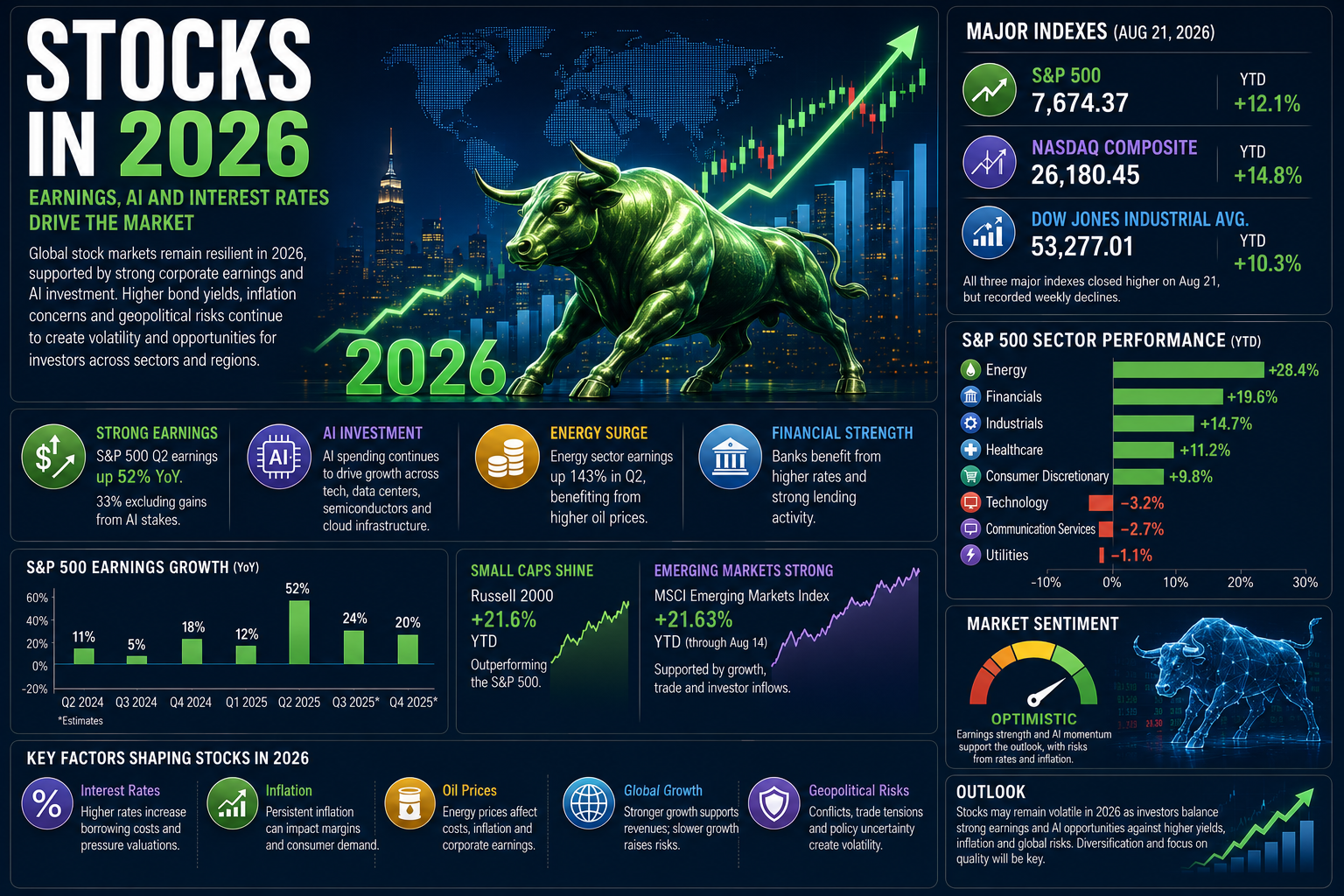
Global stock markets are navigating an important phase in 2026. Strong corporate earnings and continued investment in artificial intelligence have supported equities, while higher bond yields, inflation concerns and geopolitical uncertainty are creating new risks for investors.
The U.S. market remains particularly strong. On August 21, the S&P 500 closed at 7,674.37, the Nasdaq Composite at 26,180.45 and the Dow Jones Industrial Average at 53,277.01. Despite gains on Friday, all three major indexes recorded weekly declines.
Strong Earnings Support Stocks
Corporate earnings have been one of the biggest sources of support for stocks in 2026.
S&P 500 companies reported a 52% year-over-year increase in aggregate second-quarter earnings, according to Reuters. Even after excluding gains related to investments in AI companies, earnings still increased by 33%.
Strong profits are important because they provide fundamental support for stock valuations.
Companies that can increase revenue, control costs and maintain strong margins may continue to attract investors even when broader economic conditions are uncertain.
AI Remains a Major Stock-Market Theme
Artificial intelligence continues to influence stock markets.
Technology companies are investing heavily in:
AI data centers
Semiconductors
Cloud computing
Networking equipment
AI software
Electricity infrastructure
These investments have created opportunities for companies across the technology supply chain.
However, investors are becoming more selective. Concerns about high valuations and the enormous cost of AI infrastructure have caused periods of weakness in semiconductor and other AI-related stocks.
Technology Stocks Face Higher Expectations
Technology stocks have been among the biggest winners of the recent market cycle, but expectations are also extremely high.
Investors increasingly want to see evidence that AI spending is translating into sustainable revenue and profits.
This has created a more challenging environment for companies that are spending heavily today but may not generate significant returns for several years.
The market is therefore focusing increasingly on AI monetization, rather than simply AI adoption.
Energy Stocks Gain Attention
Energy has been another strong part of the stock market.
Higher oil prices can increase revenues for energy producers and improve earnings expectations for companies involved in oil and gas.
Reuters reported that the energy sector's S&P 500 earnings increased 143% in the second quarter, making it one of the strongest-performing sectors during the period.
However, energy companies remain sensitive to changes in crude prices and global demand.
Financial Stocks Remain Important
Financial companies have also attracted investor attention.
Banks can benefit from higher interest rates through stronger lending income, although elevated rates can also create challenges for borrowers and credit quality.
The broader financial sector has become particularly important as investors rotate away from highly valued technology stocks and look for companies with strong earnings and more traditional valuations.
LSEG's August market analysis identified energy and financials as leading equity industries, while technology hardware was a drag on performance.
Small-Cap Stocks Show Strength
Smaller companies are also attracting attention.
The Russell 2000, which tracks U.S. small-cap stocks, has performed strongly in 2026.
As of August 21, the index was up 21.6% year to date, compared with 12.1% for the S&P 500.
Small-cap companies can benefit when investors expect stronger domestic economic growth and lower financing pressures.
However, they can also be more sensitive to interest rates because smaller businesses often rely more heavily on external financing.
Interest Rates Remain a Key Risk
Interest rates continue to influence stock valuations.
Higher bond yields can make fixed-income investments more attractive relative to equities.
They can also increase corporate borrowing costs.
Growth companies are particularly sensitive because their valuations often depend heavily on future earnings.
When interest rates rise, the present value of those future earnings can decline.
This is why stock investors are paying close attention to Federal Reserve policy.
Inflation Matters for Stocks
Inflation can affect companies in several ways.
Higher prices for raw materials, transportation and labor can reduce profit margins.
Some companies can pass higher costs to customers, while others may struggle to maintain profitability.
The latest U.S. data showed consumer prices rising 3.4% over the 12 months through July 2026, while producer prices were unchanged in July.
Investors are watching whether inflation continues to moderate or whether higher energy prices create another wave of price pressure.
Geopolitical Risks Create Volatility
Global conflicts and trade tensions remain major risks for stocks.
Geopolitical events can affect:
Energy prices
Supply chains
Consumer confidence
Business investment
Government spending
Currency markets
The ongoing uncertainty around the Middle East and oil supplies has been particularly important for global markets in 2026.
Stock investors therefore need to consider both company-specific fundamentals and broader geopolitical conditions.
European Stocks Offer Diversification
European stock markets provide exposure to sectors that are less dominant in the U.S.
These include:
Banks
Energy
Industrial companies
Healthcare
Luxury goods
Defense
Infrastructure
LSEG's August data showed European and UK markets benefiting from strength in energy and financial stocks, while technology-heavy Asian markets experienced greater pressure.
This makes regional diversification increasingly important.
Emerging-Market Stocks Perform Strongly
Emerging-market equities have also delivered strong results in 2026.
The MSCI Emerging Markets index was up 21.63% year to date through August 14, according to LPL Research.
Emerging markets can provide exposure to faster-growing economies, expanding consumer markets and developing technology industries.
However, they can also be affected by currency volatility, commodity prices, interest rates and foreign capital flows.
Market Leadership Is Changing
One of the biggest themes in 2026 is the changing leadership of the stock market.
Technology remains important, but investors are increasingly looking toward other sectors.
Energy, financials, healthcare and materials have gained attention as investors consider valuations and economic conditions.
This shift could make the market broader and less dependent on a small group of mega-cap technology companies.
Corporate Earnings Remain the Main Test
For the market to continue rising, earnings will remain critical.
Strong earnings can justify higher stock prices.
Weak earnings can make expensive valuations more difficult to sustain.
Reuters reported that investors were increasingly looking to corporate earnings to support stocks as uncertainty around Federal Reserve policy continued.
The next several quarters will therefore provide important information about whether current valuations are supported by sustainable business growth.
What Investors Are Watching
Several indicators are likely to remain important through the rest of 2026.
Corporate Earnings
Investors will monitor revenue, profit margins and forward guidance.
Federal Reserve Policy
Changes in interest-rate expectations can quickly affect stock valuations.
AI Investment
The market will look for evidence that enormous AI infrastructure spending is producing measurable returns.
Oil Prices
Higher energy prices could increase inflation and pressure consumers.
Bond Yields
Rising Treasury yields can create competition for stocks and increase corporate financing costs.
Global Economic Growth
A stronger global economy could support corporate revenues, while slower growth could pressure cyclical companies.
The Outlook for Stocks
The stock-market outlook remains mixed but constructive.
Corporate earnings are strong, AI investment continues to create opportunities and several sectors outside technology are showing resilience.
At the same time, elevated valuations, higher bond yields and geopolitical uncertainty could produce additional volatility.
The market may therefore become increasingly dependent on actual earnings growth rather than investor enthusiasm alone.
Final Thoughts
Stocks remain one of the most important global investment markets in 2026.
The S&P 500, Nasdaq and Dow have maintained strong year-to-date gains despite recent weekly losses, while small-cap and emerging-market stocks have also performed strongly.
The biggest drivers are corporate earnings, AI investment, interest rates, inflation and energy prices.
Technology remains a major market force, but leadership is broadening toward energy, financials and other sectors.
For investors, the key challenge is balancing strong corporate fundamentals against valuation and macroeconomic risks.
As the year progresses, the performance of stocks will likely depend on whether earnings growth can continue to justify elevated valuations while inflation and interest-rate pressures remain under control.
FAQs
What is the stock market?
The stock market is a marketplace where investors buy and sell shares of publicly traded companies.
Why are stocks performing strongly in 2026?
Strong corporate earnings, AI investment and resilient economic activity have supported equities, although markets have experienced periods of volatility.
Which sectors are performing well?
Energy and financials have been among the stronger sectors, while some technology hardware stocks have faced pressure.
How do interest rates affect stocks?
Higher interest rates can increase borrowing costs and reduce the relative attractiveness of equities, particularly high-growth stocks.
Why is AI important for stocks?
AI is driving investment in semiconductors, data centers, cloud computing and software while creating new revenue opportunities.
Are small-cap stocks performing well?
Yes. The Russell 2000 was up 21.6% year to date as of August 21, 2026.
What are the biggest risks for stocks?
Important risks include high valuations, rising bond yields, inflation, geopolitical tensions, energy prices and weaker-than-expected economic growth.