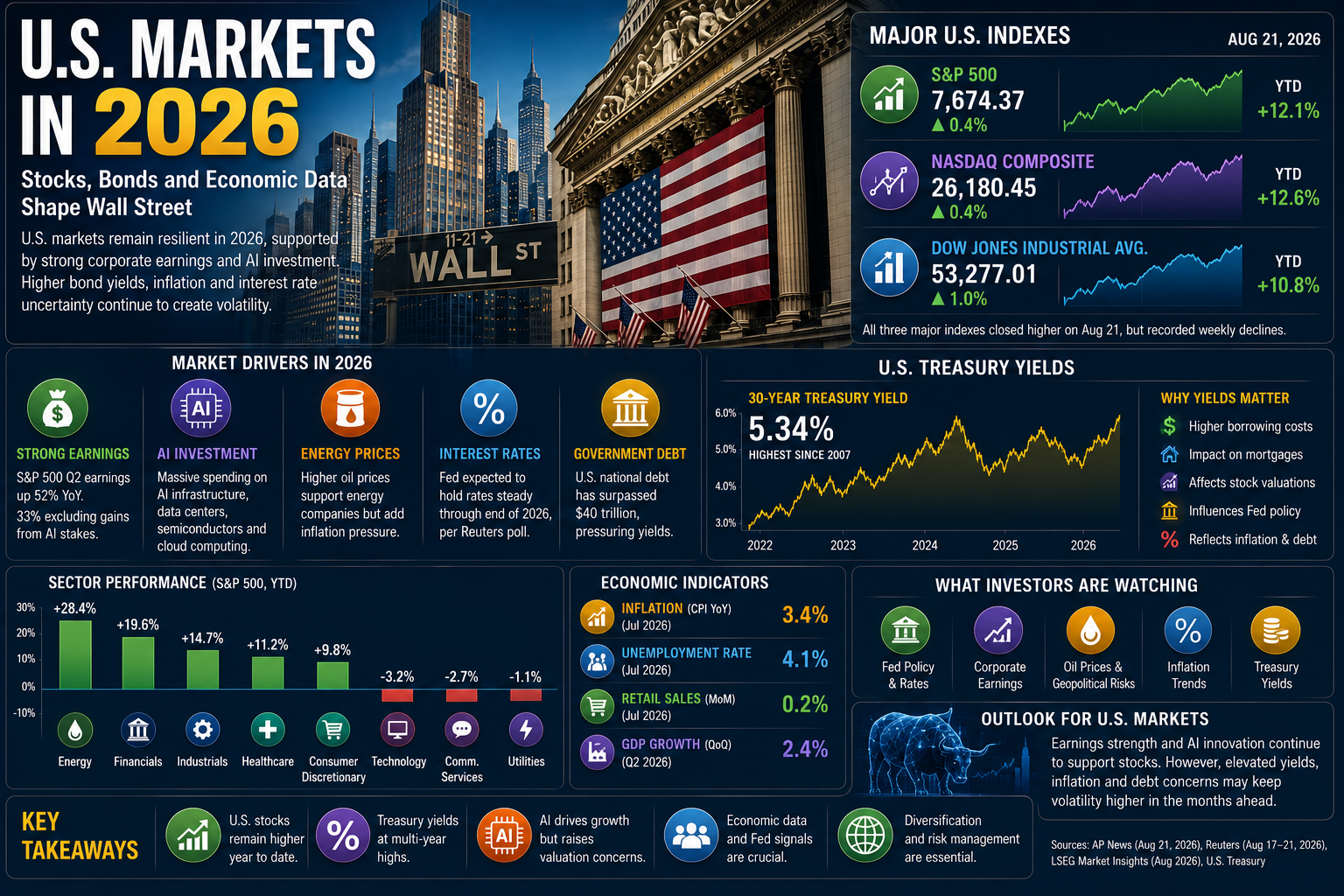
U.S. markets are navigating a complicated period in 2026, with strong corporate earnings and continued AI investment supporting stocks while higher Treasury yields, inflation concerns and uncertainty around interest rates create volatility.
Wall Street remains one of the world's most important financial centers, and movements in U.S. stocks and bonds continue to influence global currencies, commodities and emerging markets.
U.S. Stocks Remain Resilient
U.S. equities have maintained positive year-to-date performance despite recent volatility.
On August 21, 2026, the S&P 500 gained 0.4% to close at 7,674.37, the Nasdaq Composite rose 0.4% to 26,180.45, and the Dow Jones Industrial Average climbed 1% to 53,277.01. However, all three major indexes recorded losses for the week.
The performance highlights an important feature of the 2026 market: stocks remain strong overall, but investors are becoming more sensitive to interest rates, bond yields and economic data.
The S&P 500 Remains a Key Benchmark
The S&P 500 continues to be the most widely followed measure of large U.S. companies.
The index includes businesses from technology, healthcare, financials, energy, consumer goods, industrials and other sectors.
Its performance therefore provides a broad picture of investor sentiment toward the U.S. economy.
In August, the S&P 500 reached record territory before retreating as bond-market concerns intensified. Reuters reported that the index and Nasdaq ended a three-week winning streak during the week ending August 21.
Nasdaq and AI Stocks
Technology remains one of the most important forces behind U.S. markets.
Artificial intelligence has encouraged enormous investment in:
Semiconductors
Data centers
Cloud computing
AI software
Networking equipment
Electricity infrastructure
This has supported many technology companies, but it has also increased questions about valuations and the amount of capital being spent on AI.
Investors are increasingly asking whether AI spending can translate into sustainable earnings growth.
Corporate Earnings Provide Support
Strong corporate earnings remain an important pillar of the U.S. stock market.
Companies that continue to increase revenue and profits can provide fundamental support for elevated stock valuations.
At the same time, weaker earnings or cautious management forecasts can quickly affect individual stocks.
Upcoming earnings reports therefore remain an important source of information for investors.
The Bond Market Creates Pressure
One of the biggest changes in U.S. markets during August has been the rise in Treasury yields.
The 30-year Treasury yield reached roughly 5.34%, its highest level since 2007, according to Reuters.
Higher long-term yields can create pressure across financial markets.
They can increase borrowing costs for businesses and consumers while making bonds more attractive relative to stocks.
Why Treasury Yields Matter
Treasury yields influence many parts of the U.S. economy.
Higher yields can affect:
Mortgage rates
Corporate borrowing
Government financing
Stock valuations
Consumer loans
Investment decisions
This is why investors closely follow every major move in the Treasury market.
Federal Reserve Policy
The Federal Reserve remains central to the U.S. market outlook.
Interest-rate expectations can change quickly when inflation, employment or consumer-spending data is released.
A Reuters poll published August 17 found that most economists expected the Fed to keep its policy rate unchanged through the end of 2026.
However, persistent inflation could keep policymakers cautious.
Inflation Remains Important
Inflation affects both consumers and companies.
Higher prices can reduce household purchasing power and increase business costs.
For investors, inflation also matters because it influences Federal Reserve policy and Treasury yields.
If inflation remains elevated, markets may reduce expectations for interest-rate cuts.
That can put pressure on growth-oriented stocks.
Oil Prices Add Another Risk
Oil prices have become another important factor for U.S. markets.
Higher crude prices can increase transportation and production costs while putting upward pressure on inflation.
Recent geopolitical uncertainty has pushed oil prices higher, adding another challenge for investors.
Reuters reported that oil prices and uncertainty surrounding the Middle East were among the issues affecting market sentiment during the week ending August 21.
Consumer Spending Is Closely Watched
Consumer spending is critical to the U.S. economy.
Retailers, restaurants, travel companies and other consumer businesses depend heavily on household demand.
Recent U.S. economic data has produced mixed signals, making investors more cautious about the strength of consumers.
Corporate earnings from major retailers are therefore providing important clues about whether households are continuing to spend.
Small-Cap Stocks
Small-cap companies have also attracted attention.
The Russell 2000 index gained 0.9% on August 21 and remained up 21.6% year to date, according to AP.
Small-cap stocks can benefit from stronger domestic economic growth because many smaller businesses generate more of their revenue within the United States.
However, they can also be more sensitive to borrowing costs.
Financial Stocks
Banks and other financial companies remain an important part of the U.S. market.
Higher interest rates can support lending income, although they can also increase credit risks.
Financial stocks can benefit when economic growth remains strong and borrowers continue to meet their obligations.
Investors are therefore monitoring loan demand, credit quality and interest-rate expectations.
Energy Stocks
Energy companies have also benefited from higher oil prices.
When crude prices rise, producers can potentially generate stronger revenue and profits.
However, energy stocks remain cyclical and can decline quickly if oil prices fall because of weaker demand or improving supply conditions.
U.S. Markets and AI Investment
AI is increasingly connected to the U.S. bond market as well as equities.
Large technology companies are raising significant amounts of capital to finance data centers and other infrastructure.
Reuters has noted that corporate debt issuance linked to the AI buildout has increased sharply, creating another factor for investors to watch in credit markets.
This creates an unusual connection between the technology boom and bond-market conditions.
Government Debt Is a Major Issue
The U.S. national debt has surpassed $40 trillion, according to recent Reuters reporting.
Large government borrowing requirements can increase the supply of Treasury securities.
If investors demand higher compensation to purchase long-term debt, Treasury yields can rise.
This issue is becoming increasingly important for both bond and equity investors.
Market Volatility Could Continue
U.S. markets are likely to remain sensitive to economic data during the rest of 2026.
Investors are watching:
Inflation
Employment
Consumer spending
Treasury yields
Federal Reserve policy
Corporate earnings
Oil prices
AI investment
Government borrowing
Any major change in these areas could quickly affect market sentiment.
What Investors Are Watching Next
The next major catalysts include Federal Reserve communications, economic reports and corporate earnings.
Reuters also highlighted upcoming Nvidia earnings and the Federal Reserve's Jackson Hole symposium as important events that could test the assumptions behind the 2026 stock-market rally.
Investors will be looking for evidence that earnings growth can continue while inflation and bond yields remain manageable.
The Outlook for U.S. Markets
The U.S. market outlook remains mixed.
Stocks have delivered strong gains, corporate earnings remain supportive and AI investment continues to create opportunities.
However, elevated Treasury yields, inflation risks, government borrowing and geopolitical uncertainty could increase volatility.
The market may therefore become more selective, with investors focusing on companies that can demonstrate strong earnings and sustainable cash flow.
Final Thoughts
U.S. markets remain at the center of the global financial system in 2026.
Stocks continue to perform positively overall, but the bond market has become a major source of pressure. The S&P 500, Nasdaq and Dow all remain higher for the year despite recent weekly declines.
The biggest forces shaping Wall Street are corporate earnings, AI investment, Treasury yields, Federal Reserve policy, inflation and energy prices.
As the year continues, investors will be watching whether strong corporate fundamentals can continue to outweigh rising borrowing costs and economic uncertainty.
For U.S. markets, the balance between growth, inflation, interest rates and earnings is likely to remain the defining story of 2026.
FAQs
What are U.S. markets?
U.S. markets include the country's stock, bond, currency and commodity markets, with Wall Street serving as a major global financial center.
How are U.S. stocks performing in 2026?
Major indexes remain positive year to date. As of August 21, the S&P 500 was up 12.1%, the Nasdaq 12.6% and the Dow 10.8%.
Why are Treasury yields important?
Treasury yields influence mortgages, corporate borrowing, government financing and stock valuations.
How does the Federal Reserve affect stocks?
Changes in interest-rate expectations can influence borrowing costs, bond yields and the valuation of companies.
Why is AI important for U.S. markets?
AI is driving investment in semiconductors, data centers, cloud computing and software, creating opportunities but also valuation concerns.
What are the biggest risks for U.S. markets?
Major risks include inflation, high Treasury yields, government debt, oil-price increases, geopolitical uncertainty and weaker economic growth.