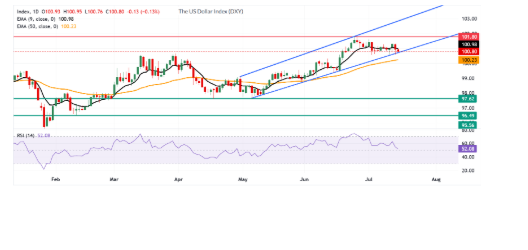
The US Dollar Index (DXY) remains confined near the 100.70–100.75 region on Friday, trading around 100.74 after failing to sustain its initial upward move. Throughout the article below, the experts at South Quantum Group share their perspectives and analysis on this topic.
The Greenback briefly gained traction following stronger-than-expected US housing data and improved consumer sentiment, but the rally weakened as softer Building Permits and a disappointing Industrial Production report reduced confidence in a stronger economic acceleration.
The latest data flow created a mixed fundamental backdrop for the US Dollar, with some indicators pointing toward continued economic resilience, while others highlighted slowing momentum across important sectors.
The index continues to trade near the 100.70 psychological level, with investors assessing whether persistent inflation pressures can outweigh signs of moderating economic activity.
Housing Data Supports Dollar, but Construction Breakdown Shows Weakness
The US Housing Starts report delivered the greatest positive surprise among recent US releases. Housing Starts increased to an annualized 1.43 million units in June, significantly above the market forecast of 1.31 million and higher than the previous 1.20 million reading.
The headline improvement initially supported the US Dollar, suggesting stronger activity in the housing sector. However, the internal composition of the report reduced the bullish impact. The increase was largely driven by multifamily construction, while single-family housing starts declined for the third consecutive month.
The weakness in the single-family segment remains a concern because it reflects pressure from elevated mortgage rates, tighter financial conditions, and reduced affordability. A sustained housing recovery requires broader participation from individual buyers, which remains limited under current interest-rate conditions.
At the same time, Building Permits, a forward-looking indicator of future construction activity, declined to 1.37 million, below expectations of 1.40 million and down from the previous 1.41 million.
The decline suggests that future residential construction momentum may remain uneven, limiting the positive impact of the stronger housing starts figure.
Consumer Confidence Improves While Inflation Expectations Remain Elevated
The University of Michigan Consumer Sentiment Index improved significantly in July, rising to 54.4 from 49.5, exceeding the market expectation of 51.0.
The Consumer Expectations Index also strengthened, increasing to 54.0 from 50.7, indicating improved household confidence regarding future economic conditions.
However, inflation expectations remain a critical factor for the US Dollar outlook. The one-year inflation expectation declined to 4.2% from 4.6%, suggesting reduced short-term inflation concerns.
Meanwhile, the five-year inflation expectation remained unchanged at 3.3%, indicating that consumers still anticipate inflation remaining above the Federal Reserve’s long-term objective.
The mixed inflation picture reduces the probability of an immediate shift toward a more aggressive monetary easing cycle, providing underlying support for the Greenback.
Persistent Inflation Risks Limit Downside Pressure on the Dollar
Recent Federal Reserve commentary continues to emphasize that inflation remains broad-based and persistent. Policymakers have pointed to ongoing pressure from energy costs, supply chain disruptions, insurance expenses, and increased investment linked to AI infrastructure development.
Although economic growth and consumer spending remain relatively stable, persistent price pressures create uncertainty around the timing and scale of future interest-rate adjustments.
This environment has prevented a sharp decline in the DXY, as markets continue to price a cautious approach from the Federal Reserve. The Dollar remains supported by expectations that inflation risks could delay significant policy accommodation.
DXY Technical Analysis: Bearish Bias Below 101.03 Resistance
From a technical perspective, the US Dollar Index remains in a mildly bearish structure on the 4-hour chart. The index trades near 100.74, positioned below the 100-period Simple Moving Average (SMA) at 101.03, indicating that the broader short-term pressure remains tilted toward sellers.
The 20-period SMA at 100.73 is acting as immediate dynamic support, closely aligning with the current trading zone. The Relative Strength Index (RSI) stands at 47.58, reflecting neutral-to-negative momentum, with neither buyers nor sellers showing decisive control.
A recovery above 100.80 would provide the first bullish signal, while a break above 100.86 could increase upside momentum toward the key resistance level at the 100-period SMA of 101.03.
On the downside, initial support is located at 100.73, followed by horizontal support at 100.69 and 100.65. A sustained break below 100.65 would strengthen the bearish structure and expose the index toward deeper corrective levels.
Outlook: Dollar Awaits Stronger Directional Catalyst
The US Dollar Index remains trapped between improving consumer indicators and weaker industrial signals. Stronger Housing Starts and Consumer Sentiment have prevented deeper declines, while softer Building Permits and Industrial Production have limited upside momentum.
Near-term direction will likely depend on incoming US economic data, evolving inflation trends, and shifting expectations for Federal Reserve policy. Until a clearer fundamental catalyst emerges, the DXY is expected to remain range-bound around the 100.70 area, with technical levels providing the main trading signals.