Wealth is changing rapidly in 2026 as investors navigate higher market volatility, technological innovation, private markets and shifting economic conditions. The modern wealth-management landscape is increasingly focused not only on growing assets, but also on diversification, tax efficiency, long-term planning and protecting wealth across generations.
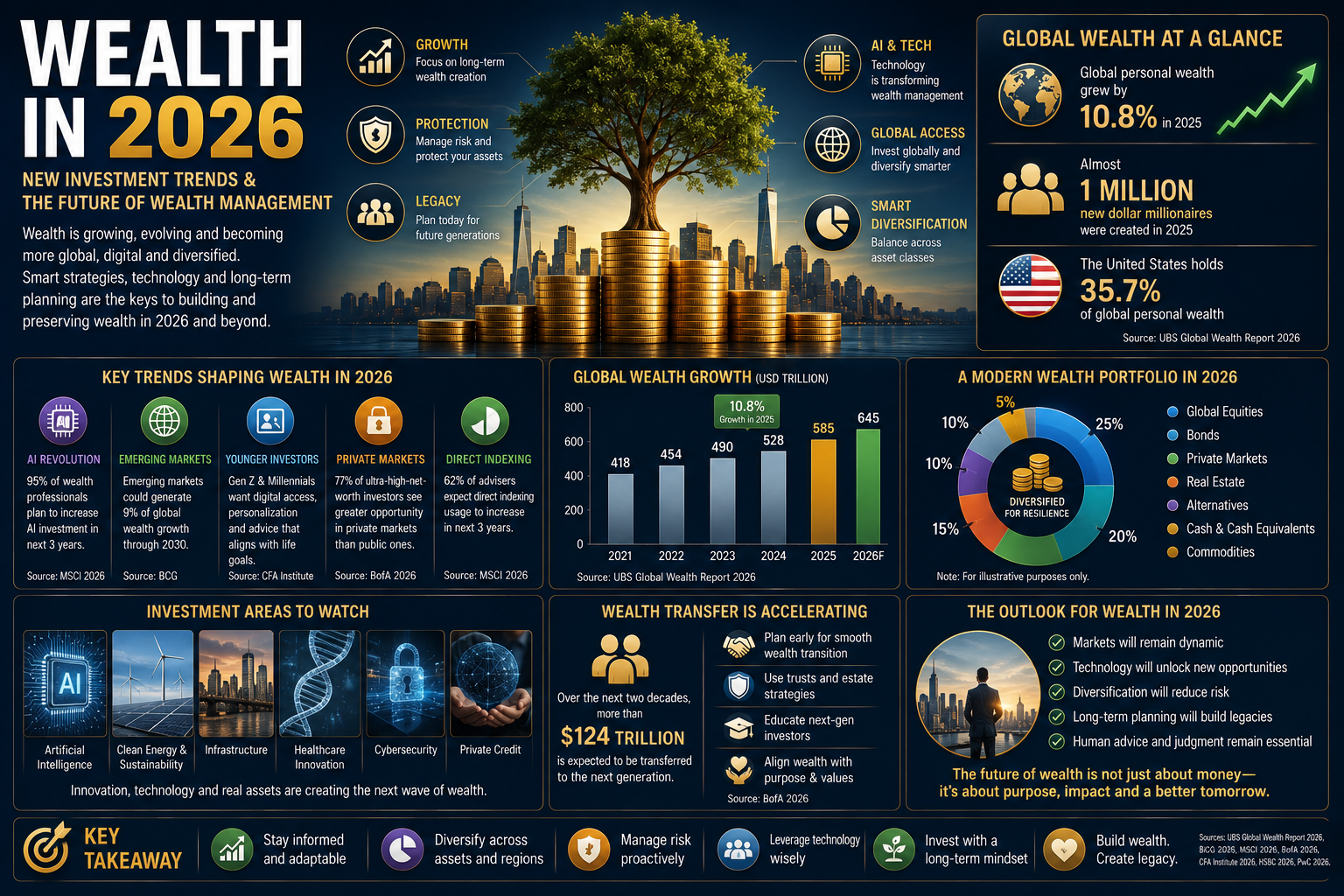
According to the UBS Global Wealth Report 2026, global personal wealth increased by 10.8% in 2025, while almost one million new dollar millionaires were created worldwide. The report also found that the United States holds about 35.7% of global personal wealth.
Wealth Management Is Changing
Traditional wealth management was largely focused on investment portfolios, retirement planning and asset allocation.
Today, wealthy investors increasingly expect a broader range of services, including:
Investment management
Tax planning
Estate planning
Private-market access
Risk management
Digital financial tools
Philanthropic planning
Intergenerational wealth transfer
The emphasis is shifting from simply maximizing returns toward building resilient financial strategies that can withstand changing market conditions.
Global Wealth Continues to Expand
Global wealth has continued to increase despite economic and geopolitical uncertainty.
UBS reported that personal wealth grew strongly in 2025, with the number of dollar millionaires increasing by nearly one million. The United States accounted for almost half of the new millionaire growth.
This expansion is also changing the geographical distribution of wealth.
Emerging markets are becoming increasingly important, with countries across Asia and other developing regions producing new affluent households and entrepreneurs.
Emerging Markets Could Drive New Wealth
The next generation of wealth is not expected to come only from traditional financial centers.
Boston Consulting Group estimates that emerging markets could generate roughly 9% of global wealth growth through 2030, with more than one million new dollar millionaires emerging.
Countries experiencing rapid economic development, technology adoption and rising household incomes could become increasingly important to global wealth managers.
This creates opportunities for financial institutions that can provide investment and planning services tailored to younger and newly wealthy clients.
AI Is Transforming Wealth Management
Artificial intelligence has become one of the biggest developments in financial services.
Wealth managers are using AI to help with:
Portfolio analysis
Market research
Client communication
Financial planning
Risk assessment
Administrative tasks
Data analysis
MSCI's 2026 Wealth Trends research found that 95% of surveyed wealth-management professionals expect to increase AI investment over the next three years.
AI can make financial services faster and more personalized, but human judgment remains important for complex financial decisions.
Younger Investors Want Digital Access
Younger wealthy investors are changing expectations around financial advice.
Research from CFA Institute found that Gen Z and millennial affluent and high-net-worth investors want real-time information, digital engagement, personalization and advice that connects investments with broader life goals.
More than 90% of the young wealthy investors surveyed reported using some form of paid financial advice.
This suggests that younger investors are not rejecting professional advice—they are demanding a more technology-enabled version of it.
Human Advice Still Matters
Despite the rise of AI, professional financial advisers remain important.
HSBC's 2026 research found that 73% of affluent and high-net-worth investors surveyed use AI in finance and investment, but only 12% said AI was the most influential factor in their most recent investment decision.
This suggests that investors may use AI to research and understand opportunities while still relying on human professionals for major decisions.
The future of wealth management may therefore be a combination of technology and human expertise.
Private Markets Gain Attention
Private equity, private credit, infrastructure and other private-market investments are becoming increasingly important to wealthy investors.
These investments can provide access to companies and assets that are not available through public stock exchanges.
A Bank of America study found that 77% of ultra-high-net-worth respondents believed private markets offered greater investment opportunities than public markets.
However, private investments can involve longer holding periods, limited liquidity and greater complexity.
Diversification Becomes More Important
Market uncertainty is encouraging investors to diversify across countries and asset classes.
MSCI's 2026 research found that 61% of surveyed advisers planned to increase allocations to developed markets outside the United States.
A diversified wealth strategy can include:
U.S. stocks
International equities
Bonds
Real estate
Private markets
Commodities
Cash
Alternative investments
The objective is to avoid relying too heavily on one market or asset class.
Direct Indexing Is Growing
Direct indexing is another strategy gaining attention among wealthy investors.
Instead of buying a traditional pooled fund, investors can own individual securities that replicate an index while allowing greater customization.
Potential benefits include:
Tax-loss harvesting
Portfolio customization
Greater control
Excluding specific companies
Aligning investments with personal preferences
MSCI reports that around 62% of advisers expect direct-indexing usage to increase over the next three years.
Wealth Transfer Is Becoming a Major Issue
One of the biggest long-term trends is the transfer of wealth between generations.
As older generations pass assets to younger family members, families need to consider:
Estate planning
Inheritance
Business succession
Tax planning
Trust structures
Family governance
Investment education
Longer life expectancy is also changing financial planning.
Bank of America found that more than 90% of respondents in its 2026 study identified longevity as an important factor in financial planning.
Family Offices Expand Their Role
Family offices manage the financial affairs of wealthy families and can coordinate investments, tax planning, estate strategies and other services.
Their investment strategies are also changing.
UBS reported that 65% of family offices surveyed were already invested across the AI value chain, including data-center infrastructure, software and semiconductor companies.
Family offices are also looking at infrastructure, energy resources and AI-enabled healthcare.
AI Is Creating New Wealth
Artificial intelligence is not only changing wealth management—it is also creating new sources of wealth.
Technology entrepreneurs, early employees and investors connected to successful AI companies have benefited from the rapid expansion of the sector.
This is contributing to a new generation of wealthy investors who may have different attitudes toward technology, digital assets and alternative investments.
The trend is also influencing luxury markets and entrepreneurial activity.
Private Markets Could Become Even Larger
The growth of private markets could continue over the coming years.
PwC projects global assets under management could rise from $139 trillion in 2024 to $200 trillion by 2030, while private markets could account for more than half of asset-management industry revenues by 2030.
This would make private investments increasingly important to the broader wealth-management industry.
Wealth Preservation vs. Wealth Growth
For many wealthy investors, the objective changes once substantial assets have been accumulated.
Instead of focusing entirely on maximum growth, investors may prioritize:
Capital preservation: Protecting existing wealth.
Income: Generating reliable cash flow.
Diversification: Reducing dependence on one asset.
Tax efficiency: Managing tax exposure.
Legacy planning: Preparing assets for future generations.
Risk management: Protecting against major financial shocks.
This is why wealth management often involves a broader strategy than simply choosing investments.
The Importance of Financial Education
Technology has made financial information easier to access.
Investors can now use online platforms, financial apps and AI tools to research markets and learn about investments.
However, easy access to information can also increase the risk of emotional decision-making.
Young investors, in particular, may be exposed to market trends through social media and online communities.
Professional advice and financial education can help investors distinguish between long-term strategies and short-term market speculation.
What Wealth Managers Are Watching
Several themes are likely to shape wealth management during the remainder of 2026:
Artificial Intelligence
AI is changing both investment opportunities and financial-advisory services.
Private Markets
Private equity, private credit and infrastructure are becoming increasingly important.
Global Diversification
Investors are looking beyond concentrated domestic portfolios.
Wealth Transfer
Families are preparing for the movement of assets between generations.
Personalization
Clients increasingly expect portfolios tailored to their goals and circumstances.
Digital Finance
Technology is making wealth-management services more accessible and efficient.
The Future of Wealth
The future of wealth management will likely combine technology, personalization and human expertise.
AI can analyze huge amounts of information and automate routine tasks, while financial professionals can provide judgment during complex decisions.
At the same time, investors are gaining access to a wider range of assets than ever before.
The challenge is deciding which opportunities actually fit a long-term financial plan.
Final Thoughts
Wealth in 2026 is about more than simply accumulating money.
Global personal wealth continues to grow, while emerging markets are producing new affluent households and younger investors are demanding more digital and personalized financial services.
AI, private markets, direct indexing and global diversification are becoming increasingly important parts of the wealth-management landscape.
At the same time, traditional principles such as diversification, risk management, financial planning and long-term thinking remain essential.
The future of wealth will likely belong to investors and advisers who can combine technology with disciplined decision-making while preparing for changing markets and the next generation of wealth.
FAQs
What does wealth management include?
Wealth management can include investment management, financial planning, tax strategies, estate planning, risk management and succession planning.
Why is AI important to wealth management?
AI can help analyze data, automate tasks, personalize financial services and support investment research.
Are private markets becoming more popular?
Yes. Wealthy investors are increasingly considering private equity, private credit, infrastructure and other alternative investments.
Why is global diversification important?
Diversification across countries and asset classes can reduce dependence on a single market and potentially improve portfolio resilience.
What is direct indexing?
Direct indexing involves owning individual securities designed to replicate an index while allowing investors greater portfolio customization.
Are younger investors using financial advisers?
Yes. CFA Institute research shows strong demand for professional advice among younger affluent and high-net-worth investors.
What is the biggest wealth trend in 2026?
AI, private markets, global diversification, personalization and intergenerational wealth transfer are among the major trends shaping wealth management.