
The NZD/USD currency pair is attempting to maintain a modest recovery bias above the 0.5600 psychological level, as broader FX markets position cautiously ahead of the upcoming US Non-Farm Payrolls (NFP) release. Throughout this article, the brokers at Aicanx break down this topic and its key implications.
Despite intermittent buying interest, the pair remains structurally fragile, reflecting continued pressure across Antipodean currencies, including the Australian Dollar (AUD) and the New Zealand Dollar (NZD), both of which are sensitive to shifts in global risk sentiment and interest rate expectations.
At the same time, the US Dollar (USD) is showing mild weakness, allowing NZD/USD to stabilize after recent downside extensions. However, upside momentum remains limited as traders balance dovish domestic monetary expectations in Australasia with a still-resilient US macroeconomic backdrop.
Antipodean Weakness and RBA Spillover Effects
Broader weakness in the Antipodean complex continues to weigh indirectly on the NZD, as markets increasingly price in a more dovish Reserve Bank of Australia (RBA) outlook, which often correlates with expectations for the Reserve Bank of New Zealand (RBNZ) policy path.
The Australian Dollar (AUD) has recently underperformed, trading lower against the USD and dragging sentiment across regional currencies. Market participants are increasingly convinced that the RBA’s next monetary policy move could lean toward the downside, reflecting cooling inflation dynamics.
A key driver of this sentiment shift has been the latest inflation data, where Australian headline CPI eased to 4.0% YoY in May, down from 4.2% in April. This deceleration reinforces the narrative that inflationary pressures are gradually normalizing, reducing the urgency for further tightening.
US Dollar Dynamics and Fed Expectations
On the other side of the pair, the US Dollar Index (DXY) has eased slightly, trading around 101.30, reflecting a modest 0.12% decline. This softening provides temporary relief for NZD/USD bulls.
A key factor behind USD weakness is the ongoing reassessment of Federal Reserve (Fed) policy expectations. Market pricing, tracked by the CME FedWatch Tool, shows that the probability of the Fed delivering at least two additional interest rate hikes has dropped to approximately 41.7%, down from 50.2% just a week earlier.
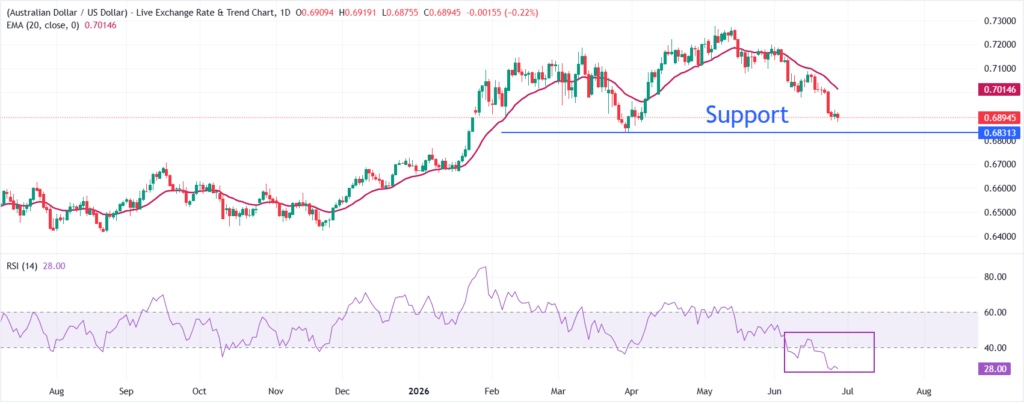
This shift suggests traders are gradually reducing their hawkish bias, anticipating that the Fed may be closer to the end of its tightening cycle than previously thought. However, uncertainty remains elevated ahead of the US NFP report, which could significantly reshape expectations around inflation resilience, wage growth, and labor market tightness.
Stronger-than-expected employment data would likely revive USD demand, while weaker figures could extend the current corrective pullback in the greenback.
NZD/USD Technical Outlook
From a technical perspective, the NZD/USD pair is attempting to stabilize after recent declines, trading near 0.5620–0.5650, with price action still anchored close to the 0.5600 support zone.
The pair remains positioned below its key short-term trend indicator, with the 20-period Exponential Moving Average (EMA) sitting near 0.5720, acting as a significant dynamic resistance level. This configuration confirms that the broader short-term trend bias remains bearish, despite the ongoing corrective bounce.
Momentum indicators, however, suggest early signs of exhaustion in downside pressure. The Relative Strength Index (RSI) is hovering near 30, signaling oversold conditions. While this does not guarantee reversal, it does indicate that bearish momentum is becoming stretched and vulnerable to consolidation or rebound attempts.
On the upside, immediate resistance is seen at 0.5680, followed by the more critical 0.5720 EMA barrier. A sustained break and daily close above this zone would be required to confirm a bullish corrective phase, potentially opening the door toward 0.5780 in the short term.
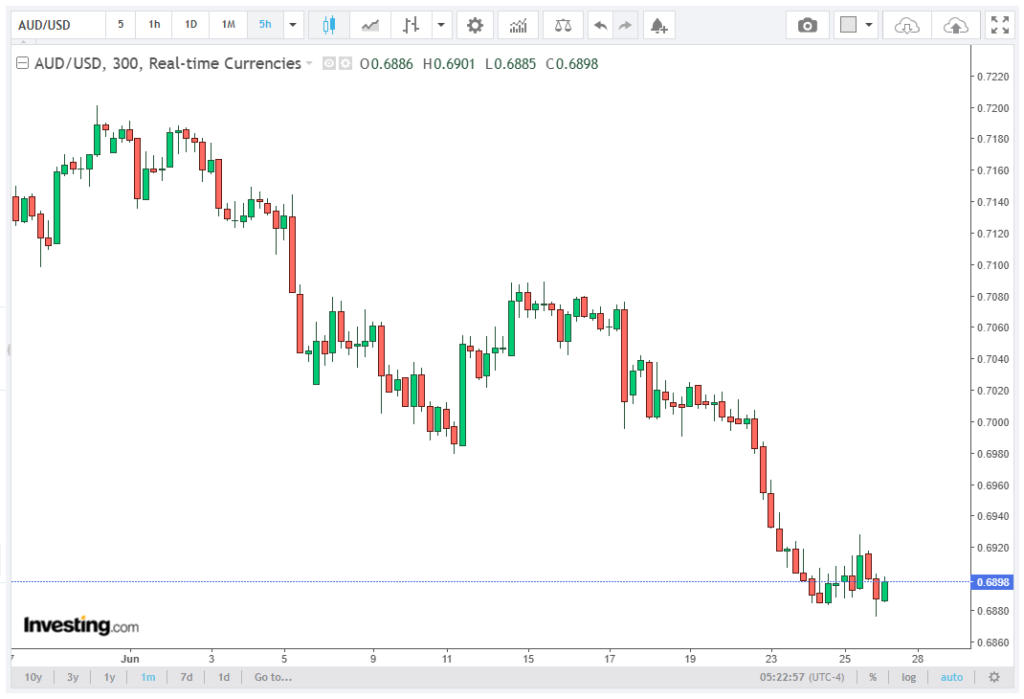
On the downside, failure to hold the 0.5600 psychological support would expose the pair to deeper losses toward 0.5550, with a more extended bearish scenario targeting the 0.5500 handle, a level closely watched by medium-term traders.
Short-Term Forecast and Market Outlook
In the near term, the NZD/USD forecast remains cautiously neutral with a slight recovery bias, provided that the pair holds above the critical 0.5600 support level. However, upside attempts are expected to remain limited and corrective in nature unless supported by a meaningful deterioration in US labor market data.
The upcoming US Non-Farm Payrolls (NFP) report is likely to serve as the primary catalyst. A strong print would reinforce USD strength, potentially pushing NZD/USD back toward recent lows. Conversely, a softer employment reading could extend the ongoing recovery phase, allowing the pair to test higher resistance levels near the 20-EMA zone.
Overall, the market environment reflects a delicate balance between dovish Antipodean monetary expectations, shifting Fed policy sentiment, and key US macroeconomic data risk, leaving NZD/USD confined to a technically driven consolidation phase rather than a decisive trend reversal.


