
The EUR/GBP exchange rate is trading near 0.8615, reflecting a phase of compressed consolidation following a weekly decline of roughly 0.5%. Price action remains tightly coiled between 0.8600 and 0.8650, with repeated intraday failures to establish sustained traction above short-term resistance levels.
The rebound from 0.8600 has introduced early signs of a possible technical base formation, but confirmation is not yet present. The broader structure still reflects a neutral-to-mildly bearish regime, with momentum constrained by overlapping macro and technical forces.
Volatility continues to contract, as indicated by a declining 14-period ATR, reinforcing the absence of a directional breakout. In this article, the brokers at Aicanx provide a detailed examination of this topic.
Macro Drivers: Offset Between External Relief and Domestic Weakness
The Euro (EUR) is getting partial support from a 6–8% decline in Oil prices from recent geopolitical highs. Lower energy costs ease inflation pressures and improve external balances in the Eurozone, especially for energy-importing economies, supporting terms of trade.
However, this is offset by weak German data, with business and consumer sentiment below short-term averages, signalling softer growth momentum and limiting upside beyond technical levels.
The British Pound (GBP) remains constrained by political uncertainty around the leadership transition. Initial intraday gains of 0.2–0.4% faded, while short-dated implied volatility near 6.5–7.2% annualised reflects ongoing uncertainty and limited directional conviction across major pairs.
Momentum Conditions: Weak but Stabilizing Signals
Short-term momentum indicators reflect a market in transition rather than trend continuation. The 4-hour RSI (14) is positioned near 40–42, suggesting weak momentum but not oversold conditions. This typically corresponds to late-stage corrective phases or early basing structures rather than active downtrends.
The MACD histogram has turned marginally positive, with readings around +0.001, indicating a reduction in bearish pressure. However, the signal line remains flat, meaning that while downside momentum is fading, bullish confirmation has not yet developed.
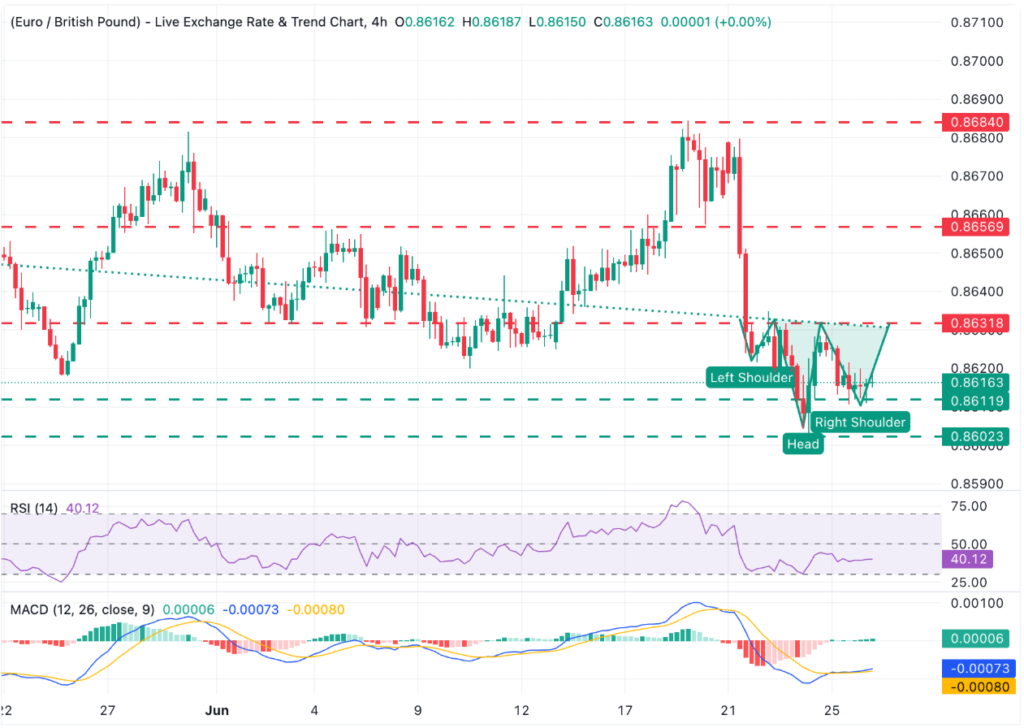
Price is also trading slightly below the 20-period EMA near 0.8620, while the 50-period EMA near 0.8630 continues to act as dynamic resistance, reinforcing a neutral-to-bearish technical bias.
Structural Formation: Reverse Head & Shoulders in Development
Price action on lower timeframes is forming a potential reverse Head & Shoulders structure, with repeated higher lows emerging from the 0.8600 base region. This suggests gradual absorption of sell-side liquidity at lower levels. However, the pattern remains incomplete until neckline resistance is broken and retested.
The key structural resistance is located at 0.8635, where multiple rejection wicks have formed. This level represents the neckline of the emerging pattern and serves as the critical trigger for bullish continuation.
A confirmed break and sustained hold above this zone would validate the formation and open measured upside potential toward the 0.8655–0.8665 region, which aligns with previous short-term supply clusters and prior swing lows.
Key Technical Levels and Market Equilibrium
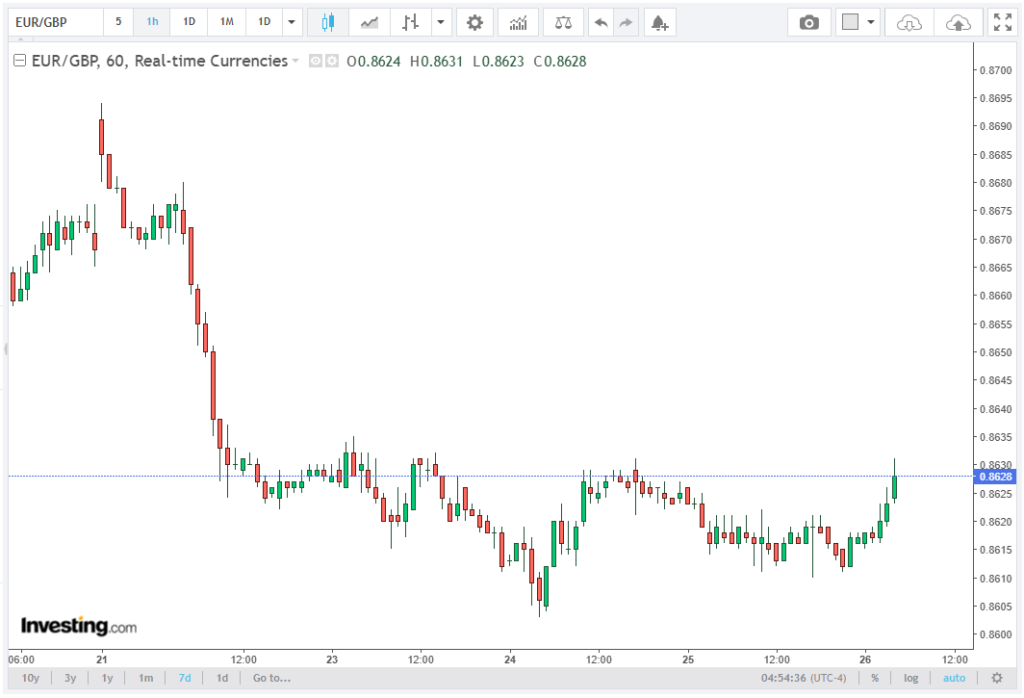
Immediate support is concentrated at 0.8610, which acts as the intraday equilibrium zone where short-term liquidity is repeatedly balanced. Below this, the structural floor remains at 0.8600, a psychologically important level that has repeatedly attracted dip-buying interest.
A decisive break below this threshold would shift market structure back into bearish continuation mode, exposing downside targets near 0.8550, followed by a deeper structural demand zone around 0.8510, which corresponds to prior multi-week lows and historical reaction areas.
On the upside, resistance is layered but increasingly defined. The first barrier sits near 0.8625, where intraday moving averages converge. Above this, the decisive level remains 0.8635, which functions as both neckline resistance and breakout trigger.
A sustained move above this level would represent a structural shift in short-term trend dynamics. Beyond that, the 0.8657 area represents the next liquidity pocket, derived from previous swing positioning and historical price reaction zones.
Outlook: Range Compression Ahead of Directional Breakout
The broader EUR/GBP outlook remains defined by a technical compression structure. The Euro benefits from external relief through lower energy prices, but remains constrained by weak German growth signals. Meanwhile, the Pound is held back by political uncertainty that limits sustained directional strength.
As a result, EUR/GBP remains locked in a tightening equilibrium between 0.8600 and 0.8650, with price action coiling beneath key resistance at 0.8635.
A confirmed breakout above this level would activate the emerging reverse Head & Shoulders formation, shifting momentum toward 0.8655 and higher. Conversely, a break below 0.8600 would invalidate the bullish structure and reintroduce downside risk toward 0.8510.
Until one of these thresholds is decisively breached, the market is likely to remain in a compressed consolidation regime, with volatility expansion expected once structural resolution occurs.


