
Global equity markets came under significant pressure this week as investors reassessed the outlook for U.S. interest rates, triggering a broad selloff in technology stocks and erasing hundreds of billions of dollars in market value. Although corporate earnings have generally remained resilient, expectations of tighter Federal Reserve policy have become the primary driver of investor sentiment, overshadowing company-specific fundamentals.
As markets adjust to the prospect of higher borrowing costs, volatility has increased across risk assets. In this analysis, Aicanx‘s economic research team explores the forces behind the selloff and the key economic signals investors should watch next.
Rising Rate Expectations Change the Market Narrative
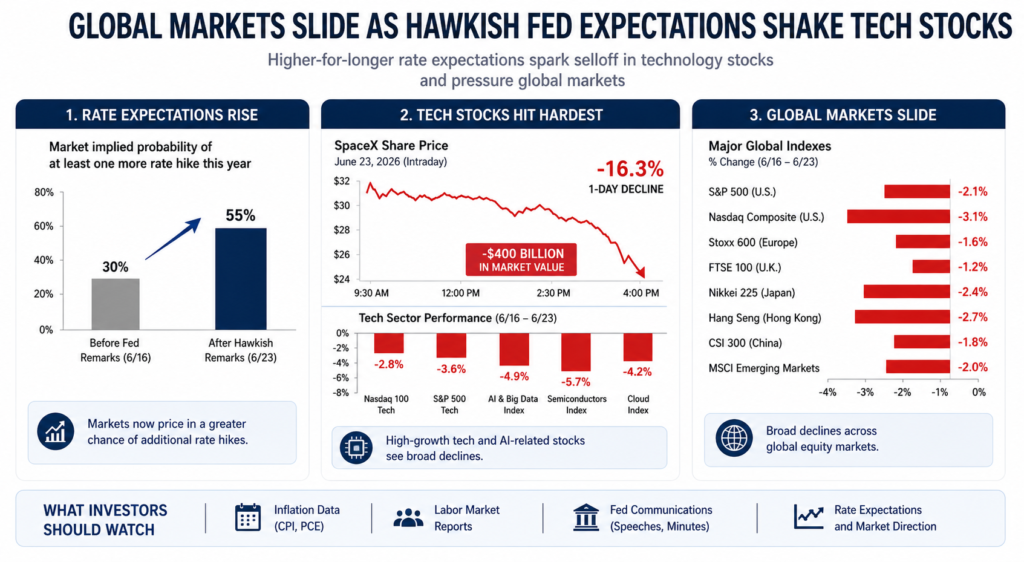
The latest wave of selling was driven primarily by expectations that the Federal Reserve will keep interest rates higher for longer than previously anticipated. Investors were caught off guard after Fed Chair Kevin Warsh delivered a more hawkish message, prompting markets to price in a greater likelihood of additional rate hikes later this year.
Higher interest rates pose a significant challenge for growth-oriented technology companies, whose valuations depend heavily on future earnings. As borrowing costs rise, the present value of those future cash flows declines while financing expansion becomes more expensive.
As a result, investors rotated out of high-growth technology stocks, triggering broad declines across global equity markets.
Technology Stocks Bear the Brunt
Technology shares experienced the sharpest selling pressure as investors questioned whether current valuations remain justified in a higher-rate environment.
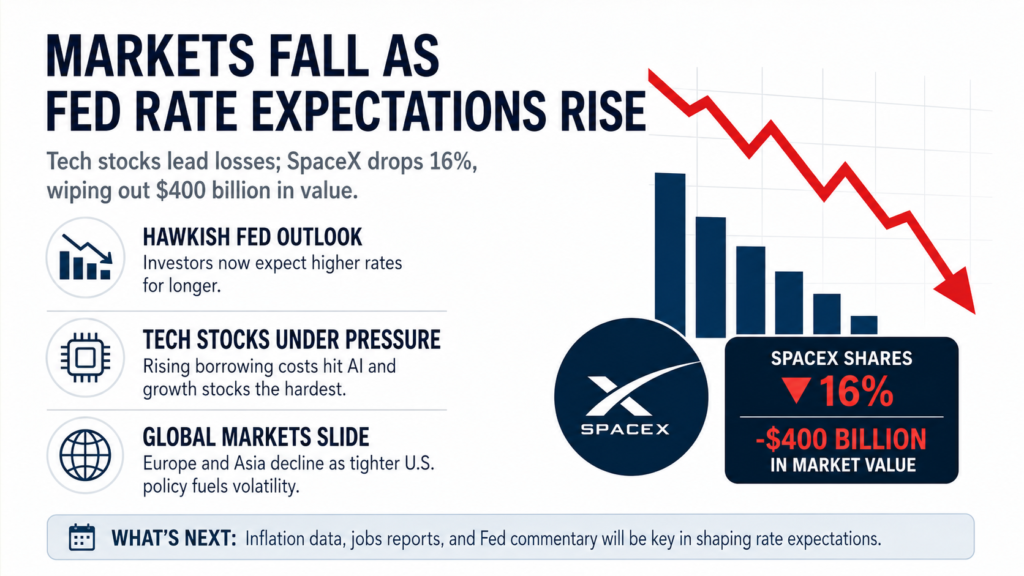
One of the biggest casualties was SpaceX, whose shares fell more than 16% in a single session, erasing approximately $400 billion in market value. Despite the sharp decline, the stock continued trading above its historic IPO price, highlighting both the extraordinary rally that preceded the correction and the volatility typically associated with newly listed growth companies.
The broader weakness extended well beyond one company as investors reduced exposure to AI-related stocks and other high-multiple technology businesses.
Higher Borrowing Costs Threaten AI Investment
AI-driven expansion. Over the past year, major cloud providers have committed billions of dollars to building new data centers, expanding networking infrastructure, and deploying advanced semiconductor technologies to meet the growing demand for artificial intelligence services. Much of this investment relies on debt financing, making the sector particularly sensitive to changes in interest rates.
According to Barclays, hyperscale technology companies are expected to issue approximately $200 billion in new debt this year to fund AI-related capital expenditures. While these investments are considered essential for long-term competitiveness, rising borrowing costs could significantly increase financing expenses and reduce expected returns on future projects.
As interest rates climb, investors are becoming more cautious about companies with aggressive capital spending plans. Higher financing costs can pressure profit margins, slow the pace of infrastructure expansion, and lead investors to reassess valuation multiples across the technology sector.
Although demand for AI infrastructure remains strong, the market is increasingly focused on whether future earnings growth will be sufficient to offset the higher cost of capital. Until interest rate expectations stabilize, financing concerns are likely to remain a key factor influencing technology stock performance.
Global Markets Follow Wall Street Lower
Cautious sentiment quickly spread across global markets as investors adjusted to the prospect of higher U.S. interest rates. European equities declined, while several Asian markets also moved lower amid concerns that tighter monetary policy could slow global economic growth and reduce demand for riskier assets.
Although falling oil prices provided some support for market sentiment, it was not enough to offset growing concerns over the Federal Reserve’s policy outlook, leaving investors focused on the potential impact of higher borrowing costs.
What Investors Should Watch Next
Investors are now turning their attention to upcoming inflation data, labor market reports, and future Federal Reserve communications, all of which could significantly influence the outlook for interest rates.
If inflation begins to ease, markets may price in a less aggressive Fed, providing renewed support for growth and technology stocks. However, if inflation remains stubbornly high, expectations for tighter monetary policy could strengthen further, prompting investors to shift away from high-growth companies and toward more defensive sectors.
Outlook
For now, Federal Reserve policy expectations remain the primary driver of market sentiment. While corporate fundamentals across much of the technology sector remain relatively strong, higher interest-rate expectations are compressing valuations and increasing volatility, particularly among AI-related stocks.
As uncertainty surrounding monetary policy persists, investors should expect markets to remain sensitive to economic data and central bank commentary. Until clearer guidance emerges, interest-rate expectations are likely to continue outweighing company-specific news in determining short-term market direction.


