
Gold (XAU/USD) faces continued downward pressure this Tuesday, hampered by a strengthening US Dollar and heightening expectations that the central bank may maintain a restrictive policy stance throughout the remainder of the year.
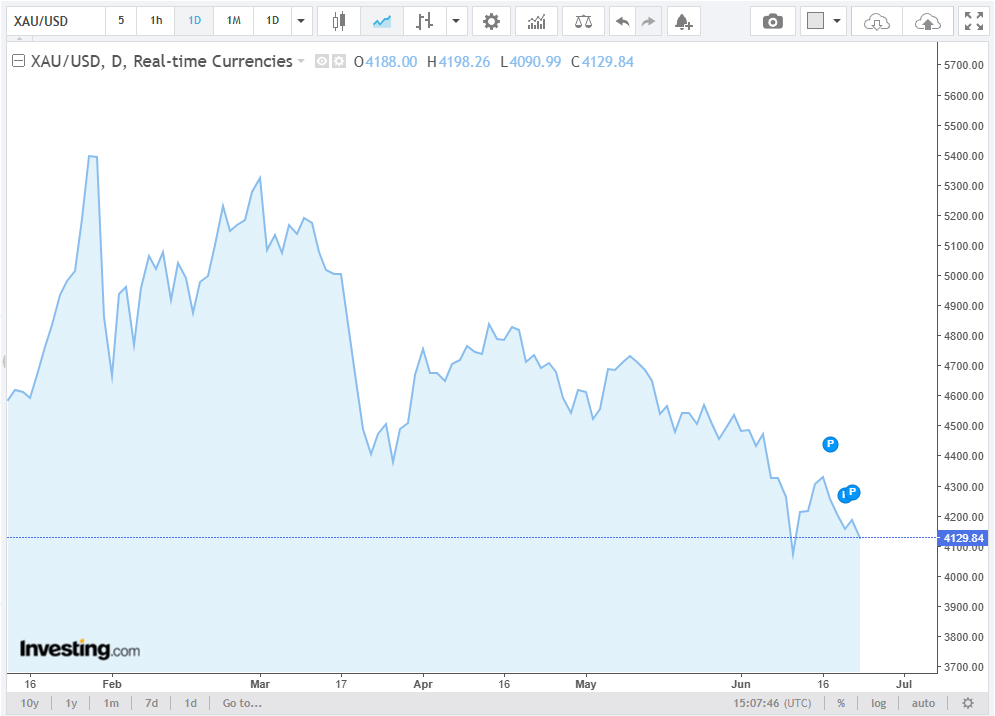
Currently, the precious metal is trading near the $4,111.99 level, having navigated significant volatility that saw prices briefly dip beneath the $4,100 milestone, reaching a daily low of $4,090.99 earlier in the session.
Market sentiment remains cautious as rising interest rate projections bolster the attractiveness of the Greenback and Treasury yields.
Currency experts at Vidasana Group highlights that the hawkish tone established during recent policy meetings has reinforced the dollar’s position, even as geopolitical cooling in the Middle East has tempered fears of an immediate inflationary spike in energy costs.
The US Dollar Index (DXY), which monitors the currency against a basket of six primary global peers, is hovering near 101.28, marking one of its strongest valuations in recent months.
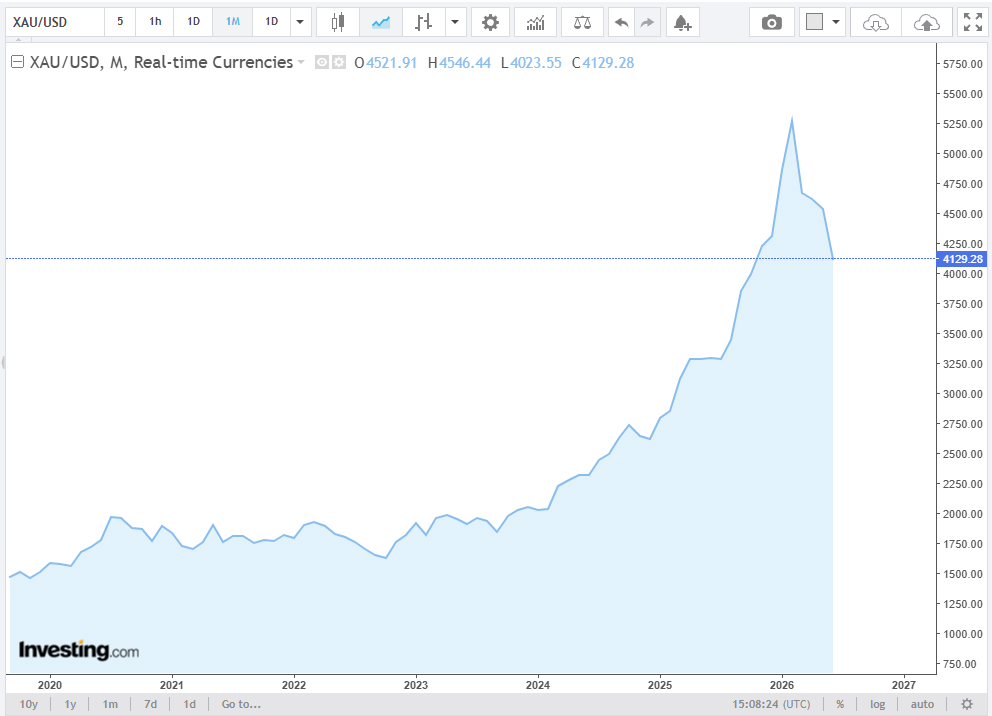
This firming trend in the dollar represents a significant correction for gold, which had previously experienced a historic two-year rally supported by central bank acquisition and geopolitical instability. XAU/USD is currently down approximately 25% from the record highs near $5,600 observed in January 2026.
Macroeconomic Indicators And The Federal Policy Outlook
Investors are now focusing on upcoming Personal Consumption Expenditures (PCE) inflation reports and the final figures for first-quarter Gross Domestic Product (GDP). These data points are expected to clarify the trajectory of future policy decisions.
Recent Purchasing Managers Index (PMI) data suggests continued economic robustness, with the Services PMI rising to 51.3 and the Manufacturing PMI accelerating to 55.7, both exceeding analyst expectations.
Unless there is a fundamental shift in the current hawkish policy framework, elevated interest rates, currently maintained at a target range of 3.50% to 3.75%, will likely continue to act as a headwind for the precious metal.
Market participants are currently pricing in an 85% probability of at least one 25-basis-point rate hike before the end of 2026 as the central bank maintains its focus on inflation targets. Higher rates typically diminish the appeal of non-yielding assets like gold compared to interest-bearing dollar-denominated instruments.
Projecting Long Term Support And Downward Risk
Current market analysis suggests that should the US Dollar Index maintain its momentum above the 100 mark, it could facilitate a further decline in gold toward the $4,000 psychological threshold. Experts note that if the metal fails to stabilize, the next significant support levels are projected at $3,887 and $3,857, which correspond to the 38.2% Fibonacci retracement level from the 2015 lows.
Should the bearish trend extend beyond these levels, analysts point to major structural support near the $3,500 peak observed in October 2025.
Meanwhile, traders continue to monitor diplomatic negotiations involving ongoing international energy and security frameworks. While Washington has temporarily eased specific sanctions to facilitate discussions, key tensions surrounding regional security and nuclear policy remain unresolved, maintaining a baseline of global uncertainty.
Technical Market Outlook: Gold Momentum and Support Zones
Gold is currently exhibiting a bearish short-term trajectory, consistently remaining below the 20-day Bollinger Simple Moving Average (SMA), which currently sits at $4,318.64.
Investors are closely watching the asset as it drifts toward the lower Bollinger Band support level of $4,043.85. Meanwhile, the daily Relative Strength Index (RSI) is hovering in the mid-30s range, signaling that the metal maintains persistent downward momentum without having entered a state of total oversold capitulation just yet.
Furthermore, the Average Directional Index (ADX) is currently positioned near 38, signaling that the prevailing downtrend remains robust. To the upside, initial resistance is established at the 20-day Bollinger SMA near $4,318.82, with the upper band at $4,593.10 serving as a distant ceiling should a technical corrective bounce occur.
Investor Outlook And Structural Profit Taking
For the retail investor, the current environment necessitates a shift in focus toward macroeconomic drivers rather than purely speculative price movements.
As the market digests the implications of a stronger dollar and shifting rate expectations, the focus remains on whether the $4,000 level can provide a meaningful floor for the commodity. A breach of this level may lead to increased volatility as long-term investors adjust their portfolio allocations.
Investors are encouraged to look past short-term headlines and monitor official central bank communications for an accurate picture of future policy alignment. The current correction phase, while significant, reflects a broader global repricing of risk assets.
Monitoring Future Developments In Global Markets
The recent price adjustments signify a transition toward a period of more cautious asset valuation. Going forward, market participants should remain vigilant regarding future regulatory updates and inflation data, which will continue to be the primary drivers of liquidity and sentiment.


