
The international foreign exchange framework is exhibiting pronounced imbalances as aggressive adjustments to Western monetary policy continue to reshape major currency alignments globally.
The safe-haven American currency preserved its rigid premium across the board during the final trading session of the week, capitalizing on growing structural hurdles surrounding a highly anticipated cross-border peace treaty. This sustained asset strength has effectively pinned major East Asian currency benchmarks to historical depths, threatening to ignite a severe structural breakdown.
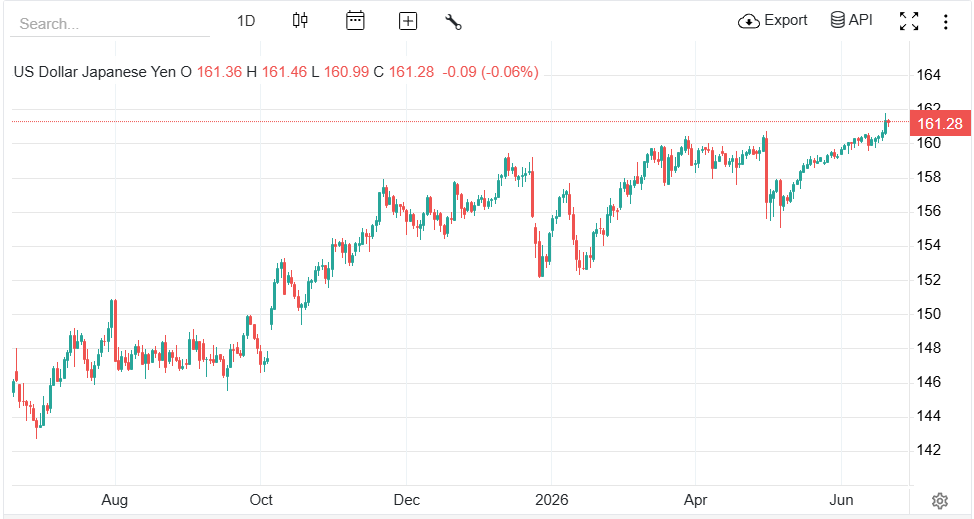
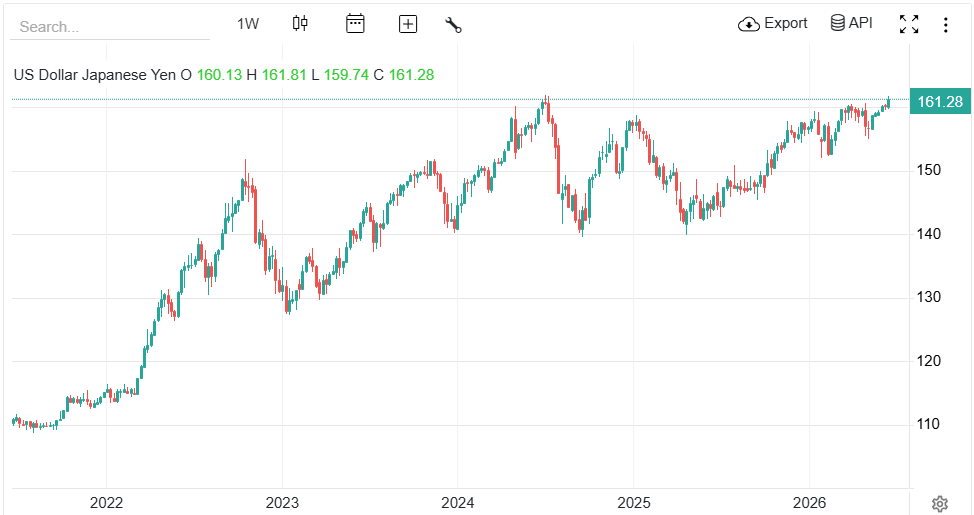
The spot rate recently climbed to a staggering peak of 161.8 units, closely approaching previous multi-month resistance lines. As economic data compiled by the financial insight team at OryxBox mentioned, breaching this overhead technical level would plunge the East Asian currency directly to its weakest valuation since 1986.
Although the currency pair subsequently exhibited a minor intraday consolidation down to 161.3, global trading desks remained on high alert for abrupt, unannounced open-market liquidity injections by sovereign fiscal ministries.
This prolonged asset depreciation is heavily compounded by significant international interest rate differentials that consistently penalize non-yielding currencies. Even after regional monetary authorities executed a historic policy adjustment to raise benchmark lending costs to a 31-year high, local yields remain structurally uncompetitive.
This stark divergence ensures that macro investment capital systematically flows out of domestic accounts to seek superior risk-adjusted returns in higher-yielding Western fixed-income pools.
Central Bank Monetary Divergence And Hawkish Forecast Realignments
The greenback’s powerful weekly rally, which pushed its broad-based clearing index up by 1% to a notable 13-month high, stems from aggressive policy shifts within the Federal Reserve. Updated quarterly economic projections revealed that nine out of nineteen active policymakers now explicitly anticipate an additional interest rate increase before the conclusion of the current fiscal period.
Currency strategists suggest that financial markets are highly incentivized to fully price in multiple borrowing cost hikes at the very next print of robust domestic data.
Compounding this supportive monetary backdrop, a scheduled lull in domestic trading liquidity has created a highly strategic operational window for sovereign regulators. Historically, fiscal authorities have shown a clear preference for executing direct market interventions during low-volume periods to maximize the behavioral impact on speculative traders.
If regulatory bodies fail to deploy defensive capital pools swiftly, macro speculators will likely exploit the supportive environment to push the asset class toward unprecedented 162.0 to 163.0 targets.
Sovereign Fiscal Expansion Anxieties And Domestic Leadership Demands
Investor confidence within East Asian equity and currency corridors has faced secondary headwinds due to mounting anxieties surrounding the long-term spending proposals of Prime Minister Sanae Takaichi. Widespread institutional skepticism regarding structural debt monetization and extensive public stimulus initiatives has severely undermined the currency’s defensive appeal.
Simultaneously, unexpected complications surrounding a bilateral peace treaty between major Western and Middle Eastern nations have reinforced the greenback’s traditional safe-haven allure.
Official confirmations that high-level diplomatic negotiations would not proceed as scheduled immediately revived geopolitical risk premiums across international clearing networks. This layer of geopolitical uncertainty has effectively neutralized previous short positions against the reserve currency, ensuring a continuous baseline of defensive institutional demand.
European Shared Currency Corrections And Sterling Intraday Volatility
While the greenback demonstrated commanding leverage over European peers during early localized trading, that specific momentum experienced a minor moderation by mid-morning. The common European currency initially compressed down to a three-month low of $1.1418 before executing a modest technical rebound to trade essentially flat at $1.1464.
This minor correction highlights a tactical pause among macro traders as they evaluate the sustainability of the greenback’s current multi-market breakout.
Concurrently, the British pound navigated a highly complex, news-driven session, collapsing to an over two-month low of $1.3164 before reversing course to trade 0.2% higher at $1.323.
Sterling traders were forced to rapidly digest a dense cluster of conflicting domestic economic data prints and significant regional electoral developments. This high-turnover environment triggered localized liquidations, forcing multi-asset funds to constantly rebalance their short-term European currency exposures.
Macro Economic Retail Data Deviations And Political Leadership Vectors
The underlying volatility across British trading corridors was fueled by domestic indicators revealing stronger than anticipated retail sales metrics for May. However, this positive consumer momentum was instantly offset by secondary public data showcasing a larger than expected budget deficit.
This fiscal degradation underscores the long-term budgetary constraints facing the sovereign administration, complicating future economic growth initiatives and limiting near-term monetary flexibility.
Amplifying this economic complexity, a decisive by-election victory by Labour Mayor Andy Burnham in the Makerfield constituency has dramatically reshaped the domestic political calculus. Political analysts suggest this key electoral triumph could fundamentally clear a strategic path to challenge British Prime Minister Keir Starmer for executive leadership.
This potential transformation within the governing apparatus introduces an additional layer of structural uncertainty, compelling foreign exchange managers to demand a higher risk premium for long-term sterling allocations.


