
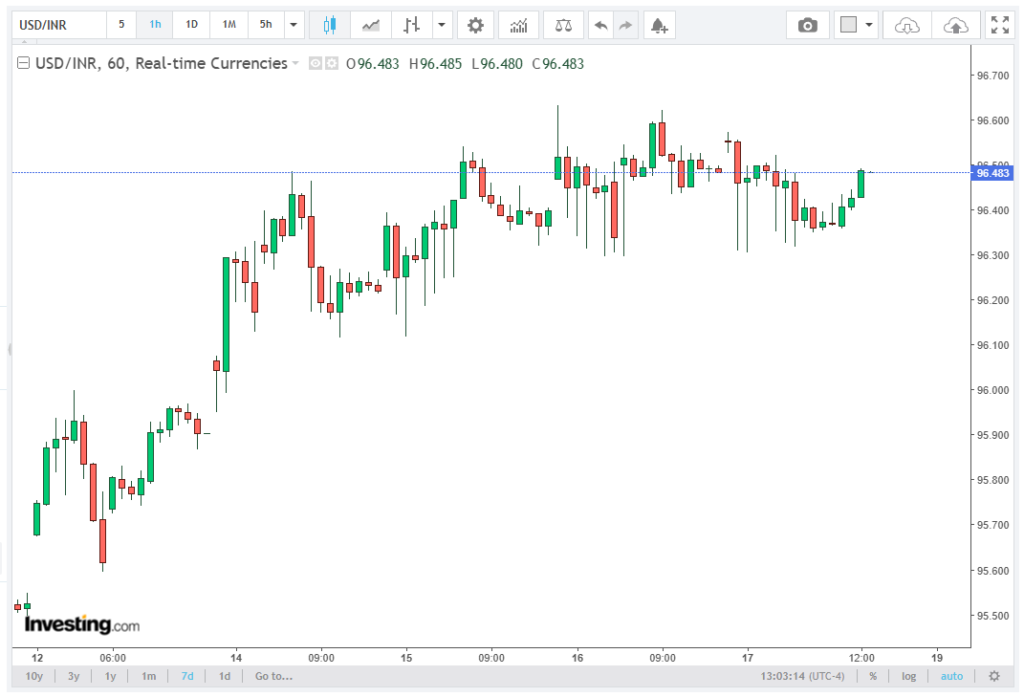
The Indian Rupee (INR) showed a modest recovery against the US Dollar (USD) ahead of the weekend, with the USD/INR exchange rate declining toward 96.30 after trading under heavy pressure throughout the week.
The rebound followed reported intervention by the Reserve Bank of India (RBI), which has been actively managing excessive volatility in the currency market.
South Quantum Group‘s team of experts takes an in-depth look at this topic throughout the article below.
The RBI’s foreign exchange intervention strategy has reportedly included operations in both the spot FX market and the non-deliverable forward (NDF) market. The central bank has maintained a measured approach, focusing on reducing disorderly movements rather than defending a fixed exchange-rate level.
This approach has helped slow the pace of INR depreciation after the currency faced sustained selling pressure.
Despite the short-term recovery, the rupee’s upside remains limited as external factors continue to weigh on emerging-market currencies. The combination of higher crude oil prices, geopolitical risks, and uncertainty surrounding global energy supplies remains a major challenge for India’s currency outlook.
Crude Oil Rally Creates Pressure on INR
The primary risk for the Indian Rupee remains the renewed strength in crude oil prices. India imports a significant portion of its energy requirements, making the currency highly sensitive to movements in global oil markets.
Rising oil prices increase the country’s import bill, place pressure on the current account balance, and can contribute to higher domestic inflation.
The MCX Crude Oil July 20 futures contract advanced 1.16% to approximately Rs. 7,700, moving closer to the monthly high of Rs. 7,832 recorded earlier in the week. The price increase reflects growing concerns that further disruptions to global energy flows could tighten supply conditions.
Historically, currencies of oil-importing economies tend to weaken when crude prices rise sharply. For the INR, sustained movement in crude oil above key technical levels could reduce foreign exchange inflows and increase demand for USD payments from energy importers.
US Dollar Supported by Safe-Haven Demand but Fed Expectations Shift
The US Dollar Index (DXY) gained 0.1% to trade near 100.80, supported by increased demand for safe-haven assets amid rising geopolitical uncertainty. However, the broader USD trend remains vulnerable as markets continue to reassess expectations for Federal Reserve monetary policy.
The release of a softer US Consumer Price Index (CPI) report for June reduced expectations that the Federal Reserve would maintain an aggressive tightening approach. Lower inflation pressure has encouraged traders to reduce expectations of additional rate increases, weighing on US Dollar demand.
According to the CME FedWatch Tool, the probability of a Federal Reserve rate hike at the upcoming policy meeting declined to 10.2%, compared with 24.6% one week earlier. The sharp reduction in rate-hike expectations reflects a shift toward a more neutral policy outlook.
A less hawkish Fed environment could provide support for emerging-market currencies, including the INR, by reducing the yield advantage of USD-denominated assets.
India Growth Outlook Remains Resilient Despite Risks
India’s domestic economic fundamentals continue to provide structural support for the currency. The Reserve Bank of India maintains that economic expansion remains on a strong trajectory despite global uncertainty.
However, key risks remain, including elevated Middle East tensions, volatile energy markets, and the possibility of a weaker monsoon season. A below-average monsoon could affect agricultural production, rural consumption, and inflation dynamics.
Strong GDP growth expectations, stable financial conditions, and continued foreign investment interest provide a positive foundation for the INR. Nevertheless, external vulnerabilities, particularly oil dependency, remain a significant factor limiting sustained currency appreciation.
USD/INR Technical Analysis: Bullish Structure Remains Intact
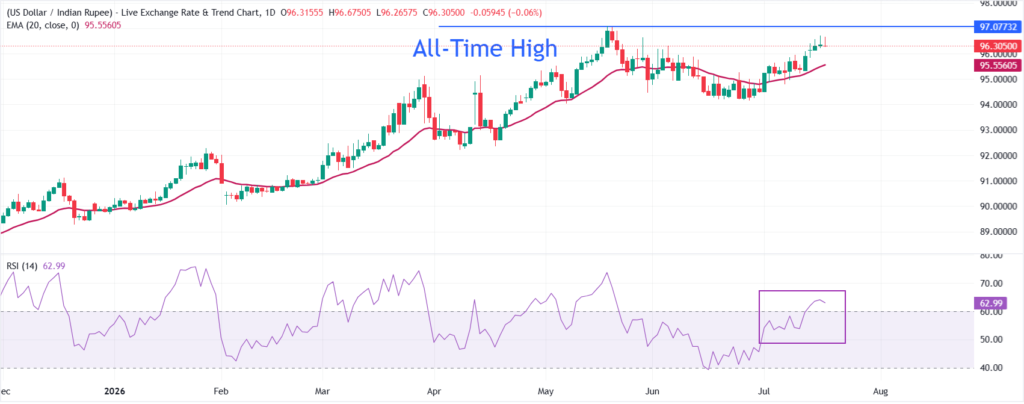
From a technical perspective, the USD/INR pair continues to maintain a bullish near-term structure, trading around 96.30 while holding above the 20-day Exponential Moving Average (EMA) at 95.55.
The pair’s ability to remain above the 95.55 support zone indicates that buyers continue to maintain control. The Relative Strength Index (RSI 14) stands at 62.99, signaling positive momentum while remaining below the traditional overbought threshold of 70.
A break below the 20-day EMA at 95.55 could weaken the current bullish trend and increase the possibility of further INR recovery. However, as long as USD/INR remains above this level, the broader upward bias remains valid.
On the upside, the key resistance level is located near the all-time high of 97.10. A sustained move above 97.10 could accelerate USD/INR gains, particularly if crude oil prices continue climbing or geopolitical risks intensify.
Overall, the Indian Rupee’s recent recovery appears temporary, with RBI intervention providing short-term support. The currency’s medium-term direction will depend on the balance between oil price movements, Fed policy expectations, and the strength of India’s domestic economic fundamentals.


