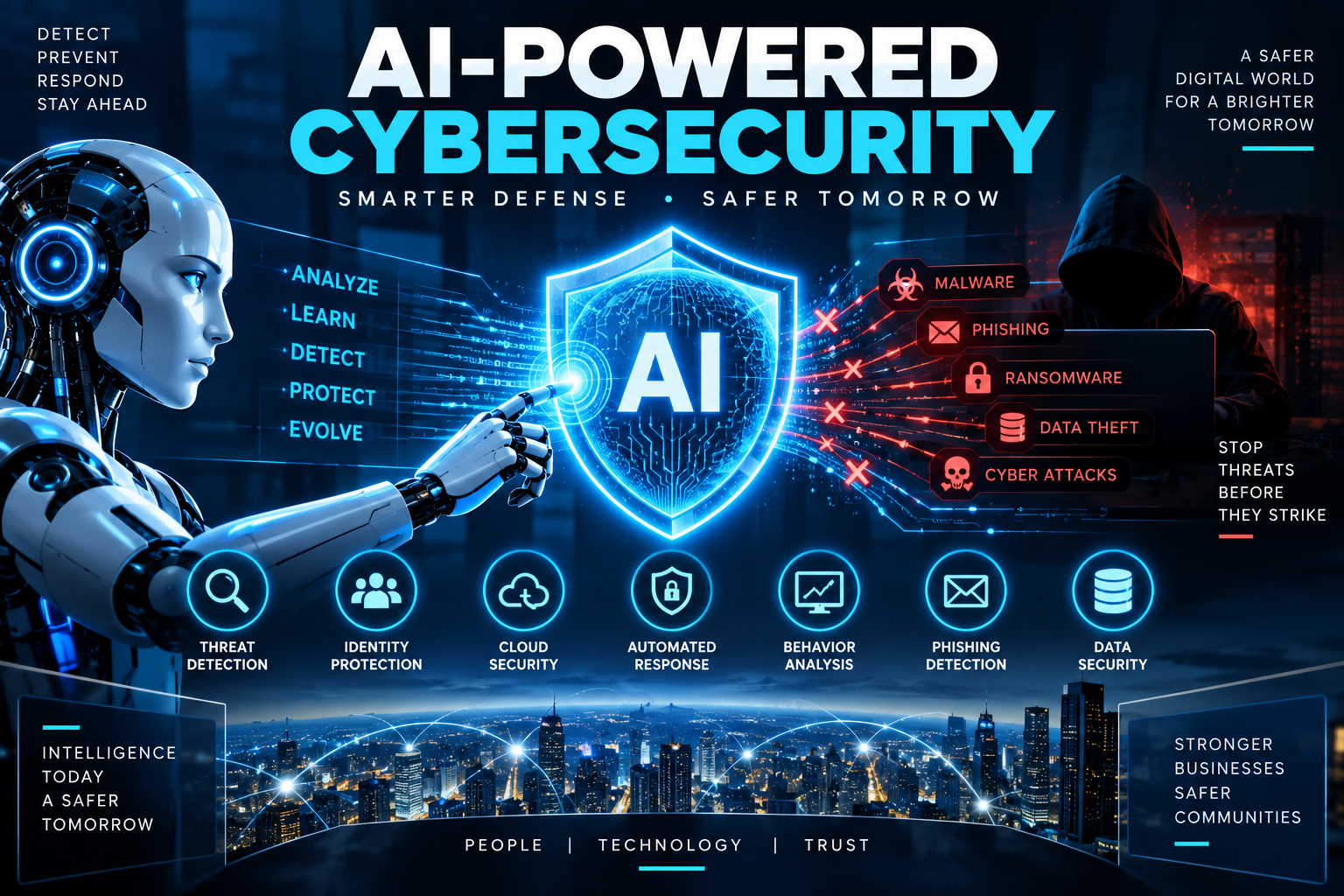
Cybersecurity has become one of the most important challenges of the digital age. Businesses, governments, financial institutions, and individuals rely on connected systems to store information, communicate, process payments, and operate critical services. At the same time, cyber threats are becoming more sophisticated, frequent, and difficult to detect.
Artificial intelligence (AI) is emerging as a powerful tool in the fight against these threats. By analyzing enormous amounts of data, identifying unusual behavior, automating security processes, and helping security teams respond faster, AI-powered cybersecurity is changing the way organizations protect digital infrastructure.
Traditional cybersecurity systems often depend on predefined rules and known threat signatures. While these methods remain useful, they can struggle with new or rapidly changing attacks. AI can complement traditional defenses by learning from patterns and detecting activity that may indicate a potential threat.
What Is AI-Powered Cybersecurity?
AI-powered cybersecurity refers to the use of artificial intelligence, machine learning, automation, and advanced data analysis to identify, prevent, investigate, and respond to cyber threats.
Modern organizations generate huge amounts of security data every day. This can include network traffic, login activity, system events, emails, application behavior, and information from security devices.
Security professionals cannot manually examine all of this information in real time. AI systems can process large volumes of data much faster, helping identify suspicious patterns and prioritize potential threats.
For example, an AI-powered security system may detect that an employee's account suddenly attempts to access unusual systems from an unfamiliar location. Instead of treating the activity as an ordinary login, the system can compare it with historical behavior and assign a higher risk score.
Why AI Is Becoming Important in Cybersecurity
Cybercriminals are constantly adapting their techniques. Attackers can use automation to scan systems, distribute malicious software, conduct phishing campaigns, and search for vulnerabilities.
The volume of digital activity also makes cybersecurity increasingly complex. A large organization may have thousands of employees, devices, applications, and cloud services.
AI can help security teams manage this complexity.
One of its most important advantages is speed. AI systems can analyze information continuously and identify suspicious activity much faster than manual processes.
AI can also reduce the workload on cybersecurity professionals by automatically investigating common alerts, grouping related events, and prioritizing incidents that require human attention.
AI and Threat Detection
Threat detection is one of the most important applications of AI in cybersecurity.
Traditional security tools often look for known indicators of compromise. This works well when a threat has already been identified, but it can be less effective against previously unseen attacks.
Machine learning systems can analyze normal patterns of behavior and identify significant deviations.
For example, if a device normally communicates with a small number of internal services but suddenly begins making unusual connections, an AI system may flag the behavior for further investigation.
This approach can help organizations detect suspicious activity even when there is no known signature for the attack.
Behavioral Analysis
Behavioral analysis allows security systems to understand how users, devices, and applications normally behave.
AI can establish behavioral patterns by examining historical activity. When something unusual happens, the system can investigate whether the behavior represents a legitimate change or a potential security incident.
Consider an employee who normally logs in during working hours and accesses a limited set of applications. If the same account suddenly performs hundreds of unusual actions at an unusual time, an AI-based system may identify the activity as potentially risky.
Behavioral analysis can be particularly valuable for detecting compromised accounts and insider threats.
AI-Powered Phishing Detection
Phishing remains one of the most common ways attackers attempt to gain access to accounts and sensitive information.
Traditional spam filters can block many malicious messages, but attackers continually change email addresses, wording, links, and techniques.
AI can analyze multiple characteristics of a message, including language patterns, sender behavior, links, attachments, and other signals.
Machine learning can help identify suspicious messages that may not exactly match previously known phishing examples.
Generative AI has also created new challenges because attackers can potentially produce more convincing and personalized fraudulent messages. This makes intelligent detection and user awareness increasingly important.
Malware Detection and Analysis
Malware can take many forms, including viruses, ransomware, spyware, and other malicious programs.
AI can assist security teams in identifying potentially malicious files and analyzing how software behaves.
Instead of relying exclusively on a known malware signature, machine learning models can examine characteristics and behavior that may indicate malicious activity.
AI can also help analysts process large numbers of suspicious files and prioritize those that deserve deeper investigation.
This does not mean AI eliminates the need for security researchers. Human expertise remains important, particularly when analyzing sophisticated or unusual threats.
AI in Network Security
Networks generate enormous quantities of information, making them an important area for AI applications.
AI-powered network security systems can analyze traffic patterns and identify unusual communication.
For example, a sudden increase in data transfers, unexpected connections, or unusual communication between systems could indicate a security problem.
AI can help security teams distinguish ordinary network activity from potentially dangerous behavior.
As organizations increasingly adopt cloud computing, remote work, connected devices, and distributed infrastructure, monitoring network behavior has become more complex. AI can provide additional visibility across these environments.
Automated Incident Response
Detecting a threat is only part of cybersecurity. Organizations must also respond quickly.
AI-powered systems can automate certain defensive actions after suspicious activity is identified.
Depending on the security architecture and organizational policies, automated systems may isolate a device, disable a compromised account, block suspicious traffic, or create an incident for human review.
Automation can reduce response times significantly.
However, organizations should carefully control automated actions. An incorrect decision could disrupt legitimate business operations. For high-impact actions, human approval may remain necessary.
AI and Ransomware Protection
Ransomware is a particularly serious cybersecurity threat because it can prevent organizations from accessing important data and systems.
AI can contribute to ransomware defense by monitoring system behavior for suspicious changes.
Large numbers of files being rapidly modified or encrypted may represent a warning signal. An AI-powered system can potentially detect such behavior and trigger defensive measures.
Organizations should not rely on AI alone, however. Strong backups, access controls, software updates, employee training, network segmentation, and incident-response planning remain essential components of ransomware protection.
Protecting Cloud Environments
Cloud computing has transformed how organizations store and process information.
Businesses may use multiple cloud services, applications, virtual machines, and remote access systems. This creates additional security considerations.
AI can help analyze cloud activity, identify unusual access patterns, detect misconfigurations, and monitor large numbers of resources.
As cloud environments become more dynamic, automated security analysis can help organizations maintain visibility without requiring security professionals to manually examine every event.
AI for Identity and Access Security
Identity has become a central part of modern cybersecurity.
Organizations need to determine not only who is attempting to access a system but also whether that access appears legitimate.
AI can analyze login patterns, device information, geographic signals, access behavior, and other indicators to identify potentially compromised accounts.
Risk-based authentication can then require additional verification when activity appears unusual.
For example, a login from a familiar device may be considered lower risk than an unexpected login combined with unusual access behavior.
The Role of Generative AI in Cybersecurity
Generative AI is introducing new opportunities for cybersecurity teams.
Security professionals can use AI assistants to summarize alerts, analyze security logs, explain technical findings, generate reports, and help investigate incidents.
AI can make complex security information easier to understand, potentially allowing organizations to respond more efficiently.
However, generative AI also introduces risks. AI systems can produce inaccurate information, misunderstand technical details, or expose sensitive information if used improperly.
Organizations should therefore establish policies governing what data can be provided to AI systems and how AI-generated recommendations are reviewed.
Challenges of AI-Powered Cybersecurity
Despite its advantages, AI-powered cybersecurity is not a perfect solution.
One major challenge is false positives. AI systems may sometimes identify legitimate activity as suspicious. Too many inaccurate alerts can overwhelm security teams.
Another challenge is false negatives. A sophisticated threat may evade detection, especially if the system has limited or poor-quality training data.
Attackers may also attempt to manipulate AI systems. This creates a continuing competition between defensive technologies and offensive techniques.
Data privacy is another concern. Security systems may process sensitive information about employees, customers, and business operations. Organizations must ensure that this information is handled responsibly.
AI models can also inherit biases or make incorrect decisions. Human oversight remains important when security decisions could have significant consequences.
AI and the Future of Cybersecurity
The relationship between AI and cybersecurity is likely to become increasingly important.
Future security systems may combine machine learning, automation, behavioral analysis, threat intelligence, and human expertise into integrated security platforms.
AI could help security teams move from reactive defense toward more proactive protection by identifying patterns that suggest potential threats before they become major incidents.
At the same time, attackers are likely to use AI to improve their own capabilities. This means the cybersecurity landscape will remain competitive.
The organizations that benefit most will likely be those that combine advanced technology with strong security fundamentals.
Building a Strong AI-Powered Security Strategy
Organizations considering AI-powered cybersecurity should begin with their most important risks.
First, they should identify critical systems, sensitive information, and important business processes.
Next, they can determine where AI could provide the greatest value. This might include threat detection, email security, endpoint monitoring, fraud detection, identity protection, or incident response.
Organizations should also maintain strong cybersecurity fundamentals, including multi-factor authentication, regular software updates, secure backups, employee education, access controls, and network monitoring.
AI should be treated as an additional layer of defense rather than a replacement for security professionals and established security practices.
Conclusion
AI-powered cybersecurity is changing how organizations defend themselves against digital threats.
Artificial intelligence can analyze massive amounts of information, recognize unusual behavior, detect potential threats, prioritize alerts, and automate certain responses. These capabilities can help security teams respond faster and manage increasingly complex digital environments.
However, AI is not a magic solution. Cybersecurity requires a combination of technology, skilled professionals, strong policies, user awareness, and effective risk management.
As cyber threats continue to evolve, AI will likely become an increasingly important part of the security ecosystem. The future of cybersecurity will not simply be about machines versus attackers. It will be about combining intelligent technology with human judgment to build safer and more resilient digital systems.
Frequently Asked Questions About AI-Powered Cybersecurity
1. What is AI-powered cybersecurity?
AI-powered cybersecurity uses artificial intelligence and machine learning to detect, analyze, prevent, and respond to cyber threats.
2. How does AI improve cybersecurity?
AI can analyze large amounts of security data quickly, identify unusual patterns, prioritize threats, and automate certain defensive responses.
3. Can AI detect new cyber threats?
AI-based behavioral and machine-learning systems can potentially identify unusual activity even when a specific threat has not previously been seen. However, no security system can detect every threat.
4. Can AI prevent phishing attacks?
AI can help identify suspicious emails by analyzing message content, sender behavior, links, attachments, and other indicators. Human awareness remains an important part of phishing protection.
5. Can AI stop ransomware?
AI can help detect suspicious file activity and other ransomware-related behaviors, but effective ransomware protection also requires backups, access controls, updates, employee training, and incident-response planning.
6. Does AI replace cybersecurity professionals?
No. AI can automate repetitive tasks and assist analysts, but human expertise remains important for investigation, decision-making, strategy, and handling complex incidents.
7. What are the biggest risks of AI in cybersecurity?
Important risks include false positives, false negatives, privacy concerns, inaccurate AI decisions, model manipulation, and the potential for attackers to use AI for malicious purposes.
8. How is generative AI used in cybersecurity?
Generative AI can help security teams summarize alerts, analyze information, explain technical findings, create reports, and assist with investigations.
9. Is AI-powered cybersecurity useful for small businesses?
Yes. AI-enabled security tools can help smaller organizations monitor systems and detect threats without requiring large security teams. However, basic security practices should remain a priority.
10. What is the future of AI-powered cybersecurity?
The future is likely to involve greater automation, behavioral analysis, intelligent threat detection, AI-assisted investigations, and closer collaboration between security professionals and AI systems.