Business loans can help entrepreneurs launch a new company, purchase equipment, manage cash flow, hire employees, or expand into new markets. However, choosing the right financing option requires careful research. Interest rates, repayment terms, eligibility requirements, fees, and funding speed can significantly affect a business's financial health.
In 2026, small-business owners in the United States can explore financing through traditional banks, online lenders, credit unions, and government-backed programs. Some options provide long-term financing for major investments, while others offer flexible access to cash for everyday operating expenses.
This guide explains the main types of business loans, compares lenders worth researching, and shares practical tips for finding financing that matches your company's needs.
What Is a Business Loan?
A business loan is financing provided to a company or business owner that must be repaid according to agreed terms. Depending on the product, repayment may include interest, fees, or other financing charges.
Businesses commonly use loans to:
Purchase equipment, machinery, or vehicles.
Cover payroll and operating expenses.
Buy inventory and supplies.
Finance marketing campaigns.
Renovate or expand business premises.
Consolidate eligible business debt.
Purchase an existing business.
Manage seasonal cash-flow shortages.
The best financing option depends on how much money a business needs, how quickly it needs the funds, and how reliably it can repay the debt.
Best Business Loan Lenders in 2026
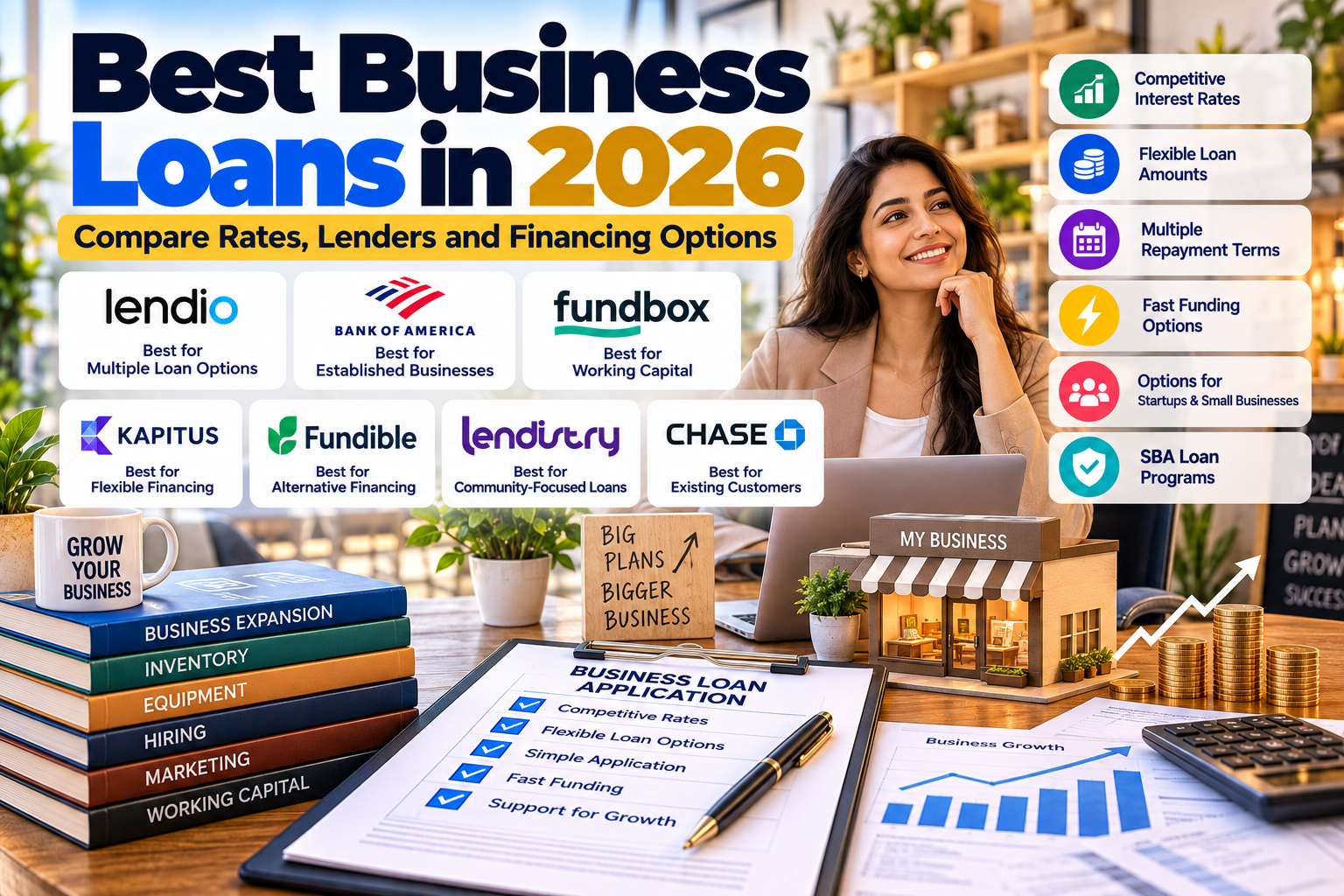
Different lenders serve different business needs. The following companies and financing providers are worth comparing, but availability, rates, and eligibility depend on the applicant and loan product.
1. Lendio — Best for Comparing Multiple Loan Options
Lendio operates as a business financing marketplace, helping business owners explore offers from different lending providers.
Rather than relying on one lender, applicants can use a marketplace to investigate several types of financing, depending on their eligibility and the partners available.
Potential advantages:
Access to different business financing options.
An application process designed to help businesses explore offers.
Options that may include term loans, lines of credit, and other financing products.
Useful for comparing different types of funding.
Potential drawbacks:
Lendio is a marketplace, so the lender ultimately providing the funds determines the final terms.
Rates and fees vary between providers.
Not every business will qualify for every product.
Best for: Entrepreneurs who want to compare several financing options before choosing a lender.
2. Bank of America — Best for Established Businesses
Bank of America offers business banking and lending products that may suit established companies with documented revenue and a strong financial history.
Its financing options can be useful for businesses seeking traditional banking relationships and funding for eligible expansion projects.
Potential advantages:
Business banking and financing services in one institution.
Loan options for qualifying established businesses.
Potential relationship benefits for eligible customers.
Financing for certain business investments and operating needs.
Potential drawbacks:
Eligibility requirements can be demanding.
Businesses may need a longer operating history and stronger financial documentation.
Funding speed and application requirements depend on the specific product.
Best for: Established businesses that want to compare traditional bank financing with online alternatives.
3. Fundbox — Best for Short-Term Cash-Flow Needs
Fundbox provides financing options designed for small businesses, including a business line of credit for eligible applicants.
A line of credit can help businesses handle temporary cash-flow gaps without applying for a new lump-sum loan every time a funding need arises.
Potential advantages:
Financing options for working capital.
Potential access to revolving credit, depending on the product.
Online application and account management.
Useful for businesses with recurring short-term funding needs.
Potential drawbacks:
Short repayment periods can create higher payment pressure.
Fees and borrowing costs must be assessed carefully.
Approval depends on business performance and eligibility requirements.
Best for: Small businesses that need flexible access to working capital.
4. Kapitus — Best for Specialized Business Financing
Kapitus offers financing solutions for businesses seeking capital for operational needs, growth, and other eligible expenses. Its product range can include term loans and revenue-based financing.
Revenue-based financing typically links repayment to a business's revenue under the agreement, so owners should understand exactly how payments are calculated.
Potential advantages:
Multiple financing structures to investigate.
Options for certain businesses that need growth capital.
Financing designed around different business requirements.
Potential drawbacks:
Financing costs can vary considerably.
Revenue-based repayment may reduce available cash during busy periods.
Business owners must understand the total repayment obligation before signing.
Best for: Businesses that want to compare specialized financing structures alongside conventional loans.
5. Fundible — Best for Exploring Flexible Eligibility
Fundible is a business financing provider that may be worth researching for companies that do not meet every traditional bank's requirements.
Its financing options and eligibility rules depend on the product and the applicant's business profile.
Potential advantages:
An alternative to traditional bank financing.
Options to explore for different business funding needs.
Potential access to financing for businesses with varying credit profiles.
Potential drawbacks:
Less favorable credit profiles may result in higher costs.
Fees and repayment schedules need careful review.
Approval and funding amounts are not guaranteed.
Best for: Business owners who want to compare alternative financing providers.
6. Lendistry — Best for Exploring Community-Focused Financing
Lendistry is a financial services provider associated with small-business financing and community-focused lending initiatives.
Depending on current program availability, businesses may be able to investigate financing designed to support eligible small businesses and underserved communities.
Potential advantages:
An alternative to mainstream commercial lenders.
Potential access to specific small-business financing programs.
Worth investigating for businesses seeking community-oriented funding options.
Potential drawbacks:
Programs and eligibility criteria can vary.
Funding availability may depend on location and the specific program.
Applicants should confirm whether a suitable product is currently accepting applications.
Best for: Eligible small businesses seeking alternative or community-focused financing opportunities.
7. Chase — Best for Existing Banking Customers to Compare
Chase offers business banking and lending services for eligible companies. Businesses with an established banking relationship may want to investigate its available financing products.
Potential advantages:
Business banking and lending services through one provider.
Financing options for qualifying companies.
A traditional bank alternative to online lending platforms.
Potential drawbacks:
Product eligibility varies.
Newer businesses may find some traditional financing requirements difficult to meet.
Application and underwriting timelines depend on the loan type.
Best for: Business owners who already use Chase or prefer to compare traditional bank financing.
Business Loan Comparison
Provider | Main reason to compare | Important consideration |
|---|---|---|
Lendio | Multiple financing options | Terms depend on the actual lender |
Bank of America | Traditional bank financing | Financial history and eligibility |
Fundbox | Working capital and credit lines | Repayment frequency and fees |
Kapitus | Specialized financing | Total repayment cost |
Fundible | Alternative financing | Rates and eligibility |
Lendistry | Community-focused options | Program availability |
Chase | Traditional business banking | Product-specific requirements |
This comparison is a starting point for research, not a guarantee of approval or the lowest rate. Always confirm current terms directly with the provider.
Types of Business Loans
Understanding the main financing options can help you avoid choosing a product that does not fit your business.
1. Term Loans
A term loan provides a lump sum that the business repays over an agreed period, usually with interest and applicable fees.
Term loans may be used for equipment purchases, renovations, expansion, or other planned investments. Repayment schedules vary by lender and product.
Best for: Businesses with a defined funding goal and a realistic repayment plan.
2. Business Lines of Credit
A business line of credit allows an approved company to draw funds up to a specified limit. Depending on the agreement, repaid principal may become available to borrow again.
Unlike a traditional term loan, a line of credit can provide repeated access to funds when cash-flow needs fluctuate.
Best for: Managing inventory purchases, temporary cash-flow gaps, and unexpected operating expenses.
3. SBA Loans
The U.S. Small Business Administration supports several loan programs through participating lenders. It generally does not lend directly to businesses through its standard 7(a) program.
The SBA 7(a) program can support eligible business purposes, including working capital, equipment, real estate, certain debt refinancing, and ownership changes. The maximum 7(a) loan amount is generally $5 million, subject to program requirements. <Cite refs={["turn222776search1"]}/>
Best for: Eligible U.S. small businesses seeking government-backed financing through participating lenders.
4. Equipment Financing
Equipment financing helps a business purchase machinery, computers, commercial vehicles, or other eligible equipment.
The equipment may serve as collateral, depending on the agreement. Business owners should compare the interest rate, fees, repayment term, and consequences of missed payments.
Best for: Companies investing in equipment that supports operations or generates revenue.
5. Invoice Financing
Invoice financing allows businesses to access funds tied to unpaid customer invoices. The structure varies by provider and may involve fees, interest, or other charges.
It can help companies that must pay suppliers and employees before customers settle their invoices.
Best for: Businesses with reliable customers but lengthy payment cycles.
6. Startup Business Loans
New businesses often face challenges because they lack established revenue, business credit history, or operating records.
Potential options include SBA microloans, eligible community development financial institution programs, equipment financing, and certain online products. Availability and requirements vary, and some startup owners may need to provide a personal guarantee or demonstrate relevant experience.
Best for: Entrepreneurs with a clear business plan and realistic projections.
How to Qualify for a Business Loan
Lenders assess whether a business is likely to repay the money. Requirements differ, but many applications involve the following factors.
Credit History
Lenders may review the owner's personal credit history, business credit profile, or both. A stronger credit profile may improve access to financing or more favorable terms, although credit is not the only factor.
Business Revenue
Revenue helps lenders assess the company's ability to make payments. Some lenders also examine profit margins, bank balances, outstanding debt, and cash-flow consistency.
Time in Business
Traditional lenders may prefer businesses with an established operating history. Some alternative providers consider newer businesses, but shorter operating histories can limit options or increase financing costs.
Business Plan
A business plan can help explain how the funds will be used and how the business expects to repay them. This is particularly useful for startups and businesses seeking substantial funding.
Financial Documents
Depending on the product, applicants may need:
Recent business bank statements.
Business and personal tax returns.
Profit-and-loss statements.
Balance sheets.
Revenue forecasts.
Business registration documents.
Identification and ownership information.
Details of existing business debt.
Prepare accurate documents before applying, and never exaggerate revenue or expected profits.
How to Choose the Right Business Loan
1. Define the Purpose of the Loan
Start by identifying exactly what the business needs the money for. A company purchasing machinery may need equipment financing, while a retailer covering seasonal inventory may benefit from a line of credit.
Choosing financing based on its purpose can help avoid unnecessary costs.
2. Compare APR and Total Financing Cost
The annual percentage rate, or APR, can help compare borrowing costs where it is available and calculated consistently. However, some business financing products use different pricing structures, so APR alone may not fully describe the cost.
Review origination fees, draw fees, factor rates, repayment frequency, prepayment terms, and the total amount due. Ask the provider to explain the cost in dollars before signing.
3. Check Repayment Terms
A loan with a low advertised payment may have a longer term or other costs. Meanwhile, frequent repayments can put pressure on daily or weekly cash flow.
Choose a repayment schedule that your business can realistically support during both strong and slow periods.
4. Compare Multiple Offers
Obtain offers from several appropriate lenders and compare the same loan amount, purpose, and approximate repayment period.
Ask whether the application requires a soft or hard credit inquiry, and determine whether a personal guarantee or collateral is required.
5. Avoid Borrowing More Than Necessary
A larger loan may increase interest and fees without producing additional business value. Estimate the amount needed, including a reasonable allowance for project costs, and ensure that the expected benefits justify the financing expense.
Example: Calculating the Cost of a Business Loan
Suppose a business borrows $50,000 through a hypothetical fixed-rate loan with a five-year repayment term and a 10% annual interest rate.
The actual monthly payment depends on the lender's calculation method and fees, but under a standard monthly amortization model:
Loan amount: $50,000
Repayment term: 60 months
Illustrative monthly payment: Approximately $1,062
Total of payments: Approximately $63,720
Total interest: Approximately $13,720
These figures are illustrative estimates, not a lender quote. Origination fees, payment schedules, and the final interest rate may change the actual cost.
Before borrowing, compare the expected monthly payment with the cash flow available after payroll, inventory, rent, taxes, and other operating expenses.
Common Business Loan Mistakes to Avoid
Choosing financing based only on speed. Fast funding can be useful, but expensive repayment terms may damage cash flow.
Ignoring fees. Origination charges, factor rates, draw fees, and other costs can make financing more expensive than it first appears.
Borrowing without a repayment plan. Estimate the payments and identify how the business will generate the money to repay them.
Applying for an unsuitable loan type. A long-term investment may not be a good match for short-term financing with frequent payments.
Overlooking personal guarantees. Some lenders may require the owner to accept personal responsibility if the business cannot repay the loan.
Failing to read the agreement. Understand collateral requirements, default provisions, payment schedules, and early repayment terms before signing.
Alternatives to Business Loans
A loan is not always the best way to finance a business. Depending on the situation, consider:
Business grants: Competitive funding that may not require repayment, although eligibility and restrictions apply.
Business credit cards: Potentially useful for smaller purchases when the balance can be repaid affordably.
Invoice factoring: Selling eligible invoices to a provider for immediate funds, usually at a cost.
Equipment leasing: Accessing equipment without purchasing it outright.
Equity investment: Raising capital in exchange for ownership or another agreed investment arrangement.
Supplier payment terms: Negotiating payment schedules with vendors.
Retained earnings: Funding growth using profits the business has already generated.
Compare the financial cost and long-term implications of each alternative.
Frequently Asked Questions
What is the best business loan in 2026?
There is no single best business loan for every company. Lendio may help businesses compare multiple offers, Bank of America and Chase are options for traditional bank financing, and Fundbox may be worth investigating for working-capital needs. The right choice depends on eligibility, cost, and business purpose.
Can I get a business loan with bad credit?
Some alternative lenders consider applicants with weaker credit, but the available loan amounts and terms may be limited, and costs can be higher. Compare reputable providers and make sure repayments are affordable before accepting an offer.
Can a startup get a business loan?
Yes, some financing options are available to eligible startups. These may include microloans, community-focused programs, equipment financing, and selected online products. Requirements vary, and lenders may request a business plan, personal guarantee, collateral, or evidence of the owner's ability to repay.
How much can a small business borrow?
The amount depends on the lender, financing program, business revenue, credit history, time in operation, and repayment capacity. Some products offer small amounts, while eligible SBA 7(a) loans can reach $5 million. <Cite refs={["turn222776search1"]}/>
Are SBA loans better than online business loans?
SBA-backed financing can offer useful terms to eligible businesses, but the application process and documentation may be more involved. Online loans may offer a faster process but can have higher costs or shorter repayment periods. Compare actual offers rather than assuming one option is always better.
How can I improve my chances of approval?
Maintain accurate financial records, monitor credit, reduce unnecessary debt, prepare a clear funding plan, and apply for an amount that your business can realistically repay. Matching the loan type to the funding purpose can also help.
Final Thoughts
Business loans can provide valuable funding for companies that need to invest in growth, manage operating expenses, or respond to changing market conditions. However, choosing the right financing means understanding the total cost, repayment schedule, eligibility rules, and potential risks.
Compare providers such as Lendio, Bank of America, Fundbox, Kapitus, Fundible, Lendistry, and Chase where their products fit your needs. For eligible U.S. small businesses, SBA-backed financing may also be worth exploring through participating lenders.
Before accepting an offer, review the agreement carefully, calculate whether the business can afford repayments, and ensure the funding supports a realistic business goal.
Disclaimer: This article is for informational and educational purposes only and is not financial, legal, or tax advice. Loan availability, interest rates, fees, and eligibility requirements can change. Verify current terms directly with lenders and consider consulting a qualified financial professional before borrowing.