Personal loans can help people cover planned expenses, consolidate high-interest debt, pay for home improvements, or manage unexpected costs. However, choosing the right loan involves more than finding a lender that promises fast approval. Interest rates, origination fees, repayment terms, monthly payments, and eligibility requirements all affect the total cost of borrowing.
In 2026, borrowers in the United States can compare traditional financial institutions, online lenders, and credit unions to find personal loans suited to their needs. Some lenders focus on borrowers with strong credit, while others offer options for people with fair credit or limited credit histories.
This guide explores personal loan lenders worth comparing, explains how personal loans work, and provides practical tips for borrowing responsibly.
What Is a Personal Loan?
A personal loan is money borrowed from a lender that is generally repaid in fixed installments over an agreed period. Many personal loans are unsecured, meaning they do not require collateral such as a car or house.
Once approved, borrowers typically receive the funds as a lump sum and repay the loan with interest and any applicable fees.
Common uses for personal loans include:
Debt consolidation
Home improvements and repairs
Emergency expenses
Medical and dental bills
Moving costs
Major planned purchases
Other eligible personal expenses
Lenders may restrict certain uses, including some education, business, or investment expenses. Always review the loan agreement before applying.
Best Personal Loan Lenders in 2026
The following lenders offer different features and may suit different borrower profiles. The best choice depends on your credit history, income, borrowing amount, location, and financial goals.
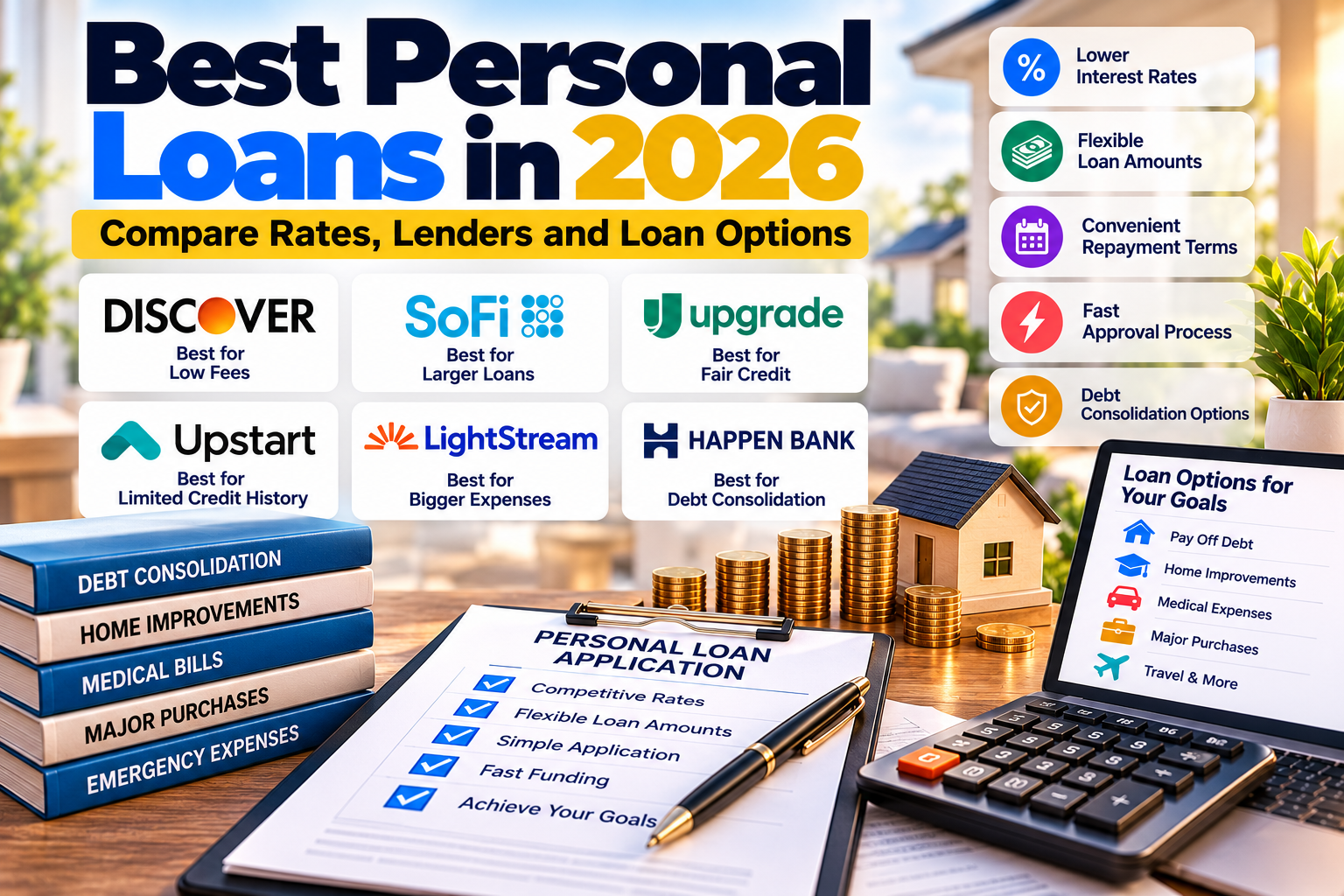
1. Discover — Best for Low Fees
Discover is worth considering for borrowers who want a straightforward personal loan and predictable repayment terms. Its personal loans have been highlighted for competitive pricing and no loan fees in NerdWallet's 2026 review.
Potential advantages:
No origination or late fees under its advertised personal loan terms.
Online prequalification options.
Fixed monthly payments.
Direct payment to creditors for eligible debt-consolidation loans.
Potential drawbacks:
Credit and income requirements apply.
The minimum borrowing amount may not suit people who need only a small loan.
Approval and the rate offered depend on the applicant's financial profile.
Best for: Borrowers who qualify and want to compare a personal loan with a transparent fee structure.
2. SoFi — Best for Larger Personal Loans
SoFi is an online financial services company that offers personal loans for eligible borrowers. Its relatively high loan limits can make it an option for people financing larger expenses or consolidating multiple debts.
Potential advantages:
Personal loans of up to $100,000 for eligible applicants.
Online application and account management.
Potential rate discounts for qualifying customers.
Options for debt consolidation and other eligible expenses.
Potential drawbacks:
A large loan limit does not mean every applicant will qualify for that amount.
The lender's minimum loan amount may be too high for small expenses.
Rates depend on creditworthiness and other underwriting factors.
Best for: Qualified borrowers who need a larger loan and want to compare online lending options.
3. Upgrade — Best for Borrowers With Fair Credit
Upgrade offers personal loans and may consider applicants who do not have excellent credit. Its products can include secured loans and joint applications, depending on eligibility and availability.
Potential advantages:
Options for some borrowers with fair or imperfect credit.
Online prequalification.
Potential discounts for autopay or eligible debt-consolidation arrangements.
Multiple loan amounts and repayment terms.
Potential drawbacks:
Origination fees may apply.
Borrowers with weaker credit may receive higher APRs.
A secured loan can put the pledged asset at risk if payments are not made.
Best for: Borrowers who want to explore options beyond lenders that primarily serve applicants with strong credit.
4. Upstart — Best for Limited Credit History
Upstart uses a broader underwriting approach that may consider factors beyond a traditional credit score. This can make it worth investigating for some applicants with limited credit histories.
Potential advantages:
Online application process.
Alternative factors may be considered during underwriting.
Options for different borrowing needs.
Prequalification may be available without an initial hard credit inquiry.
Potential drawbacks:
Approval is not guaranteed.
Rates can be high for some applicants.
Origination fees and loan terms depend on the offer.
Best for: Applicants whose credit history is limited and who want to compare lenders with different underwriting approaches.
5. LightStream — Best for Larger Expenses and Longer Terms
LightStream offers personal loans for borrowers who meet its eligibility requirements. It may be useful for people with strong credit who need to finance a significant expense.
Potential advantages:
Loans for eligible large expenses.
Multiple repayment-term options.
No origination fees under its advertised personal loan terms.
Competitive offers may be available to well-qualified borrowers.
Potential drawbacks:
Applicants may need a strong credit profile to obtain the most favorable terms.
Prequalification options may be more limited than those of some competitors.
A longer loan term can increase the total interest paid.
Best for: Creditworthy borrowers who want to compare financing for a larger purchase or home improvement project.
6. Happen Bank — Best for Debt Consolidation to Compare
Happen Bank, formerly LendingClub, offers personal loans that may be used for eligible debt-consolidation needs. Borrowers can investigate whether combining several balances into one installment loan would improve their repayment plan.
Potential advantages:
Personal loans for eligible debt-consolidation expenses.
Online application process.
Potential rate discounts for qualifying repayment arrangements.
Loan options for a range of borrowing needs.
Potential drawbacks:
Origination fees may apply.
The offered APR may not be lower than the interest rates on existing debts.
Consolidation does not erase debt; the borrower still has to repay the new loan.
Best for: Borrowers who want to compare a fixed-payment loan with their existing credit card or other eligible debt.
Important: Lender products, names, fees, and eligibility criteria can change. Verify current terms directly before applying.
Personal Loan Lender Comparison
Lender | Main reason to compare | What to check |
|---|---|---|
Discover | Low-fee borrowing | Eligibility and offered APR |
SoFi | Larger loan amounts | Minimum loan amount and terms |
Upgrade | Fair-credit options | Origination fees and total cost |
Upstart | Limited credit history | Offered rate and underwriting criteria |
LightStream | Larger expenses | Credit requirements and repayment term |
Happen Bank | Debt consolidation | Fees and creditor-payment options |
This is a starting shortlist, not a guarantee that any lender will offer the lowest rate. Obtain personalized offers and compare the same borrowing amount and repayment period.
How Do Personal Loan Interest Rates Work?
Personal loan interest rates represent the cost of borrowing money. The annual percentage rate, or APR, is especially useful when comparing offers because it incorporates the interest rate and certain loan fees.
Your personal loan rate may depend on:
Credit score and credit history
Income and employment stability
Existing debt and debt-to-income ratio
Loan amount and repayment term
Whether collateral or a co-borrower is involved
The lender's underwriting policies
Borrowers with strong credit may qualify for lower rates, while applicants with weaker credit can face significantly higher borrowing costs.
Do not assume the lowest advertised rate is the rate you will receive. Ask lenders for personalized offers and compare APRs, fees, and total repayment costs.
How to Choose the Best Personal Loan
1. Determine How Much You Need
Borrow only the amount necessary for your intended expense. A larger loan can increase interest costs and make monthly repayments harder to manage.
Before applying, estimate the expense and check whether savings, a payment plan, or another lower-cost option could meet the same need.
2. Compare APRs and Fees
Some lenders charge an origination fee, which may be deducted from the money you receive. For example, if you borrow $10,000 and the lender deducts a 5% origination fee, you would receive $9,500 before any other applicable deductions while still owing the contractual loan balance.
Compare both the APR and the amount you will actually receive. Also review late-payment charges and any other fees described in the loan agreement.
3. Choose an Affordable Repayment Term
A shorter term generally means higher monthly payments but less time paying interest. A longer term can reduce monthly payments while increasing the total interest paid.
Choose a repayment period that fits your budget without making the overall loan unnecessarily expensive.
4. Check Prequalification Options
Some lenders allow you to check potential rates using a soft credit inquiry, which generally does not affect your credit score. Prequalification is not a final approval, and the final terms may differ after the lender verifies your information.
Ask whether checking an offer involves a soft or hard credit inquiry before proceeding.
5. Read the Loan Agreement Carefully
Before accepting an offer, review the loan amount, APR, payment schedule, fees, late-payment policy, and early-repayment terms. Confirm how the funds will be delivered and whether the lender places any restrictions on their use.
Example: How Much Could a Personal Loan Cost?
Consider a hypothetical $10,000 personal loan repaid over three years with a fixed 12% annual interest rate and no additional fees.
Loan amount: $10,000
Repayment term: 36 months
Illustrative monthly payment: Approximately $332
Total of payments: Approximately $11,957
Total interest: Approximately $1,957
These figures are illustrative estimates using a standard fixed-payment loan calculation. Your actual payment and total cost will depend on the APR, fees, repayment schedule, and final lender offer.
A lower rate or shorter term may reduce total interest, but a shorter term can increase the required monthly payment.
Can a Personal Loan Help Consolidate Debt?
Debt consolidation involves using a new loan to repay multiple existing debts. It may simplify repayment by replacing several bills with one fixed monthly payment.
However, consolidation makes financial sense only when the new loan's total cost and repayment terms are appropriate for your situation.
Before consolidating debt:
Add up the balances you intend to repay.
Compare the new loan's APR with your existing interest rates.
Include origination fees and other charges.
Check whether the repayment period will increase.
Avoid accumulating new high-interest debt after consolidating.
A lower monthly payment is not necessarily a lower overall cost if you extend repayment substantially.
Personal Loans for Bad Credit
Applicants with poor or limited credit may still find lenders willing to review their applications, but available loans can be more expensive. Some lenders may consider additional financial information or offer secured options.
If you have bad credit, consider these steps:
Check your credit reports for errors.
Compare offers from several lenders that accept your credit profile.
Use prequalification where available.
Avoid borrowing more than you can repay.
Review the APR and fees carefully.
Consider a credit union or reputable nonprofit credit counselor if appropriate.
Be cautious of lenders or intermediaries that guarantee approval in exchange for upfront payment. Never pay an unknown company simply because it promises to secure a loan.
Alternatives to Personal Loans
A personal loan is not always the best solution. Depending on your circumstances, alternatives may include:
Emergency savings: May avoid interest and loan fees if funds are available.
Credit union financing: A credit union may offer suitable borrowing terms to eligible members.
A balance-transfer credit card: May help eligible borrowers manage credit card debt if they understand the promotional period and fees.
A payment plan: Some medical providers and service companies offer installment arrangements.
Credit counseling: A reputable nonprofit counselor may help assess debt-management options.
Saving for a planned purchase: Delaying a nonessential expense can avoid borrowing costs.
Compare the risks, fees, and repayment requirements of each option before making a decision.
Common Personal Loan Mistakes to Avoid
Focusing only on the monthly payment: A smaller payment may result from a longer term and more interest paid overall.
Ignoring origination fees: Fees can reduce the funds you receive and increase the cost of borrowing.
Submitting too many applications without planning: Multiple hard credit inquiries can affect your credit profile. Check inquiry policies before applying.
Borrowing more than necessary: Extra borrowing increases debt and can make repayment more difficult.
Overlooking late-payment consequences: Missed payments can lead to fees, collection activity, and credit damage.
Using debt to cover recurring budget shortfalls: A loan may provide temporary relief without addressing the underlying spending or income problem.
Frequently Asked Questions
What is the best personal loan lender in 2026?
There is no single best lender for everyone. Discover may suit qualified borrowers seeking low fees, SoFi may suit people who need larger loans, Upgrade may be worth considering for fair credit, and Upstart may appeal to applicants with limited credit histories. Compare personalized offers before choosing.
What credit score is needed for a personal loan?
Requirements vary by lender and product. Some lenders prefer good or excellent credit, while others consider applicants with fair credit or limited histories. Approval also depends on income, existing debt, and other eligibility criteria.
How much can I borrow with a personal loan?
Loan amounts vary by lender and borrower. Some products offer relatively small loans, while others advertise limits of $50,000 or $100,000 for eligible applicants. Your approved amount may be much lower than the maximum advertised.
Can I get a personal loan with no origination fee?
Yes, some lenders offer personal loans without origination fees. Check the APR and all other terms because a no-fee loan is not automatically the cheapest option.
How quickly can I receive personal loan funds?
Some lenders offer same-day or next-day funding for eligible borrowers, while others take longer. Funding depends on approval, identity verification, bank processing, and the lender's policies.
Are personal loans better than credit cards?
It depends on the purpose, interest rate, fees, and repayment plan. A personal loan may offer fixed payments, while a credit card provides revolving credit. Compare the total cost and avoid taking on debt that you cannot comfortably repay.
Final Thoughts
The best personal loan in 2026 is one that meets your borrowing needs at a manageable cost. Discover, SoFi, Upgrade, Upstart, LightStream, and Happen Bank are options worth researching, but the most suitable lender will depend on your credit profile, income, loan amount, and preferred repayment term.
Before accepting a loan, compare several personalized APR offers, examine fees, calculate the total repayment amount, and make sure the monthly payment fits your budget. Responsible borrowing begins with understanding the full cost—not just the amount you can receive.
Disclaimer: This article is for informational and educational purposes only and is not financial, tax, or legal advice. Rates, loan availability, fees, and eligibility requirements may change. Verify terms directly with lenders and consider consulting a qualified financial professional before making borrowing decisions.
SEO Metadata
SEO Title: Best Personal Loans in 2026: Compare Rates and Lenders
Meta Description: Compare the best personal loans in 2026. Explore lender options, interest rates, fees, credit requirements, repayment terms, and borrowing tips.
Focus Keyword: Best Personal Loans
Secondary Keywords:
Best personal loans in 2026
Personal loan lenders
Personal loan interest rates
Low-interest personal loans
Online personal loans
Personal loans for fair credit
Personal loans for bad credit
Debt consolidation loans
Personal loan comparison
Personal loan APR
Personal loan origination fees
Unsecured personal loans
Personal loan eligibility
Personal loan repayment terms
Personal loans with no fees
Fast personal loans
Personal loan prequalification
Personal loans for home improvement
Personal loan monthly payment
How to choose a personal loan
URL Slug: best-personal-loans-2026
SEO Image Alt Text: Best personal loans in 2026 compared by interest rates, lender fees, loan amounts, and repayment options.
Suggested Categories: Personal Finance, Loans, Banking
Suggested Tags: Best Personal Loans, Personal Loan Rates, Loan Lenders, Debt Consolidation, Credit Score, Borrowing Tips
Suggested Internal Links:
Best Mortgage Lenders in 2026
Best Mortgage Refinance Lenders in 2026
Mortgages and Loans in 2026
Best Business Credit Cards in 2026
Best First Credit Cards in 2026
Recommended Schema: Article and BreadcrumbList