Student loan payments can take a significant portion of a graduate's monthly income. For borrowers with high interest rates, refinancing may offer an opportunity to reduce borrowing costs, simplify repayment, or adjust the length of a loan.
The best student loan refinance companies in 2026 offer competitive interest rates, flexible repayment terms, transparent fees, and features that match different borrowers' needs. However, the lowest advertised rate is not always the best deal. Your credit history, income, loan balance, degree, and financial goals can influence the terms you qualify for.
This guide compares student loan refinancing lenders, explains how refinancing works, and highlights important risks borrowers should understand before applying.
What Is Student Loan Refinancing?
Student loan refinancing means replacing one or more existing student loans with a new loan from a private lender. The new loan pays off the previous balances, and you make payments according to the new loan agreement.
Borrowers may refinance to:
Qualify for a lower interest rate.
Reduce the total interest paid over time.
Combine multiple private student loans into one payment.
Change the repayment period.
Move from a variable interest rate to a fixed rate, or vice versa.
Release a cosigner if the lender's eligibility rules allow it.
Refinancing is different from federal student loan consolidation. Federal consolidation combines eligible federal loans into a Direct Consolidation Loan under federal rules. Private refinancing replaces existing debt with a new private loan and can change your rights and protections.
Important: Refinancing federal student loans into a private loan means giving up federal benefits associated with the refinanced loans, including access to eligible federal income-driven repayment and forgiveness programs. Consider these consequences carefully before proceeding. <Cite refs={["turn415539search1","turn415539search2"]}/>
Best Student Loan Refinance Companies in 2026
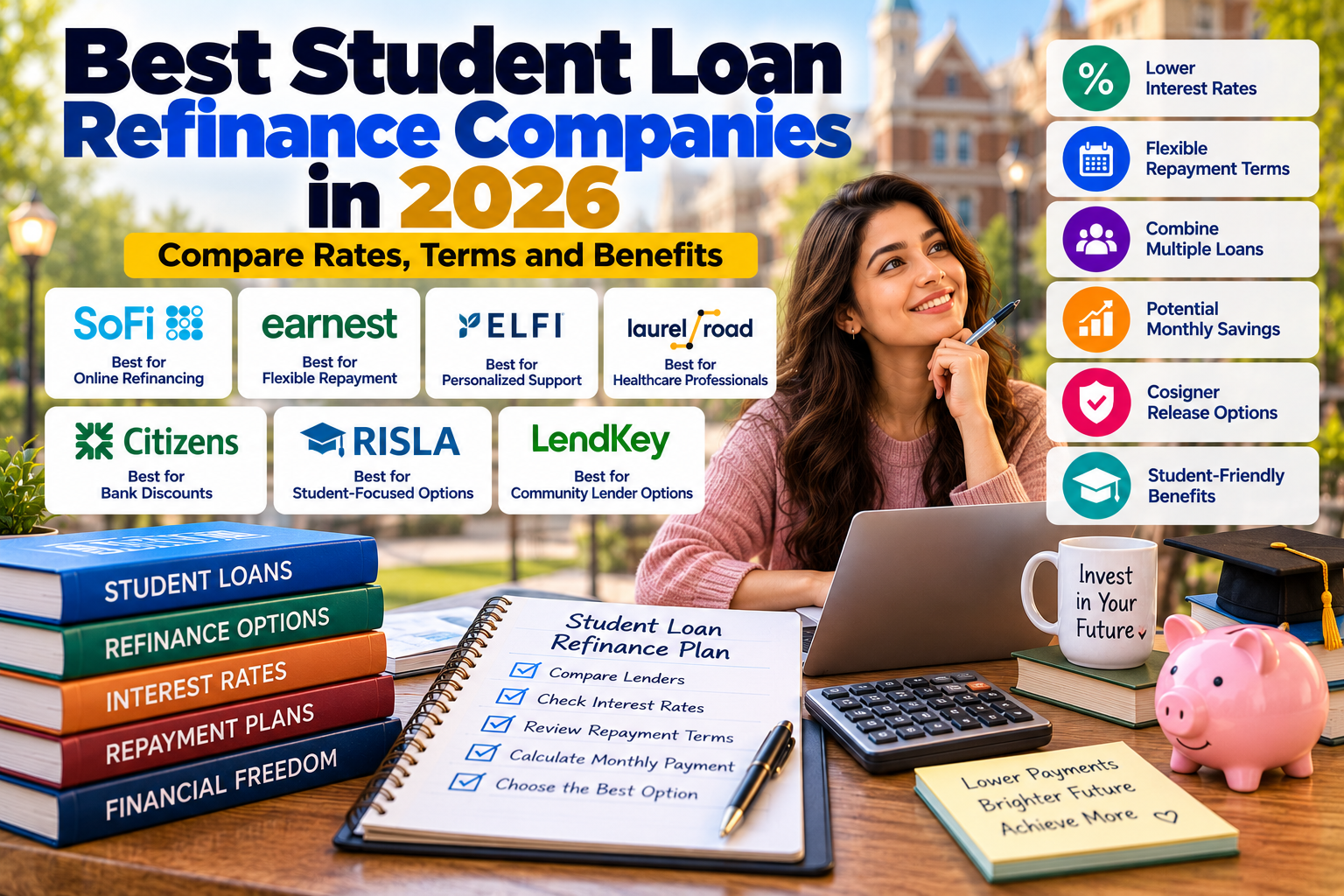
The following lenders are worth comparing when researching student loan refinancing in the United States. They differ in eligibility, repayment options, and borrower benefits. Confirm current rates and terms directly before applying.
1. SoFi — Best for Online Refinancing
SoFi offers student loan refinancing for eligible borrowers and provides an online application and account management experience.
Features to compare:
Fixed- and variable-rate offers, where available.
Different repayment terms.
Options for eligible borrowers to refinance qualifying federal or private student loans.
Potential discounts or member benefits, subject to current terms.
What to consider: Eligibility and pricing depend on your credit profile, income, and other factors. If you have federal loans, evaluate the value of your federal repayment protections before moving to a private lender.
Best for: Borrowers who want to compare online refinancing options and account-management features.
Website: SoFi
2. Earnest — Best for Repayment Flexibility
Earnest is a private lender known for offering student loan refinancing options with repayment features that eligible borrowers can customize.
Features to compare:
Available fixed- and variable-rate options.
Repayment term choices.
Payment scheduling features.
Eligibility requirements for applicants and cosigners.
What to consider: Flexible payment options do not necessarily mean lower total borrowing costs. Review the repayment term, APR, monthly payment, and any conditions attached to optional features.
Best for: Borrowers who value flexibility when choosing a repayment schedule.
Website: Earnest
3. Education Loan Finance (ELFI) — Best for Personalized Support
Education Loan Finance, commonly known as ELFI, offers student loan refinancing and support for borrowers evaluating their options.
Features to compare:
Refinancing for eligible student loan balances.
Fixed- and variable-rate options, where available.
Repayment terms and eligibility criteria.
Application guidance and borrower support.
What to consider: Compare the final offer with at least two other lenders. Ask about fees, payment relief options, and the requirements for refinancing with a cosigner.
Best for: Borrowers who prefer additional guidance while comparing refinancing offers.
Website: ELFI
4. Laurel Road — Best for Healthcare Professionals
Laurel Road is a lender worth exploring for healthcare professionals, including eligible doctors, dentists, and other borrowers in qualifying occupations.
Features to compare:
Refinancing options for eligible graduates.
Programs designed for certain healthcare professionals.
Available repayment terms.
Potential discounts or benefits for eligible applicants.
What to consider: Special programs may have specific eligibility conditions. Healthcare workers in residency or fellowship should compare payment requirements and any options relevant to their training period.
Best for: Eligible healthcare professionals looking for occupation-specific refinancing features.
Website: Laurel Road
5. Citizens — Best for Exploring Bank Discounts
Citizens offers student loan refinancing options for eligible borrowers. Depending on the current product terms, some applicants may qualify for discounts or other banking-related benefits.
Features to compare:
Available refinancing amounts.
Fixed-rate repayment options and any variable-rate options offered.
Repayment periods.
Eligibility for relationship or automatic-payment discounts.
What to consider: Check whether a discount applies to your situation and whether it changes the total cost enough to make the offer competitive.
Best for: Borrowers who want to compare a bank's refinancing terms with specialist lenders.
Website: Citizens
6. RISLA — Best for Exploring Borrower Benefits
The Rhode Island Student Loan Authority (RISLA) offers education financing products, including refinancing options. Its current programs and eligibility requirements should be reviewed before applying.
Features to compare:
Available refinancing products and terms.
Repayment and financial assistance features.
Fees and rate conditions.
Eligibility requirements for applicants.
What to consider: Confirm the current refinancing product, who can apply, and whether the repayment features meet your needs.
Best for: Borrowers who want to compare a student-loan-focused organization with private banks and online lenders.
Website: RISLA
7. LendKey — Best for Comparing Community-Lender Options
LendKey connects eligible borrowers with student loan refinancing options offered through participating community banks and credit unions.
Features to compare:
Access to offers from participating lenders.
Available repayment terms.
Application and eligibility requirements.
Fees and servicing arrangements.
What to consider: Terms may depend on the lender providing the loan. Confirm who will service the loan, how payments are handled, and which repayment protections are included.
Best for: Borrowers interested in comparing options from participating community lenders.
Website: LendKey
Student Loan Refinance Lender Comparison
Lender | Potential fit | What to compare |
|---|---|---|
SoFi | Online refinancing | APR, discounts, repayment terms |
Earnest | Flexible repayment | Payment options, eligibility, total cost |
ELFI | Personalized support | Rate, fees, service, repayment choices |
Laurel Road | Healthcare professionals | Occupation-specific eligibility and benefits |
Citizens | Bank-based refinancing | Discounts, loan limits, terms |
RISLA | Student-loan-focused options | Current products, fees, repayment features |
LendKey | Community-lender offers | Participating lender terms and servicing |
This is a comparison shortlist, not a guaranteed ranking. The best lender for you depends on the actual offer you qualify for. Rates, product availability, and eligibility criteria can change.
What Are Student Loan Refinance Rates in 2026?
Student loan refinancing rates vary by lender and borrower. Your credit score, income, existing debt, repayment term, and whether you apply with a cosigner can influence the rate offered.
Rates are commonly presented as an annual percentage rate (APR), which helps borrowers compare interest and certain fees.
Some lenders advertise low starting rates, but those offers generally apply only to applicants who meet the lender's strongest credit and financial criteria. The rate you receive may be higher.
When comparing offers, review:
The actual fixed or variable APR.
The length of the repayment term.
Any origination or administrative fees.
The monthly payment.
The total amount payable over the loan's life.
Whether a discount requires automatic payments or another condition.
A fixed rate generally remains the same during the loan term. A variable rate can change, potentially increasing your monthly payment and total borrowing cost.
For current lender comparisons, consult Bankrate's student loan refinancing guide and verify the terms directly with lenders. <Cite refs={["turn415539search0","turn415539news29"]}/>
Example: How Much Could Refinancing Save?
Consider a borrower with a $30,000 private student loan at a hypothetical fixed interest rate of 8%, with ten years remaining.
Suppose the borrower qualifies for a new ten-year loan at a fixed 5% interest rate, with no additional fees.
Detail | Existing loan | New refinance loan |
|---|---|---|
Starting balance | $30,000 | $30,000 |
Illustrative annual rate | 8% | 5% |
Repayment period | 10 years | 10 years |
Estimated monthly payment | $364 | $318 |
Estimated total payments | $43,680 | $38,160 |
Under these simplified assumptions, the new loan would reduce the monthly payment by approximately $46 and lower total payments by around $5,520.
These figures are illustrative estimates, not a lender quote. Actual results depend on the APR, fees, payment timing, and repayment terms. If refinancing extends the repayment period, the monthly payment might fall even when total interest increases.
For federal loans, this calculation does not account for the potential value of federal protections or forgiveness programs, which may be more important than a lower interest rate.
Who Should Consider Refinancing Student Loans?
Refinancing may be worth exploring if you:
Have private student loans with relatively high interest rates.
Have improved your credit score since taking out your original loans.
Have stable income and can comfortably afford the new payment.
Can qualify for a lower APR without costly fees.
Want to change your repayment term.
Have compared the new loan's total cost with your existing repayment plan.
Borrowers with strong credit and reliable income may have access to more competitive offers. However, approval and savings are never guaranteed.
When Should You Avoid Refinancing Federal Student Loans?
Federal student loans may offer benefits that private refinancing cannot reproduce.
Before refinancing federal loans, carefully consider whether you might need:
Income-driven repayment: Eligible federal repayment plans can link payments to income and family circumstances, subject to applicable rules.
Loan forgiveness: Certain borrowers may qualify for programs such as Public Service Loan Forgiveness or other federal forgiveness options.
Deferment or forbearance: Federal programs may provide qualifying borrowers with temporary payment relief under specified conditions.
Federal discharge protections: Eligible federal loans have certain discharge and cancellation provisions that may not be identical under private loan agreements.
Refinancing federal loans into a private loan generally removes access to these federal benefits for the refinanced balance. The decision can be difficult to reverse.
Review current options through Federal Student Aid and the Consumer Financial Protection Bureau before making a decision. <Cite refs={["turn415539search1","turn415539search2","turn415539search28"]}/>
How to Qualify for Student Loan Refinancing
Lenders evaluate several factors when reviewing applications.
Credit score and credit history
A strong credit history may improve your chances of approval and help you qualify for a lower rate. Lenders may also assess missed payments, existing balances, and other credit information.
Income and employment
Lenders generally want evidence that you can afford the proposed monthly payment. They may review your income, employment, and other financial obligations.
Debt-to-income ratio
Your debt-to-income ratio compares monthly debt payments with gross monthly income. A lower ratio may make it easier to demonstrate that you can manage a new loan payment.
Education and loan status
Some lenders require borrowers to have graduated or to meet particular enrollment or repayment conditions. Check whether your degree, school, and existing loan status qualify.
Cosigner eligibility
A creditworthy cosigner may improve approval odds or pricing for some applicants. However, the cosigner becomes legally responsible for the debt if the borrower fails to pay. Review any cosigner-release conditions before applying.
How to Refinance Student Loans Step by Step
Step 1: Review your current loans.
List each balance, interest rate, remaining repayment period, and monthly payment. Identify which loans are federal and which are private.
Step 2: Check your existing benefits.
For federal loans, investigate repayment plans and forgiveness eligibility before considering private refinancing. Do not assume that a lower rate will outweigh the value of these benefits.
Step 3: Compare multiple lenders.
Request prequalification where available. Check whether the process uses a soft credit inquiry or a hard inquiry and compare the APRs and terms you are offered.
Step 4: Calculate total repayment costs.
Compare the monthly payment, total interest, fees, and loan term. Avoid focusing only on the lowest monthly payment.
Step 5: Review the final agreement.
Confirm the rate, repayment schedule, fees, payment-relief options, and any cosigner obligations before signing.
Step 6: Confirm payoff of the old loans.
After the new loan is funded, verify that the original lenders have received the payoff amounts. Continue making required payments until the old balances are confirmed as paid.
Common Student Loan Refinancing Mistakes
Avoid these mistakes when evaluating refinancing offers:
Refinancing federal loans without reviewing forgiveness eligibility.
Choosing a variable rate without considering the risk of rate increases.
Extending repayment without calculating total interest.
Ignoring fees or discounts with specific conditions.
Applying with multiple lenders without understanding credit inquiry policies.
Assuming the lowest advertised rate is the rate you will receive.
Failing to verify that the original loans have been paid off.
Sharing sensitive financial or login information with an unverified company.
A careful comparison can help you avoid a refinancing decision that creates higher costs or removes protections you may need later.
Frequently Asked Questions
What is the best student loan refinance company in 2026?
There is no single best lender for every borrower. SoFi, Earnest, ELFI, Laurel Road, Citizens, RISLA, and LendKey are options to compare based on rates, fees, eligibility, and repayment features.
Can refinancing lower my student loan payments?
It may. A lower interest rate or longer repayment term can reduce monthly payments. However, a longer term may increase the total interest paid.
Can I refinance federal student loans?
Private lenders may allow eligible borrowers to refinance federal student loans, but doing so converts the refinanced balance into private debt and generally removes federal repayment and forgiveness protections for that balance. Review your options carefully before proceeding.
Does refinancing student loans hurt your credit score?
Applying may involve a hard credit inquiry, depending on the lender and application stage. Opening a new account can also affect your credit profile. The long-term impact depends on your overall credit behavior and circumstances.
Can I refinance student loans without a cosigner?
Yes, some borrowers qualify independently based on their credit, income, and other factors. If your application is weak, a qualified cosigner may improve your chances, but that person assumes legal repayment responsibility.
Is a fixed or variable student loan refinance rate better?
A fixed rate offers more predictable payments. A variable rate may start lower but can rise over time. Compare the risks and total cost under different rate scenarios.
How many times can I refinance student loans?
Some borrowers refinance more than once if they later qualify for better terms. Before refinancing again, compare any new fees, the remaining repayment period, and whether the change provides meaningful savings.
Final Thoughts
The best student loan refinance companies in 2026 offer terms that fit a borrower's financial situation, not just an attractive advertised rate. SoFi, Earnest, ELFI, Laurel Road, Citizens, RISLA, and LendKey provide different options worth researching.
Compare actual APRs, repayment terms, fees, and borrower benefits before choosing a lender. If your loans are federal, review current federal repayment and forgiveness options first. Refinancing can be useful for some borrowers, especially those with high-rate private loans, but the right decision depends on the full financial picture.
Disclaimer: This article is for educational purposes only and does not constitute financial, tax, or legal advice. Rates, eligibility, and lender terms can change. Verify current offers directly with lenders and assess the consequences before refinancing.