
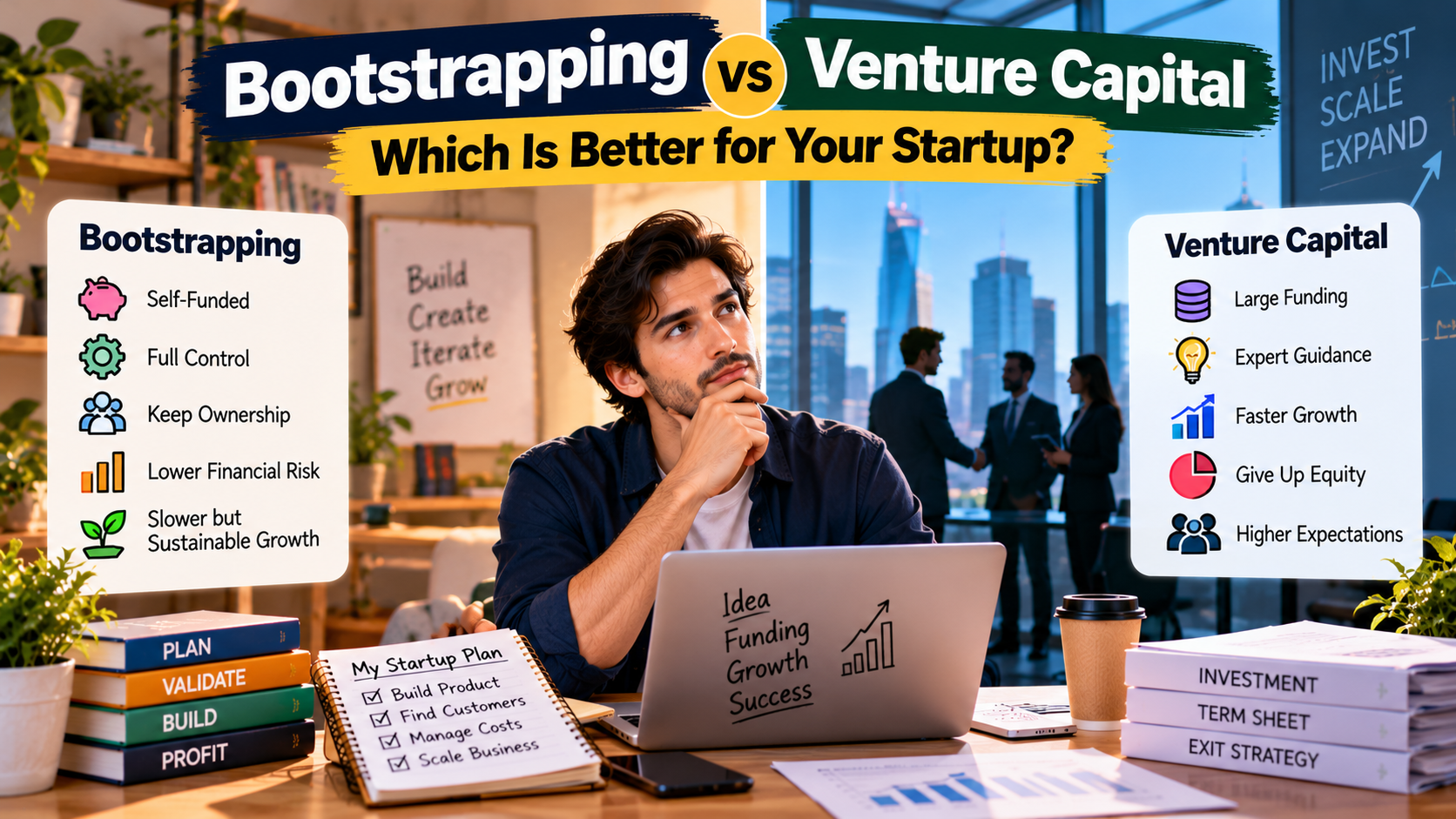
Starting a business requires more than a promising idea. Entrepreneurs also need enough money to develop products, acquire customers, pay operating expenses, and support growth. One of the most important early decisions is determining how to finance the business.
Two common approaches are bootstrapping and venture capital. Bootstrapping involves building a business primarily with personal funds, business revenue, or other resources that do not require selling equity to outside investors. Venture capital involves raising investment from professional investors in exchange for an ownership stake, usually in businesses with substantial growth potential.
Both approaches can help startups develop, but they create different financial obligations, ownership structures, and expectations.
Bootstrapping may allow founders to maintain greater control and grow at their own pace. Venture capital can provide substantial funding, industry connections, and resources to pursue faster expansion. However, outside investment often brings greater expectations for growth, reporting, and eventual investor returns.
There is no universally correct choice. The best funding strategy depends on the business model, market opportunity, capital requirements, risk tolerance, and long-term objectives of the founders.
This guide explains the differences between bootstrapping and venture capital, their advantages and disadvantages, and how entrepreneurs can choose a suitable startup funding strategy.
What Is Bootstrapping?
Bootstrapping is the process of building and operating a business using limited external funding. Entrepreneurs may use personal savings, revenue from early customers, retained profits, or resources they already own.
Instead of raising a large investment at the beginning, founders focus on controlling expenses and generating enough income to support operations.
For example, a freelance developer might start by providing services to clients, use the earnings to purchase better equipment, and gradually turn the service into a small software business.
An online store might begin with a limited product range, validate customer demand, and reinvest profits into additional inventory.
Advantages of bootstrapping
Greater ownership and control
Founders generally avoid giving away equity when they finance the business through personal resources and revenue. They can retain more authority over strategic decisions, although their choices may still be affected by lenders, contracts, or other obligations.
Financial discipline
Limited capital encourages entrepreneurs to prioritize essential spending, test ideas before investing heavily, and pay attention to profitability.
Fewer external growth pressures
A bootstrapped company may have more flexibility to pursue steady growth rather than meet investor expectations for rapid expansion or a specific exit.
Customer-focused development
Because customer revenue is important, founders may focus closely on solving real problems and building products that customers are willing to pay for.
Disadvantages of bootstrapping
Bootstrapping also has limitations.
The business may grow more slowly because expansion depends on available cash and operating revenue. Founders may have fewer resources for hiring, research, marketing, and product development.
Using personal savings can create financial risk, particularly if the business takes longer than expected to generate revenue.
Limited capital can also make it difficult to compete in industries that require significant upfront investment.
Bootstrapping works best when the business can begin on a manageable scale, generate revenue relatively early, and grow without requiring unusually large capital commitments.
What Is Venture Capital?
Venture capital is a form of equity financing in which investors provide funding to companies with the potential for substantial growth.
Venture capital firms typically invest in businesses that could expand significantly and generate a return through a future acquisition, public listing, or another liquidity event.
In exchange for investment, founders generally sell a portion of the company's ownership. The terms may also affect voting rights, board representation, future fundraising, and other decisions.
Venture capital is common in areas such as software, biotechnology, advanced technology, and other industries where companies may need significant resources before becoming profitable.
For example, a software startup developing a complex enterprise platform might raise venture capital to hire engineers, develop its product, and establish a sales team before it generates enough revenue to fund those activities.
Advantages of venture capital
Access to larger amounts of funding
External investment can help businesses finance product development, recruitment, marketing, infrastructure, and expansion that would be difficult to support through early revenue alone.
Access to expertise and networks
Some investors provide strategic advice, industry relationships, hiring support, and introductions to potential customers or future investors.
Potential for faster expansion
When a company has a strong business model and a large market opportunity, additional capital can help it expand more quickly.
Reduced dependence on personal savings
Founders may avoid funding every expense from their own resources. However, venture investment does not eliminate business risk or guarantee future success.
Disadvantages of venture capital
Dilution of ownership
When a startup issues equity to investors, founders own a smaller percentage of the company. Additional funding rounds may create further dilution.
Greater expectations
Venture investors generally seek substantial returns. This can create pressure to grow quickly, enter new markets, or pursue strategies that differ from a founder's original preferences.
More complex decision-making
Investment agreements may introduce board oversight, approval requirements, reporting obligations, and other governance arrangements.
Time-consuming fundraising
Preparing presentations, meeting investors, negotiating terms, and completing due diligence can consume significant time.
No guarantee of future funding
Raising one round does not guarantee that investors will finance later rounds. If a company spends too quickly and cannot secure additional capital, it may face serious financial difficulties.
Venture capital can be valuable when a business has a credible opportunity that requires substantial funding, but it is not necessary or suitable for every startup.
Bootstrapping vs. Venture Capital: Key Differences
The main differences relate to ownership, available capital, growth expectations, financial risk, and decision-making.
Factor | Bootstrapping | Venture capital |
|---|---|---|
Funding source | Personal resources and business revenue | Outside equity investors |
Founder ownership | Usually retained to a greater extent | Reduced through equity issuance |
Growth pace | Often tied to available cash and revenue | Can accelerate with sufficient capital |
Decision-making | Usually more founder-controlled | May involve investor and board oversight |
Financial pressure | Cash-flow and personal capital constraints | Growth and investor-return expectations |
Fundraising process | Often simpler, though other financing may still be needed | Usually involves pitching, diligence, and negotiations |
Suitable businesses | Models that can grow through revenue | Businesses with large growth potential and substantial capital needs |
Profitability | Often important for financing ongoing operations | May be deferred while investing in growth |
These are general patterns, not absolute rules. Some bootstrapped businesses grow rapidly, while some venture-backed companies prioritize early profitability. The details depend on the company and its financing agreements.
Which Funding Option Is Better for a Small Business?
For many small businesses, bootstrapping is a practical starting point.
A consulting firm, freelance agency, specialized online store, or digital product business may be able to start with limited capital and generate revenue without raising institutional investment.
In these cases, venture capital may introduce unnecessary complexity. Selling equity is not always worthwhile when a business can grow steadily through customer revenue.
Bootstrapping may be particularly suitable when:
Initial startup costs are relatively low.
The business can generate revenue early.
Founders want to maintain ownership.
Growth can be financed through retained earnings.
The business does not need to dominate a market rapidly.
However, a business that requires extensive research, expensive infrastructure, or a large upfront investment may need a different financing strategy.
The key question is not whether bootstrapping is inherently better. It is whether the business can achieve its objectives with the capital available.
When Should a Startup Consider Venture Capital?
Venture capital may be appropriate when the business has a substantial growth opportunity that cannot reasonably be pursued through its current resources.
Consider a technology startup developing a complex product that requires a specialized engineering team and significant research before it can serve customers.
If the market opportunity is large and early evidence suggests that customers want the product, external investment could help the company reach important milestones more quickly.
Venture capital may be worth exploring when:
The addressable market is large.
The business can scale significantly.
Product development requires substantial investment.
Speed matters because of competition or market conditions.
The company has evidence of customer demand or a credible technical advantage.
Founders are comfortable sharing ownership and certain governance rights.
Raising venture capital solely because competitors have done so is not a sound strategy. Funding should address a specific business need and support a clear plan for creating value.
Can a Startup Combine Bootstrapping and Venture Capital?
Yes. Some businesses begin by bootstrapping and later raise external investment when they have stronger evidence of demand.
This approach can allow founders to validate their idea, develop an initial product, and establish early customer relationships before negotiating with investors.
For example, a startup might initially use founder savings and customer revenue to build a basic software product. Once it demonstrates customer demand and a repeatable sales process, it may raise funding to hire staff or enter additional markets.
Starting with revenue can strengthen a company's negotiating position, although it does not guarantee better investment terms.
A hybrid strategy can also include other financing sources, such as loans, grants, crowdfunding, or strategic partnerships. Each has different eligibility requirements, costs, obligations, and risks.
The right combination depends on the company's financial position and objectives.
Other Startup Funding Options to Consider
Bootstrapping and venture capital are not the only choices available to entrepreneurs.
Small business loans
Loans provide capital that must generally be repaid with interest according to agreed terms. They can help finance equipment, inventory, or working capital, but repayment obligations may create pressure if revenue falls.
Crowdfunding
Crowdfunding allows businesses to seek contributions from a larger group of people through a suitable platform. Depending on the arrangement, supporters may receive a product, a reward, or an ownership interest.
Successful campaigns usually require preparation, audience development, and clear communication. Platform rules and legal requirements vary.
Angel investors
Angel investors are individuals who invest their own money in early-stage companies. Some also provide mentoring and professional connections.
Like venture capital, angel investment generally involves giving up equity, and the terms should be reviewed carefully.
Grants and business competitions
Certain governments, nonprofit organizations, universities, and private organizations offer grants or competitions for eligible businesses. Funding may be restricted to specific industries, locations, or objectives, and applications can be competitive.
Revenue-based financing
Some financing arrangements allow a business to receive capital in exchange for a percentage of future revenue until a defined repayment amount or condition is reached. Costs and terms vary, so entrepreneurs should evaluate the total repayment obligation carefully.
Before choosing any funding source, compare its total cost, legal obligations, impact on ownership, and suitability for the business.
How to Decide Which Funding Strategy Fits Your Startup
A structured evaluation can help founders make a more informed decision.
1. Estimate your actual capital requirements
Calculate the money needed to develop the product, begin operations, acquire customers, and maintain a reasonable cash reserve.
Avoid raising or borrowing more money than the business can use productively.
2. Evaluate your revenue model
Ask how the business will generate revenue, how quickly customers might pay, and whether gross margins can support operating costs.
Businesses that generate revenue early may have more opportunities to bootstrap.
3. Understand your growth objectives
Decide whether the goal is to build a sustainable, profitable business or pursue rapid expansion in a large market.
Both goals can be legitimate, but they may require different financing strategies.
4. Consider ownership and control
Think carefully about how much ownership you are willing to sell and which decisions you would be comfortable sharing with investors.
Review proposed agreements with qualified legal and financial advisers before signing.
5. Compare the risks
Bootstrapping may expose personal savings or limit growth because of cash constraints. Venture capital may reduce founder ownership and create pressure to meet ambitious milestones.
No option eliminates risk. The objective is to choose the type of risk that fits your circumstances.
6. Define measurable milestones
Before raising money, identify what the funding should accomplish.
Examples include launching a product, reaching a specific number of paying customers, improving retention, expanding distribution, or achieving a defined operational milestone.
Clear milestones make it easier to evaluate whether additional funding is justified.
Common Startup Funding Mistakes to Avoid
Entrepreneurs can make costly decisions when they focus on obtaining money instead of building a sustainable business.
Raising too much too early: A large investment can encourage unnecessary spending before the business model has been validated.
Giving away equity without understanding the terms: Founders should consider dilution, voting rights, board arrangements, future financing, and other contractual provisions.
Ignoring cash flow: Funding can disappear quickly if spending is not connected to measurable priorities.
Choosing investors for money alone: Investors may differ in expertise, expectations, communication style, and involvement. Compatibility matters.
Taking on debt without a repayment plan: Borrowing creates financial obligations even when sales are weaker than expected.
Treating fundraising as proof of success: Investment can provide resources, but it does not prove that customers will buy the product or that the company will become profitable.
Ignoring alternative financing: Loans, grants, revenue, partnerships, or smaller funding rounds may be more appropriate in certain situations.
Careful financial planning and realistic expectations can help founders avoid these mistakes.
Conclusion
Choosing between bootstrapping and venture capital is one of the important financial decisions an entrepreneur may face. Bootstrapping can preserve greater ownership and encourage disciplined spending, while venture capital can provide resources and connections for businesses with substantial growth potential.
Neither strategy is universally superior. A service business that can grow through customer revenue may benefit from bootstrapping, while a capital-intensive startup pursuing a large market may need outside investment.
Some businesses can combine both approaches, starting with limited resources and raising capital after validating demand.
Before deciding, evaluate your business model, capital requirements, growth objectives, risk tolerance, and willingness to share ownership. Compare alternative funding options and understand the financial and legal implications of each.
The best funding strategy is the one that gives your business a realistic path to sustainable growth while supporting the founders' long-term objectives.
Frequently Asked Questions
Is bootstrapping better than venture capital?
Bootstrapping can be better for businesses that can grow through customer revenue and whose founders want to retain greater control. Venture capital may be more suitable when substantial investment is needed to pursue a large growth opportunity.
Can a startup succeed without venture capital?
Yes. Many businesses can operate through personal resources, customer revenue, loans, or other funding sources. Whether this is practical depends on the business model and the capital required.
Do venture capital investors own the entire company?
Usually not. Investors generally receive a negotiated ownership stake in exchange for their investment. The percentage and associated rights depend on the transaction terms.
Can a bootstrapped startup raise venture capital later?
Yes. A company can begin with founder funding and revenue, then seek investment when it has demonstrated customer demand or identified a clear need for expansion.
What is the biggest disadvantage of venture capital?
Potential disadvantages include ownership dilution, investor expectations, additional governance requirements, and pressure to achieve significant growth. The impact depends on the investment terms and relationship with investors.
What should founders do before raising money?
Founders should understand their capital needs, validate customer demand, prepare realistic financial projections, define funding milestones, and review the legal and financial terms of potential investments.