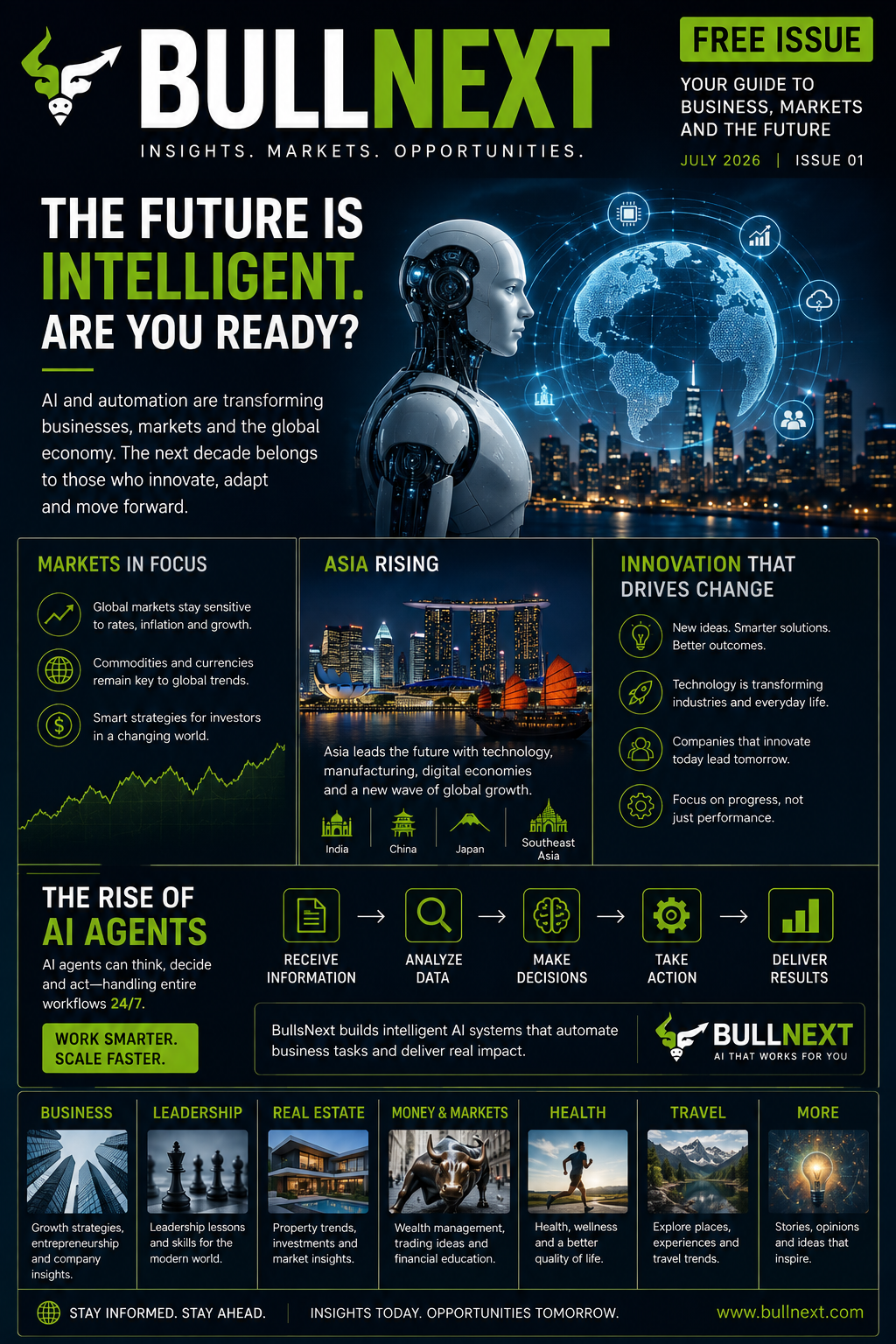
Welcome to the BullNext Free Issue, a special overview of the ideas and trends shaping business, technology, markets, and the global economy in 2026.
BullNext is a publishing platform covering areas including Markets, Tech & AI, Innovation, Leadership, Business, Asian Markets, Real Estate, Money & Markets, Health, Travel, and more. Its current coverage includes stories ranging from AI agents and decision intelligence to global markets, innovation, and economic trends.
The common theme across these subjects is change. Businesses are adapting to artificial intelligence, investors are watching shifting economic conditions, and consumers are becoming increasingly connected to digital services.
For readers, understanding these trends can provide a clearer picture of where opportunities may emerge.
AI Is Moving From Experiment to Business Infrastructure
Artificial intelligence is no longer limited to generating text, creating images, or answering questions.
In 2026, businesses are increasingly exploring AI for practical applications such as customer service, data analysis, workflow automation, forecasting, marketing, and decision-making.
BullNext's recent technology coverage highlights this transition, including articles about AI agents, AI-powered decision intelligence, AI observability, digital twins, and AI-powered customer experiences.
The important shift is from asking:
"What can AI generate?"
to asking:
"What work can AI actually perform?"
That distinction could define the next stage of enterprise AI adoption.
The Rise of AI Agents
One of the most significant developments is the rise of AI agents.
Traditional software usually waits for a user to provide instructions. An AI agent can potentially interpret a goal, analyze information, use software tools, make decisions, and complete multiple steps in a workflow.
A simplified process could look like:
Receive information → Analyze → Decide → Take action → Report results
This could be useful in customer service, sales, finance, marketing, logistics, ecommerce, and other business functions.
BullNext's current coverage describes AI agents as systems that can work through multi-step business processes while helping employees focus on more strategic and creative responsibilities.
The opportunity is significant, but businesses still need appropriate oversight. AI-generated decisions should be evaluated according to the risk and importance of the task.
AI-Powered Decision Intelligence
Another important development is AI-powered decision intelligence.
Businesses already collect enormous amounts of information from sales, customers, websites, financial systems, supply chains, and other sources.
The challenge isn't necessarily collecting more data.
The challenge is understanding it quickly enough to make good decisions.
AI-powered decision intelligence can analyze patterns, identify relationships, forecast possible outcomes, and help executives evaluate different options.
BullNext describes this as a move beyond traditional business intelligence, where systems can help organizations think about not only what happened, but also what could happen next and what actions might produce better results.
Human leadership remains important. AI can provide information and scenarios, but business leaders still need to consider strategy, uncertainty, regulations, ethics, and factors that may not be represented in the data.
Why AI Observability Matters
As businesses deploy more AI systems, another challenge is emerging: understanding what those systems are doing.
A traditional software monitoring system can show whether an application is running properly.
AI systems can be more complicated.
Businesses may need to understand:
How models are performing
Whether outputs are accurate
How AI agents are behaving
Where failures occur
How customers are experiencing AI-powered services
When human intervention is necessary
BullNext's recent coverage describes AI observability as increasingly important as organizations integrate AI agents and automated systems more deeply into their operations.
This means the future of AI isn't only about building smarter systems. It is also about making those systems more reliable, transparent, and manageable.
Global Markets in 2026
Technology is only one side of the story.
Financial markets are also responding to changing interest-rate expectations, inflation, energy prices, corporate earnings, currencies, and geopolitical developments.
BullNext's current Markets coverage includes U.S. markets, global markets, rates and bonds, commodities, funds, and other financial topics.
Recent BullNext market analysis highlights how stocks, bonds, currencies, commodities, and AI investment are interacting to create a complicated investment environment.
For investors, diversification and risk management remain important because different asset classes can respond very differently to the same economic event.
AI and the Stock Market
Artificial intelligence has also become a major investment theme.
Companies are spending heavily on:
Data centers
Semiconductors
Cloud computing
AI software
Networking equipment
Electricity infrastructure
Advanced computing
This investment has created opportunities for technology companies and businesses supplying the infrastructure needed for AI.
But it has also created an important question:
Will future earnings justify today's AI investment and valuations?
BullNext's recent global-markets coverage highlights the continuing importance of AI investment while noting that investors are increasingly examining whether spending will translate into sustainable earnings and productivity gains.
Asia Continues to Rise
Asia remains one of the most important regions in the global economy.
China, India, Japan, South Korea, and Southeast Asia all contribute to the region's economic importance in different ways.
Asia is a major center for:
Manufacturing
Semiconductors
Technology
Ecommerce
Digital payments
Consumer markets
Energy
Global trade
South Asia is also attracting significant attention. BullNext's current economic coverage highlights the region's growth potential and the increasing importance of India as a major contributor to economic activity.
For investors and businesses, Asia is therefore more than a geographic region. It is an important part of the future global growth story.
Innovation Is Driving Business Growth
Innovation remains another central theme.
Modern businesses are using innovation to improve products, reduce costs, enhance customer experiences, and create new revenue opportunities.
BullNext's innovation coverage highlights several forms of innovation, including product innovation, process innovation, business-model innovation, and marketing innovation.
Process innovation is particularly important because it can improve how a company operates behind the scenes.
Examples include:
Workflow automation
Digital document management
Cloud collaboration
AI-driven analytics
Robotic process automation
These improvements may not always be visible to customers, but they can have a significant impact on efficiency.
Customer Experience Is Changing
Customer expectations are also evolving.
People increasingly expect businesses to respond quickly, understand their preferences, and provide consistent experiences across websites, applications, email, social platforms, and physical locations.
AI can help businesses analyze customer behavior, personalize interactions, automate routine support, and provide employees with useful information.
BullNext's recent coverage describes this shift from basic chatbots toward broader AI-powered customer experiences.
However, technology should support customer relationships rather than make them feel impersonal.
The strongest customer experience may combine automation for speed with human support when empathy, judgment, or complex problem-solving is required.
The Global Economy
The global economy in 2026 is balancing several competing forces.
Economic growth remains positive, while inflation, energy costs, trade uncertainty, and geopolitical risks continue to influence businesses and investors.
BullNext's recent economic coverage highlights AI investment as one of the forces supporting economic activity while also discussing energy pressures and changing global trade conditions.
Businesses therefore need to remain flexible.
A strategy that works in one economic environment may need to change when interest rates, energy costs, currencies, or consumer demand shift.
The Importance of Leadership
Technology alone cannot guarantee business success.
Leadership determines how effectively an organization responds to change.
Modern leaders need to understand:
Technology
Data
AI
Employees
Customers
Risk
Markets
Innovation
BullNext's Leadership section focuses on topics such as C-suite leadership, careers, education, and the skills required for modern business leaders.
The strongest leaders may increasingly be those who can combine human judgment with technological capabilities.
AI can process information quickly, but leadership still requires communication, responsibility, creativity, and strategic thinking.
What Readers Can Expect From BullNext
The BullNext platform brings together different areas of business and lifestyle coverage.
Readers can explore:
Markets: Stocks, bonds, currencies, commodities, and economic trends.
Tech & AI: Artificial intelligence, digital transformation, and emerging technologies.
Innovation: New ideas, business models, and technologies changing industries.
Leadership: Management, careers, education, and executive skills.
Asian Markets: Economic and financial developments across Asia.
Real Estate: Property markets and investment strategies.
Money & Markets: Personal finance, wealth management, and financial education.
Health: Wellness and healthcare topics.
Travel: Destinations, experiences, and travel trends.
This variety allows readers to understand business from multiple perspectives rather than focusing on a single industry.
What Comes Next?
The next few years could bring even greater integration between AI, business, finance, and everyday life.
AI agents may handle increasingly complex workflows.
Digital twins may help companies simulate physical operations.
Decision-intelligence systems may support strategic planning.
AI observability may become essential for managing automated systems.
At the same time, investors will continue watching interest rates, inflation, corporate earnings, energy markets, technology spending, and global economic growth.
The companies that succeed may not simply be the ones adopting the most technology.
They may be the companies that understand where technology creates genuine value.
Final Thoughts
The BullNext Free Issue brings together the major themes shaping business and markets in 2026: artificial intelligence, AI agents, innovation, global markets, Asian economies, leadership, customer experience, and economic change.
The biggest lesson is that these subjects are increasingly connected.
AI affects markets.
Markets influence business investment.
Innovation changes customer expectations.
Leadership determines how organizations respond.
And global economic conditions influence all of them.
BullNext's current coverage reflects this increasingly interconnected environment, with stories spanning AI, markets, innovation, leadership, health, real estate, and global economic developments.
For readers, the goal isn't simply to follow every headline. It is to understand the larger forces behind those headlines.
Technology is changing how businesses work.
Markets are changing how investors think.
Innovation is changing what customers expect.
And global connectivity is changing where opportunities emerge.
The future will belong to organizations and individuals that can adapt to these changes while keeping a clear focus on real-world value.