Technology is moving from the background of business operations to the center of strategic decision-making. Artificial intelligence, cloud computing, advanced data platforms, cybersecurity, automation, and high-performance computing are changing how organizations operate and compete.
For businesses looking to move beyond AI experimentation, the challenge is no longer simply choosing an AI model. Organizations also need the infrastructure, data, networking, security, and management capabilities required to put AI into production.
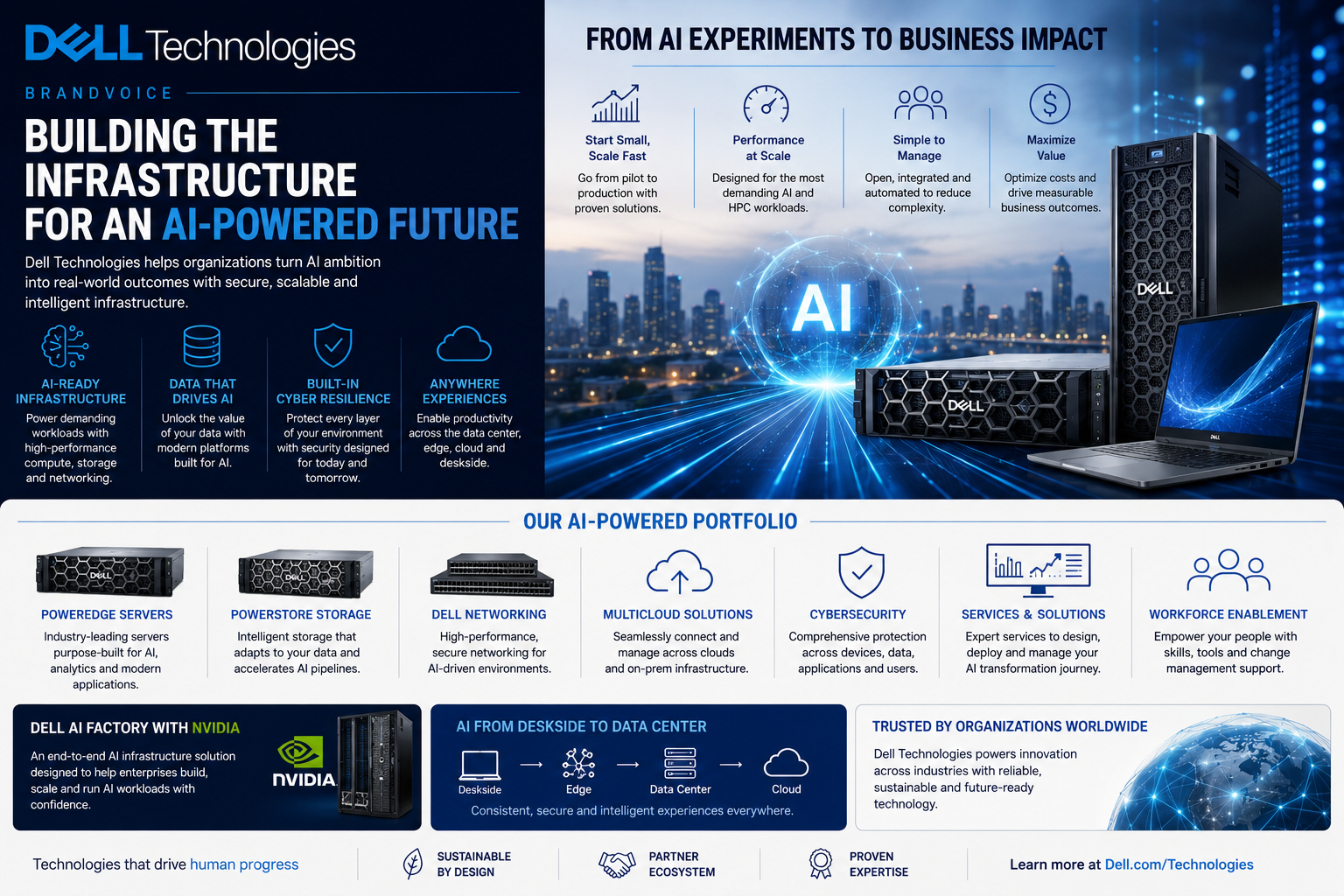
This is where Dell Technologies has positioned its technology portfolio, with a growing focus on enterprise AI infrastructure and the transition from experimentation to scalable business applications. Dell's recent announcements emphasize AI-ready infrastructure spanning compute, storage, networking, data, security, and services.
From AI Experiments to Real Business Outcomes
Many organizations began their AI journeys with small pilot projects.
A team might test an AI assistant, experiment with generative AI, or build a proof of concept.
But moving from a successful demonstration to a production environment is much more complicated.
Companies need to consider:
Data availability
Computing capacity
Storage
Networking
Security
Governance
Cost
Scalability
Employee adoption
Ongoing management
Dell's recent AI strategy focuses heavily on this transition from AI pilot projects to production deployments. The company says its Dell AI Factory with NVIDIA is designed to provide an integrated foundation for organizations scaling AI workloads.
The broader lesson for businesses is clear: AI success depends not only on the model, but also on the infrastructure surrounding it.
Why Infrastructure Matters
AI applications can require significant computing resources.
Training sophisticated models can require specialized processors and large datasets. Even inference—the process of using an AI model after training—can create substantial demand when thousands or millions of users interact with an application.
This creates new infrastructure requirements.
Businesses need systems capable of handling AI workloads while maintaining reliability, security, and predictable costs.
Dell's PowerEdge server portfolio and AI infrastructure offerings are designed around these requirements, with configurations supporting demanding AI, analytics, virtualization, and other enterprise workloads.
The Data Challenge
AI is only as useful as the information it can access.
Organizations often have data distributed across databases, applications, file systems, cloud environments, and physical infrastructure.
This can make it difficult to provide AI systems with the right information at the right time.
Dell has therefore emphasized the importance of an AI-ready data foundation alongside computing infrastructure. Its recent AI Factory announcements include updates intended to help organizations organize and use enterprise data for AI workloads.
For businesses, this highlights an important principle:
AI strategy should begin with data strategy.
Before investing heavily in AI applications, organizations should understand where their data lives, how reliable it is, who can access it, and how it can be used responsibly.
The Rise of Agentic AI
Generative AI can answer questions and generate content.
The next development is increasingly focused on agentic AI—systems that can potentially perform multi-step tasks, interact with tools, and execute workflows with greater autonomy.
This could transform areas such as:
Customer service
IT operations
Research
Finance
Software development
Supply chains
Business administration
Dell announced solutions designed to support agentic AI locally, including infrastructure and software intended to help organizations build, test, and govern AI agents.
For enterprises, local or controlled AI deployments can be particularly relevant when organizations need greater control over sensitive data, security, performance, or operating costs.
AI From the Data Center to the Desk
Enterprise AI doesn't necessarily have to live exclusively in centralized cloud environments.
Some workloads may benefit from being processed closer to employees, devices, factories, hospitals, or other locations where decisions are made.
This is part of the broader edge AI trend.
Dell's recent announcements include a deskside agentic-AI approach intended to allow enterprises to run certain AI workloads locally and connect them with larger AI infrastructure as requirements grow.
This distributed model could become increasingly important for organizations that need low latency, data control, or predictable performance.
Modernizing the Data Center
AI is also forcing companies to reconsider traditional data-center design.
High-performance AI systems can create substantial requirements for:
Power
Cooling
Networking
Storage
Physical space
Infrastructure management
Dell's 2026 data-center announcements included new PowerEdge systems, storage technologies, cybersecurity capabilities, and automation tools designed around modern AI and enterprise workloads.
The data center of the future may therefore look significantly different from the infrastructure many organizations built for traditional workloads.
AI and Cybersecurity
As AI becomes more deeply integrated into business operations, security becomes even more important.
Organizations need to protect:
Enterprise data
AI models
User identities
Applications
Infrastructure
AI agents
Network connections
A security problem involving an AI system could affect not only information but also automated business processes.
Dell has highlighted cyber resilience as part of its broader infrastructure strategy, including technologies intended to help organizations protect and recover data and infrastructure.
For executives, this means AI adoption and cybersecurity planning should increasingly happen together.
The Importance of Flexible Infrastructure
Technology changes quickly.
An organization investing in infrastructure today needs to consider what its requirements could look like several years from now.
Flexible systems can make it easier to:
Add computing capacity
Expand storage
Upgrade networking
Support new AI models
Modernize software
Adapt to changing workloads
Dell has emphasized modularity and scalability across several of its infrastructure announcements, reflecting the need for organizations to modernize without repeatedly rebuilding their entire technology environment.
Partnerships Are Becoming More Important
No single company can provide every component of the modern AI ecosystem.
AI infrastructure increasingly involves collaboration among:
Hardware companies
Chip manufacturers
Software developers
Cloud providers
AI model companies
Data-platform providers
System integrators
Dell's AI ecosystem includes partnerships with companies such as NVIDIA and Mistral AI, among others. Dell announced that Mistral AI is using Dell infrastructure for large-language-model training and deployment and that the companies are expanding their collaboration.
This ecosystem approach can give enterprises more options when building AI environments.
AI and the Future of Work
Technology infrastructure ultimately exists to support people and organizations.
AI can help employees analyze information, automate repetitive tasks, generate content, and make decisions faster.
But successful AI adoption also requires workforce development.
Employees need to understand:
How to use AI tools
When AI should be trusted
When human review is required
How to protect sensitive information
How AI changes existing workflows
Dell's BrandVoice coverage has also highlighted the importance of reskilling and continuous learning as organizations adopt AI.
Technology investment and employee development therefore need to progress together.
What CIOs Should Consider
For CIOs and technology leaders, building an AI-ready organization involves more than buying servers.
Important questions include:
Is our data ready for AI?
Can our infrastructure scale?
How will we secure AI workloads?
Where should AI run—cloud, on-premises, edge, or a combination?
How will we measure ROI?
Which workloads should be automated?
How will employees use the technology?
These questions can help technology leaders connect infrastructure decisions with business outcomes.
Moving Toward the AI-Native Enterprise
The concept of an AI-native enterprise is becoming increasingly important.
Rather than treating AI as an isolated application, organizations can begin incorporating AI into everyday processes.
That could mean:
AI-assisted customer service
AI-powered analytics
Automated IT operations
Intelligent supply chains
AI-supported research
Agentic workflows
Predictive business decisions
Dell has outlined an AI-native strategy centered on areas such as AI-ready data, distributed infrastructure, secured autonomous systems, an integrated technology stack, and AI economics.
The goal is to make AI part of the organization's operating model rather than simply another software tool.
The Competitive Advantage
AI infrastructure itself isn't necessarily the competitive advantage.
The advantage comes from what organizations can build with it.
A company might use AI infrastructure to:
Develop new products
Improve customer experiences
Accelerate research
Reduce repetitive work
Analyze large datasets
Improve operational efficiency
Create new services
This shifts the conversation from technology ownership to business outcomes.
The organizations that gain the most from AI may be those that connect infrastructure investment directly to measurable strategic goals.
Looking Ahead
The AI landscape will continue to evolve.
New models will emerge.
Computing architectures will change.
Data requirements will increase.
AI agents may become more capable.
Edge computing may expand.
Organizations will continue balancing cloud services with infrastructure they control directly.
This makes flexibility increasingly important.
Businesses shouldn't build technology strategies around a single moment in AI's development.
They need infrastructure that can evolve alongside the technology.
Final Thoughts
The next phase of enterprise AI will be less about experimentation and more about execution.
Organizations need reliable infrastructure, accessible data, strong security, scalable computing, effective networking, and employees who understand how to use AI responsibly.
Dell Technologies is positioning its portfolio around this transition, with recent developments spanning AI infrastructure, data platforms, agentic AI, servers, storage, networking, cybersecurity, and automation.
For business leaders, the central lesson is simple:
AI isn't just a software decision. It's an infrastructure, data, workforce, security, and strategy decision.
The companies that successfully bring these pieces together will be better positioned to turn AI from an exciting experiment into a practical source of innovation and business value.