Relying on a single source of income can make financial planning difficult, particularly when earnings depend on one employer, one client, or one business. Creating multiple income streams online can provide additional earning opportunities and help individuals build greater financial flexibility over time.
The internet has made it possible to sell professional services, develop digital products, create educational content, participate in affiliate programs, and operate online businesses without necessarily maintaining a physical storefront.
However, building multiple income streams requires more than signing up for several platforms. Each opportunity has its own costs, risks, learning curve, and potential returns. Some generate revenue only when work is performed, while others may continue producing sales after the initial work is completed.
The most practical strategy is to start with one suitable income source, develop a repeatable process, and gradually add complementary opportunities.
This guide explains how to create multiple income streams online, which business models beginners can consider, how to avoid common mistakes, and how to build a more sustainable online income strategy.
What Are Multiple Income Streams?
Multiple income streams are different sources through which a person or business earns money.
For example, a freelance writer might earn income from client projects, sell writing templates, publish a paid educational guide, and earn commissions from relevant software recommendations.
These sources differ in how they generate revenue and how much ongoing work they require.
Common categories include:
Active income: Earnings directly linked to time or work, such as freelancing and consulting.
Product-based income: Revenue from selling physical or digital products.
Audience-based income: Earnings from advertising, sponsorships, memberships, or affiliate marketing.
Recurring income: Payments from subscriptions, retainers, memberships, or ongoing service agreements.
Investment income: Potential returns from financial assets, which involve different risks and capital requirements.
Not every income stream is passive, predictable, or profitable. A digital product may require regular updates and customer support, while an affiliate website may need continuous content development to maintain traffic.
The goal is to build a combination of income sources that fits your skills, financial situation, available time, and long-term objectives.
Why Build Multiple Income Streams Online?
Creating additional income sources can offer several advantages when approached carefully.
Greater financial flexibility
Additional earnings may help cover expenses, build savings, repay debt, or fund future business opportunities. The benefit depends on how much remains after expenses and taxes.
More opportunities to use existing skills
A skill developed for one purpose can often support several business models. For example, a designer might provide client services while also selling templates or creating educational resources.
Reduced dependence on one customer or platform
A freelancer who depends on a single client may face financial difficulty if that relationship ends. A broader customer base can reduce this concentration risk.
Similarly, an online business that relies entirely on one marketplace or social platform may be affected by changes to its policies, fees, or algorithms.
Opportunities for long-term growth
Some income sources can become more efficient as systems improve. A digital product, for example, may be sold repeatedly without requiring the same amount of production work for every purchase.
Nevertheless, building several income streams takes time. Diversification does not eliminate risk, and multiple small income sources are not automatically better than one profitable, stable business.
1. Start With Freelancing or Online Services
Freelancing is one of the most accessible ways to begin earning online when you already have a marketable skill.
Businesses and individuals hire independent professionals for services such as:
Content writing and editing.
Graphic design and branding.
Website development.
Search engine optimization.
Video editing.
Virtual assistance.
Social media management.
Data analysis and automation.
A service business often requires less upfront capital than an inventory-based business because the primary offering is expertise.
To begin, choose a specific service and define the customer you want to serve. Rather than offering every possible digital service, focus on a clear problem that you can solve well.
For example, a freelancer might specialize in creating SEO articles for technology companies or editing short videos for online educators.
Build a small portfolio with relevant samples, establish clear pricing, and contact potential clients through professional networks, suitable marketplaces, referrals, or personalized outreach.
Once you develop a reliable service, you can explore related income streams, such as selling templates, offering training, or creating packaged services.
Practical tip: Focus first on delivering a service consistently and profitably. Adding more business models before securing customers can divide your attention.
2. Sell Digital Products
Digital products are downloadable or electronically delivered items that customers can purchase online.
Examples include:
Ebooks and practical guides.
Spreadsheet templates.
Printable planners.
Design resources.
Website themes and digital assets.
Educational worksheets.
Business documents and checklists.
Online courses.
One advantage of digital products is that the same product can be sold to multiple customers without manufacturing a new physical item for each order.
However, digital products are not cost-free to operate. Research, creation, promotion, platform fees, updates, refunds, and customer support all require resources.
Start by identifying a problem that a specific audience wants to solve. A useful spreadsheet that helps small businesses track expenses, for example, may have more commercial value than a generic template with no clearly defined audience.
Before investing heavily in product development, test interest through customer interviews, a sample download, a landing page, or a small launch.
Make sure your products use content and assets you have the right to sell, and provide clear instructions about what buyers receive.
3. Build an Affiliate Marketing Business
Affiliate marketing involves promoting another company's products or services through tracked referral links. When a qualifying purchase or other required action occurs, the affiliate may earn a commission.
This model can be suitable for people who can create useful content or reach an audience interested in specific products.
Common affiliate marketing channels include:
Product comparison articles.
Educational blogs.
Tutorials and demonstrations.
Email newsletters.
Videos and social media content.
Industry-specific resource pages.
For example, a website about business software might publish a comparison of project management tools and include affiliate links where appropriate.
Successful affiliate marketing depends on audience relevance and trust. Recommending products solely because they offer high commissions can damage credibility and reduce long-term results.
Commission rates, payment conditions, and program availability vary. Affiliate income can also change when a company adjusts its terms or when search traffic fluctuates.
Disclose affiliate relationships clearly and follow the applicable advertising, consumer protection, and platform rules.
Practical tip: Choose a focused niche and help readers make informed decisions. Useful content is more sustainable than publishing large numbers of thin promotional pages.
4. Create a Blog or Niche Website
A blog or niche website can generate income by attracting people searching for information, advice, reviews, or solutions.
Potential revenue sources include advertising, affiliate commissions, sponsorships, digital products, and paid subscriptions.
For instance, a website focused on ecommerce operations could publish guides about inventory management, customer retention, shipping costs, and online store optimization.
The website could later earn revenue by promoting relevant software, selling downloadable resources, or offering specialized services.
However, blogging is usually a long-term project. Search engine rankings are not guaranteed, and traffic may take considerable time to develop.
A successful website needs a clear audience, original and helpful content, a technically sound structure, and a plan for attracting readers.
Before launching, research competing websites and identify questions that are not adequately answered. Publish content that demonstrates useful knowledge rather than simply rewriting material that already exists.
As traffic grows, diversify revenue where appropriate instead of relying entirely on a single advertising network or affiliate program.
5. Offer Online Courses or Coaching
People with relevant expertise may be able to earn income by teaching others.
Potential subjects include professional skills, language learning, software, design, marketing, business operations, and academic subjects.
There are several possible formats:
Individual tutoring sessions.
Group workshops.
Live online classes.
Recorded courses.
Paid learning communities.
Specialized coaching programs.
The best format depends on the subject, audience, and expected level of support.
For example, someone experienced in spreadsheet automation might offer live workshops before developing a structured recorded course.
Starting with a small workshop can help validate demand, collect feedback, and identify which topics students find most valuable.
Be transparent about your qualifications and the outcomes customers can reasonably expect. Avoid promising guaranteed earnings, career results, or other outcomes you cannot control.
Course creation also involves work beyond recording lessons. Students may need technical assistance, updated materials, exercises, and answers to questions.
6. Use Print-on-Demand or Ecommerce
Selling physical products online can create another income stream, but product businesses require careful financial planning.
Print-on-demand allows products such as shirts, mugs, posters, and bags to be produced after an order is placed. This can reduce the need to purchase inventory in advance.
Traditional ecommerce gives sellers more control over products and customer experience, but it may require inventory, packaging, storage, shipping, and returns management.
Before choosing a model, investigate:
Product demand.
Supplier reliability.
Product quality.
Production and shipping costs.
Marketplace or payment fees.
Return and refund policies.
Customer acquisition costs.
Applicable legal and tax requirements.
Calculate the contribution from each sale before assuming that a product is profitable.
For example, if an item sells for $30 and product, fulfillment, payment, and other variable costs total $22, the remaining $8 must still contribute toward marketing, fixed costs, taxes, and profit.
Test products on a small scale where possible. Avoid buying large amounts of inventory until there is credible evidence of demand.
7. Create Content and Build an Audience
Content creation can become an income source when a person develops an audience that values their work.
Creators may earn through sponsorships, advertising, affiliate marketing, memberships, digital products, or services.
Potential formats include videos, podcasts, newsletters, educational posts, and social media content.
The most important decision is choosing a clear subject and audience. A creator who consistently helps beginner entrepreneurs solve practical problems may build a more useful audience than someone who publishes unrelated content without a recognizable purpose.
Audience development usually takes time. Views and followers do not automatically translate into revenue, and income may fluctuate with engagement, advertiser demand, and platform policies.
Build a repeatable publishing process and prioritize content that provides genuine value. Where appropriate, develop an email list or website so that the business is not entirely dependent on a single social platform.
Use original material or properly licensed assets, respect copyright, and disclose sponsorships or affiliate relationships.
8. Provide Recurring Services or Retainers
Recurring service agreements can help create more predictable revenue than relying exclusively on one-time projects.
Examples include monthly SEO support, website maintenance, bookkeeping, content production, virtual assistance, and ongoing consulting.
A retainer generally defines the services provided, expected deliverables, communication arrangements, and payment schedule.
For example, a small agency might offer a monthly package that includes a specified number of articles, reporting, and optimization tasks.
Recurring arrangements can make revenue planning easier, but they also create ongoing obligations. Businesses must ensure they have enough time and resources to deliver consistently.
Set clear boundaries, define what is included, and review pricing as workload and costs change.
This model can be particularly useful for freelancers who want to develop stable client relationships before investing in more scalable products.
9. Consider Investments Only After Understanding the Risks
Financial investments can provide another source of potential returns, but they differ substantially from income earned through an online business.
Depending on the investment, returns may come from interest, dividends, distributions, or changes in asset value. Returns are not guaranteed, and investments can lose value.
Before investing, consider your emergency savings, existing debt, time horizon, risk tolerance, fees, taxes, and local regulations.
Avoid treating speculative trading or unusually high-return offers as dependable income sources. Be especially cautious of opportunities that promise guaranteed profits, require recruitment of other participants, or pressure you to transfer money quickly.
Invest only after understanding the product and its risks. If you need personalized investment guidance, consider consulting a suitably qualified financial professional.
For beginners with limited capital, developing a reliable earning skill or a profitable service business may be a more appropriate first priority than pursuing uncertain investment returns.
How to Choose the Right Income Streams
Not every income source is suitable for every person. The best combination depends on existing skills, available time, startup capital, and personal financial goals.
Use the following comparison as a starting point.
Income stream | Initial cost | Ongoing work | Main challenge |
|---|---|---|---|
Freelancing | Low if skills and equipment are available | High | Finding and serving clients |
Digital products | Low to moderate | Moderate | Product demand and promotion |
Affiliate marketing | Low to moderate | Moderate to high | Building relevant traffic and trust |
Blogging | Low to moderate | High initially | Developing consistent readership |
Online courses | Low to moderate | Moderate to high | Credibility and student acquisition |
Ecommerce | Varies by model | Moderate to high | Margins and fulfillment |
Recurring services | Often low | Ongoing | Consistent delivery and retention |
Investments | Depends on the asset | Varies | Market risk and capital requirements |
These cost categories are relative, not guaranteed budgets. Actual requirements vary by country, platform, business model, and the resources already available.
For most beginners, starting with one active income source is a practical approach. It can generate experience, reveal customer needs, and provide cash flow that may later support product development.
A Step-by-Step Plan to Build Multiple Income Streams
Building several income sources does not require launching everything at once. A staged approach can reduce complexity and make it easier to understand what works.
Step 1: Assess your skills and resources
List your current skills, professional experience, equipment, available hours, and financial limitations.
Identify activities you can deliver competently without a large initial investment.
Step 2: Select one primary income source
Choose a business model that matches your strengths and has a plausible customer base.
Define the target audience, the offer, the price, and how potential customers will discover you.
Step 3: Test demand
Speak with potential customers, publish samples, offer a small service package, or test a product concept.
Look for real evidence of buying interest instead of relying entirely on positive comments or online trends.
Step 4: Establish a repeatable process
Document how you attract customers, deliver the product or service, receive payment, and handle customer support.
A repeatable process makes it easier to identify inefficiencies and manage growth.
Step 5: Track income and expenses
Record revenue, operating costs, fees, refunds, and taxes where applicable.
Calculate what remains after expenses. A second income stream is not necessarily beneficial if it consumes too much time or costs more to operate than it earns.
Step 6: Add a complementary income stream
Once the first model is reasonably stable, consider a related opportunity.
For example, a freelancer might sell templates connected to their services, while a blogger might develop an educational guide for an audience they already understand.
Related income streams can share skills, knowledge, customers, and marketing channels.
Step 7: Review and improve
Evaluate each income source periodically. Keep the activities that support your goals and reconsider those that consistently underperform.
The objective is to develop a manageable portfolio of income sources rather than creating unnecessary work.
Common Mistakes to Avoid
Starting too many projects at once
Managing several new businesses simultaneously can divide attention and delay progress. Begin with one primary income source and establish a reliable process before expanding.
Believing every online opportunity is passive
Most income streams require some combination of marketing, maintenance, customer support, and ongoing improvement. Understand the work involved before committing.
Ignoring business expenses
Revenue does not equal profit. Account for platform fees, software, marketing, product costs, refunds, and taxes.
Depending on one platform
A change in marketplace rules, search rankings, or social media algorithms can affect revenue. Where practical, develop direct customer relationships and alternative ways to reach your audience.
Falling for online income scams
Be cautious of guaranteed returns, unrealistic earnings claims, fake job offers, and schemes that require payment before revealing how the opportunity works.
Research companies and platforms independently, read contractual terms, and never invest money you cannot afford to lose in speculative opportunities.
Neglecting customer trust
Accurate information, reliable delivery, transparent pricing, and responsive support help establish long-term relationships. Short-term tactics that mislead customers can harm the entire business.
How to Manage Multiple Income Streams Efficiently
As income sources increase, organization becomes more important.
Use a calendar or task management system to allocate time to customer work, product development, marketing, and administration. Avoid allowing every project to compete for attention without clear priorities.
Maintain separate records for each income source. This helps reveal which activities generate the strongest contribution after costs and time spent.
Automate repetitive tasks where appropriate, such as invoicing, scheduling, or routine reporting. Choose tools based on actual needs rather than purchasing software for every possible task.
Set aside money for applicable taxes and other obligations. Keep an emergency reserve appropriate to your circumstances, and avoid relying on uncertain future income to cover essential expenses.
Most importantly, assess the value of your time. An income stream that produces modest revenue but requires extensive ongoing work may be less attractive than a simpler, more profitable alternative.
Conclusion
Creating multiple income streams online can help people explore new earning opportunities, develop valuable skills, and reduce dependence on a single source of revenue.
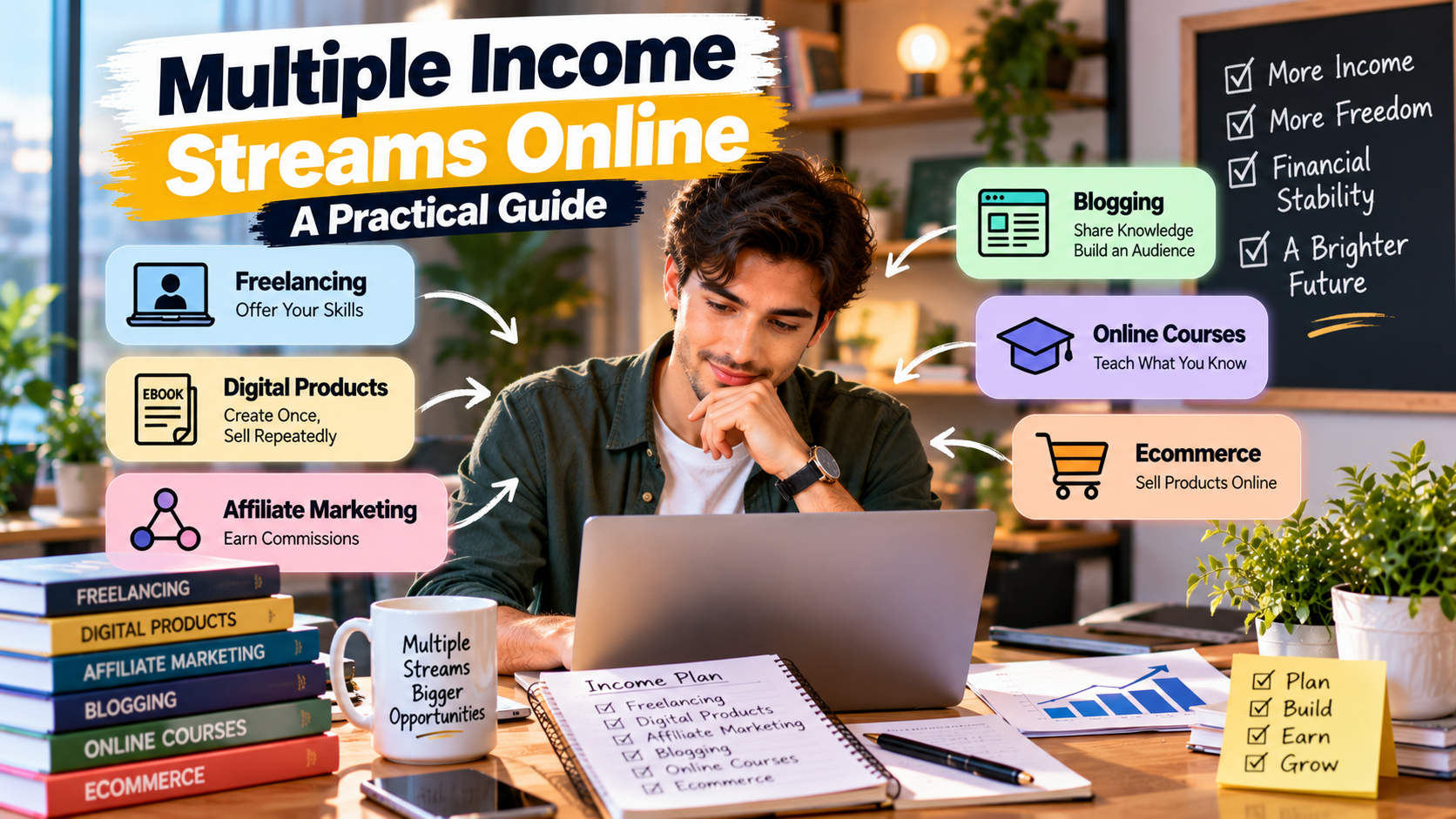
Options include freelancing, digital products, affiliate marketing, blogging, online courses, ecommerce, recurring services, and suitable financial investments. Each model has different costs, risks, and time requirements.
The strongest starting point is usually to choose one opportunity that matches your skills and resources, validate customer demand, and develop a repeatable way to earn revenue. Once the first source becomes manageable, you can explore related opportunities that build on existing expertise or reach the same audience.
Avoid chasing every new trend or assuming that online income is automatically passive. Focus on delivering real value, tracking expenses, maintaining customer trust, and improving your processes over time.
Building multiple income streams is a gradual process. With realistic expectations and consistent effort, it can become part of a broader strategy for financial flexibility and sustainable business growth.
Frequently Asked Questions
What is the easiest way to create multiple income streams online?
For people who already have a marketable skill, freelancing or providing online services may be a practical first step. Once a reliable customer base develops, related opportunities such as digital products, training, or recurring service packages can be explored.
Can I build multiple income streams with little money?
Yes, some models can be started with relatively low upfront costs, particularly service businesses and certain digital products. However, they still require time, skills, marketing, and sometimes paid tools or platform fees.
Are online income streams passive?
Some online business models can generate sales without repeating the same amount of work for every transaction, but most require ongoing maintenance, marketing, updates, or customer support. Truly effortless and guaranteed income is uncommon.
How many income streams should a beginner have?
There is no ideal number. Beginners may benefit from focusing on one income source until it becomes manageable and then adding a complementary source. The right number depends on available time, financial goals, and operational capacity.
Is affiliate marketing a reliable source of income?
Affiliate marketing can generate income when relevant content reaches an audience that trusts the recommendations. However, results depend on traffic, customer behavior, program terms, and commission structures, so earnings are not guaranteed.
How can I avoid online income scams?
Research the business and platform independently, verify payment terms, read agreements carefully, and be skeptical of guaranteed profits or unrealistic income claims. Never send money or disclose sensitive information simply because an opportunity appears urgent or lucrative.