
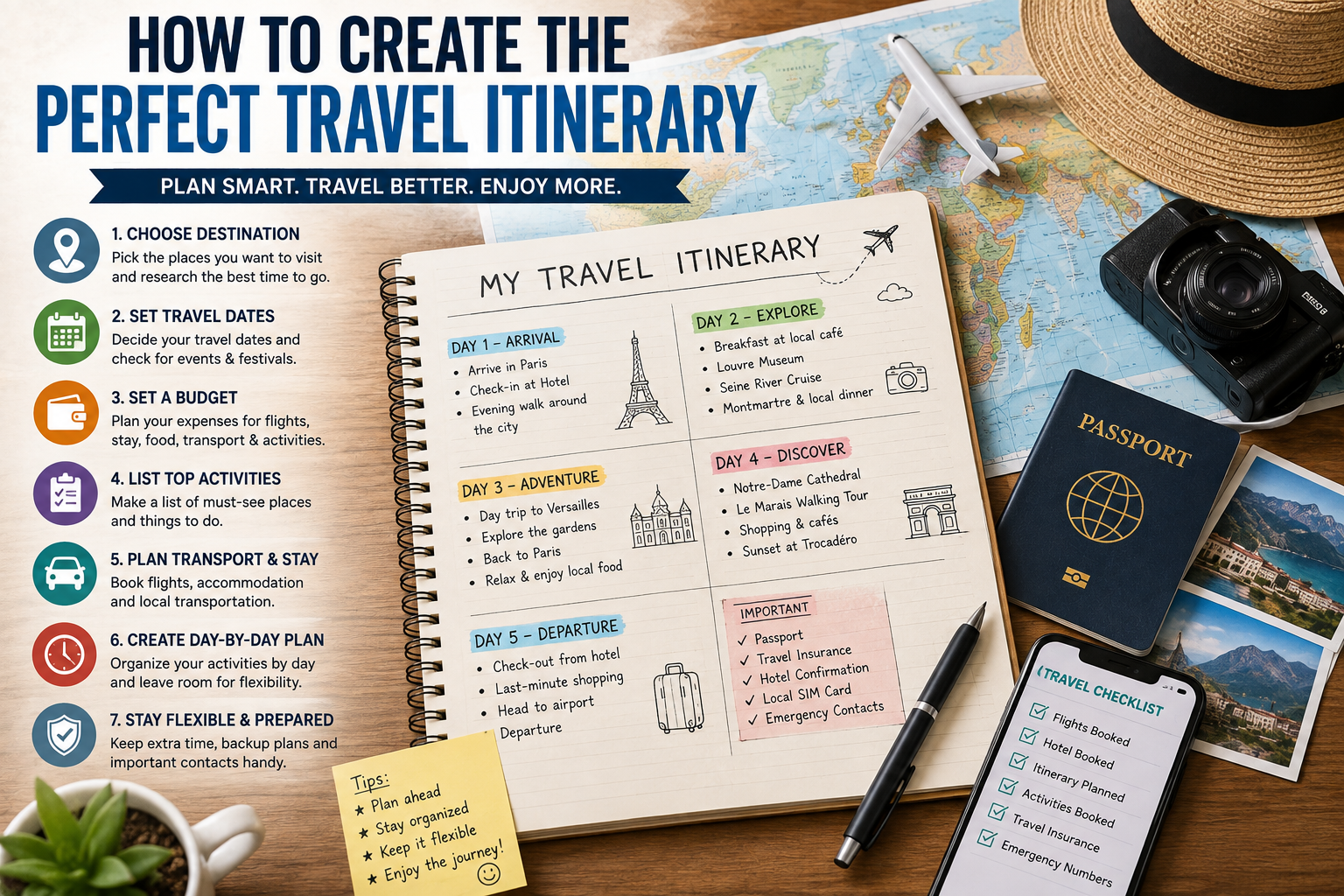
Planning a trip is exciting, but organizing flights, accommodation, transportation, activities, restaurants, and sightseeing can quickly become overwhelming. A well-designed travel itinerary can make the process much easier by putting the important details in one place.
A travel itinerary is not meant to control every minute of your vacation. The best itineraries provide structure while leaving enough room for rest, unexpected discoveries, and changes in plans. Current itinerary-planning guidance also emphasizes organizing fixed bookings first, grouping nearby activities together, allowing realistic travel time, and avoiding an overly packed schedule.
Whether you are planning a weekend getaway, family vacation, solo adventure, road trip, or international holiday, this step-by-step guide can help you create an itinerary that is organized, practical, and enjoyable.
What Is a Travel Itinerary?
A travel itinerary is a structured plan showing where you will go, where you will stay, what you plan to do, and how you will move between locations.
A useful itinerary can include:
Travel dates
Flight or train details
Accommodation information
Transportation
Activities
Attractions
Restaurant ideas
Reservation details
Important addresses
Emergency contacts
Free time
Traditional tourism guidance describes an itinerary as a planned journey that includes destinations, transportation, accommodation, and activities.
The level of detail is up to you. A simple three-day trip may only require a few notes per day, while a complicated international journey may need more detailed information.
Why Should You Create a Travel Itinerary?
An itinerary can help you make better use of your time and reduce last-minute decisions.
It can help you:
Keep important reservations organized
Understand how much time you actually have
Avoid unnecessary travel between attractions
Plan transportation
Remember important bookings
Manage your travel budget
Leave enough time for rest
Share plans with travel companions
The goal is not to create a rigid schedule. It is to create a reliable framework for your trip.
Step 1: Decide Your Travel Dates
Start with the basics.
Write down your departure date, arrival date, and return date. Then determine how many usable days you actually have.
For example, if you arrive at 9 PM on the first day, that day is mostly an arrival day rather than a full sightseeing day. Similarly, an early-morning departure may mean your final day has very little time for activities.
This is an important detail that travelers sometimes overlook. A five-night trip does not necessarily provide five full sightseeing days.
Step 2: Set Your Travel Budget
Before filling your itinerary with activities, decide how much you can comfortably spend.
Divide your estimated budget into categories such as:
Flights or transportation
Accommodation
Food
Local transportation
Attractions
Tours
Shopping
Emergency expenses
Having a budget helps you decide which activities are worth paying for and where you can save.
Your itinerary should support your budget rather than constantly push you beyond it.
Step 3: Choose Your Main Destination Areas
If your trip includes a large city or multiple destinations, identify the main areas you want to explore.
Instead of trying to visit attractions randomly, organize your plans geographically.
For example, if several museums, restaurants, parks, and landmarks are located in the same neighborhood, consider exploring them on the same day.
Grouping activities by location can reduce unnecessary transportation and give you more time to actually enjoy the destination.
Step 4: Make a List of Must-See Places
Before assigning activities to specific days, create a master list.
Write down everything you are interested in seeing or doing.
For example:
Major landmarks
Museums
Beaches
Parks
Markets
Historic neighborhoods
Restaurants
Shopping areas
Cultural experiences
Outdoor activities
Day trips
Then divide your list into three groups:
Must Do: Experiences you do not want to miss.
Would Like to Do: Activities you would enjoy if time allows.
Optional: Things you can skip without affecting the trip.
This makes it easier to prioritize when your schedule becomes busy.
Step 5: Check Opening Hours and Reservations
Not every attraction is available every day or at every time.
Before adding an activity to your itinerary, check its current opening hours, ticket requirements, reservation rules, and location.
Some popular attractions, tours, restaurants, and experiences may require advance reservations.
Place these fixed activities into your itinerary first.
Your flexible activities can then be arranged around them.
Step 6: Build Your Itinerary Around Fixed Bookings
Your flights, trains, hotel check-ins, tours, and other time-sensitive reservations should become the foundation of your itinerary.
These are your fixed points.
Once they are placed on the calendar, add flexible activities around them.
A useful approach is:
Fixed booking → nearby activities → meals → free time
This prevents you from accidentally scheduling an activity that conflicts with an important reservation.
Step 7: Group Nearby Attractions Together
This is one of the most useful itinerary-planning techniques.
Avoid creating a schedule that requires you to cross an entire city several times in one day.
Instead, choose one main area and explore it properly.
For example:
Morning: Historic district
Afternoon: Nearby museum
Evening: Local restaurant and evening walk
This is generally more efficient than traveling across the city between every activity.
It can also make your trip more enjoyable because you have more time to explore spontaneously.
Step 8: Do Not Schedule Every Minute
One of the biggest itinerary mistakes is overplanning.
A schedule that looks impressive on paper may be exhausting in reality.
Instead of planning ten attractions in one day, choose a few important activities and leave some free time.
You may want to spend longer than expected at a museum, discover an interesting café, take photographs, or simply rest.
A good itinerary should guide you rather than control you.
Step 9: Add Realistic Travel Time
Do not assume that moving from one attraction to another takes only a few minutes.
Consider:
Walking time
Public transportation
Traffic
Parking
Waiting times
Security checks
Finding entrances
Getting lost
Delays
Add a reasonable buffer between major activities.
This is particularly important when traveling with children, older family members, or large groups.
Step 10: Plan Meals
Food is an important part of the travel experience, but meals also require time.
Instead of scheduling attractions continuously from morning to night, leave space for breakfast, lunch, dinner, and snacks.
You do not have to reserve every restaurant in advance.
For popular restaurants or special occasions, however, advance reservations may be useful.
You can also create a short list of restaurants near the areas you plan to visit.
Step 11: Include Rest Time
Travel can be tiring.
Even if you are excited about seeing everything, your energy may not match your original plan.
Include some downtime in your itinerary.
You could spend an hour at your hotel, relax in a park, enjoy a café, or simply return to your accommodation early.
Rest is not wasted travel time. It can help you enjoy the rest of your trip more.
Step 12: Plan Transportation Between Destinations
If your itinerary includes multiple cities or regions, plan how you will travel between them.
Consider:
Flights
Trains
Buses
Rental cars
Ferries
Private transfers
Record departure times, arrival times, stations or airports, and approximate travel duration.
Remember that transportation days are still travel days. Do not treat a six-hour train journey as if you have six free hours for sightseeing.
Step 13: Add Accommodation Details
Keep your accommodation information in the itinerary.
Include:
Hotel or property name
Address
Check-in time
Check-out time
Reservation number
Contact information
Transportation information
Keeping these details together can save time when you arrive at a new destination.
Step 14: Keep Important Documents Together
Your itinerary should also contain or link to important travel information.
Depending on your trip, this could include:
Flight confirmations
Hotel reservations
Train tickets
Tour confirmations
Travel insurance details
Passport information
Visa information
Emergency contacts
Keep backup copies where appropriate and make important information available offline.
Step 15: Create a Simple Daily Structure
You do not need a complicated spreadsheet.
A simple daily format can work very well:
Day 1 — Arrival
Morning: Travel
Afternoon: Hotel check-in
Evening: Easy local exploration and dinner
Day 2 — Main Attractions
Morning: Major attraction
Afternoon: Nearby museum or landmark
Evening: Dinner and free time
Day 3 — Local Experience
Morning: Market or cultural activity
Afternoon: Flexible exploration
Evening: Special dinner or entertainment
This structure provides direction while allowing flexibility.
Step 16: Add a Backup Plan
Weather, transportation delays, closures, and unexpected circumstances can affect travel plans.
For important outdoor activities, have an indoor alternative.
For example:
Plan A: Walking tour and outdoor attraction
Plan B: Museum, shopping area, café, or indoor cultural experience
Having alternatives can prevent a single change from ruining an entire day.
Step 17: Keep Your Itinerary Easy to Access
Your itinerary is only useful if you can find it when you need it.
You can store it in:
A notes app
A document
A spreadsheet
A travel planning app
A printed copy
Cloud storage
For important trips, keeping both digital and offline or printed backups can be useful.
A single organized source of information is easier to manage than scattered screenshots, emails, and messages.
Step 18: Share the Itinerary
If you are traveling with family or friends, share the itinerary with everyone involved.
This helps everyone understand:
Where you are going
When activities are scheduled
Where you are staying
How transportation works
Which activities are optional
If traveling alone, consider sharing your general itinerary with someone you trust.
Step 19: Review the Itinerary Before Departure
A few days before your trip, review the entire plan.
Check:
Flight times
Hotel reservations
Activity bookings
Transportation
Opening hours
Weather
Entry requirements
Addresses
Confirmation numbers
Look for conflicts and unrealistic schedules.
This final review can help identify problems before you are already on the road.
Step 20: Stay Flexible During the Trip
Your itinerary should not prevent you from enjoying unexpected opportunities.
A local recommendation may lead you to an amazing restaurant. A beautiful neighborhood may deserve more time than expected. Bad weather may require a change of plans.
Allow yourself to adapt.
The best itinerary is not necessarily the one you follow perfectly. It is the one that helps you enjoy your trip while giving you enough flexibility to respond to real-life situations.
Simple Travel Itinerary Template
You can use this basic format for almost any trip:
Trip: [Destination]
Dates: [Start Date – End Date]
Accommodation: [Hotel / Address]
Transportation: [Flight / Train / Car]
Day 1
Arrival
Transportation to accommodation
Check-in
Nearby meal
Rest or light exploration
Day 2
Main attraction
Nearby activity
Lunch
Afternoon exploration
Dinner
Day 3
Cultural or outdoor activity
Free time
Shopping or local experience
Dinner
Day 4
Day trip or flexible activities
Final sightseeing
Packing
Final Day
Check-out
Transportation to airport/station
Departure
Adjust the number of days and activities according to your actual trip.
Common Travel Itinerary Mistakes
Planning Too Many Activities
Trying to see everything can leave you exhausted.
Ignoring Travel Time
Attractions may look close on a map but take much longer to reach in real life.
Forgetting Arrival and Departure Time
Arrival and departure days are often only partial sightseeing days.
Not Checking Opening Hours
An attraction may be closed on the exact day you planned to visit.
Booking Activities Too Close Together
Unexpected delays can cause you to miss reservations.
Leaving No Free Time
A trip without downtime can become tiring rather than enjoyable.
Keeping Information in Too Many Places
Scattered screenshots and emails can make important information difficult to find.
Frequently Asked Questions
What is the best way to create a travel itinerary?
Start with your dates, budget, transportation, accommodation, and fixed reservations. Then organize activities by location, add realistic travel time, and leave space for meals and rest.
How detailed should a travel itinerary be?
It should be detailed enough to keep important information organized but flexible enough to accommodate unexpected changes. A minute-by-minute schedule is usually unnecessary.
How many activities should I plan for one day?
There is no universal number. Two or three major activities may be enough for many travelers, depending on distance, activity length, transportation, and personal energy.
Should I plan every meal in my itinerary?
Not necessarily. You can note restaurants you want to try and make reservations for popular places while leaving other meals flexible.
Should I include travel time in my itinerary?
Yes. Travel time is an important part of your schedule. Include walking, public transportation, traffic, waiting, parking, and other realistic delays.
How far in advance should I create a travel itinerary?
Start with the basic structure as soon as your destination and dates are confirmed. Add detailed activities after flights, accommodation, and important reservations are established.
Can I create a travel itinerary without an app?
Absolutely. A notebook, document, spreadsheet, or printed itinerary can work well. The important thing is keeping essential information organized and accessible.
Should I print my travel itinerary?
A printed copy can be useful as a backup, particularly if you expect limited internet or phone access. Keeping a digital copy is also convenient.
What should a travel itinerary include?
A useful itinerary can include dates, transportation, accommodation, activities, reservations, addresses, contact information, meal ideas, and important travel documents.
How can I make my itinerary less stressful?
Avoid overplanning, group nearby activities together, add buffer time, schedule breaks, and leave some parts of each day flexible.
What should I do if my itinerary changes?
Stay flexible and prioritize the most important activities. Move optional activities to another day or replace them with alternatives. A good itinerary should be adaptable.
Conclusion
Creating a travel itinerary does not mean planning every second of your vacation. It means organizing the important details so you can spend less time figuring out what to do and more time enjoying your destination.
Start with your dates and budget, confirm transportation and accommodation, identify your must-see experiences, group activities by location, and build each day around realistic travel times.
Most importantly, leave room for meals, rest, unexpected discoveries, and changes in plans.
A well-designed itinerary should give your trip structure without taking away its sense of adventure. With a little preparation, you can create a travel plan that is organized, flexible, and enjoyable from beginning to end.