
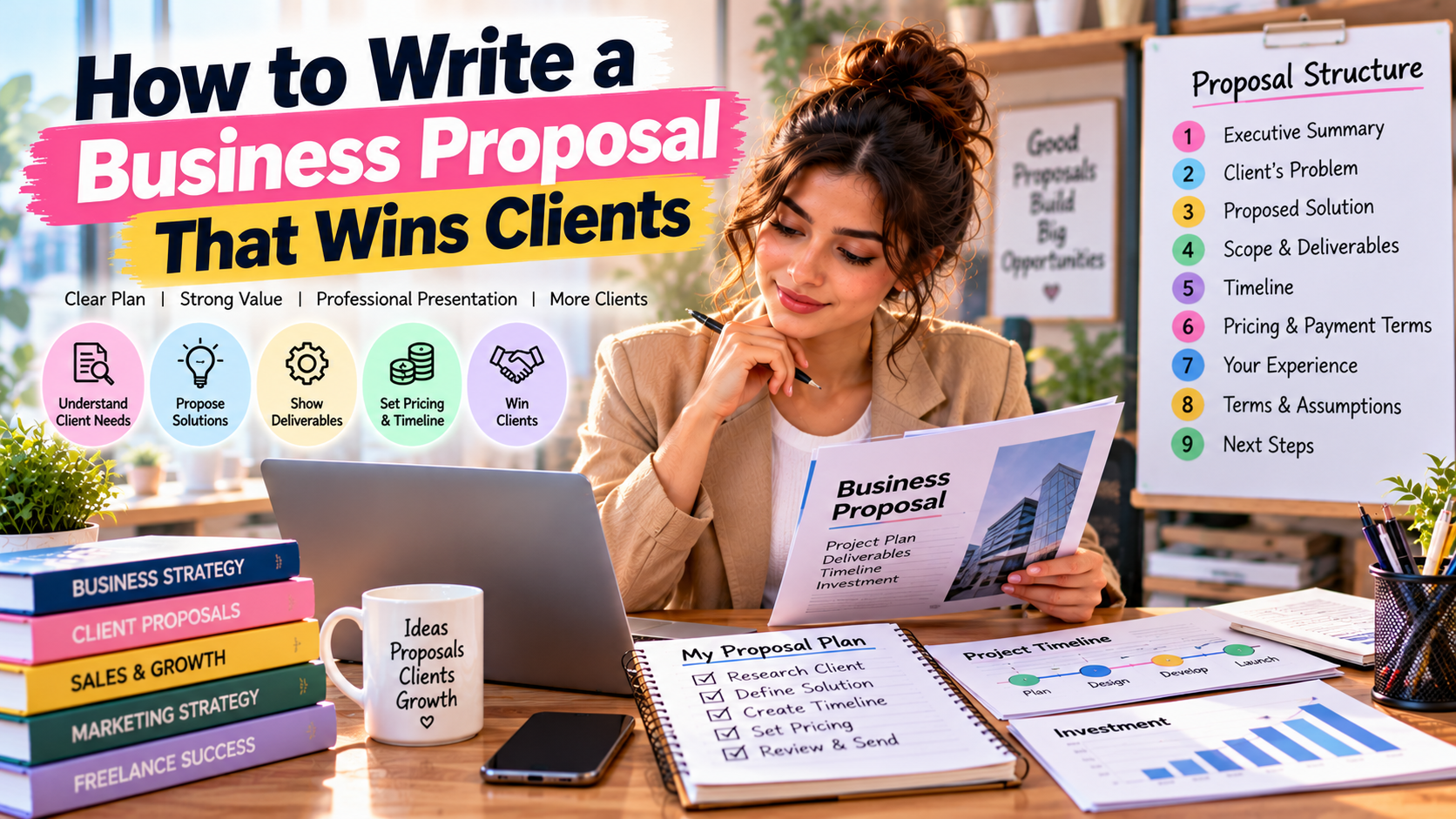
Winning new clients is an important part of growing a business, whether you provide professional services, sell products to other companies, or manage a consulting firm. However, finding a potential customer is only the beginning. You also need to explain how your business can solve the customer's problem and why your proposed solution deserves consideration.
A well-written business proposal helps communicate that value. It outlines the client's needs, presents a practical solution, explains the expected costs, and establishes clear expectations for delivery.
An effective proposal is not simply a document describing your company. It is a persuasive business tool built around the customer's objectives.
Whether you are a freelancer submitting a project quote, an agency pitching a marketing campaign, or a company seeking a long-term contract, understanding how to write a business proposal can improve the way you communicate with prospective clients.
This guide explains the essential sections of a professional proposal, the steps involved in preparing one, common mistakes to avoid, and practical ways to improve your chances of winning business.
What Is a Business Proposal?
A business proposal is a document that presents a product, service, or solution to a potential customer, partner, or organization.
Its purpose is to show how the proposed work addresses a specific need and what the recipient can expect if they agree to proceed.
Business proposals are commonly used by consultants, freelancers, marketing agencies, software providers, contractors, and other companies that sell products or services to clients.
For example, a digital marketing agency might submit a proposal explaining how it will improve a company's online visibility. The document could outline the recommended services, project timeline, pricing, deliverables, and performance measurements.
A strong proposal answers five essential questions:
What problem does the client need to solve?
What solution are you recommending?
Why is your approach appropriate?
How much will the project cost, and how long will it take?
What should happen next if the client accepts?
The clearer these answers are, the easier it becomes for a potential client to evaluate the offer.
Business Proposal vs. Business Plan: What Is the Difference?
These terms are sometimes confused, but they serve different purposes.
A business plan explains how a business intends to operate, generate revenue, manage expenses, and achieve its objectives.
A business proposal presents a specific offer to a prospective customer, partner, or other recipient.
For example, an entrepreneur developing a new company might create a business plan to organize its strategy. The same entrepreneur could later write a proposal offering consulting services to another company.
Understanding the distinction helps ensure that the document addresses the reader's actual needs.
Step 1: Research the Client Before Writing
One of the most common proposal-writing mistakes is using the same generic document for every potential client.
A proposal becomes more persuasive when it demonstrates an understanding of the recipient's situation.
Before writing, gather information about the client's business, target customers, objectives, current challenges, and expectations.
Depending on the project, you might review the client's website, existing products, public reports, customer feedback, or previous discussions.
If the client has already described a problem, make sure you understand its practical implications.
For example, a company requesting website development may be concerned about slow loading times, outdated design, poor mobile usability, or low conversion rates. Each issue requires a different solution.
Ask questions when information is missing. Clarifying the project scope early can prevent misunderstandings and reduce the likelihood of costly revisions later.
Practical tip: Write down the client's main problem in one or two sentences before developing your solution. If you cannot explain the problem clearly, you may need more information.
Step 2: Start With a Clear Executive Summary
The executive summary introduces the proposal and explains why the recommended solution is worth considering.
Although it appears at the beginning, it is often easier to write after you have developed the rest of the proposal.
A useful executive summary briefly covers:
The client's main challenge.
The proposed solution.
The expected deliverables or outcomes.
The broad timeline.
The investment required.
The primary reason your approach is suitable.
Keep this section focused on the client rather than filling it with a long company history.
For example, a proposal for a website redesign might explain that the project will improve mobile usability, simplify navigation, and create a clearer path from landing pages to inquiries.
Avoid making unsupported promises. If specific results depend on customer behavior, market conditions, or other factors outside your control, describe the intended improvements rather than guaranteeing a particular outcome.
Step 3: Define the Client's Problem
A proposal should show that you understand the reason the client is considering a purchase.
This section describes the current situation, identifies the main challenge, and explains why addressing it matters.
The problem statement should be specific enough to guide the proposed solution.
For instance, a business may not simply need more marketing. It may need to improve the quality of incoming leads, reduce wasted advertising spending, or reach a clearly defined customer segment.
Similarly, a software client may not need a completely new platform. Its actual requirement might be to automate a repetitive workflow or improve reporting.
A precise problem statement helps prevent unnecessary work and makes the recommendation more relevant.
Where possible, base the description on information provided by the client or supported by research. Do not invent performance figures, customer complaints, or operational problems to make the proposal appear more compelling.
Step 4: Present a Practical Solution
Once the problem is clear, explain how your product or service will address it.
Describe the work you recommend, why it is appropriate, and how it will be delivered.
For a service proposal, this might include the activities you will perform, the tools or methods you plan to use, and the stages of implementation.
For a product proposal, it might explain the recommended product configuration, implementation requirements, support arrangements, and relevant limitations.
Avoid vague statements such as "We will improve your business." Instead, describe concrete deliverables.
For example, a content marketing proposal might include a content audit, keyword research, a publishing plan, a defined number of articles, and a reporting schedule.
The proposal should also explain why your approach is suitable for the client's priorities and budget.
If several approaches are possible, briefly compare the alternatives and explain the trade-offs. This helps clients make informed decisions rather than feeling pressured into a single option.
Step 5: Explain the Scope and Deliverables
The scope defines what is included in the project and what is outside its boundaries.
This section is especially important for freelance services, consulting, software development, creative work, and projects with multiple stages.
List the expected deliverables clearly.
For example, a website development proposal might specify the number of pages, agreed features, design revisions, content responsibilities, testing, and handover requirements.
It should also clarify responsibilities. The client may need to supply content, provide account access, approve designs, or deliver feedback within an agreed period.
Explain how additional requests will be handled. If work outside the original scope requires extra fees or time, describe the process for approving those changes.
Clear scope definitions protect both parties and make it easier to evaluate whether the project has been completed successfully.
Step 6: Establish a Realistic Timeline
A professional business proposal should explain how the work will progress and when important milestones are expected.
A timeline may include research, planning, development, review, revisions, delivery, and final approval.
For example, a small website project might include a planning stage, a design review, development, testing, and launch. The actual duration will depend on complexity, client feedback, and the availability of required materials.
When estimating time, consider dependencies and potential delays. Avoid promising an unrealistic deadline simply to make the proposal more attractive.
If the project depends on client approvals, third-party services, or external information, make those dependencies clear.
A realistic timeline builds trust and helps both parties coordinate their responsibilities.
Step 7: Set Pricing and Payment Terms
Pricing is one of the most important parts of a business proposal because clients need to understand the financial commitment before accepting the offer.
The proposal should explain the total price or pricing structure, what the price includes, and any relevant additional costs.
Common pricing models include:
Fixed-price projects: A defined fee for an agreed scope of work.
Hourly pricing: Payment based on the time spent.
Monthly retainers: A recurring fee for ongoing services.
Milestone-based payments: Payments tied to agreed stages or deliverables.
Subscription pricing: Recurring charges for continued access to a product or service.
Choose a structure that suits the work and makes the financial arrangement clear.
For a fixed-price proposal, explain how changes to the scope will be priced. For hourly work, specify the rate, expected hours if appropriate, and invoicing schedule.
Payment terms should cover deposit requirements where applicable, due dates, accepted payment methods, and any relevant taxes or expenses.
Do not set prices solely by copying competitors. Consider the cost of delivering the work, the expertise required, the value provided, the risk involved, and the client's budget.
A clear price supported by a clear scope is generally more useful than a low price that leaves important details uncertain.
Step 8: Demonstrate Your Credibility
Clients need reasons to believe that you can deliver what you propose.
Your proposal can demonstrate credibility through relevant experience, qualifications, previous work, case studies, testimonials, or a clear explanation of your process.
Choose evidence that relates directly to the project.
For example, a business seeking ecommerce development may value examples of relevant online stores more than a general list of unrelated projects.
If you are new to the industry, you can still demonstrate capability through sample work, a small demonstration, a detailed implementation plan, or relevant professional training.
Use accurate information and obtain permission before sharing confidential client details or testimonials.
Avoid exaggerating past results or claiming expertise you cannot support. Trust is easier to establish when the proposal is specific, transparent, and realistic.
Step 9: Address Risks, Assumptions, and Terms
A strong proposal should not hide practical limitations.
Depending on the project, relevant details may include:
Information or materials the client must provide.
Third-party software or service dependencies.
Assumptions about project requirements.
Revision limits.
Support arrangements after delivery.
Confidentiality requirements.
Ownership and licensing of work.
Cancellation and change procedures.
For larger projects, a separate contract may be required to establish the full legal terms.
The proposal should remain easy to understand while identifying important conditions that affect the price, timeline, and delivery.
Clear expectations reduce the risk of disputes and make it easier for both parties to determine whether the proposed arrangement is appropriate.
Step 10: Finish With a Clear Call to Action
A proposal should explain exactly what the client needs to do to move forward.
The next step might be approving the scope, selecting a package, signing an agreement, arranging a meeting, or paying an agreed deposit.
Make the process straightforward and avoid vague endings that leave the client unsure about how to proceed.
For example, you might ask the client to confirm the preferred package and arrange a kickoff meeting to finalize the project schedule.
If the proposal has an expiration date because pricing or availability may change, state that date clearly and reasonably.
A professional call to action encourages a decision without using unnecessary pressure.
A Simple Business Proposal Template
The following structure can be adapted for consulting, freelance services, agency work, and other business-to-business offers.
Business Proposal Template
Copy and adapt this outline for your next client proposal.
1. Proposal Title
[Project or Service Name]
Prepared for: [Client Name]
Prepared by: [Your Name or Company]
Date: [Proposal Date]
2. Executive Summary
Briefly explain the client's need, your proposed solution, and the main expected deliverables.
3. Understanding of the Problem
Describe the client's challenge and the objectives the project is intended to address.
4. Proposed Solution
Explain your approach, key activities, and the reasons for recommending it.
5. Scope and Deliverables
List the work included, expected outputs, exclusions, and client responsibilities.
6. Timeline
Outline project stages, milestones, and expected completion dates.
7. Pricing and Payment Terms
State the total price or pricing model, payment schedule, and any additional costs.
8. Relevant Experience
Include relevant examples, qualifications, case studies, or references.
9. Terms and Assumptions
Describe important dependencies, revisions, support arrangements, and other applicable conditions.
10. Next Steps
Explain how the client can approve the proposal and begin the project.
This template is a starting point, not a substitute for a contract where one is necessary. Adapt it to the size, complexity, and risks of the project.
Common Business Proposal Mistakes to Avoid
Even a well-designed proposal can fail to win a client if it is unclear, generic, or difficult to evaluate.
Making the proposal too generic
Clients want to understand how your solution relates to their specific needs. Tailor the problem statement, recommendations, and deliverables to each opportunity.
Focusing too much on your company
Experience matters, but the proposal should prioritize the client's challenge and explain how your capabilities address it.
Leaving the scope unclear
Vague deliverables can lead to disagreements about what the price includes. Describe the expected work and boundaries in practical terms.
Offering unrealistic prices or timelines
Underpricing may make a project unprofitable, while unrealistic deadlines can damage trust. Base estimates on the actual work and resources required.
Using unsupported promises
Do not guarantee rankings, revenue, sales growth, or other outcomes that depend on factors outside your control. Explain what you will deliver and how progress will be evaluated.
Ignoring formatting and proofreading
Spelling mistakes, inconsistent formatting, broken links, and confusing tables can make a proposal harder to trust. Review the document before sending it.
Failing to follow up
A client may have questions or need clarification before making a decision. A polite follow-up can help identify concerns without creating unnecessary pressure.
How to Make Your Business Proposal More Persuasive
A persuasive proposal makes the decision easier for the recipient.
First, use clear language. Avoid unnecessary technical terms unless the client understands them and they help explain the solution.
Second, connect the proposed activities to the client's objectives. Explain why each major element is included and what purpose it serves.
Third, provide enough detail for evaluation without overwhelming the reader. A small project may need only a concise document, while a complex project may require supporting schedules, technical specifications, or financial information.
Fourth, make the price easy to understand. Separate the main fee from optional services or potential additional costs.
Finally, make the document easy to navigate. Use clear headings, readable typography, consistent formatting, and a logical order.
The proposal should help the client understand the offer, assess the trade-offs, and make a confident decision.
How AI Tools Can Help With Proposal Writing
AI tools can support proposal preparation by organizing notes, improving clarity, creating an initial outline, and helping identify missing sections.
For example, a business owner can use an AI writing assistant to turn meeting notes into a draft problem statement or create a checklist of information needed before quoting a project.
However, AI-generated text should not replace client research or professional judgment.
Review all names, figures, prices, dates, technical details, and contractual language. Make sure the proposal reflects the actual scope and capabilities of your business.
Avoid entering confidential client information into tools unless their privacy and data-handling arrangements are appropriate for that information.
The best use of AI is to reduce repetitive drafting work while preserving accuracy, personalization, and accountability.
Conclusion
Learning how to write a business proposal that wins clients involves more than presenting an attractive document. It requires understanding the client's needs, recommending a practical solution, defining deliverables, explaining pricing, and setting clear expectations.
A strong proposal is tailored to the opportunity and supported by credible evidence. It helps the client understand what you offer, why the approach is appropriate, and what will happen if they choose to proceed.
Start with a clear structure, keep the client's objectives at the center, and review the document carefully before sending it. Use realistic timelines, transparent pricing, and a straightforward call to action.
Over time, reviewing client feedback and improving your proposal process can help your business communicate more effectively and manage sales opportunities more professionally.
Frequently Asked Questions
What should a business proposal include?
A business proposal typically includes an executive summary, the client's problem, the proposed solution, scope and deliverables, timeline, pricing, relevant experience, terms, and next steps.
How long should a business proposal be?
The length depends on the project. A straightforward service proposal may be only a few pages, while a complex contract or enterprise project may require more detailed documentation.
How do I write a business proposal for a new client?
Research the client, clarify their needs, define a suitable solution, outline the deliverables, estimate costs and timing, demonstrate relevant expertise, and explain how the client can proceed.
Is a business proposal the same as a quotation?
Not necessarily. A quotation primarily states the price for specified goods or services. A business proposal usually explains the client's needs, the recommended approach, the scope, pricing, and other relevant details.
Can I use AI to write a business proposal?
Yes. AI can help with outlines, drafting, editing, and organizing information. However, you should verify all facts, personalize the document, and ensure that pricing, deliverables, and terms accurately reflect your offer.
How can I increase the chances of winning a proposal?
Understand the client's problem, provide a relevant solution, use credible supporting evidence, explain pricing clearly, establish realistic expectations, and make the next step easy to understand.