
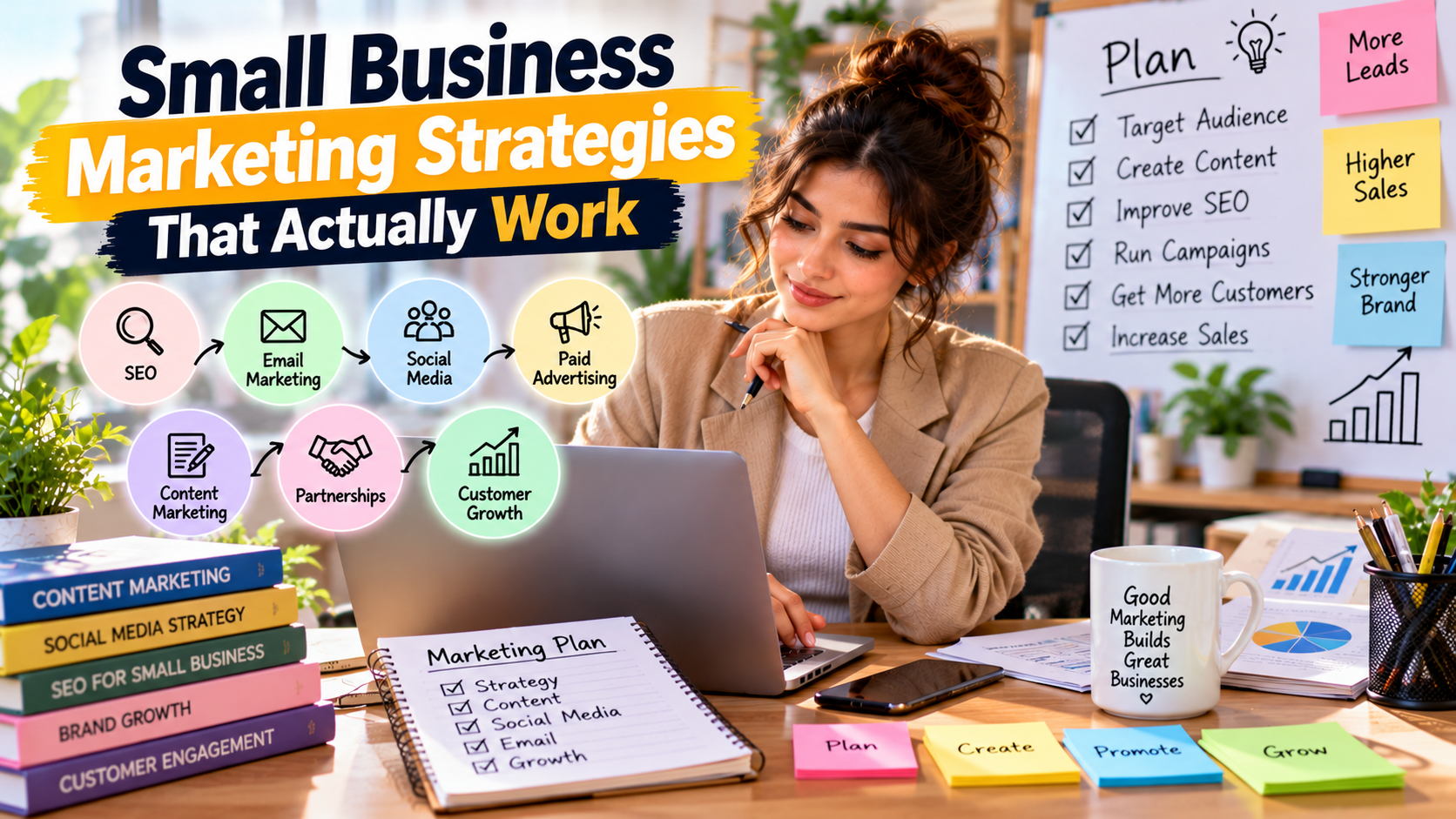
Marketing is essential for small businesses that want to attract customers, build brand awareness, and generate consistent revenue. However, many business owners face a common challenge: they have limited budgets, small teams, and little time to experiment with different marketing methods.
The solution is not necessarily to spend more money. Effective marketing begins with understanding the target audience, communicating a clear value proposition, and choosing channels that reach potential customers at the right time.
Some businesses benefit from search engine optimization, while others generate results through referrals, email marketing, social media, partnerships, or direct outreach. The most suitable approach depends on the business model, customer behavior, competition, and available resources.
This guide explores practical small business marketing strategies that can help entrepreneurs reach relevant audiences, generate leads, improve customer relationships, and build a sustainable marketing process.
Why Marketing Matters for Small Businesses
A good product or service does not automatically attract buyers. Potential customers need to discover the business, understand what it offers, and feel confident that it can meet their needs.
Marketing connects a business with those customers. It helps communicate the value of an offer, differentiate the company from competitors, and encourage people to take action.
For small businesses, marketing also provides a way to compete without matching the budgets of larger companies. A specialized service, helpful content, strong customer relationships, or a well-defined niche can make a business attractive to a specific audience.
Effective marketing can help businesses:
Increase awareness among relevant customers.
Generate qualified leads and sales opportunities.
Build trust and credibility.
Encourage repeat purchases and referrals.
Understand customer needs and preferences.
Measure which activities produce worthwhile results.
The objective is not to use every available marketing channel. It is to identify the methods that support business goals and use them consistently.
1. Define Your Target Audience
One of the most important small business marketing strategies is identifying exactly who the business wants to reach.
When a company tries to market to everyone, its message can become too broad to connect with any particular customer group. A clearly defined audience makes it easier to choose the right channels, develop relevant content, and communicate the benefits of a product or service.
Start by identifying the people or organizations most likely to purchase your offer.
Consider their needs, budget, location, industry, purchasing habits, and the problems they want to solve.
For example, a company providing accounting services might focus on independent professionals and small businesses that need help managing financial records. A business selling home office accessories might target remote workers looking for practical workspace improvements.
Customer research can include interviews, surveys, website analytics, customer reviews, and conversations with existing clients.
How to apply this strategy: Write a short customer profile that describes your ideal buyer, the problem they face, and the reasons they might choose your business over an alternative.
2. Build a Professional Website
A website can serve as a central location where potential customers learn about a business, evaluate its services, and take the next step.
Even when customers discover a company through social media or referrals, they may visit its website before making a purchasing decision.
A useful business website should clearly communicate what the company does, whom it serves, and how visitors can contact the business or make a purchase.
Important elements include:
A clear headline explaining the offer.
Detailed product or service information.
Contact information and an appropriate call to action.
Evidence of credibility, such as genuine testimonials or case studies.
Mobile-friendly pages and straightforward navigation.
Clear pricing or an explanation of how to request a quote, where appropriate.
Website performance also matters. Slow pages, confusing layouts, broken links, and difficult checkout processes can discourage potential customers.
A small business does not necessarily need an expensive custom website. A straightforward, secure, well-maintained site can be sufficient when it meets the needs of its audience.
3. Invest in Search Engine Optimization
Search engine optimization, commonly known as SEO, helps businesses improve their visibility in organic search results.
Unlike advertising, organic search traffic does not require payment for every click. However, SEO requires time, consistent effort, and content that genuinely helps users. Rankings and traffic are not guaranteed.
Small businesses can begin with a few practical activities.
Research relevant keywords
Identify the words and questions potential customers use when searching for products or services.
A business offering website design might target phrases related to website design services for small businesses, ecommerce website development, or website redesign costs, depending on its actual services and competition.
Choose keywords that match customer intent rather than targeting search volume alone.
Create helpful content
Publish articles, guides, comparison pages, and frequently asked questions that address genuine customer needs.
A bookkeeping firm, for example, might create a guide explaining how small businesses can organize invoices and monitor cash flow.
Optimize website pages
Write descriptive page titles, useful headings, relevant meta descriptions, and clear page content. Ensure that important pages can be crawled and indexed by search engines.
Improve technical performance
Check mobile usability, page loading speed, internal links, broken pages, and site structure. Technical problems can make useful content harder to access.
Earn relevant backlinks
Build relationships with reputable organizations, industry publications, partners, and professional communities. Focus on links that make sense for your audience rather than purchasing large volumes of low-quality links.
SEO is most effective when it supports the overall customer experience. The goal is to help relevant people discover useful information and find a clear path to your products or services.
4. Use Content Marketing to Build Trust
Content marketing involves creating and sharing useful information to attract and educate a target audience.
Instead of promoting a product in every message, businesses can answer questions, explain processes, solve common problems, and demonstrate expertise.
Useful content formats include:
Educational blog posts.
Step-by-step tutorials.
Frequently asked questions.
Short videos and demonstrations.
Industry insights and practical checklists.
Case studies based on genuine customer results.
Downloadable templates and guides.
For example, a software company might publish a tutorial about improving team productivity. A marketing agency could explain how to evaluate website performance. A home improvement business might publish a maintenance checklist.
Content should be created with a clear purpose. Each piece should address a specific customer need and, where appropriate, guide readers toward a relevant next step.
Consistency is important, but publishing large amounts of low-value material is unlikely to build meaningful trust. A smaller number of useful, accurate articles may be more valuable than frequent content that repeats existing information without adding insight.
5. Make Social Media Work for Your Business
Social media can help small businesses demonstrate their expertise, interact with customers, and distribute content.
However, opening accounts on every platform can waste time. Businesses should choose platforms based on where their target audience is active and how people use those platforms.
For example, a visually oriented business might benefit from image-focused platforms, while a business serving other companies may find professional networks more relevant.
An effective social media strategy can include:
Educational posts that answer common questions.
Product demonstrations and service explanations.
Behind-the-scenes content.
Customer stories shared with permission.
Responses to common objections.
Announcements about relevant products or offers.
Avoid treating every post as a sales pitch. Content that helps customers understand a problem or make a better decision can strengthen credibility over time.
Track meaningful results, such as website visits, inquiries, qualified leads, and sales attributable to social campaigns. Follower counts alone do not show whether social media is contributing to business growth.
6. Build an Email Marketing Strategy
Email marketing gives businesses a direct way to communicate with people who have chosen to receive their messages.
Unlike social media audiences, an email list can be managed through a suitable email service provider, although businesses must still comply with privacy requirements and applicable marketing regulations.
A business can encourage interested visitors to subscribe by offering useful resources, product updates, educational newsletters, or relevant information.
Effective email marketing practices include:
Sending useful, relevant content.
Using clear subject lines.
Segmenting subscribers based on their interests where appropriate.
Including a clear call to action.
Making unsubscribe options easy to find.
Measuring clicks, conversions, unsubscribes, and revenue where applicable.
For example, an online store might send product care advice after a purchase. A consulting company might share a monthly newsletter with practical industry insights.
Email marketing is not simply about sending more messages. Its value comes from delivering relevant information to people who want to receive it.
7. Use Local Marketing to Reach Nearby Customers
Businesses that serve a specific geographic area can benefit from local marketing.
Restaurants, repair services, clinics, salons, consultants, and other location-based businesses often need to reach people searching for solutions nearby.
Useful local marketing activities include maintaining accurate business listings, encouraging genuine customer reviews, publishing location-relevant website content, and building relationships with local organizations.
A business eligible for a Google Business Profile should keep its information accurate, including its address or service area, hours, contact details, and services.
Customer reviews can influence purchasing decisions, so businesses should request feedback appropriately and respond professionally. They should not fabricate reviews or offer improper incentives for positive ratings.
Local partnerships can also help. A home renovation company, for example, may establish relationships with complementary service providers whose customers have similar needs.
The most effective local marketing focuses on making the business easy to discover, evaluate, and contact.
8. Encourage Referrals and Repeat Business
Acquiring new customers can require considerable time and money. Existing customers can become an important source of repeat sales and referrals when they have a positive experience.
Referral marketing encourages satisfied customers to recommend a business to others. It works best when the offer is clear, the service is reliable, and customers have a genuine reason to recommend the company.
Businesses can support referrals by providing excellent customer service, following up after purchases, and making it easy for customers to share their experience.
Some businesses also use structured referral programs. If rewards are offered, the terms should be transparent and compliant with relevant rules.
Repeat business can be encouraged through useful follow-up messages, customer education, product updates, loyalty programs, and reliable after-sales support.
The priority should be customer value. Incentives cannot compensate for poor quality, missed deadlines, or unresolved problems.
9. Test Paid Advertising Carefully
Paid advertising can help businesses reach potential customers more quickly than some organic methods. However, advertising also creates financial risk when campaigns are launched without clear objectives or proper tracking.
Common channels include search advertising, social media ads, and relevant industry advertising platforms.
Before spending money, define the purpose of the campaign. Is the goal to generate qualified leads, sell a product, encourage appointments, or test demand for a new offer?
Next, establish a manageable budget and a method for measuring results.
Important metrics include:
Cost per click.
Cost per lead.
Conversion rate.
Customer acquisition cost.
Revenue attributed to the campaign.
Return on advertising spend.
A low cost per click does not necessarily mean a campaign is profitable. The visitors must be relevant, the offer must meet their needs, and the resulting sales must justify the overall cost.
Start with a small test, evaluate the quality of leads and sales, and increase spending only when the economics support it.
10. Partner With Complementary Businesses
Partnerships can help small businesses reach relevant audiences without building every marketing channel independently.
A complementary business serves a similar audience but offers a different product or service.
For example, a web design agency might partner with a copywriter, while a business consultant might collaborate with an accounting firm. Both businesses may benefit from referrals because their services address related customer needs.
Possible partnership activities include joint educational content, webinars, referral arrangements, co-hosted events, and useful resource exchanges.
A successful partnership should offer value to both parties and their audiences.
Choose partners carefully, define responsibilities clearly, and agree on how leads, referrals, and any associated compensation will be handled.
11. Use Customer Reviews and Case Studies
Potential customers often want evidence that a business can deliver what it promises.
Customer reviews and case studies can help answer that concern when they are genuine, relevant, and presented accurately.
A useful case study explains the customer's initial problem, the approach taken, and the outcome achieved. Where possible, include measurable results and enough context to avoid misleading readers.
For example, a marketing agency might describe how it improved a client's website conversion rate, provided the client has authorized the disclosure and the data supports the claim.
Reviews should be collected honestly. Do not invent customer experiences, alter feedback to change its meaning, or present unverified claims as established facts.
If a business is new and has few reviews, it can build credibility through transparent service descriptions, sample work, demonstrations, qualifications, and clear policies.
Trust is built through consistency between what the business promises and what it actually delivers.
12. Track Marketing Performance and Improve Results
Marketing becomes easier to manage when businesses understand which activities produce meaningful outcomes.
Without measurement, entrepreneurs may continue spending time and money on campaigns that generate attention but few qualified customers.
Start with a small set of metrics aligned with business goals.
Marketing goal | Useful metric |
|---|---|
Improve website visibility | Organic impressions and relevant search clicks |
Generate leads | Qualified inquiries and cost per lead |
Increase online sales | Conversion rate and revenue |
Improve customer retention | Repeat purchase rate |
Measure advertising | Customer acquisition cost and return on ad spend |
Build email engagement | Click rate, conversions, and unsubscribes |
Not every business needs a complicated analytics system. A spreadsheet, website analytics tool, and accurate sales records may be enough to begin.
Review performance regularly and investigate changes. If a campaign generates many inquiries but few sales, the problem may be the offer, audience, pricing, follow-up process, or quality of leads.
Use the findings to make specific improvements rather than changing every part of the marketing strategy at once.
How to Choose the Right Marketing Strategy for Your Business
There is no single marketing strategy that works equally well for every small business.
The right choice depends on the customer's buying process, the product or service, available resources, and how quickly the business needs results.
Consider these broad starting points:
Service businesses: Direct outreach, referrals, professional networking, helpful content, and case studies.
Local businesses: Accurate local listings, customer reviews, local search optimization, and community partnerships.
Ecommerce businesses: Product page optimization, email marketing, customer reviews, relevant social content, and carefully measured advertising.
B2B businesses: Educational content, professional networks, targeted outreach, webinars, and partnerships.
Content-based businesses: SEO, newsletters, audience development, and relevant affiliate or sponsorship opportunities.
These are starting points rather than fixed rules. A business may need to test several channels before discovering which ones deliver the best results.
A Simple 30-Day Marketing Plan for Small Businesses
A structured plan helps entrepreneurs turn marketing ideas into consistent action.
Week 1: Understand your customers
Define your target audience.
Review competitors and customer questions.
Clarify your offer and main selling points.
Set one measurable marketing objective.
Week 2: Strengthen your online presence
Improve your website or business profile.
Update service or product information.
Check contact details and calls to action.
Prepare useful content for your audience.
Week 3: Launch focused marketing activities
Publish relevant content.
Contact suitable prospects or partners.
Start an email newsletter if appropriate.
Test one relevant social or advertising channel.
Week 4: Measure and improve
Review inquiries, sales, and costs.
Identify the most promising channel.
Improve weak pages or campaign messages.
Set priorities for the next month.
The first month is an opportunity to establish a process and gather evidence. Meaningful marketing results may take longer, especially when a business relies on organic search or is building an audience from scratch.
Common Small Business Marketing Mistakes to Avoid
Even a well-designed marketing plan can underperform when execution is inconsistent or the business focuses on the wrong priorities.
Trying every platform at once: Spreading limited resources across too many channels can reduce quality and consistency. Start with the channels most relevant to your audience.
Ignoring customer needs: Marketing messages should explain how the offer helps customers, not simply describe how great the company is.
Expecting instant SEO results: Organic search visibility often takes time. Use realistic expectations and monitor progress rather than relying on immediate rankings.
Spending on ads without tracking: Advertising should be evaluated against leads, sales, and costs. More clicks do not automatically mean more profit.
Neglecting follow-up: Interested prospects may need additional information before purchasing. Respond promptly and use an organized follow-up process.
Failing to measure results: Without basic performance data, businesses cannot reliably identify which activities deserve more attention.
Using misleading claims: Exaggerated promises and fabricated testimonials can damage customer trust and create legal or reputational risks.
A successful marketing strategy is not about doing everything. It is about selecting appropriate activities, delivering value, and improving them based on evidence.
Conclusion
Effective small business marketing strategies do not have to depend on a large budget. Businesses can improve visibility, attract relevant customers, and build lasting relationships through clear positioning, search engine optimization, content marketing, email, referrals, local outreach, and carefully measured advertising.
The key is to understand the target audience and choose channels that fit how those customers discover and evaluate products or services.
Start with a manageable plan, set measurable goals, and track the results. Invest more in activities that produce qualified leads and profitable sales, and revise those that fail to deliver meaningful value.
Marketing is an ongoing process rather than a one-time campaign. Small improvements in customer understanding, communication, service quality, and measurement can help a business build a stronger foundation for sustainable growth.
Frequently Asked Questions
What is the most effective marketing strategy for a small business?
The most effective strategy depends on the business and its audience. SEO, referrals, email marketing, direct outreach, local marketing, and social media can all be useful when selected according to customer behavior and business goals.
How can a small business market itself with little money?
Businesses can begin with customer referrals, useful organic content, targeted outreach, basic SEO, partnerships, and free or low-cost business listings where eligible. The best approach is to focus on a few channels rather than spreading resources too thinly.
Is digital marketing necessary for small businesses?
Digital marketing can help businesses become discoverable, communicate with customers, and measure results. The right mix depends on the audience; some businesses also benefit significantly from referrals, local relationships, and offline activities.
How long does small business marketing take to produce results?
Timelines vary. Direct outreach or paid advertising may generate early inquiries, while SEO and audience-building activities often require sustained effort. Results depend on competition, offer quality, budget, and execution.
How should a small business measure marketing success?
Businesses should track metrics connected to their objectives, such as qualified leads, conversion rate, customer acquisition cost, repeat purchases, revenue, and profit. Social media engagement and website traffic are useful when they contribute to these broader goals.