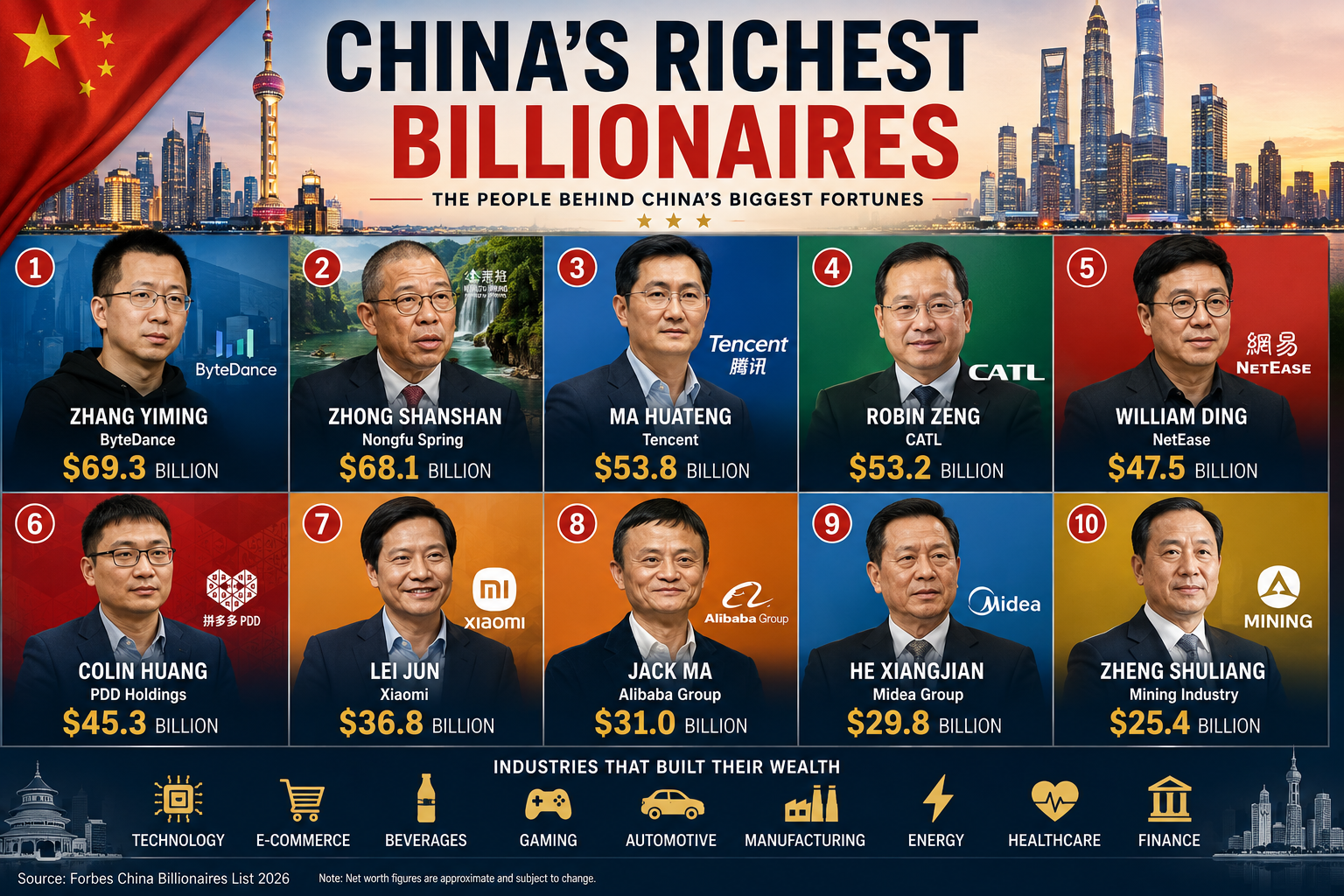
China has produced some of the world's most successful entrepreneurs and business leaders, building enormous companies across technology, e-commerce, beverages, gaming, automobiles, batteries, retail, and manufacturing.
The country's billionaire landscape changes frequently because many fortunes are connected to publicly traded companies and private-business valuations. According to Forbes' 2026 annual ranking, mainland China had 539 billionaires, up from 450 the previous year. The combined wealth of Chinese billionaires reached nearly $2.2 trillion in that ranking.
Among China's wealthiest individuals are technology founders such as Zhang Yiming and Ma Huateng, consumer-business entrepreneurs such as Zhong Shanshan, and industrial leaders such as Robin Zeng.
Here is a look at some of China's richest business figures and how they built their fortunes.
1. Zhang Yiming — ByteDance
Estimated net worth: $69.3 billion
Zhang Yiming, the co-founder of ByteDance, was China's richest person in Forbes' 2026 annual ranking.
ByteDance is best known internationally for TikTok, while its broader portfolio includes other internet, media, entertainment, and artificial-intelligence businesses. Forbes reported that Zhang founded ByteDance in 2012 and later stepped down from the company's leadership roles while maintaining significant influence through his ownership.
Zhang's rise demonstrates how a technology company created around content recommendation and mobile applications can grow into a global business.
Business lesson
Technology businesses can scale rapidly when they combine a strong product with data, personalization, and a massive potential audience.
2. Zhong Shanshan — Nongfu Spring
Estimated net worth: $68.1 billion in Forbes' 2026 annual ranking
Zhong Shanshan is the founder and chairman of Nongfu Spring, one of China's best-known bottled-water and beverage companies.
His background is particularly notable. Forbes reports that Zhong left school at a young age and later worked as a construction worker, newspaper reporter, and beverage sales agent before eventually starting his own business.
Nongfu Spring became a major consumer brand, while Zhong also controls Wantai Biological, a healthcare company.
Business lesson
A successful business does not always need to be based on advanced technology. Strong consumer brands can also create enormous long-term value.
3. Ma Huateng — Tencent
Estimated net worth: $53.8 billion in Forbes' 2026 annual ranking
Ma Huateng, also known as Pony Ma, is the chairman and CEO of Tencent.
Tencent operates across internet services, online gaming, digital payments, entertainment, and other technology businesses. Its WeChat platform has more than 1.4 billion monthly users, according to Forbes.
Ma helped establish Tencent in 1998 after working in internet-related technology.
The company's ability to build a broad ecosystem around communication, entertainment, and digital services helped turn Tencent into one of China's most valuable technology businesses.
Business lesson
A company can become much stronger when different products and services work together as an ecosystem.
4. Robin Zeng — CATL
Estimated net worth: $53.2 billion in Forbes' 2026 annual ranking
Robin Zeng is the founder and chairman of Contemporary Amperex Technology, better known as CATL.
CATL is a major producer of batteries for electric vehicles and energy-storage applications. Forbes' 2026 ranking placed Zeng among China's wealthiest individuals.
His success demonstrates the enormous economic opportunity created by the transition toward electric transportation and energy storage.
Business lesson
Industrial businesses can become extremely valuable when they provide critical infrastructure for a rapidly expanding industry.
5. William Ding — NetEase
Estimated net worth: $47.5 billion in Forbes' 2026 annual ranking
William Ding, also known as Ding Lei, founded NetEase and became one of China's major technology entrepreneurs.
NetEase developed a significant presence in online gaming and internet services.
Forbes' 2025 China ranking placed Ding fifth among China's richest people, with an estimated fortune of $47.5 billion at the time of measurement.
Business lesson
Digital entertainment can become a powerful global business when companies understand consumer behavior and continually develop new content.
6. Colin Huang — PDD Holdings
Estimated net worth: $45.3 billion in Forbes' 2025 China ranking
Colin Huang is the founder of PDD Holdings, the company behind Pinduoduo and associated with the international e-commerce platform Temu.
His business career demonstrates how e-commerce companies can use technology and unconventional shopping models to compete in highly competitive consumer markets.
Forbes ranked Huang sixth on its 2025 China list, with a fortune estimated at $45.3 billion.
Business lesson
Challenging established business models can create opportunities in highly competitive industries.
7. Lei Jun — Xiaomi
Estimated net worth: $36.8 billion in Forbes' 2025 China ranking
Lei Jun is the founder and chairman of Xiaomi, a major consumer technology company.
Xiaomi became known for smartphones but expanded into a broader ecosystem of connected consumer devices and technology products.
Forbes placed Lei Jun seventh on its 2025 China ranking, estimating his wealth at $36.8 billion.
Business lesson
A company can use a strong initial product to develop a wider ecosystem of complementary products.
8. Jack Ma — Alibaba
Estimated net worth: $31 billion in Forbes' 2025 China ranking
Jack Ma is the co-founder of Alibaba, one of China's most influential e-commerce companies.
Alibaba helped transform online commerce in China and developed businesses across e-commerce, cloud computing, logistics, digital services, and other areas.
Forbes ranked Jack Ma eighth on its 2025 China list with an estimated fortune of $31 billion.
Although his current wealth ranking is below some other Chinese billionaires, his influence on China's technology and e-commerce industries remains significant.
Business lesson
Entrepreneurs can create enormous businesses by identifying major changes in consumer behavior early.
9. He Xiangjian — Midea
Estimated net worth: $29.8 billion in Forbes' 2025 China ranking
He Xiangjian built his fortune through Midea, one of China's major home-appliance manufacturers.
His story demonstrates that China's billionaire class is not dominated entirely by internet companies.
Manufacturing and consumer appliances have also created significant wealth through scale, exports, innovation, and operational efficiency.
Business lesson
Traditional industries can become highly valuable when companies achieve global scale and operational excellence.
10. Zheng Shuliang — Mining
Estimated net worth: $25.4 billion in Forbes' 2025 China ranking
Zheng Shuliang and his family built their fortune in the metals and mining sector.
His position among China's wealthiest people illustrates the diversity of China's billionaire economy.
Technology may attract considerable attention, but natural resources and industrial businesses remain important sources of wealth.
Business lesson
Industries connected to essential resources can create substantial long-term value when managed effectively.
China's Billionaire Wealth Is Spread Across Many Industries
One interesting feature of China's billionaire landscape is its diversity.
According to Forbes' 2025 China list, the top 100 included billionaires from industries such as:
Technology
Food and beverages
Energy
Automotive
Manufacturing
Healthcare
Fashion and retail
Finance
Real estate
Logistics
Media and entertainment
This demonstrates that there is no single route to extraordinary wealth.
Why Technology Has Created So Many Chinese Billionaires
Technology has played a major role in China's economic transformation.
Companies involved in:
E-commerce
Social media
Gaming
Artificial intelligence
Smartphones
Internet services
Digital payments
Semiconductors
can potentially reach enormous markets.
China's growing focus on artificial intelligence has also affected billionaire wealth. Forbes reported that China's AI advances helped boost investor optimism and contributed to the rise in the collective fortunes of the country's richest people in 2026.
China's New Generation of Wealth
The Chinese billionaire landscape continues to evolve.
New fortunes are emerging from artificial intelligence, electric vehicles, robotics, consumer brands, and advanced manufacturing.
At the same time, older fortunes remain important in sectors such as beverages, real estate, manufacturing, and finance.
This creates an interesting combination of established business empires and newer technology-driven fortunes.
What Can Entrepreneurs Learn From China's Richest People?
The stories of China's wealthiest entrepreneurs offer several useful lessons.
Solve Large Problems
The biggest businesses often address problems affecting millions of customers.
Build Scalable Companies
Technology and manufacturing companies can grow rapidly when their products can reach large markets.
Develop Strong Brands
Nongfu Spring and Xiaomi demonstrate the importance of recognizable consumer brands.
Invest in Innovation
Technology changes quickly, so companies need to continue developing new products and services.
Think Beyond One Product
Many successful companies expand into related businesses to create broader ecosystems.
Understand Local Markets
Successful Chinese companies often built their initial strength by deeply understanding domestic consumers before expanding internationally.
Frequently Asked Questions
Who is the richest person in China?
In Forbes' 2026 annual ranking, Zhang Yiming, co-founder of ByteDance, was China's richest person with an estimated net worth of $69.3 billion. Zhong Shanshan followed with $68.1 billion.
Who is Zhang Yiming?
Zhang Yiming is the co-founder of ByteDance, the technology company behind TikTok. He founded ByteDance in 2012 and remains one of China's wealthiest technology entrepreneurs.
Who is China's richest woman?
China's billionaire rankings can change from year to year, so the answer depends on the ranking date and methodology. Current annual lists should be checked for the latest position.
How many billionaires are there in China?
Forbes counted 539 mainland Chinese billionaires in its 2026 annual ranking, making mainland China the country with the second-largest number of billionaires after the United States.
What industries created China's richest billionaires?
Technology, beverages, gaming, e-commerce, energy, automobiles, manufacturing, healthcare, and finance have all produced major Chinese fortunes.
Is Jack Ma still one of China's richest people?
Yes. Jack Ma remains a billionaire and appeared eighth on Forbes' 2025 China list with an estimated net worth of $31 billion at the time of measurement.
How did Zhong Shanshan become wealthy?
Zhong Shanshan built his fortune primarily through Nongfu Spring and also controls Wantai Biological. He started his career in several different jobs before becoming an entrepreneur.
Who founded Tencent?
Tencent was founded in 1998 by a group including Ma Huateng, who became the company's chairman and CEO.
Why does billionaire net worth change?
Much of billionaire wealth is connected to company shares and business valuations. Changes in stock prices, company performance, exchange rates, and private-company valuations can therefore change estimated net worth.
Are all Chinese billionaires technology entrepreneurs?
No. China's billionaire class includes people whose fortunes come from food and beverages, manufacturing, energy, automotive companies, healthcare, finance, real estate, and other industries.
Who is the richest Chinese technology entrepreneur?
The answer can change as company valuations move. In Forbes' 2026 annual ranking, Zhang Yiming was China's richest person, followed by other major technology entrepreneurs including Ma Huateng.
Conclusion
China's richest people represent a diverse collection of entrepreneurs and business leaders.
Zhang Yiming built a global technology empire through ByteDance. Zhong Shanshan created enormous value in beverages and healthcare. Ma Huateng built Tencent into a technology ecosystem, while Robin Zeng benefited from the rapid growth of electric-vehicle batteries.
Others, including William Ding, Colin Huang, Lei Jun, Jack Ma, and He Xiangjian, demonstrate how gaming, e-commerce, smartphones, internet services, and manufacturing can all create enormous businesses.
Their stories show that China's billionaire economy is not built around one industry or one business model.
For entrepreneurs, the most valuable lesson is to study how these individuals identified opportunities, built scalable businesses, adapted to changing markets, and created products and services for enormous customer bases.