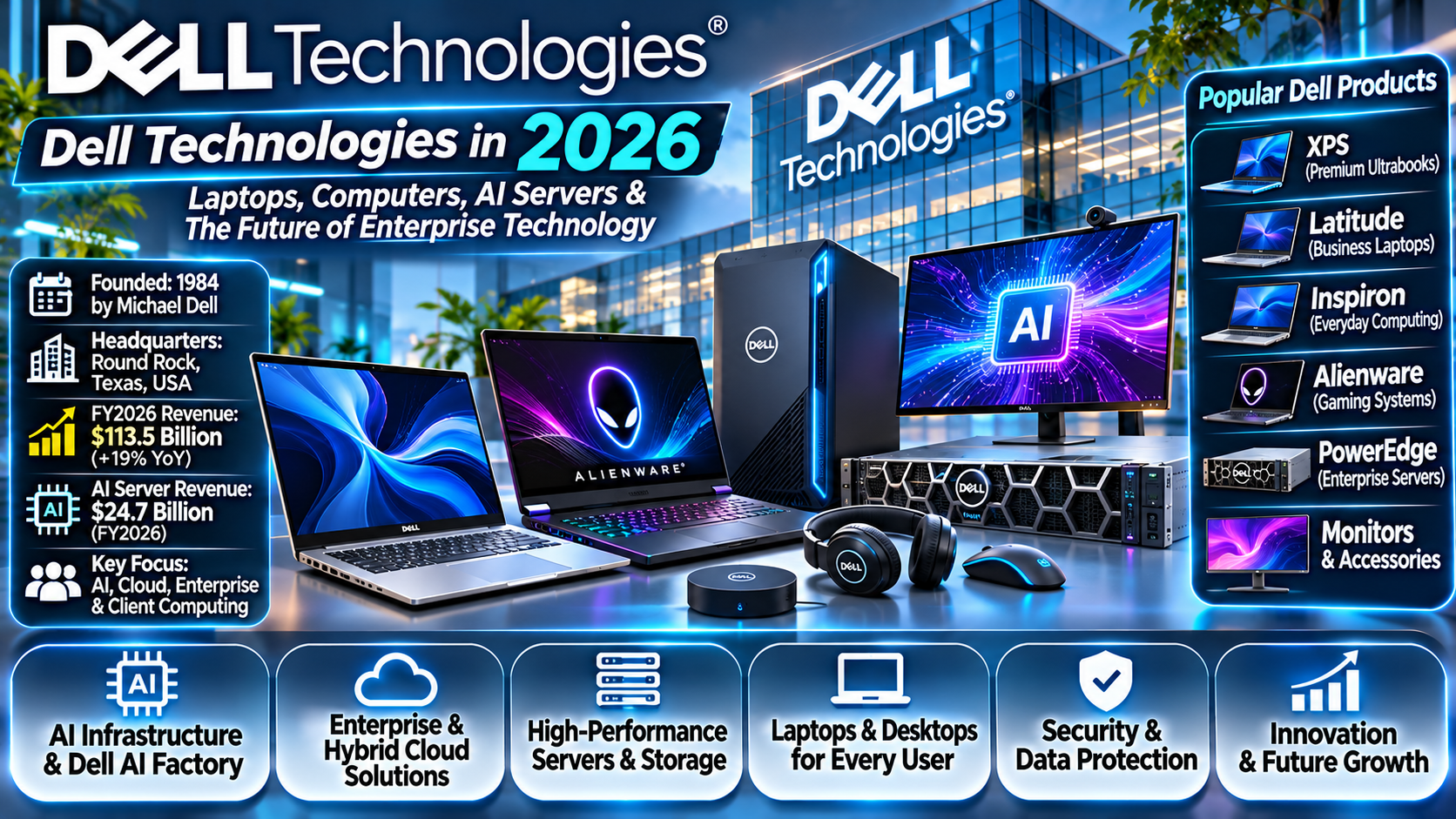
The global technology industry is evolving rapidly as artificial intelligence, cloud computing, cybersecurity, and advanced hardware transform how people work and businesses operate. Among the companies playing an important role in this transformation is Dell Technologies.
Known for its laptops, desktop computers, monitors, enterprise servers, storage systems, and IT infrastructure, Dell has developed into one of the world's major technology companies.
The company serves individual consumers, students, professionals, government organizations, and large enterprises. Its products support everything from everyday computing to complex data-center operations and artificial intelligence workloads.
In 2026, Dell's business is increasingly influenced by demand for AI infrastructure. The company is expanding its server, storage, networking, and AI-related offerings while continuing to serve the traditional personal computer market.
This guide explores Dell's history, product categories, popular laptop collections, enterprise solutions, AI strategy, competitors, and future opportunities.
1. What Is Dell Technologies?
<Entity value="Dell Technologies" category="company" disambig="American multinational computer technology and enterprise IT infrastructure company"/> is an American technology company headquartered in Round Rock, Texas.
It designs, develops, markets, sells, and supports a wide range of technology products and services.
Its major business areas include:
Personal computers and laptops
Desktop computers and workstations
Computer monitors and accessories
Enterprise servers
Data storage systems
Networking infrastructure
AI computing solutions
Cybersecurity and data protection
IT consulting and support services
Dell operates across consumer and commercial markets. Its technology is used in homes, offices, educational institutions, hospitals, government departments, research facilities, and large data centers.
The company's strategy combines personal computing products with enterprise infrastructure, allowing it to serve customers with different technology requirements.
2. The History of Dell: From a College Dorm Room to a Global Technology Company
Dell's history began in 1984 when Michael Dell founded the company as PC's Limited while studying at the University of Texas at Austin.
His original business idea was to sell personal computers directly to customers, avoiding some of the traditional distribution layers used by computer retailers.
This approach allowed the company to focus on customer requirements, customization, and competitive pricing.
Important milestones
Year | Major Development |
|---|---|
1984 | Michael Dell founded PC's Limited |
1987 | The company began international expansion |
1988 | Dell went public and adopted the Dell Computer Corporation name |
1990s | Dell expanded its global computer business |
1996 | The company strengthened its online sales operations |
2003 | The company adopted the name Dell Inc. |
2013 | Michael Dell and Silver Lake completed the company's privatization |
2016 | Dell completed its acquisition of EMC, expanding its enterprise technology business |
2018 | Dell returned to public trading |
2021 | The company adopted the Dell Technologies corporate identity more prominently |
2026 | AI infrastructure became a major growth driver |
Dell's direct-sales approach helped establish its early competitive advantage. Its expansion into enterprise infrastructure later transformed it into a much broader technology business.
3. Who Owns Dell Technologies?
Dell Technologies is a publicly traded American company listed on the New York Stock Exchange under the ticker symbol DELL.
Michael Dell is the company's founder and chairman and chief executive officer.
The company has a diverse shareholder base, including institutional investors and individual shareholders.
Dell's business is organized into two major reporting segments:
Infrastructure Solutions Group (ISG):
AI-optimized servers
Traditional servers
Networking equipment
Enterprise storage
Data-center infrastructure
Client Solutions Group (CSG):
Consumer computers
Commercial laptops
Desktop computers
Workstations
Monitors and accessories
This structure allows Dell to serve both personal computing customers and organizations that need advanced IT infrastructure.
4. Dell's Most Popular Product Categories
Dell offers a broad range of hardware and technology solutions.
A. Dell Laptops
<IMAGE_PLACEHOLDER>
Dell laptops are among the company's most recognizable products.
They are designed for students, professionals, business users, creators, and gamers.
Popular laptop families include:
Dell XPS
Dell Inspiron
Dell Latitude
Dell Precision
Dell Pro
Dell Alienware
Each family targets different requirements, including portability, productivity, professional computing, and gaming.
B. Dell XPS
The XPS family has traditionally represented Dell's premium consumer laptop positioning.
These computers are designed for users who value:
Premium construction
High-resolution displays
Portable designs
Strong computing performance
Professional and creative workflows
Availability and product naming may change as Dell updates its laptop portfolio.
C. Dell Latitude
Latitude laptops are designed primarily for business and professional environments.
Common features and priorities include:
Business productivity
Enterprise security
Manageability
Docking and connectivity options
Portability
Support and deployment services
They are used by organizations that need dependable computers for employees and business operations.
D. Dell Alienware
<IMAGE_PLACEHOLDER>
Alienware is Dell's gaming-focused computer brand.
Its product range includes gaming laptops, desktop systems, and related accessories.
Alienware products are designed for demanding gaming experiences and may include:
High-performance processors
Dedicated graphics cards
High-refresh-rate displays
Advanced cooling systems
Gaming-oriented designs
E. Dell Desktop Computers
Dell desktop computers are used in homes, offices, schools, and professional environments.
The range includes compact desktop systems, traditional towers, and specialized workstations.
Businesses often select desktops for their performance, upgrade options, connectivity, and centralized IT management.
F. Dell Monitors and Accessories
Dell also produces monitors and computer accessories.
Its product categories include:
UltraSharp monitors
Business monitors
Gaming displays
Keyboards
Mice
Docking stations
Webcams
Headsets
These products support home offices, corporate workplaces, creative professionals, and gaming setups.
5. Dell's Enterprise Technology and Infrastructure Solutions
Dell is not simply a computer manufacturer. A substantial part of its business focuses on enterprise IT infrastructure.
Organizations require powerful technology systems to operate applications, manage information, protect data, and support digital services.
Dell provides several solutions for these requirements.
Enterprise Servers
<IMAGE_PLACEHOLDER>
Dell PowerEdge servers are designed for enterprise computing environments.
They support workloads such as:
Business applications
Database management
Virtualization
Cloud infrastructure
Artificial intelligence
Data analytics
High-performance computing
These systems are used by companies, service providers, government organizations, and data-center operators.
Enterprise Storage
Businesses generate and manage large volumes of digital information.
Dell offers storage platforms designed to support data availability, performance, backup, and recovery.
Its storage portfolio includes:
All-flash storage
File storage
Block storage
Object storage
Data protection systems
Software-defined storage solutions
Networking Infrastructure
Networking equipment connects computers, servers, storage systems, and other digital infrastructure.
Dell's networking solutions support enterprise connectivity, data-center operations, and modern IT environments.
Hybrid Cloud Solutions
Many organizations use a combination of public cloud services, private infrastructure, and on-premises systems.
Dell offers solutions designed to help businesses manage these different environments.
This hybrid approach can give organizations greater flexibility over data location, performance, security, and operational costs.
6. Dell and Artificial Intelligence in 2026
Artificial intelligence has become one of the most important growth opportunities for Dell Technologies.
Modern AI systems require powerful processors, high-performance storage, fast networking, and specialized computing infrastructure.
Dell is expanding its AI-focused product portfolio to support organizations building and deploying AI applications.
Dell AI Factory
The Dell AI Factory is an integrated approach to helping organizations develop and operate AI solutions.
It combines infrastructure, software, services, and partner technologies.
Its objectives include helping organizations:
Prepare and manage data
Train AI models
Deploy AI applications
Run AI inference workloads
Manage AI infrastructure
Improve security and operational control
AI-Optimized Servers
AI servers are designed for computationally demanding workloads.
They may incorporate specialized accelerators, high-performance processors, advanced memory, and fast networking.
These systems can support:
Generative AI
Large language models
Machine learning
AI model training
AI inference
Data analytics
Dell and NVIDIA
Dell works with <Entity value="NVIDIA" category="brand" disambig="American AI computing and graphics processor company"/> to deliver AI infrastructure solutions.
The partnership combines Dell's server, storage, networking, and enterprise capabilities with NVIDIA's accelerated computing technologies.
In October 2026, Dell announced additional developments across its AI Factory with NVIDIA, including enterprise agentic AI solutions and infrastructure designed to help organizations move AI projects into production. Dell reported that more than 6,500 enterprises had adopted the AI Factory offering. <Cite refs={["turn838184search4"]}/>
Why AI Infrastructure Matters
AI is increasing demand for data-center computing capacity.
Organizations need infrastructure capable of handling large datasets, complex models, and continuous AI workloads.
This creates opportunities for companies that provide servers, storage, networking, and integrated enterprise solutions.
7. Dell's Business Performance and Growth in 2026
Dell's financial performance demonstrates the growing importance of enterprise infrastructure and AI computing.
In its fiscal 2026 results, Dell reported:
Financial Metric | FY2026 Result |
|---|---|
Full-year revenue | $113.5 billion |
Revenue growth | 19% |
Infrastructure Solutions Group revenue | $60.8 billion |
Client Solutions Group revenue | $51.0 billion |
Operating cash flow | $11.2 billion |
The company reported $24.7 billion in full-year AI-optimized server revenue for FY2026, representing substantial growth compared with the previous fiscal year. <Cite refs={["turn838184search0","turn838184search1"]}/>
Later in 2026, Dell raised its fiscal 2027 outlook as AI server demand continued to accelerate. Reuters reported that the company increased its annual revenue forecast to $192 billion and its fiscal 2027 AI-optimized server revenue outlook to $74 billion. <Cite refs={["turn838184news22"]}/>
These figures highlight how AI infrastructure is changing Dell's business mix.
Note: Dell's fiscal year does not align exactly with the calendar year. Fiscal 2026 ended on January 30, 2026.
8. Dell vs. Other Technology Companies
Dell competes with several major technology manufacturers across consumer computing, enterprise infrastructure, and data-center solutions.
Company | Main Strength | Major Market |
|---|---|---|
Dell Technologies | PCs, servers, storage, enterprise IT | Consumer and enterprise |
HP | PCs, printers, business hardware | Consumer and enterprise |
Lenovo | Laptops, desktops, workstations | Consumer and enterprise |
Apple | Integrated hardware and software ecosystem | Consumer and professional |
ASUS | Computers, components, and gaming | Consumer and gaming |
HPE | Enterprise servers and infrastructure | Enterprise |
Supermicro | High-performance servers and AI infrastructure | Enterprise and data centers |
Each company has different strengths, product strategies, and target customers.
Dell's broad combination of client devices and enterprise infrastructure gives it a significant position in the global technology market.
9. Why Dell Remains Popular Among Consumers and Businesses
Dell's continued relevance is supported by several competitive advantages.
Wide Product Selection
Dell offers products for different budgets, professional requirements, and computing needs.
Enterprise Experience
Its long history in business computing and infrastructure helps it serve large organizations with complex technology requirements.
Customization Options
Depending on the product and market, customers can configure computers with different processors, memory, storage, displays, and other specifications.
Global Customer Support
Dell provides product support, deployment assistance, and enterprise services across many markets.
Integrated Technology Portfolio
Businesses can purchase computers, servers, storage, networking equipment, and related services from the same technology provider.
AI Infrastructure Investment
Its growing AI server business gives Dell opportunities beyond the traditional personal computer market.
10. Challenges Facing Dell Technologies
Despite its strong market position, Dell faces several business challenges.
Intense Competition
Dell competes with established computer manufacturers and specialized enterprise hardware companies.
Competition can place pressure on prices, margins, and product differentiation.
Semiconductor Supply
Modern computers and servers depend on processors, memory, storage chips, and other specialized components.
Supply constraints or rising component prices can affect manufacturing costs and product availability.
Changing PC Demand
Personal computer demand can fluctuate based on economic conditions, business investment, replacement cycles, and consumer purchasing decisions.
AI Infrastructure Costs
AI servers require advanced components and complex cooling, power, and networking systems.
Delivering these systems profitably requires careful supply-chain and operational management.
Cybersecurity Risks
Dell products and enterprise infrastructure operate in environments where security is essential.
Companies must continuously address vulnerabilities, data protection, software updates, and cyber threats.
Global Supply Chain Complexity
Dell relies on international suppliers, manufacturing partners, and logistics networks.
Trade restrictions, transportation disruptions, and geopolitical uncertainty can affect operations.
11. Dell's Future Strategy Beyond 2026
Dell's future growth will depend on its ability to adapt to changes in computing, AI, enterprise infrastructure, and consumer technology.
Several areas are likely to remain important.
Artificial intelligence: Expanding AI servers and integrated AI solutions may continue to create significant business opportunities.
Modern data centers: Organizations will need infrastructure that supports high-performance computing, storage, networking, and efficient power management.
Commercial PCs: Businesses will continue to require secure, manageable, and productive computers for employees.
Hybrid cloud: Organizations may continue combining on-premises infrastructure with public cloud services.
Cybersecurity and data protection: Security will remain a major requirement as businesses adopt more connected systems and AI applications.
Energy efficiency: Data centers and high-performance computing systems will face increasing pressure to improve power and cooling efficiency.
Global enterprise partnerships: Collaborations with software companies, semiconductor manufacturers, and cloud providers can strengthen Dell's position.
12. How to Choose the Right Dell Laptop or Computer
Selecting a Dell computer requires understanding your needs rather than simply choosing the most expensive model.
User Type | Product Category to Explore | Important Considerations |
|---|---|---|
Students | Mainstream Dell laptops | Battery life, portability, price |
Office workers | Dell business laptops | Security, reliability, support |
Developers | Performance laptops or workstations | CPU, RAM, storage |
Designers | Dell workstations and suitable displays | Graphics, color accuracy, memory |
Gamers | Alienware systems | GPU, cooling, refresh rate |
Businesses | Commercial PCs and servers | Manageability, scalability, security |
Buying Tips
Choose a processor that matches your workload.
Consider at least 16GB of RAM for many modern multitasking and professional use cases.
Prefer SSD storage for responsive everyday performance.
Check battery life if portability is important.
Compare display resolution and color quality for creative work.
Review warranty and local service availability.
Compare the full specifications of different configurations before purchasing.
Product availability and configurations vary by country and retailer.
Frequently Asked Questions About Dell
1. What is Dell Technologies known for?
Dell is known for laptops, desktop computers, monitors, enterprise servers, storage systems, networking equipment, and AI infrastructure.
2. Who founded Dell?
Michael Dell founded PC's Limited in 1984 while studying at the University of Texas at Austin.
3. Who owns Dell Technologies?
Dell Technologies is a publicly traded company. Its founder, Michael Dell, serves as chairman and CEO.
4. Where is Dell headquartered?
Dell Technologies is headquartered in Round Rock, Texas, United States.
5. What are Dell's most popular laptop brands?
Dell's laptop portfolio includes product families such as XPS, Inspiron, Latitude, Precision, Dell Pro, and Alienware. Product naming and availability can change.
6. What is Dell Alienware?
Alienware is Dell's gaming-focused brand, offering gaming laptops, desktop computers, and related products.
7. What is Dell PowerEdge?
PowerEdge is Dell's server portfolio, designed for enterprise computing, virtualization, data centers, and AI-related workloads.
8. What is Dell AI Factory?
Dell AI Factory is an integrated offering that combines infrastructure, software, services, and partner technologies to help organizations build and deploy AI solutions.
9. Is Dell a good brand for business computers?
Dell offers a broad range of commercial computers and enterprise services. The best choice depends on the organization's performance, security, support, and budget requirements.
10. What is Dell's future in artificial intelligence?
Dell is investing in AI-optimized servers, data-center infrastructure, storage, networking, and enterprise AI solutions as demand for AI computing expands.
Conclusion
Dell Technologies has developed from a personal computer startup into a major global technology company serving consumers, professionals, and enterprise organizations.
Its product portfolio extends from laptops and desktop computers to advanced servers, storage systems, networking equipment, and AI infrastructure.
In 2026, artificial intelligence is becoming an increasingly important part of Dell's business strategy. Growing demand for AI-optimized servers and enterprise computing solutions is creating opportunities beyond the traditional PC market.
However, competition, component costs, cybersecurity, and supply-chain complexity remain important challenges.
Dell's long-term success will depend on continued innovation, reliable products, strong enterprise relationships, and its ability to adapt to the next generation of computing.