Successful businesses need more than innovative products, advanced technology, and financial resources. They also need effective leaders who can guide teams, make informed decisions, solve problems, and turn organizational goals into measurable results.
Leadership plays a central role in determining how employees work, how organizations respond to challenges, and how businesses achieve long-term growth.
However, modern leadership is changing. Remote and hybrid work, artificial intelligence, global competition, employee expectations, and rapid technological developments have created new responsibilities for business leaders.
Traditional management approaches may no longer be sufficient. Today's leaders must combine strategic thinking, emotional intelligence, communication, adaptability, and technological awareness.
This is why effective leadership strategies are essential in 2026.
Whether you are a business owner, CEO, department manager, startup founder, or aspiring executive, the right leadership approach can help you build stronger teams and create a more productive workplace.
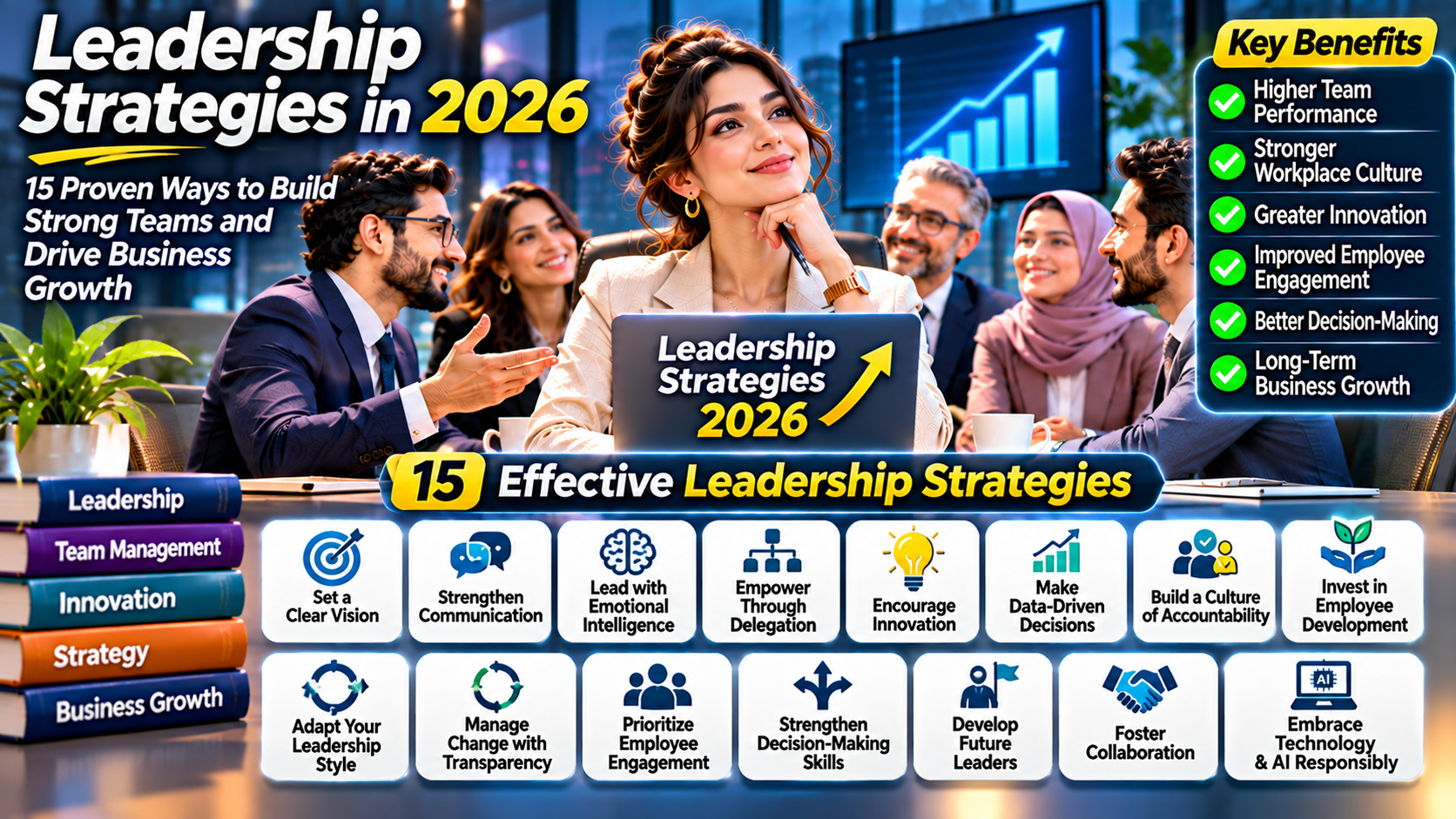
In this guide, we explore 15 practical leadership strategies, their benefits, implementation methods, common challenges, and the leadership trends shaping the future of business.
What Are Leadership Strategies?
Leadership strategies are structured approaches that leaders use to guide employees, manage teams, achieve organizational objectives, and improve business performance.
These strategies help leaders determine how to communicate expectations, motivate employees, allocate resources, manage conflicts, and make important decisions.
Effective leadership strategies typically focus on:
Establishing a clear organizational vision
Setting measurable goals and priorities
Building trust and professional relationships
Improving employee engagement
Encouraging innovation and creativity
Developing future leaders
Managing organizational change
Making data-informed decisions
Strengthening communication
Creating accountability
The most effective leadership strategy depends on the organization's size, industry, culture, objectives, and workforce.
There is no single approach that works in every situation. Successful leaders understand when to provide direction, when to delegate responsibility, and when to involve employees in decision-making.
Why Leadership Strategies Matter in 2026
Modern organizations operate in an environment where business priorities, technology, and customer expectations can change quickly.
Strong leadership helps businesses remain focused while adapting to new opportunities and challenges.
1. Improving Employee Performance
Employees perform more effectively when they understand their responsibilities, receive constructive feedback, and have access to the resources they need.
Good leadership creates clear expectations and encourages employees to take ownership of their work.
2. Strengthening Workplace Culture
Leadership influences how employees communicate, collaborate, and treat one another.
A positive leadership approach promotes respect, accountability, inclusion, and professional development.
3. Supporting Business Growth
Organizations need leaders who can identify opportunities, manage resources, and align teams with strategic objectives.
Effective leadership helps connect daily activities with long-term business goals.
4. Managing Technological Change
AI, automation, cloud computing, and data analytics are changing business operations.
Leaders must understand how these technologies affect employees, workflows, customer experiences, and organizational performance.
5. Building Organizational Resilience
Unexpected challenges can affect operations, finances, employee morale, and customer relationships.
Strong leaders help teams respond constructively, adjust priorities, and maintain business continuity.
15 Effective Leadership Strategies for Business Success
1. Develop a Clear Vision and Communicate It
One of the most important leadership strategies is establishing a clear vision.
Employees need to understand where the organization is going and how their individual responsibilities contribute to its success.
A strong vision provides direction, creates alignment, and helps employees understand the purpose behind their work.
How to implement this strategy:
Define long-term business objectives.
Communicate organizational priorities regularly.
Explain how team goals support the wider vision.
Make expectations understandable and realistic.
Review progress and adjust priorities when necessary.
For example, a technology company planning to expand into international markets should communicate its growth objectives, target markets, and expected contributions from different departments.
When employees understand the direction, they can make better decisions and work toward shared outcomes.
2. Build Strong Communication Across Teams
Effective communication is the foundation of successful leadership.
Leaders must communicate expectations, explain decisions, listen to employees, and provide constructive feedback.
Poor communication can create misunderstandings, missed deadlines, workplace conflict, and reduced productivity.
Practical communication techniques include:
Schedule regular team meetings.
Encourage employees to ask questions.
Provide clear instructions and feedback.
Use appropriate collaboration tools.
Communicate organizational changes transparently.
Listen actively before responding.
Leaders should also adapt their communication styles to different situations.
A sensitive employee concern may require a private conversation, while a project update may be better communicated through a team meeting.
3. Lead with Emotional Intelligence
Emotional intelligence is the ability to recognize, understand, and manage emotions while responding appropriately to the emotions of others.
It is an important leadership capability because business decisions often involve people, relationships, pressure, and uncertainty.
Leaders with strong emotional intelligence are better positioned to manage conflict, build trust, and maintain professional relationships.
Important emotional intelligence skills include:
Self-awareness
Self-regulation
Empathy
Active listening
Relationship management
Constructive conflict resolution
For example, when an employee makes a mistake, an emotionally intelligent leader investigates the situation, provides guidance, and identifies ways to prevent similar problems.
Instead of creating unnecessary fear, the leader encourages accountability and improvement.
4. Empower Employees Through Delegation
Effective leaders understand that they cannot manage every task personally.
Delegation allows employees to take responsibility, develop new skills, and contribute more actively to organizational success.
It also gives leaders additional time to focus on strategy, planning, and high-priority decisions.
How to delegate effectively:
Identify tasks that can be assigned to others.
Select employees based on their skills and experience.
Explain expected outcomes and deadlines.
Provide access to the necessary resources.
Allow employees to make appropriate decisions.
Monitor progress without unnecessary interference.
Delegation should not mean transferring responsibility without support. Leaders must remain available to provide guidance and remove obstacles.
5. Encourage Innovation and Creative Thinking
Businesses that encourage innovation are better positioned to identify new opportunities and respond to changing markets.
Leaders should create an environment where employees feel comfortable suggesting improvements and testing reasonable ideas.
Ways to encourage innovation include:
Organizing brainstorming sessions.
Welcoming suggestions from different departments.
Supporting controlled experiments.
Recognizing useful ideas.
Learning from unsuccessful projects.
Investing in employee development.
For example, a marketing team may discover a more efficient customer acquisition method by testing different campaign formats and analyzing the results.
Leaders should create space for experimentation while maintaining clear performance and risk-management standards.
6. Make Data-Driven Decisions
Modern businesses generate large amounts of information through sales systems, customer platforms, financial reports, and operational tools.
Effective leaders use relevant data to understand performance and support informed decisions.
Rather than relying entirely on assumptions, they examine measurable indicators.
Examples include:
Revenue growth
Customer retention
Employee turnover
Project completion rates
Customer satisfaction
Operational costs
Marketing return on investment
Productivity measures
Data should support leadership judgment rather than replace it.
Leaders must also consider data quality, privacy, context, and potential bias when interpreting reports.
7. Build a Culture of Accountability
Accountability helps employees understand their responsibilities and take ownership of results.
Organizations with clear accountability structures can identify problems earlier, improve coordination, and maintain consistent standards.
Practical ways to establish accountability:
Define responsibilities clearly.
Set measurable performance expectations.
Establish realistic deadlines.
Review progress regularly.
Address performance issues constructively.
Recognize employees who deliver results.
Accountability should apply to leaders as well as employees.
When managers accept responsibility for their decisions, they demonstrate the behavior they expect from their teams.
8. Invest in Employee Development
A strong organization needs employees who can continue learning and adapting.
Leaders should treat professional development as a long-term investment rather than an occasional activity.
Employee development can improve performance, increase engagement, and prepare organizations for future challenges.
Useful development initiatives include:
Technical training
Leadership workshops
Mentorship programs
Cross-functional projects
Professional certifications
Communication training
Career development planning
For example, a company preparing to introduce AI-powered workflows may provide employees with practical training before changing existing processes.
This reduces uncertainty and helps employees develop the skills required for new responsibilities.
9. Adapt Your Leadership Style to the Situation
Different employees, projects, and organizational challenges require different leadership approaches.
A new employee may need detailed guidance, while an experienced professional may perform better with greater independence.
Effective leaders understand when to be directive, collaborative, supportive, or delegative.
Leadership Approach | Best Used When |
|---|---|
Directive | Quick decisions or urgent situations |
Democratic | Team input and collaboration are important |
Transformational | Leading innovation and organizational change |
Servant Leadership | Supporting employee development and well-being |
Coaching | Developing employee skills and confidence |
Delegative | Working with experienced and independent teams |
The goal is not to follow one leadership style permanently. It is to respond appropriately to the needs of the situation.
10. Manage Change with Transparency
Organizational change can create uncertainty among employees.
Changes in technology, management structures, business priorities, or operational processes may affect how people perform their jobs.
Leaders must explain why change is necessary and how it will affect the organization.
An effective change-management approach includes:
Explaining the reason for change.
Communicating expected outcomes.
Identifying potential employee concerns.
Providing training and resources.
Introducing changes in manageable stages.
Monitoring results and collecting feedback.
Transparent communication helps employees understand the process and reduces unnecessary resistance.
11. Prioritize Employee Engagement
Employee engagement describes the level of commitment, involvement, and connection employees feel toward their work and organization.
Engaged employees are more likely to contribute ideas, collaborate effectively, and take responsibility for their performance.
Leaders can improve engagement by:
Recognizing employee contributions.
Providing meaningful responsibilities.
Encouraging professional growth.
Listening to employee feedback.
Promoting respectful workplace relationships.
Supporting reasonable work-life boundaries.
Engagement should be measured through meaningful feedback and organizational indicators rather than assumptions.
12. Strengthen Decision-Making Skills
Leaders regularly make decisions that affect employees, customers, finances, and business operations.
Effective decision-making requires understanding the problem, evaluating available information, considering risks, and selecting an appropriate course of action.
A practical decision-making process:
Define the problem clearly.
Gather relevant information.
Identify possible solutions.
Evaluate benefits and risks.
Consider stakeholder perspectives.
Make a decision.
Monitor the outcome.
Leaders should also recognize when a decision requires consultation with financial, legal, technical, or other specialists.
13. Develop Future Leaders
Organizations need leadership continuity.
Depending entirely on one executive or manager can create operational risks when that individual changes roles or leaves the company.
Developing future leaders helps businesses maintain knowledge, strengthen teams, and prepare for expansion.
Leadership development methods include:
Mentorship programs
Leadership training
Succession planning
Cross-functional assignments
Management responsibilities
Coaching and feedback
Exposure to strategic projects
Future leaders should be identified through performance, potential, professional conduct, and readiness for greater responsibility.
14. Build a Collaborative Workplace
Modern business challenges often require cooperation across departments.
Marketing, finance, operations, technology, sales, and human resources must work together to achieve organizational objectives.
Leaders can encourage collaboration by:
Establishing shared goals.
Promoting cross-functional projects.
Encouraging knowledge sharing.
Reducing unnecessary communication barriers.
Recognizing collective achievements.
Resolving departmental conflicts fairly.
A collaborative culture allows employees to combine different skills and perspectives to solve complex problems.
15. Embrace Technology and AI Responsibly
Technology awareness has become an important leadership capability.
Leaders do not need to become software engineers, but they should understand how technology can improve business operations and where it introduces new risks.
AI and automation can support:
Routine administrative tasks
Customer service workflows
Data analysis
Business reporting
Content research
Operational planning
Workflow management
However, technology adoption should include appropriate human oversight, employee training, privacy protections, cybersecurity controls, and clear accountability.
The best leaders use technology to improve human capabilities rather than treating automation as a replacement for thoughtful management.
Leadership Strategies for Different Business Environments
Leadership approaches should reflect the organization's size, industry, workforce, and stage of development.
Leadership Strategies for Startups
Startup leaders often work with limited budgets, small teams, and rapidly changing priorities.
Their leadership strategies should focus on:
Establishing clear priorities.
Maintaining transparent communication.
Making decisions efficiently.
Encouraging experimentation.
Building a flexible team.
Managing resources carefully.
Developing a scalable business culture.
Startup leaders should balance speed with responsible decision-making.
Leadership Strategies for Small Businesses
Small business leaders often manage several responsibilities simultaneously.
Effective strategies include:
Delegating daily operations.
Building strong customer relationships.
Training employees across important functions.
Monitoring cash flow and business performance.
Improving operational efficiency.
Establishing clear workplace expectations.
Strong leadership can help small businesses grow without creating unnecessary organizational complexity.
Leadership Strategies for Large Organizations
Large organizations require coordination across multiple departments, locations, and management levels.
Their leaders should prioritize:
Strategic alignment.
Leadership development.
Organizational accountability.
Cross-functional collaboration.
Change management.
Risk management.
Performance measurement.
Consistency in communication and decision-making becomes particularly important as organizations expand.
Leadership Strategies for Remote and Hybrid Teams
Remote and hybrid work arrangements require leaders to manage performance and collaboration across different locations.
Useful strategies include:
Setting clear communication expectations.
Defining measurable outcomes.
Using appropriate collaboration platforms.
Scheduling regular check-ins.
Encouraging inclusive participation.
Supporting employee well-being.
Evaluating results rather than relying only on visible activity.
Remote leadership should focus on trust, clarity, and accountability.
Leadership Strategies and Business Performance: What Should Leaders Measure?
Leadership effectiveness should be evaluated through observable outcomes.
A business can use different performance indicators to understand whether its leadership practices are producing positive results.
Performance Area | Useful Measurement |
|---|---|
Employee Engagement | Employee surveys and feedback |
Productivity | Output, efficiency, and project completion |
Employee Retention | Turnover and retention rates |
Business Growth | Revenue and profitability trends |
Customer Experience | Satisfaction and retention |
Team Collaboration | Cross-functional project outcomes |
Leadership Development | Internal promotions and succession readiness |
Innovation | Implemented improvements and successful experiments |
No single metric provides a complete picture of leadership effectiveness.
Organizations should combine quantitative results with employee feedback, customer perspectives, and long-term business outcomes.
Common Leadership Mistakes to Avoid
Even experienced leaders can develop habits that negatively affect team performance.
Understanding common mistakes can help managers improve their leadership approach.
1. Micromanaging Employees
Constantly controlling small tasks reduces employee independence and can damage trust.
Leaders should establish clear expectations and allow capable employees to manage their responsibilities.
2. Poor Communication
Unclear instructions and inconsistent updates can create confusion.
Leaders should communicate priorities, expectations, and important changes consistently.
3. Ignoring Employee Feedback
Employees often understand operational challenges because they work directly with customers, systems, and daily processes.
Ignoring their feedback can result in missed opportunities for improvement.
4. Avoiding Difficult Decisions
Delaying important decisions can increase uncertainty and create larger problems.
Leaders should evaluate available information and address issues within an appropriate timeframe.
5. Failing to Recognize Contributions
Employees need constructive feedback and appropriate recognition.
Leaders should acknowledge meaningful contributions while maintaining fair performance standards.
6. Resisting Change
Businesses must adapt to new customer expectations, technologies, and market conditions.
Leaders who reject useful improvements may limit organizational growth.
How to Create a Leadership Strategy for Your Organization
A leadership strategy should be connected to the organization's business objectives and workforce needs.
The following steps provide a practical starting point.
Step 1: Assess Your Current Leadership Environment
Review existing management practices, employee feedback, communication processes, and organizational performance.
Identify strengths and areas that require improvement.
Step 2: Define Leadership Objectives
Establish specific goals, such as improving employee engagement, developing managers, strengthening collaboration, or improving decision-making.
Step 3: Identify Leadership Gaps
Determine which capabilities need development.
These may include communication, strategic thinking, conflict resolution, technology awareness, or financial understanding.
Step 4: Develop a Leadership Action Plan
Create practical initiatives with clear responsibilities, timelines, and measurable outcomes.
Step 5: Train and Support Managers
Provide coaching, mentoring, workshops, and relevant learning resources.
Step 6: Measure Progress
Review employee feedback, performance indicators, and business outcomes.
Step 7: Improve Continuously
Leadership development is an ongoing process. Review results and adjust strategies as organizational needs change.
The Future of Leadership Strategies in 2026 and Beyond
Leadership will continue evolving as technology, employee expectations, and business models change.
Several trends are likely to influence how organizations develop and implement leadership strategies.
AI-Aware Leadership
Leaders will increasingly need to understand AI capabilities, limitations, governance, and business applications.
Greater Focus on Emotional Intelligence
As workplaces become more complex, empathy, communication, and relationship management will remain essential leadership skills.
Skills-Based Workforce Development
Organizations will increasingly focus on identifying employee capabilities and developing skills that support changing business needs.
Flexible Leadership Models
Remote, hybrid, and global teams will require more adaptable communication and management practices.
Data-Informed Leadership
Leaders will use analytics to evaluate performance, identify challenges, and support strategic decisions.
Stronger Emphasis on Trust and Transparency
Employees and customers increasingly expect organizations to communicate honestly and act responsibly.
Continuous Leadership Development
Businesses will invest in mentorship, coaching, and succession planning to prepare future executives and managers.
Frequently Asked Questions (FAQs)
1. What are the most effective leadership strategies in 2026?
Effective leadership strategies include clear communication, emotional intelligence, employee empowerment, strategic planning, accountability, data-driven decision-making, and continuous professional development.
2. Why are leadership strategies important for businesses?
Leadership strategies help organizations align employees with business goals, improve performance, strengthen workplace culture, manage change, and support sustainable growth.
3. What is the best leadership strategy?
There is no single best leadership strategy for every organization. The most effective approach depends on business objectives, employee experience, organizational culture, and the situation leaders face.
4. How can leaders improve employee performance?
Leaders can improve performance by setting clear expectations, providing constructive feedback, offering training, recognizing contributions, and giving employees appropriate responsibility.
5. What role does emotional intelligence play in leadership?
Emotional intelligence helps leaders understand emotions, manage relationships, resolve conflicts, communicate effectively, and build trust with employees.
6. How can leadership strategies improve business growth?
Strong leadership can improve team productivity, encourage innovation, strengthen customer relationships, support better decisions, and align business activities with long-term objectives.
7. How should leaders manage remote teams?
Leaders should establish clear expectations, use suitable collaboration tools, maintain regular communication, support employee well-being, and measure outcomes rather than physical presence.
8. How can someone develop leadership skills?
Leadership skills can be developed through practical experience, mentorship, professional training, feedback, communication practice, and taking responsibility for projects and teams.
9. What is the difference between leadership and management?
Leadership focuses on direction, influence, vision, and motivating people toward shared goals. Management focuses more on planning, organizing, coordinating, and controlling resources. Both are important for organizational success.
10. How can businesses measure leadership effectiveness?
Businesses can evaluate leadership through employee engagement, retention, productivity, customer satisfaction, organizational performance, and leadership development outcomes.
Conclusion
Effective leadership strategies are essential for organizations that want to build strong teams, improve performance, and achieve sustainable business growth.
In 2026, successful leaders must combine traditional leadership capabilities with adaptability, emotional intelligence, technological awareness, and strategic thinking.
From developing a clear vision and encouraging innovation to empowering employees and embracing AI responsibly, every leadership strategy should contribute to stronger organizational performance.
The most successful leaders do not simply give instructions. They create an environment where employees understand their purpose, develop their capabilities, and contribute meaningfully to shared goals.
Businesses that invest in effective leadership today will be better prepared to manage change, develop future executives, and compete in an increasingly complex business environment.