Marketing has evolved far beyond traditional advertising and promotional campaigns. Businesses now rely on data analytics, artificial intelligence, digital platforms, customer experience, and brand storytelling to attract customers and remain competitive.
At the center of this transformation are Chief Marketing Officers (CMOs). These executives guide marketing strategy, manage brand reputation, oversee customer acquisition, and ensure that marketing activities support business objectives.
However, modern marketing challenges are becoming increasingly complex. CMOs must understand changing consumer behavior, evaluate emerging technologies, manage marketing budgets, and demonstrate measurable business results.
This makes professional networking especially valuable.
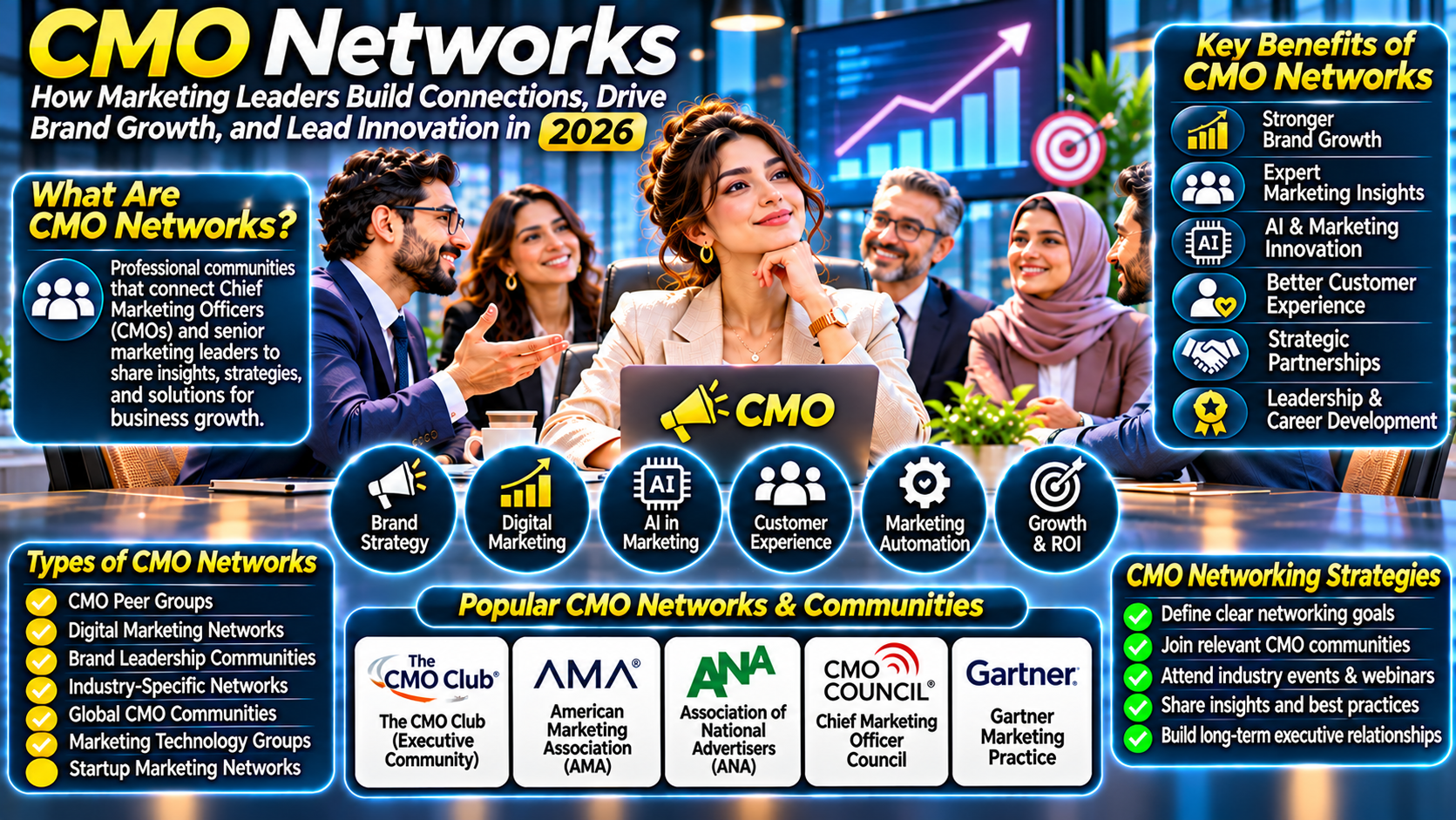
CMO networks connect Chief Marketing Officers, senior marketing executives, brand strategists, digital marketing professionals, and business leaders. These communities provide opportunities to exchange knowledge, discuss industry challenges, explore new strategies, and build valuable professional relationships.
In this guide, we explore what CMO networks are, their benefits, popular marketing leadership communities, networking strategies, and how they help businesses achieve sustainable growth in 2026.
What Are CMO Networks?
CMO networks are professional communities designed to connect Chief Marketing Officers and senior marketing professionals.
These networks allow marketing leaders to share experiences, discuss emerging trends, exchange strategic insights, and develop relationships with other industry decision-makers.
Unlike general business networking groups, CMO networks focus specifically on marketing leadership, brand management, customer acquisition, digital transformation, and marketing performance.
Members may discuss topics such as:
Brand strategy and reputation management
Digital marketing and customer acquisition
Artificial intelligence in marketing
Marketing automation and personalization
Customer experience and retention
Social media and content marketing
Marketing analytics and performance measurement
Public relations and corporate communications
Marketing technology and innovation
Leadership and team development
CMO networks may operate through executive associations, private peer groups, conferences, online communities, and invitation-only leadership programs.
Their primary purpose is to help marketing executives learn from one another, strengthen their leadership capabilities, and make more informed strategic decisions.
Why CMO Networks Matter in 2026
The responsibilities of marketing executives have expanded significantly. CMOs are no longer focused only on advertising, promotional activities, and brand awareness.
They are increasingly responsible for connecting marketing performance with customer loyalty, revenue growth, business strategy, and organizational innovation.
Several developments make CMO networks particularly valuable.
1. Rapid Growth of AI in Marketing
Artificial intelligence is transforming how companies research audiences, generate content, personalize campaigns, and analyze customer behavior.
CMOs must understand how to use AI effectively while maintaining brand consistency, data privacy, and customer trust.
Professional networks allow marketing leaders to exchange experiences about AI-powered marketing tools, automation, and responsible implementation.
2. Changing Consumer Behavior
Customers interact with brands across websites, social media, search engines, mobile applications, and digital marketplaces.
Understanding these changing behaviors requires continuous learning and access to industry insights.
CMO communities provide opportunities to discuss customer expectations, emerging trends, and effective engagement strategies.
3. Increasing Marketing Competition
Businesses compete for attention across increasingly crowded digital platforms.
Marketing executives must develop stronger positioning, creative campaigns, and measurable growth strategies.
Networking with experienced CMOs can provide fresh perspectives on brand differentiation and competitive positioning.
4. Greater Focus on Marketing ROI
Companies increasingly expect marketing departments to demonstrate how campaigns contribute to business results.
CMOs must understand customer acquisition costs, conversion rates, customer lifetime value, return on marketing investment, and revenue attribution.
Executive communities help members discuss performance measurement and practical approaches to marketing accountability.
5. Growing Importance of Customer Experience
Modern marketing involves the complete customer journey, from initial awareness to purchase and long-term loyalty.
CMO networks help leaders explore personalization, customer engagement, retention strategies, and integrated brand experiences.
Key Benefits of CMO Networks
Joining a CMO network can provide professional, strategic, and organizational advantages.
1. Strategic Knowledge Sharing
Marketing executives frequently encounter similar challenges, even across different industries.
Professional communities provide opportunities to discuss campaign performance, marketing technology, customer behavior, brand positioning, and business growth.
For example, a CMO planning an international brand campaign can learn from another executive who has already managed a similar expansion.
2. Access to Marketing Insights
Marketing trends and digital platforms change rapidly.
CMO networks help members exchange perspectives on emerging technologies, changing consumer preferences, advertising developments, and marketing strategies.
These insights can support more informed decisions.
3. Stronger Professional Relationships
Executive relationships can create opportunities for partnerships, collaboration, mentorship, and career development.
CMO networks connect marketing leaders with experienced professionals, agency executives, technology providers, and other business decision-makers.
4. Better Marketing Technology Decisions
Businesses use a growing range of marketing platforms, including customer relationship management systems, analytics tools, automation software, and advertising technology.
CMOs can learn from other executives about technology selection, implementation challenges, and practical business outcomes.
5. Leadership Development
Effective marketing leadership requires communication, strategic thinking, financial understanding, creativity, and team management.
Executive networking communities provide opportunities to learn from experienced marketing leaders and strengthen these capabilities.
6. Brand Growth Opportunities
CMOs can exchange ideas about brand awareness, reputation management, customer loyalty, and market positioning.
These discussions may help organizations identify new ways to attract customers and strengthen their competitive position.
7. Career Development
Professional networks help marketing executives build their industry reputation, discover leadership opportunities, develop mentorship relationships, and expand their professional connections.
Types of CMO Networks
Different CMO communities serve different professional interests and business requirements.
Network Type | Main Purpose |
|---|---|
CMO Peer Groups | Confidential discussions among marketing executives |
Digital Marketing Networks | Sharing digital marketing strategies and insights |
Brand Leadership Communities | Brand positioning, reputation, and identity |
Industry-Specific Networks | Marketing knowledge for particular industries |
Global CMO Communities | International connections and market perspectives |
Startup Marketing Networks | Supporting startup founders and growth leaders |
Marketing Technology Communities | Discussing automation, analytics, and AI tools |
Invitation-Only Executive Groups | Private networking among senior marketing leaders |
Some networks focus on executive development, while others emphasize digital marketing, brand strategy, technology, or industry-specific challenges.
Popular CMO Networks and Marketing Leadership Communities
Marketing executives can explore several established professional organizations and communities.
1. The CMO Club
The CMO Club is an executive community focused on connecting senior marketing leaders.
It provides opportunities for peer discussions, leadership development, networking, and knowledge exchange.
Its activities can help marketing executives explore leadership challenges and share practical experiences.
Website: https://thecmoclub.com/
2. American Marketing Association (AMA)
The American Marketing Association supports marketing professionals through educational resources, professional development, research, and networking opportunities.
Its community can be useful for CMOs interested in marketing strategy, industry knowledge, and professional growth.
Website: https://www.ama.org/
3. ANA (Association of National Advertisers)
ANA supports advertisers and marketing organizations through industry resources, professional communities, events, and educational programs.
Its resources cover brand management, marketing effectiveness, advertising, data, and industry developments.
Website: https://www.ana.net/
4. Chief Marketing Officer Council
The Chief Marketing Officer Council connects senior marketing executives and provides research, insights, and professional networking opportunities.
Its focus includes marketing leadership, brand strategy, customer experience, and business growth.
Website: https://www.cmocouncil.org/
5. Gartner Marketing Practice
Gartner provides research, advisory services, and insights that support marketing executives and business leaders.
Its marketing resources help leaders evaluate emerging trends, develop marketing strategies, and understand changing customer expectations.
Website: https://www.gartner.com/
6. LinkedIn Marketing Leadership Communities
LinkedIn provides a professional platform where CMOs can connect with marketing executives, follow industry developments, participate in discussions, and discover professional events.
It is also useful for building relationships with agency leaders, marketing consultants, and business decision-makers.
Website: https://www.linkedin.com/
Note: Membership criteria, event schedules, and available networking services vary. Check each organization's current offerings before joining.
How CMO Networks Support Digital Marketing and Brand Growth
Digital marketing has become an essential part of modern business strategy. Companies use multiple channels to reach customers, communicate their value, and generate revenue.
CMO networks can support these activities by encouraging knowledge sharing and collaboration.
Improving Brand Positioning
CMOs can exchange ideas about identifying target audiences, developing brand messaging, and creating a distinctive market position.
Strengthening Customer Acquisition
Marketing executives can discuss strategies for improving search visibility, paid advertising, social media engagement, email marketing, and conversion optimization.
Enhancing Customer Retention
Professional communities can provide insights into loyalty programs, customer communication, personalization, and long-term relationship management.
Exploring Marketing Automation
CMOs can learn how automation platforms support lead generation, campaign management, customer segmentation, and marketing workflows.
Improving Marketing Performance
Executives can exchange ideas about analytics, reporting, campaign attribution, and measuring marketing return on investment.
The Role of AI in Modern CMO Networks
Artificial intelligence is becoming one of the most important topics in marketing leadership discussions.
AI-powered systems can support content production, customer segmentation, predictive analytics, campaign optimization, and personalized communication.
CMO networks provide opportunities to explore how these technologies can be implemented effectively.
Important discussion areas include:
AI-Powered Content: Exploring how AI supports content research, drafting, creative development, and campaign production while maintaining editorial quality.
Customer Personalization: Using customer data and predictive systems to deliver more relevant experiences.
Marketing Automation: Improving repetitive marketing activities, lead management, and campaign workflows.
Predictive Analytics: Identifying customer behavior patterns and evaluating potential campaign outcomes.
Marketing Governance: Addressing data privacy, transparency, intellectual property, brand safety, and responsible AI usage.
Performance Optimization: Exploring how AI-powered analytics can help marketing teams evaluate campaign performance and allocate resources.
AI can improve marketing efficiency, but human creativity, strategic judgment, and brand understanding remain essential.
CMO Networking Strategies: How to Build Valuable Connections
Joining a marketing leadership community is only the beginning. Building meaningful professional relationships requires consistent participation and a clear networking strategy.
1. Define Your Networking Goals
Before joining a CMO network, identify what you want to achieve.
Your objectives may include:
Learning about AI-powered marketing
Improving brand positioning
Understanding customer acquisition strategies
Building relationships with marketing executives
Exploring international business opportunities
Developing leadership capabilities
Learning about marketing technology
Clear goals help you identify communities that match your professional interests.
2. Join Relevant Marketing Communities
Choose networks that align with your industry, experience, and marketing responsibilities.
For example, a CMO working in e-commerce may benefit from communities focused on customer experience, digital advertising, conversion optimization, and marketing analytics.
A CMO in financial services may prefer communities discussing reputation management, customer trust, regulatory considerations, and financial marketing.
3. Attend Industry Events
Participate in marketing conferences, executive roundtables, webinars, and professional networking events.
These activities create opportunities to meet other marketing leaders and discuss industry challenges.
4. Share Valuable Insights
Effective networking involves contributing knowledge rather than simply seeking opportunities.
Share useful experiences, marketing research, campaign lessons, and professional perspectives.
Consistent participation can strengthen your reputation within an executive community.
5. Build Long-Term Relationships
Strong professional relationships develop through trust, communication, and mutual value.
Follow up after meetings, share relevant resources, and remain engaged in meaningful discussions.
6. Use Digital Networking Platforms
Online platforms make it easier to connect with marketing executives across different countries and industries.
LinkedIn, professional association websites, and private executive communities can support ongoing networking.
Challenges of CMO Networks
Although CMO networks offer many advantages, they also have limitations.
Time Constraints
Senior marketing executives often manage demanding schedules.
Attending conferences and participating in professional communities can become difficult without proper time management.
Confidentiality Concerns
Marketing discussions may involve sensitive campaign information, customer data, business strategies, and brand decisions.
Members should respect confidentiality agreements and organizational policies.
Networking Without Clear Objectives
Joining too many communities without defined goals can lead to wasted time and limited professional value.
Limited Practical Value
Not every discussion provides actionable insights. Executives should prioritize communities that offer relevant knowledge, useful resources, and meaningful professional connections.
Membership Costs
Some executive communities require paid memberships, event fees, or additional participation costs.
Marketing leaders should evaluate whether the potential benefits justify the investment.
How to Choose the Right CMO Network
Selecting the right professional community depends on your marketing objectives, industry, leadership experience, and available resources.
Consider the following factors before joining.
Evaluation Factor | What to Consider |
|---|---|
Member Quality | Are members experienced CMOs and senior marketing executives? |
Industry Relevance | Does the community understand your business sector? |
Networking Opportunities | Does it provide meaningful executive interaction? |
Knowledge Resources | Are research, insights, and educational materials available? |
Event Quality | Does it organize valuable marketing conferences and discussions? |
Privacy | Are confidentiality and data protection taken seriously? |
Membership Cost | Does the value justify the financial commitment? |
A focused and relevant CMO community can be more valuable than joining numerous general networking groups.
How Businesses Can Benefit from CMO Networks
CMO networks do not only benefit individual executives. Organizations can also gain value when their marketing leaders participate in relevant professional communities.
Businesses may benefit through:
Stronger brand positioning: Marketing leaders gain new perspectives on brand strategy and market differentiation.
Improved customer acquisition: Executives can learn from successful campaigns and customer engagement strategies.
Better marketing technology decisions: Professional insights can help organizations evaluate platforms and tools.
More effective marketing teams: CMOs can develop leadership and workforce management skills.
Greater innovation: Exposure to emerging technologies and industry experiences can inspire new marketing approaches.
Improved business alignment: Marketing leaders can better connect brand activities with revenue and organizational objectives.
Companies should encourage professional development while ensuring that confidential customer and business information remains protected.
The Future of CMO Networks in 2026 and Beyond
The future of CMO networks will be shaped by technological innovation, changing customer expectations, and the growing strategic importance of marketing.
Several developments are likely to influence these communities.
AI-Focused Marketing Communities
As AI becomes more integrated into marketing operations, executive communities will increasingly discuss automation, personalization, predictive analytics, and responsible AI practices.
Greater Focus on Customer Experience
Marketing leaders will continue exploring how businesses can create consistent and personalized customer experiences across digital and physical channels.
Data-Driven Marketing Leadership
CMO networks will place greater emphasis on analytics, campaign measurement, attribution, and marketing performance.
Global Executive Networking
Digital platforms and virtual events will make it easier for marketing leaders to exchange insights across countries and industries.
Stronger Collaboration Across C-Suite Roles
CMOs will increasingly collaborate with CEOs, CFOs, CIOs, and CHROs. Networking communities may place greater emphasis on connecting marketing strategy with financial performance, technology, and organizational development.
More Specialized Communities
Professional networks may become more focused on areas such as brand leadership, marketing technology, customer experience, digital advertising, and AI-powered marketing.
Frequently Asked Questions (FAQs)
1. What are CMO networks?
CMO networks are professional communities that connect Chief Marketing Officers and senior marketing executives to exchange knowledge, discuss industry challenges, develop relationships, and explore marketing trends.
2. Why should CMOs join professional networks?
CMOs can gain access to industry insights, executive relationships, leadership development, marketing research, and discussions about emerging technologies.
3. What are the best CMO networks in 2026?
Relevant organizations and communities include The CMO Club, American Marketing Association, ANA, Chief Marketing Officer Council, Gartner Marketing Practice, and professional marketing leadership communities on LinkedIn.
4. How do CMO networks support business growth?
They help marketing leaders exchange ideas about brand positioning, customer acquisition, marketing technology, customer retention, and campaign performance.
5. Are CMO networks useful for startup marketing leaders?
Yes. Startup marketing executives can learn about brand development, customer acquisition, digital marketing, marketing budgets, and building effective marketing teams.
6. Can CMO networks help with AI marketing?
Yes. Members can discuss AI-powered content, campaign automation, customer personalization, predictive analytics, and responsible AI implementation.
7. What is the difference between CMO networks and general marketing groups?
CMO networks focus on executive-level leadership, business strategy, brand growth, marketing performance, and organizational decision-making. General marketing groups may cover broader professional and technical marketing topics.
8. How can I join a CMO network?
You can explore established marketing organizations, attend industry conferences, participate in executive events, join professional communities, and connect with marketing leaders through platforms such as LinkedIn.
Conclusion
CMO networks have become valuable resources for marketing executives navigating a rapidly changing business environment.
By connecting with other marketing leaders, CMOs can exchange strategic knowledge, explore emerging technologies, strengthen professional relationships, and develop new approaches to brand growth.
In 2026, marketing leadership requires much more than creative campaigns. It involves customer experience, AI adoption, data-driven decision-making, brand reputation, and measurable business performance.
For marketing executives who want to remain informed, improve their leadership capabilities, and build meaningful professional connections, joining the right CMO network can be a valuable long-term investment.