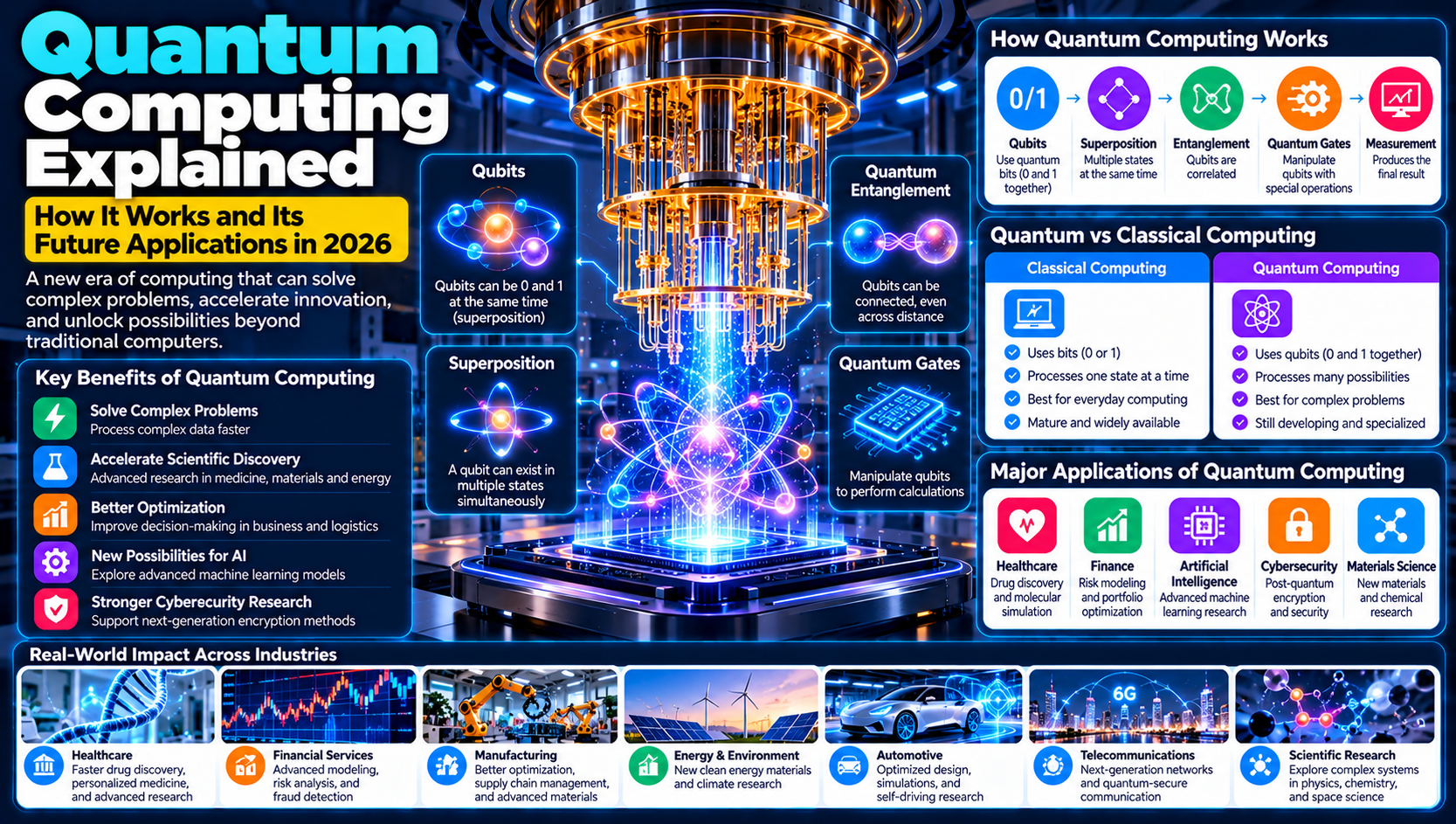
Technology continues to evolve, and quantum computing is emerging as one of the most fascinating developments in modern science. While traditional computers have transformed communication, business, research, and everyday life, quantum computers introduce a completely different approach to processing information.
From drug discovery and financial modeling to artificial intelligence and advanced materials research, quantum computing could help researchers solve certain complex problems that are extremely difficult for conventional computers.
But what exactly is quantum computing? How does it work, and why are technology companies, governments, and research institutions investing heavily in it?
Quantum computing uses principles from quantum mechanics to process information in ways that differ from traditional computing. Instead of relying exclusively on classical bits, quantum computers use quantum bits, commonly called qubits.
This guide explains quantum computing in simple terms, explores its key technologies, examines real-world applications, and discusses its opportunities and limitations in 2026.
What Is Quantum Computing?
Quantum computing is a type of computing that uses principles of quantum mechanics to process information.
Traditional computers use bits that represent either 0 or 1. Quantum computers use qubits, which can represent quantum combinations of 0 and 1 before measurement.
This approach allows quantum algorithms to explore certain computational possibilities differently from classical algorithms.
Quantum computing is particularly promising for specialized problems involving:
Molecular and chemical simulations
Optimization and complex modeling
Materials science
Certain cryptographic problems
Selected machine learning research
However, quantum computers are not automatically faster than traditional computers for every task. Their advantages depend on the problem, the algorithm, and the quality of the quantum hardware.
How Does Quantum Computing Work?
Quantum computing operates through several important principles of quantum mechanics. Understanding these concepts makes it easier to see why quantum computers are different from conventional machines.
1. Qubits
A qubit is the basic unit of quantum information.
A classical bit has one definite value at a time: 0 or 1. A qubit can exist in a quantum state that combines both possibilities.
When a qubit is measured, the result is a classical outcome, usually 0 or 1.
Qubits can be implemented using different physical technologies, including superconducting circuits, trapped ions, neutral atoms, and photons.
2. Superposition
Superposition allows a qubit to exist in a combination of possible states.
Unlike a classical bit, which is either 0 or 1, a qubit can be prepared in a state that includes both possibilities.
This does not mean a quantum computer simply calculates every possible answer simultaneously. Quantum algorithms carefully manipulate quantum states to increase the likelihood of obtaining useful answers when measurements are performed.
3. Quantum Entanglement
Entanglement is a quantum phenomenon in which two or more qubits become correlated in ways that cannot be explained by treating them as completely independent systems.
Entangled qubits are important because they allow quantum computers to represent and process complex relationships between quantum states.
This property plays a major role in many quantum algorithms and error-correction techniques.
4. Quantum Interference
Quantum interference allows quantum algorithms to strengthen the probability of useful outcomes and reduce the probability of less useful ones.
By applying carefully designed quantum operations, a quantum circuit can manipulate probability amplitudes before measurement.
This is one of the mechanisms that makes certain quantum algorithms powerful.
5. Quantum Gates
Quantum gates are operations that change the states of qubits.
They are similar in concept to logic gates in traditional computing, but they follow the rules of quantum mechanics.
Common quantum gates include:
Hadamard gate
Pauli-X gate
Pauli-Y gate
Pauli-Z gate
CNOT gate
Phase gates
Quantum circuits combine these gates to perform calculations.
Quantum Computing vs. Classical Computing
Quantum and classical computers use different methods to represent and process information. They are designed for different computational purposes.
Feature | Classical Computing | Quantum Computing |
|---|---|---|
Basic unit | Bit | Qubit |
Information | 0 or 1 | Quantum state |
Main principles | Classical logic and electronics | Quantum mechanics |
Processing | Classical algorithms | Quantum algorithms |
Hardware | CPUs, GPUs, memory | Quantum processors and control systems |
Best suited for | Everyday computing and general workloads | Specialized quantum problems |
Error handling | Mature error correction | Complex quantum error correction |
Availability | Widely accessible | Limited and developing |
Classical computers remain essential for everyday activities such as browsing, business software, gaming, communication, and data processing.
Quantum computers are expected to complement classical systems rather than replace them.
Types of Quantum Computing Technologies
Researchers are developing several approaches to building quantum computers. Each has its own advantages, engineering challenges, and potential applications.
1. Superconducting Quantum Computing
Superconducting quantum computers use specially designed electrical circuits that behave according to quantum mechanical principles.
These systems generally operate at extremely low temperatures to maintain their quantum states.
They are actively developed by companies and research organizations because they support sophisticated quantum circuit operations.
2. Trapped-Ion Quantum Computing
Trapped-ion systems use electrically charged atoms held in place using electromagnetic fields.
Lasers control the quantum states of these ions and perform operations between qubits.
Trapped-ion technology is known for high-quality quantum operations, although scaling and operating speed remain important engineering challenges.
3. Photonic Quantum Computing
Photonic quantum computers use particles of light, known as photons, to carry quantum information.
This approach offers potential advantages in communication and networking because photons can travel through optical systems.
However, generating, manipulating, and detecting photons reliably remains technically challenging.
4. Neutral-Atom Quantum Computing
Neutral-atom systems use individual atoms held in carefully arranged optical traps.
Researchers manipulate these atoms with lasers to create quantum operations.
This approach has attracted interest because it offers promising methods for arranging and scaling large groups of qubits.
5. Topological Quantum Computing
Topological quantum computing is a research approach that aims to protect quantum information using special physical properties of quantum states.
Its long-term goal is to make quantum systems more resistant to certain errors.
However, building practical topological qubits remains a significant scientific and engineering challenge.
Major Applications of Quantum Computing
Quantum computing is still developing, but research projects and early experiments are exploring its potential across multiple industries.
1. Healthcare and Drug Discovery
Drug discovery often involves understanding complicated molecular interactions.
Quantum computers may eventually help researchers simulate certain chemical systems more accurately or efficiently than some classical methods.
Potential applications include:
Studying molecular structures
Modeling chemical reactions
Supporting drug discovery research
Investigating protein interactions
Developing new medical materials
These applications remain an active research area. Quantum computing is not currently a replacement for established medical research and clinical testing.
2. Artificial Intelligence and Machine Learning
Quantum computing and artificial intelligence are two major areas of technology research.
Quantum machine learning explores whether quantum systems can improve selected machine learning tasks.
Potential research areas include:
Complex optimization
Machine learning experimentation
Pattern analysis
Scientific data modeling
Hybrid quantum-classical algorithms
However, practical advantages over conventional AI hardware have not been established for most real-world machine learning workloads.
3. Financial Services
Financial institutions analyze large amounts of information to evaluate risk, manage portfolios, and support investment decisions.
Quantum algorithms may eventually help with selected optimization and simulation problems.
Potential applications include:
Portfolio optimization
Financial risk modeling
Scenario analysis
Fraud detection research
Complex market simulations
Quantum computing is not currently a guaranteed way to improve financial predictions or investment returns.
4. Cybersecurity and Encryption
Quantum computing has important implications for cybersecurity.
Some future, sufficiently powerful quantum computers could threaten widely used public-key cryptographic systems, including RSA and elliptic-curve cryptography.
This is why organizations are preparing for post-quantum cryptography.
Post-quantum cryptography uses mathematical approaches designed to resist attacks from both classical and quantum computers.
Businesses should begin reviewing their cryptographic systems and planning migrations where appropriate.
5. Materials Science
Developing new materials often requires understanding the behavior of atoms and electrons.
Quantum computers may eventually help scientists model certain molecular and material systems.
Possible research applications include:
Advanced battery materials
Improved catalysts
Semiconductor research
New chemical compounds
Energy-efficient materials
These developments could contribute to innovation in electronics, transportation, energy, and manufacturing.
6. Logistics and Supply Chain Management
Businesses frequently face complex planning problems involving transportation, inventory, delivery routes, and resource allocation.
Quantum optimization research explores whether quantum approaches can help with selected problems.
Potential applications include:
Route optimization
Warehouse planning
Delivery scheduling
Inventory allocation
Production scheduling
Classical optimization techniques remain highly effective and widely used for these tasks today.
7. Energy and Climate Research
Quantum computing could contribute to research involving complex chemical and physical systems.
Potential areas include:
Battery development
Renewable energy materials
Chemical catalysts
Energy storage
Climate-related scientific modeling
These applications could become important as researchers explore new approaches to energy efficiency and sustainability.
Benefits of Quantum Computing
Quantum computing offers several potential advantages for specialized computational problems.
1. New Computational Capabilities
Quantum computers can process certain types of information using principles unavailable to classical computers.
This creates new possibilities for solving specialized scientific and mathematical problems.
2. Advanced Molecular Simulation
Quantum systems may provide useful ways to model molecules and chemical interactions, potentially supporting research in medicine, chemistry, and materials science.
3. New Optimization Approaches
Quantum algorithms offer alternative approaches to selected optimization problems, although practical performance advantages depend on the application.
4. Scientific Research Opportunities
Quantum computing could help researchers investigate complex physical systems and develop new scientific models.
5. Innovation Across Industries
Over time, advances in quantum hardware and software may create new opportunities in healthcare, finance, energy, manufacturing, and cybersecurity.
Challenges and Limitations of Quantum Computing
Despite its potential, quantum computing faces several major challenges.
1. Qubit Errors
Qubits are extremely sensitive to environmental disturbances.
Small changes in temperature, electromagnetic conditions, or other environmental factors can introduce errors into quantum calculations.
2. Decoherence
Decoherence occurs when a quantum system loses the properties needed to maintain its quantum state.
It can disrupt calculations and limit how long quantum information remains useful.
3. High Operating Costs
Many quantum computers require specialized equipment, advanced control systems, and highly controlled operating environments.
These requirements make quantum hardware expensive to develop and maintain.
4. Scaling Difficulties
Building a quantum processor with more qubits is not enough. Those qubits must also maintain sufficient quality, connectivity, and reliability.
Scaling useful quantum systems remains a major engineering challenge.
5. Limited Practical Applications
Quantum computers cannot outperform classical computers on every problem.
Many proposed applications are still experimental, and practical advantages must be demonstrated through careful benchmarking.
6. Shortage of Specialized Skills
Quantum computing requires knowledge of physics, mathematics, computer science, and engineering.
Organizations may find it difficult to recruit experienced professionals in this specialized field.
Quantum Computing vs. Artificial Intelligence
Quantum computing and artificial intelligence are different technologies, but researchers are exploring ways to combine them.
Feature | Quantum Computing | Artificial Intelligence |
|---|---|---|
Main purpose | Process specialized quantum problems | Perform tasks that require intelligent behavior |
Core technology | Qubits and quantum circuits | Machine learning models and algorithms |
Main foundation | Quantum mechanics | Statistics, mathematics, and computer science |
Applications | Molecular simulation and selected optimization | Automation, prediction, language, and image analysis |
Development stage | Early and specialized | Widely deployed |
Hardware | Quantum processors | CPUs, GPUs, and specialized AI chips |
Quantum machine learning is an emerging research field that explores how quantum computing could support selected machine learning tasks.
However, quantum computing is not required for modern AI systems, and most AI applications today operate on classical hardware.
Leading Quantum Computing Companies and Platforms
Several technology companies and research organizations are developing quantum hardware, software, and cloud-based services.
IBM Quantum
IBM develops superconducting quantum processors and provides access to quantum computing resources through its cloud platform.
Its Qiskit software ecosystem helps developers and researchers build quantum circuits and experiments.
Google Quantum AI
Google Quantum AI conducts research into quantum processors, quantum algorithms, and error correction.
Its work contributes to the development of more capable quantum computing systems.
Microsoft Azure Quantum
Microsoft Azure Quantum provides access to quantum development tools and quantum computing resources through its cloud ecosystem.
It supports experimentation with quantum software and different hardware technologies.
Amazon Braket
Amazon Braket is a cloud service that allows users to experiment with quantum computing hardware and simulators from supported providers.
It helps developers explore quantum algorithms without building their own quantum hardware.
D-Wave
D-Wave develops quantum computing systems focused on quantum annealing, an approach designed for certain optimization problems.
Its technology is distinct from the gate-based quantum computers developed by many other companies.
IonQ
IonQ develops trapped-ion quantum computers and provides access to its systems through supported cloud platforms.
Its work focuses on improving quantum processor performance and reliability.
Quantum Computing in Business: What Should Companies Do Today?
Most businesses do not need to purchase quantum computers or immediately invest in quantum hardware.
However, organizations can prepare for future developments through practical steps.
1. Understand relevant use cases
Identify whether your industry faces specialized problems involving complex simulations, scientific research, or optimization.
2. Follow quantum technology developments
Monitor research progress, hardware improvements, software tools, and practical industry demonstrations.
3. Explore cloud-based quantum platforms
Platforms such as IBM Quantum, Amazon Braket, and Azure Quantum provide opportunities to learn and experiment without purchasing quantum hardware.
4. Develop technical skills
Encourage technical teams to learn quantum computing fundamentals, quantum algorithms, and programming frameworks.
5. Prepare for post-quantum cybersecurity
Review cryptographic systems and identify sensitive information that may need long-term protection.
6. Evaluate real business value
Before investing, compare quantum approaches with classical alternatives. Focus on measurable performance, cost, reliability, and business outcomes.
The Future of Quantum Computing in 2026 and Beyond
Quantum computing is progressing through improvements in hardware engineering, error correction, quantum algorithms, and cloud accessibility.
Several developments are shaping its future.
More Reliable Quantum Processors
Researchers are working to improve qubit quality, reduce errors, and build more reliable quantum processors.
Advances in Quantum Error Correction
Quantum error correction aims to protect quantum information by encoding it across multiple physical qubits.
Improved error correction is considered essential for building large-scale, fault-tolerant quantum computers.
Hybrid Quantum-Classical Computing
Hybrid systems combine classical computers with quantum processors.
Classical computers can manage tasks such as data preparation and optimization while quantum processors handle selected quantum operations.
Quantum Cloud Services
Cloud platforms are making quantum computing resources more accessible to universities, developers, researchers, and businesses.
Post-Quantum Cybersecurity
Organizations are preparing for a future in which powerful quantum computers could threaten some existing encryption systems.
Post-quantum cryptography is becoming an important part of long-term cybersecurity planning.
Frequently Asked Questions (FAQs)
1. What is quantum computing in simple words?
Quantum computing is a type of computing that uses quantum mechanics to process information through qubits instead of relying only on traditional bits.
2. How is quantum computing different from normal computing?
Classical computers use bits that represent 0 or 1. Quantum computers use qubits that can exist in combinations of quantum states and use phenomena such as superposition and entanglement.
3. Is quantum computing faster than traditional computing?
Not for every task. Quantum computers may offer advantages for certain specialized problems, but classical computers remain more effective for most everyday computing activities.
4. What are the main applications of quantum computing?
Potential applications include drug discovery, molecular simulation, materials science, optimization, financial modeling, and cybersecurity research.
5. Can quantum computers break encryption?
A sufficiently powerful fault-tolerant quantum computer could threaten some widely used public-key encryption systems. This is why post-quantum cryptography is being developed and adopted.
6. Which companies are developing quantum computers?
Companies working in this area include IBM, Google, Microsoft, Amazon, D-Wave, and IonQ.
7. Can businesses use quantum computing today?
Businesses can experiment with quantum computing through cloud-based platforms. However, practical commercial advantages remain limited to selected research and specialized applications.
8. Will quantum computers replace classical computers?
No. Quantum computers are expected to complement classical systems by handling specialized problems rather than replacing conventional computers.
9. Do you need programming skills to learn quantum computing?
Basic programming knowledge is helpful, especially in Python. Mathematics and introductory physics can also help learners understand quantum concepts.
10. What is the future of quantum computing?
The future depends on improvements in qubit reliability, error correction, scalability, algorithms, and practical applications. Progress could create new opportunities in science, technology, and industry.
Conclusion
Quantum computing represents a major development in the evolution of computing technology. By using quantum principles such as superposition, entanglement, and interference, quantum systems offer new ways to approach specialized computational challenges.
Although the technology is still developing, its potential applications in healthcare, artificial intelligence research, finance, cybersecurity, materials science, and energy make it an important field to watch.
For businesses, the best approach in 2026 is to understand the technology, explore relevant use cases, monitor practical developments, and prepare for changes in cybersecurity.
Quantum computing is not a replacement for traditional computers. Instead, it could become a powerful addition to the technology ecosystem, helping researchers and organizations tackle problems that are difficult to solve using conventional methods.