Machine learning is one of the most important technologies driving modern artificial intelligence. From personalized product recommendations and fraud detection to medical research and self-driving vehicles, machine learning is transforming how computers process information and solve problems.
Many digital services people use every day depend on machine learning without requiring users to understand the technology behind them.
For example, streaming platforms recommend movies based on viewing habits, email services identify spam messages, and financial institutions analyze transactions to detect suspicious activity.
These capabilities are possible because machine learning systems can learn patterns from data and use those patterns to make predictions or decisions.
As businesses continue adopting artificial intelligence, understanding machine learning has become increasingly valuable for professionals, entrepreneurs, developers, and organizations.
In this guide, we explain what machine learning is, how it works, its major types, real-world applications, benefits, limitations, and future developments.
What Is Machine Learning?
Machine learning (ML) is a branch of artificial intelligence that enables computer systems to learn patterns from data and improve their performance on specific tasks without requiring developers to manually program every individual rule.
Instead of following only fixed instructions, machine learning models identify relationships within training data and use what they learn to make predictions or generate outputs when presented with new information.
For example, a traditional computer program might identify spam emails using a list of predefined rules. A machine learning model can learn from examples of spam and legitimate emails to recognize patterns that help classify new messages.
Machine learning is used in many areas, including:
Fraud detection.
Product recommendations.
Image recognition.
Speech recognition.
Medical research.
Predictive analytics.
Customer behavior analysis.
Autonomous systems.
Natural language processing.
Machine learning is a subset of artificial intelligence, but the two terms do not mean exactly the same thing.
How Does Machine Learning Work?
Machine learning systems generally follow a process involving data collection, preparation, model training, evaluation, and deployment.
Although different algorithms use different mathematical techniques, the overall workflow usually follows several stages.
1. Data Collection
Machine learning begins with data.
Data may come from business databases, websites, applications, sensors, transactions, images, documents, or other sources.
For example, an online retailer may collect information about product purchases, customer preferences, and browsing behavior.
2. Data Preparation
Collected data often contains missing values, duplicate records, inconsistent formats, or errors.
Before training a model, developers prepare and organize the information so it can be used effectively.
This process may involve:
Removing duplicate records.
Correcting data errors.
Handling missing information.
Standardizing formats.
Selecting relevant variables.
Preparing training and testing datasets.
High-quality data is important because poor data can lead to unreliable predictions.
3. Model Selection
Developers select a suitable machine learning algorithm according to the problem they want to solve.
For example:
Classification models identify categories.
Regression models predict numerical values.
Clustering algorithms identify groups.
Neural networks learn complex patterns.
The choice depends on the available data, business objective, and required performance.
4. Model Training
During training, the algorithm processes examples and adjusts its internal parameters to learn patterns in the data.
For supervised learning, the model receives examples with known answers. It compares its predictions with the correct results and adjusts to reduce errors.
5. Model Evaluation
After training, developers test the model using data that was not used during training.
Evaluation helps determine whether the model can perform reliably on new information.
Common evaluation measures include:
Accuracy.
Precision.
Recall.
F1 score.
Mean absolute error.
Root mean squared error.
The appropriate metric depends on the type of machine learning problem.
6. Model Deployment
Once a model meets the required performance standards, it can be integrated into an application or business system.
For example, a bank may deploy a fraud detection model within its transaction monitoring system.
7. Monitoring and Improvement
Machine learning models require ongoing monitoring.
Changes in customer behavior, business conditions, or data patterns can reduce model performance over time.
Organizations may need to retrain models, update datasets, or adjust their systems to maintain reliability.
What Are the Main Types of Machine Learning?
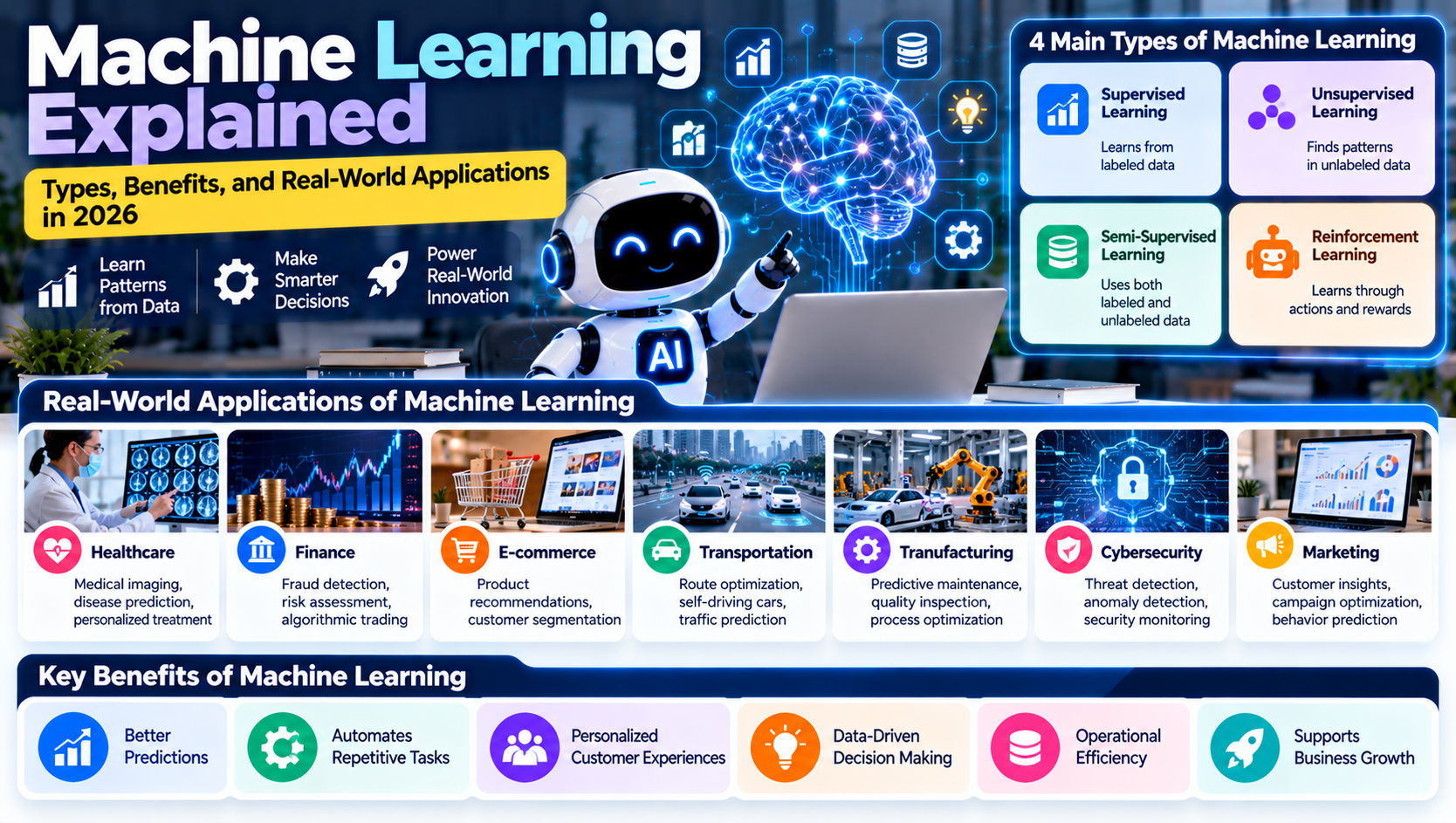
Machine learning is commonly divided into four major categories: supervised learning, unsupervised learning, semi-supervised learning, and reinforcement learning.
Each category uses a different approach to learning from information.
1. Supervised Learning
Supervised learning uses labeled training data. This means the training examples include the correct output that the model is expected to learn.
The model studies the relationship between input information and known answers to make predictions about new data.
Common applications:
Email spam detection.
House price prediction.
Credit risk assessment.
Customer churn prediction.
Image classification.
Sales forecasting.
Example:
A real estate company can train a supervised learning model using historical property information, including location, size, number of rooms, and selling prices.
The model learns relationships between these factors and can estimate the likely price of another property.
Common algorithms:
Linear regression.
Logistic regression.
Decision trees.
Random forests.
Support vector machines.
Gradient boosting.
2. Unsupervised Learning
Unsupervised learning works with data that does not have predefined labels.
Instead of learning from known answers, the algorithm identifies patterns, similarities, structures, or groups within the information.
Common applications:
Customer segmentation.
Anomaly detection.
Market research.
Grouping similar documents.
Data exploration.
Recommendation systems.
Example:
An online retailer can analyze customer purchasing behavior and identify groups of customers with similar shopping patterns.
Marketing teams can use these groups to better understand customer preferences.
Common algorithms:
K-means clustering.
Hierarchical clustering.
DBSCAN.
Principal component analysis.
Autoencoders.
3. Semi-Supervised Learning
Semi-supervised learning combines a relatively small amount of labeled data with a larger amount of unlabeled data.
This approach can be useful when collecting and labeling large datasets is expensive or time-consuming.
Common applications:
Medical image analysis.
Speech recognition.
Image classification.
Document categorization.
Web content analysis.
Example:
A healthcare research team may have a small collection of medical images reviewed by specialists and a much larger collection without labels.
A semi-supervised approach can use both datasets to help train a model.
4. Reinforcement Learning
Reinforcement learning involves an agent learning through interaction with an environment.
The agent takes actions and receives rewards or penalties based on the results. Over time, it learns strategies that aim to maximize cumulative rewards.
Common applications:
Robotics.
Game-playing systems.
Autonomous navigation research.
Resource allocation.
Traffic signal optimization.
Industrial control.
Example:
A robot can learn how to navigate an environment by trying different movements and receiving feedback about whether its actions move it closer to a target.
Reinforcement learning is also an important technique in some advanced AI training approaches.
Machine Learning vs. Artificial Intelligence vs. Deep Learning
These terms are closely connected, but they describe different concepts.
Technology | Meaning | Main Purpose |
|---|---|---|
Artificial Intelligence | A broad field of intelligent computer systems | Perform tasks associated with human intelligence |
Machine Learning | A subset of AI that learns patterns from data | Make predictions and identify patterns |
Deep Learning | A subset of machine learning using multi-layer neural networks | Learn complex representations from large datasets |
Artificial Intelligence
Artificial intelligence is the broad field concerned with creating systems that can perform tasks such as reasoning, understanding language, planning, and recognizing patterns.
Machine Learning
Machine learning is an approach within AI that allows computer systems to learn from examples and data rather than relying entirely on manually written rules.
Deep Learning
Deep learning uses artificial neural networks with multiple layers to learn complex patterns.
It is particularly important in image recognition, speech processing, language models, and generative AI.
How They Are Connected
Deep learning is part of machine learning, and machine learning is part of artificial intelligence.
Understanding this relationship helps explain how modern AI technologies are developed.
Real-World Applications of Machine Learning
Machine learning is used across many industries to analyze information, improve predictions, and support business operations.
Here are some of its most important applications.
1. Healthcare
Machine learning is helping healthcare organizations analyze complex medical information.
Applications include:
Medical image analysis.
Disease risk prediction.
Patient data analysis.
Medical research.
Drug discovery support.
Hospital resource planning.
Example: Machine learning models can help identify patterns in medical images that may assist qualified professionals during clinical evaluation.
These systems require clinical validation and should not replace medical judgment.
2. Banking and Finance
Financial institutions use machine learning to identify suspicious activity and analyze financial risks.
Applications include:
Fraud detection.
Credit risk assessment.
Transaction monitoring.
Financial forecasting.
Customer segmentation.
Anti-money laundering support.
Example: A bank can analyze transaction patterns to identify activity that differs significantly from a customer's usual behavior.
Potentially suspicious transactions can then be flagged for further investigation.
3. E-Commerce and Retail
Online retailers use machine learning to understand customer preferences and improve shopping experiences.
Applications include:
Product recommendations.
Demand forecasting.
Customer segmentation.
Inventory planning.
Price analysis.
Customer behavior prediction.
Example: An online store can recommend products based on a customer's browsing history, previous purchases, and patterns from similar users.
4. Transportation and Logistics
Transportation companies use machine learning to support route planning, demand forecasting, and operational efficiency.
Applications include:
Traffic prediction.
Route optimization.
Delivery planning.
Predictive vehicle maintenance.
Fleet management.
Autonomous driving research.
Example: A logistics company can use historical delivery information and current operational data to help identify efficient delivery routes.
5. Manufacturing
Manufacturers use machine learning to monitor production systems and improve equipment management.
Applications include:
Predictive maintenance.
Quality inspection.
Production forecasting.
Defect detection.
Supply chain planning.
Equipment monitoring.
Example: Machine learning can analyze sensor information from industrial equipment to identify patterns associated with potential failures.
6. Education
Educational institutions can use machine learning to better understand student performance and support personalized learning.
Applications include:
Learning progress analysis.
Student performance prediction.
Recommendation of learning resources.
Educational content classification.
Administrative planning.
Example: An educational platform can analyze student activity and recommend additional learning materials based on areas where a student needs more practice.
7. Cybersecurity
Machine learning plays an important role in identifying unusual patterns in digital systems.
Applications include:
Network anomaly detection.
Suspicious login identification.
Malware classification.
Spam detection.
Security event analysis.
Example: A security platform can analyze network activity and flag unusual behavior for security professionals to investigate.
8. Marketing and Advertising
Marketing teams use machine learning to analyze audiences and improve campaign performance.
Applications include:
Audience segmentation.
Customer churn prediction.
Advertising optimization.
Campaign analysis.
Purchase prediction.
Recommendation systems.
Example: A marketing company can analyze customer interactions to identify audience segments that are more likely to respond to a particular campaign.
Benefits of Machine Learning
Machine learning offers several advantages when applied to appropriate business and technical problems.
1. Better Data Analysis
Machine learning can identify complex patterns in datasets that may be difficult to detect through manual analysis.
2. Improved Predictions
Trained models can use historical information to estimate future outcomes, such as customer demand, equipment failures, or sales trends.
3. Automation of Repetitive Tasks
Machine learning can support the automation of classification, detection, and prediction activities.
4. Personalized Experiences
Businesses can use machine learning to recommend products, content, and services based on relevant user behavior.
5. Fraud and Anomaly Detection
Models can identify unusual patterns that may indicate suspicious transactions, security incidents, or operational problems.
6. Operational Efficiency
Machine learning can help organizations optimize workflows, resource allocation, and maintenance activities.
7. Continuous Improvement
Models can be updated and retrained as new data becomes available, helping them adapt to changing conditions.
Challenges and Limitations of Machine Learning
Despite its advantages, machine learning also has limitations that organizations must understand.
1. Data Quality Problems
Machine learning depends on data. Incomplete, inaccurate, or inconsistent datasets can lead to poor results.
2. Bias in Training Data
If training data contains historical bias, models may reproduce or amplify unfair patterns.
3. High Computational Requirements
Some advanced machine learning models require substantial computing resources, specialized hardware, and technical infrastructure.
4. Model Interpretability
Certain complex models can be difficult to explain, making it challenging to understand why they produced a particular prediction.
5. Overfitting
A model may perform very well on training data but poorly on new information if it learns the training examples too closely.
6. Privacy and Security Risks
Machine learning projects may involve personal or confidential information, requiring appropriate data protection and access controls.
7. Ongoing Maintenance
Models may become less accurate as real-world patterns change. Organizations need monitoring, testing, and maintenance processes.
Popular Machine Learning Tools and Frameworks
Developers, researchers, and businesses use different platforms to build, train, and deploy machine learning systems.
1. TensorFlow
<Entity value="TensorFlow" category="software" disambig="Open-source machine learning framework"/> is an open-source platform for developing and deploying machine learning models.
It supports deep learning, neural networks, and other machine learning applications.
Official Website: https://www.tensorflow.org/
2. PyTorch
<Entity value="PyTorch" category="software" disambig="Open-source machine learning framework"/> is widely used for machine learning research and development.
It provides flexible tools for building and training neural networks.
Official Website: https://pytorch.org/
3. Scikit-learn
<Entity value="Scikit-learn" category="software" disambig="Python machine learning library"/> is a popular Python library for traditional machine learning tasks.
It provides algorithms for classification, regression, clustering, and model evaluation.
Official Website: https://scikit-learn.org/
4. Google Cloud Vertex AI
<Entity value="Google Cloud Vertex AI" category="software" disambig="Google Cloud machine learning platform"/> provides tools for developing, training, deploying, and managing machine learning models.
Official Website: https://cloud.google.com/vertex-ai
5. Amazon SageMaker AI
<Entity value="Amazon SageMaker AI" category="software" disambig="AWS machine learning platform"/> supports machine learning development and deployment through cloud-based infrastructure and tools.
Official Website: https://aws.amazon.com/sagemaker/
6. Microsoft Azure Machine Learning
<Entity value="Azure Machine Learning" category="software" disambig="Microsoft cloud machine learning service"/> provides tools for building, training, managing, and deploying machine learning models.
Official Website: https://azure.microsoft.com/en-us/products/machine-learning
How Businesses Can Start Using Machine Learning
Organizations do not need to begin with complicated machine learning projects.
A practical implementation strategy starts with a clearly defined problem.
Step 1: Identify a Business Problem
Determine what you want to improve.
Examples include:
Predicting customer demand.
Identifying fraudulent transactions.
Understanding customer behavior.
Forecasting sales.
Improving product recommendations.
Step 2: Collect Relevant Data
Identify the information needed to address the problem.
Check whether the data is accurate, relevant, sufficiently representative, and collected in an appropriate manner.
Step 3: Select a Suitable Approach
Choose the machine learning method according to the objective.
For example:
Supervised learning for labeled prediction tasks.
Unsupervised learning for identifying groups and patterns.
Reinforcement learning for certain interactive decision-making problems.
Step 4: Choose the Right Technology
Businesses with technical teams can explore frameworks such as TensorFlow, PyTorch, and Scikit-learn.
Organizations that prefer managed infrastructure can evaluate cloud machine learning platforms.
Step 5: Train and Evaluate the Model
Train the model using suitable datasets and evaluate its performance on separate test data.
Use metrics that match the business problem rather than relying on accuracy alone.
Step 6: Deploy and Monitor
Integrate the model into the required business application.
Monitor its predictions, reliability, security, and performance over time.
Step 7: Improve the System
Update datasets, retrain the model when necessary, and evaluate whether it continues meeting business objectives.
Machine Learning vs. Traditional Programming
Traditional programming and machine learning solve problems in different ways.
Comparison | Traditional Programming | Machine Learning |
|---|---|---|
Main approach | Human-written rules | Patterns learned from data |
Input | Data and programmed instructions | Training data and learning algorithm |
Output | Results based on instructions | Predictions or learned outputs |
Rule creation | Primarily manual | Learned from examples |
Adaptability | Requires rule updates | Can be retrained using new data |
Common uses | Calculations and fixed workflows | Prediction, classification, pattern recognition |
Example:
A traditional program may classify emails using specific words and rules.
A machine learning system can learn patterns from examples of spam and legitimate messages, helping it classify new emails based on more complex relationships.
Both approaches remain useful. Many business systems combine traditional programming and machine learning.
The Future of Machine Learning in 2026 and Beyond
Machine learning continues to evolve as computing infrastructure, data availability, and AI research advance.
Several developments are influencing its future.
1. Generative AI: Machine learning techniques power generative systems that create text, images, audio, video, and code.
2. AI Agents: Machine learning and other AI techniques support increasingly capable systems that can interpret information, use tools, and perform multi-step tasks.
3. Edge AI: More machine learning models are being deployed on devices such as smartphones, cameras, industrial sensors, and connected equipment.
4. Explainable AI: Organizations are placing greater emphasis on understanding and explaining model outputs, particularly in high-impact applications.
5. Automated Machine Learning: AutoML tools help simplify parts of the model development process, making machine learning more accessible to some organizations.
6. Responsible AI: Privacy, fairness, transparency, security, and accountability will remain important as machine learning becomes more widely adopted.
7. Industry-Specific Models: Organizations are increasingly exploring machine learning systems designed for specialized requirements in healthcare, finance, manufacturing, and other sectors.
The future of machine learning will involve more powerful applications, but reliable data, responsible implementation, and human oversight will remain essential.
Frequently Asked Questions (FAQs)
1. What is machine learning in simple words?
Machine learning is a type of artificial intelligence that enables computers to learn patterns from data and use those patterns to make predictions or decisions without requiring every rule to be manually programmed.
2. What are the four main types of machine learning?
The four commonly recognized categories are supervised learning, unsupervised learning, semi-supervised learning, and reinforcement learning.
3. What is the difference between AI and machine learning?
Artificial intelligence is the broader field of creating intelligent computer systems. Machine learning is a subset of AI that allows systems to learn from data.
4. What is an example of machine learning in everyday life?
Examples include email spam filters, movie recommendations, voice recognition, online shopping recommendations, and fraud detection systems.
5. Is machine learning difficult to learn?
Basic concepts can be understood without programming experience. However, building machine learning models generally requires knowledge of mathematics, statistics, programming, and data analysis.
6. Which programming language is commonly used for machine learning?
Python is one of the most widely used languages because of its extensive libraries, development tools, and machine learning ecosystem.
7. What is the difference between machine learning and deep learning?
Machine learning includes different algorithms that learn patterns from data. Deep learning is a subset of machine learning that uses multi-layer neural networks to learn complex patterns.
8. Can small businesses use machine learning?
Yes. Small businesses can use ready-made machine learning features in CRM systems, marketing platforms, recommendation tools, analytics software, and cloud services without necessarily developing their own models.
9. What are the biggest challenges of machine learning?
Common challenges include poor data quality, biased datasets, privacy concerns, high computing requirements, model interpretability, and ongoing maintenance.
Conclusion
Machine learning is a fundamental technology behind many modern artificial intelligence applications. It allows computer systems to learn from data, recognize patterns, make predictions, and support increasingly complex tasks.
From fraud detection and healthcare research to product recommendations, cybersecurity, and business forecasting, machine learning is creating opportunities across industries.
Understanding its four main types, practical applications, benefits, and limitations can help businesses and professionals make more informed technology decisions.
Organizations do not need to begin with advanced systems. They can start by identifying a specific problem, collecting reliable data, selecting an appropriate model, and measuring the results.
As artificial intelligence continues evolving, machine learning will remain an important part of how businesses and digital services operate.