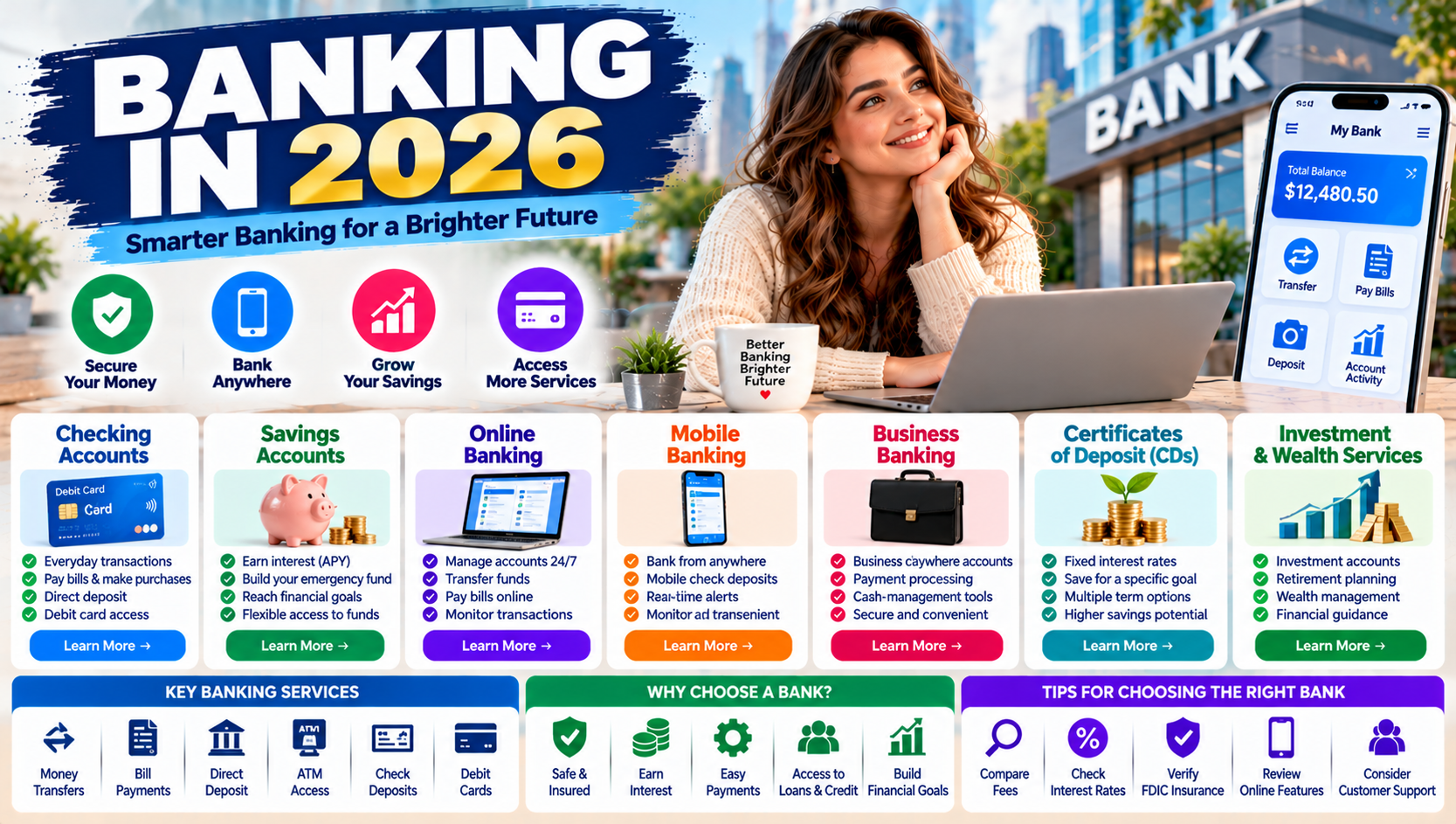
Banking plays an important role in managing personal finances, saving money, making payments, and planning for the future. Whether you receive a salary, operate a small business, pay monthly bills, or save for a major purchase, choosing the right banking services can help you manage your money more effectively.
In 2026, customers can choose from traditional banks with physical branches, online-only banks, credit unions, and financial technology platforms that provide access to certain banking services. Each option offers different features, costs, account requirements, and levels of customer support.
Understanding how banking works can help consumers compare accounts, avoid unnecessary fees, protect their money, and make informed financial decisions.
This guide explains the main types of banking, common financial services, the advantages of digital banking, and practical tips for choosing a bank that fits your needs.
What Is Banking?
Banking is the system through which financial institutions accept deposits, facilitate payments, provide loans, and offer other financial services to individuals and businesses.
Banks help customers store money, receive income, transfer funds, pay bills, and build savings. Eligible customers may also access credit cards, personal loans, mortgages, and business financing.
Banks typically earn revenue through interest on loans, service fees, and other financial activities. They may pay interest to customers who maintain eligible deposit accounts.
The banking system also supports the broader economy by facilitating financial transactions, helping businesses manage cash flow, and providing financing for purchases and investments.
Types of Banking in 2026
Banking services are available through several types of institutions and delivery methods.
1. Traditional Banking
Traditional banks operate physical branches and generally offer online and mobile banking alongside in-person services.
Customers can visit a branch to deposit checks, discuss loans, obtain assistance with account issues, or complete certain transactions.
Traditional banking may be suitable for customers who prefer face-to-face support, need regular cash services, or want access to a broad range of financial products.
Potential benefits:
In-person customer service
Access to branches and ATMs
Checking and savings accounts
Personal and business lending products
Assistance with complex transactions
Availability, fees, and services vary by institution.
2. Online Banking
Online banking allows customers to manage financial accounts through a bank's website or mobile application.
Depending on the institution, customers may be able to transfer funds, pay bills, deposit checks, review transactions, and manage debit cards without visiting a branch.
Online banks may have lower operating costs than banks with extensive branch networks, and some pass part of those savings to customers through reduced fees or competitive savings rates.
However, customers should evaluate ATM access, cash-deposit options, customer support, and account protections before opening an account.
3. Mobile Banking
Mobile banking refers to using a smartphone or tablet to access banking services.
Common features include:
Checking account balances
Viewing transaction histories
Depositing checks using a camera
Paying bills
Sending and receiving transfers
Setting transaction and fraud alerts
Locking or reporting a debit card
Mobile banking can make everyday money management more convenient. Customers should protect their devices, use strong passwords, enable multifactor authentication where available, and avoid accessing financial accounts through suspicious links.
4. Business Banking
Business banking provides financial services for companies, freelancers, entrepreneurs, and other organizations.
Common services include business checking accounts, savings accounts, payment processing, business credit cards, commercial loans, and cash management tools.
A separate business account can help owners distinguish company transactions from personal spending, simplify bookkeeping, and prepare financial records for tax reporting.
Business owners should compare transaction limits, monthly fees, cash-deposit charges, payment-processing costs, and integration with accounting software.
5. Investment and Private Banking
Some financial institutions offer investment services, wealth management, or private banking for customers who need more specialized financial support.
These services may include investment accounts, portfolio management, retirement planning, estate-related services, and personalized financial guidance.
Investment products generally involve different risks from ordinary bank deposits. Securities and investment accounts are not automatically protected by FDIC deposit insurance simply because they are offered through a financial institution.
Customers should understand the fees, risks, and applicable protections before investing.
Common Types of Bank Accounts
Selecting the right account depends on how you plan to use your money.
Account type | Main purpose | Important considerations |
|---|---|---|
Checking account | Everyday spending and payments | Monthly fees, overdraft policies, ATM access |
Savings account | Building savings and emergency funds | Interest rate, withdrawal conditions, minimum balance |
Money market deposit account | Saving with certain transaction features | Fees, minimum balance, access rules |
Certificate of deposit (CD) | Saving money for a fixed term | Interest rate, maturity date, early withdrawal penalties |
Business checking account | Managing business income and expenses | Transaction limits, cash deposits, service fees |
Joint account | Sharing account access with another person | Ownership rights, access, and responsibility |
Not every bank offers every account type, and account terms differ by institution.
Checking Accounts
A checking account is designed for regular transactions such as receiving direct deposits, paying bills, making purchases, and withdrawing cash.
Many checking accounts include a debit card and online banking access.
Before opening an account, review its monthly maintenance fee, minimum balance requirements, ATM charges, overdraft policies, and transaction limits.
Some accounts waive monthly fees if customers meet certain conditions, such as maintaining a specified balance or receiving qualifying direct deposits.
Savings Accounts
Savings accounts are intended to help customers set money aside for future needs.
Depending on the bank and account, deposits may earn interest. Some online banks offer high-yield savings accounts with competitive annual percentage yields (APYs), although rates can change.
When comparing savings accounts, consider the APY, minimum balance, monthly fees, withdrawal arrangements, and how easily you can transfer money when needed.
An emergency fund held in an accessible savings account can help cover unexpected expenses without relying entirely on credit cards or loans.
Certificates of Deposit
A certificate of deposit is a deposit product that generally pays interest over an agreed term.
Terms may range from a few months to several years. Some CDs offer fixed interest rates, but withdrawing funds before maturity may trigger a penalty.
CDs may suit customers who can leave money untouched for the selected period. Before opening one, compare the APY, maturity date, early withdrawal conditions, and available renewal options.
Benefits of Having a Bank Account
A bank account can make it easier to manage money and access financial services.
Secure Money Management
Depositing money at an appropriately insured bank can protect eligible deposits against the failure of the insured institution, subject to applicable limits and ownership-category rules.
In the United States, the FDIC generally insures eligible deposits up to $250,000 per depositor, per insured bank, for each account ownership category. Confirm that the institution and account are covered. <Cite refs={["turn197199search2","turn197199search8"]}/>
Convenient Payments
Bank accounts can support direct deposit, electronic bill payments, debit card purchases, and transfers.
These services may reduce the need to carry large amounts of cash or purchase money orders for routine payments.
Savings Growth
Savings accounts and CDs may earn interest, allowing deposits to grow over time.
Comparing APYs and account fees can help customers find an option that fits their savings goals.
Access to Financial Products
A banking relationship may make it easier to explore other services, including loans, credit cards, and business accounts.
Approval for these products is not guaranteed and depends on the provider's eligibility and underwriting requirements.
Easier Financial Tracking
Online statements and transaction histories help customers review spending, identify recurring expenses, and monitor account activity.
Regular account reviews can also help detect unauthorized transactions sooner.
What Is Digital Banking?
Digital banking refers to accessing financial services electronically rather than relying exclusively on physical branches.
Many banks now combine traditional services with mobile applications, online account management, electronic transfers, and automated alerts.
Digital banking can be particularly useful for people who prefer to manage their finances outside standard branch hours.
Common Digital Banking Features
Online transfers: Move money between eligible accounts or to other recipients.
Mobile check deposits: Deposit eligible checks through a bank's app.
Electronic bill payments: Schedule payments for utilities, subscriptions, loans, and other bills.
Account alerts: Receive notifications about deposits, withdrawals, low balances, or suspicious activity.
Card controls: Some banking apps let users temporarily lock cards, manage spending settings, or report a missing card.
Digital statements: Access account records without waiting for paper statements.
Features differ by provider. Review the bank's terms to understand transaction limits, transfer timing, and any charges.
Traditional Banks vs. Online Banks
Both traditional and online banks can provide checking and savings accounts, but their services and costs may differ.
Feature | Traditional bank | Online bank |
|---|---|---|
Physical branches | Usually available | Generally limited or unavailable |
Digital banking | Common | Core part of the service |
Cash deposits | Often available at branches | May require partner locations or other methods |
Customer support | Branch, phone, and digital channels may be available | Usually phone, chat, email, or digital channels |
Fees | Depend on account and provider | Some offer low-fee accounts, but terms vary |
Savings rates | Vary by institution | Some offer competitive rates |
Best fit | Customers who value branch access | Customers comfortable managing accounts digitally |
Neither type is automatically better. Compare the actual account terms and services rather than relying on the institution's category.
How to Choose the Best Bank
The right bank depends on your financial habits, preferred services, and account requirements.
1. Compare Account Fees
Review monthly maintenance fees, ATM charges, overdraft fees, wire transfer charges, and other costs.
A bank account with a high advertised interest rate may not be the best value if its fees reduce your earnings.
2. Check Interest Rates and APYs
If you plan to save money, compare the APY offered by different institutions.
For savings accounts and CDs, check whether the rate is variable or fixed, whether promotional conditions apply, and how long any promotional rate lasts.
3. Verify Deposit Insurance
For U.S. bank deposits, confirm the institution's FDIC insurance status using official resources. Credit unions may provide federal deposit insurance through the National Credit Union Administration (NCUA).
Do not assume that a financial technology app is itself an insured bank. If a nonbank company advertises banking services through a partner institution, understand which entity holds the deposit and what conditions apply to insurance coverage. <Cite refs={["turn197199search9","turn197199search2"]}/>
4. Review Mobile and Online Features
Look for secure login options, transaction alerts, convenient transfers, accessible statements, and reliable customer support.
If you frequently deposit cash or checks, confirm that the bank supports your preferred deposit method.
5. Understand Minimum Balance Requirements
Some accounts require a minimum opening deposit or ongoing balance.
Check whether falling below a specified balance triggers a fee or affects your eligibility for a particular interest rate.
6. Evaluate Customer Service
Research available support hours and contact methods. Read independent customer feedback with care, paying particular attention to how the institution handles account access problems, fraud reports, and disputed transactions.
7. Consider Your Financial Goals
A checking account may be ideal for everyday transactions, while a high-yield savings account or CD may better suit a specific savings goal.
Business owners may need accounts with payment processing, bookkeeping integrations, and higher transaction limits.
Banking Fees You Should Understand
Banking fees can reduce the value of an account if you do not understand how they work.
Common fees include:
Monthly maintenance fees: Charged for maintaining certain accounts.
Overdraft fees: May apply under the bank's policies when a transaction exceeds the available balance.
ATM fees: May be charged for using certain out-of-network machines.
Wire transfer fees: May apply to domestic or international transfers.
Stop-payment fees: May apply when requesting that certain payments be stopped.
Early CD withdrawal penalties: May apply when funds are withdrawn before the CD matures.
Not all accounts charge these fees. Read the account agreement and fee schedule before opening an account.
You can reduce avoidable costs by selecting an account with appropriate features, setting low-balance alerts, monitoring automatic payments, and understanding overdraft options.
The Consumer Financial Protection Bureau's bank account resources provide additional guidance on account selection and common banking issues. <Cite refs={["turn197199search7"]}/>
How to Open a Bank Account
Opening an account is usually straightforward, although requirements differ between institutions and account types.
Step 1: Choose an Institution
Compare banks or credit unions based on fees, account features, access, customer service, and deposit insurance.
Step 2: Gather Required Information
U.S. banks commonly request identifying information such as your legal name, date of birth, residential address, and Social Security number or other accepted taxpayer identification.
The institution may also require a government-issued identification document and additional information to verify your identity.
Step 3: Complete the Application
Apply online, through the bank's mobile app, or at a branch if one is available.
Answer the application questions accurately and review the account terms.
Step 4: Make an Opening Deposit
Some accounts require an opening deposit, while others may allow you to open an account without one.
Check the institution's current requirements before applying.
Step 5: Activate Account Services
Set up online banking, enable security features, and activate your debit card if one is issued.
Consider enabling alerts for large transactions, low balances, and changes to account settings.
Step 6: Monitor Your Account
Review statements and transactions regularly. Contact the bank promptly if you notice an unfamiliar transaction or suspected account compromise.
Online Banking Security Tips
Digital banking is convenient, but account security remains important.
Use strong, unique passwords. Avoid reusing your banking password on other websites.
Enable multifactor authentication. Use additional verification where available.
Avoid suspicious links. Access your bank through its official app or by entering its verified website address.
Protect your devices. Keep your operating system and banking apps updated.
Never share verification codes. A caller or message claiming to be from your bank may be fraudulent.
Monitor transactions. Report suspicious activity or unauthorized electronic transfers to your bank immediately.
Verify customer support contacts. Use contact details from the bank's official website, statement, or card rather than an unexpected message.
The FDIC provides consumer resources on financial scams and protecting personal information. <Cite refs={["turn197199search1","turn197199search9"]}/>
Banking for Small Businesses
Business banking helps companies manage revenue, expenses, payroll, and financial records.
A suitable business account can separate business transactions from personal finances, which may simplify bookkeeping and make it easier to review cash flow.
When selecting a business bank, consider:
Monthly account fees
Minimum balance requirements
Cash-deposit limits and charges
Electronic payment options
Wire transfer fees
Employee debit cards and account permissions
Integration with accounting software
Access to business credit and lending products
Small businesses should also consider how quickly payments become available and whether the bank offers support suited to their transaction volume.
The FDIC's consumer guidance for small businesses recommends maintaining accurate records, choosing appropriate banking services, and ensuring payments can be received securely. <Cite refs={["turn197199search1","turn197199search4"]}/>
Frequently Asked Questions About Banking
What is the main purpose of banking?
Banking helps individuals and businesses store money, make payments, access credit, save for future goals, and manage financial transactions.
What is the difference between a checking account and a savings account?
A checking account is primarily designed for everyday transactions, while a savings account is intended to hold money for future needs and may earn interest.
Are online banks safe?
Online banks can be safe when they use appropriate security measures and, in the United States, are properly insured for eligible deposits. Verify the institution's insurance status and review its security and account terms.
Is my money protected if a bank fails?
Eligible deposits at FDIC-insured U.S. banks are generally protected up to $250,000 per depositor, per insured bank, for each account ownership category. Coverage rules and limits matter, so verify how your accounts are classified.
How do banks make money?
Banks commonly earn revenue through interest on loans, service fees, and other financial activities. They may pay interest on eligible deposit accounts.
Can I open a bank account online?
Many banks allow customers to apply online. You will generally need to provide identifying information and complete the institution's identity verification process.
What should I look for when choosing a bank?
Compare fees, interest rates, account features, ATM access, customer service, security, deposit insurance, and minimum balance requirements.
What is digital banking?
Digital banking allows customers to access banking services through websites, mobile applications, and other electronic channels.
Can I have more than one bank account?
Yes. Many people maintain separate accounts for everyday spending, savings, emergency funds, and business finances. Consider any fees and minimum balance requirements associated with each account.
What is the difference between a bank and a credit union?
Banks and credit unions both offer financial services, but their ownership structures and governance differ. Banks generally operate as for-profit institutions, while credit unions are member-owned cooperatives. Both may provide federally insured deposit accounts if they meet the applicable requirements.
Final Thoughts
Banking is an essential part of managing personal and business finances. From traditional checking accounts to high-yield savings accounts and digital banking tools, consumers have many options for storing money, making payments, and planning for future expenses.
The best banking choice depends on your priorities. Some customers value physical branches and in-person support, while others prefer the convenience of online account management and competitive savings rates.
Before opening an account, compare fees, interest rates, minimum balance requirements, account features, and deposit insurance. Protect your login details, monitor transactions, and review your statements regularly.
By understanding the basics of banking and comparing account terms carefully, you can choose financial services that support your everyday needs and long-term goals.
Disclaimer: This article is for educational and informational purposes only and does not constitute financial, legal, or tax advice. Account features, fees, interest rates, and eligibility requirements vary by institution and may change. Verify current terms directly with the bank or credit union before opening an account.