Buying a home is one of the biggest financial decisions many people make. Choosing the right mortgage lender can help you find suitable loan terms, understand your borrowing costs, and make the homebuying process more manageable.
Mortgage lenders differ in the interest rates they offer, closing costs, loan programs, customer service, and application processes. Some specialize in first-time homebuyers, while others focus on government-backed mortgages, refinancing, or high-value properties.
In this guide, we compare some of the best mortgage lenders in the United States in 2026, explain their key features, and share practical tips for choosing a lender that fits your budget and financial goals.
What Is a Mortgage Lender?
A mortgage lender is a bank, credit union, or financial company that provides loans to help borrowers purchase real estate or refinance an existing mortgage.
The borrower generally repays the loan through scheduled monthly payments that include principal and interest. Depending on the mortgage, payments may also include property taxes, homeowners insurance, and mortgage insurance.
Mortgage lenders typically evaluate several factors before approving an application, including:
Credit history and credit score.
Income and employment.
Existing debt obligations.
Down payment and available assets.
Property value and loan amount.
The type of mortgage requested.
Comparing several lenders can help you understand which option offers the best combination of affordability, eligibility, and service.
Best Mortgage Lenders in 2026
The following U.S. lenders are worth considering for different homebuying and refinancing needs. These recommendations reflect published 2026 lender comparisons, not a guarantee that a particular lender will offer you the lowest rate.
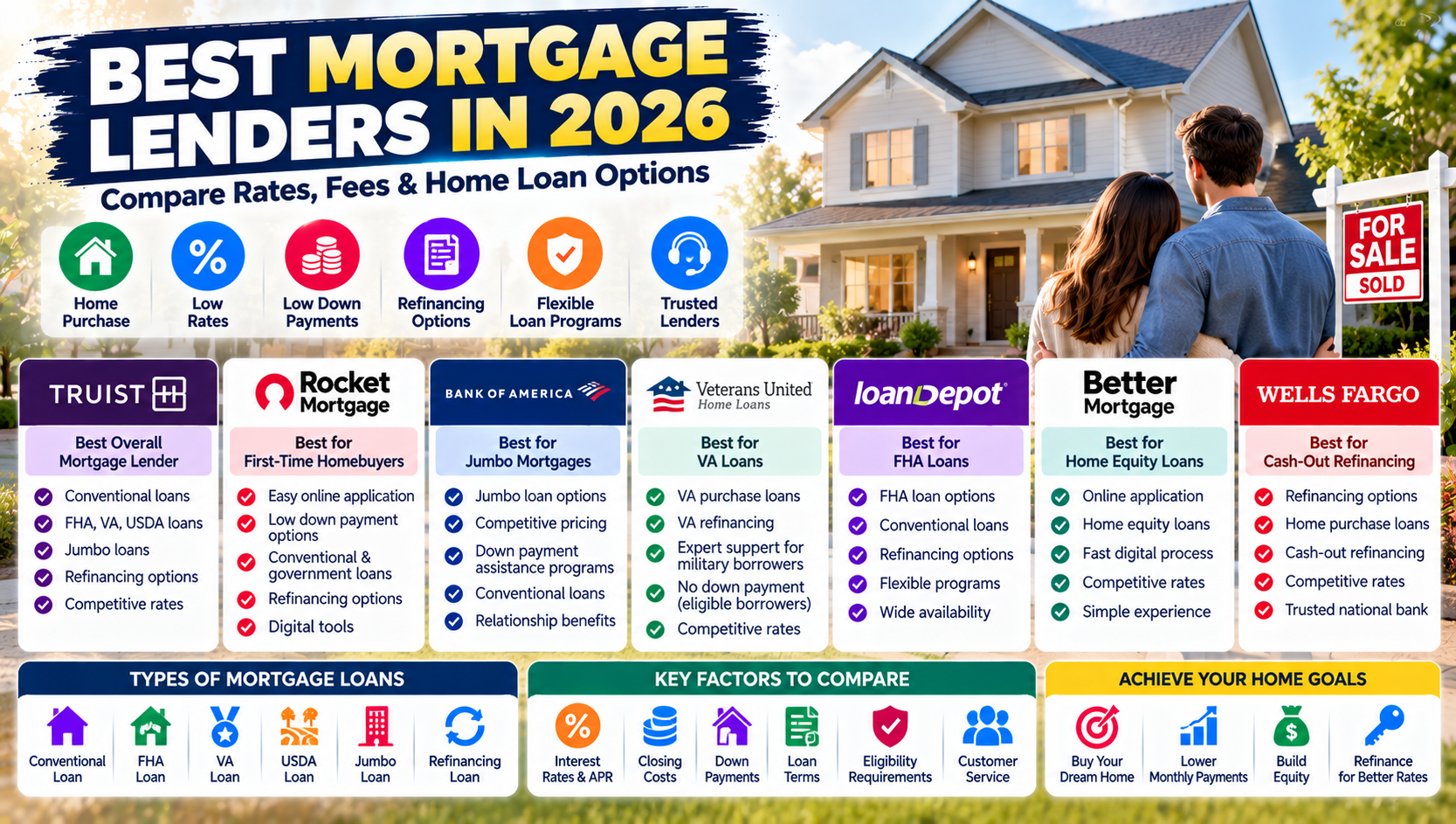
Mortgage Lender | Best For | Key Advantage |
|---|---|---|
Truist | Overall mortgage options | Broad range of loan products and competitive pricing |
Rocket Mortgage | First-time homebuyers | Digital application experience and low-down-payment options |
Bank of America | Jumbo mortgages | High-value home financing and potential assistance programs |
Veterans United Home Loans | Eligible veterans and service members | Extensive VA loan experience |
LoanDepot | FHA mortgage options | Range of government-backed mortgage products |
Better Mortgage | Home equity loans | Digital application experience for eligible homeowners |
Wells Fargo | Cash-out refinancing | Mortgage and refinancing options |
Loan availability, rates, fees, and eligibility vary by state, property, borrower, and loan type. Confirm current terms directly with each lender before applying.
1. Truist — Best Overall Mortgage Lender
Truist is worth comparing for borrowers who want access to a broad selection of mortgage products.
Key features:
Conventional mortgage options.
Government-backed mortgage programs for eligible borrowers.
Jumbo loans and selected specialty mortgages.
Refinancing options.
Potential down-payment assistance, subject to program requirements.
Who should consider it?
Truist may suit homebuyers who want to compare different mortgage products through a traditional financial institution.
Its published 2026 recognition from NerdWallet reflects its overall mortgage offering, including pricing, loan variety, and application experience. However, your personalized rate and fees may differ from those offered to other borrowers.
Before applying, request a detailed quote and compare the total borrowing cost with other lenders.
2. Rocket Mortgage — Best for First-Time Homebuyers
Rocket Mortgage is a major U.S. mortgage lender known for its digital application process and range of home financing options.
Key features:
Online mortgage application tools.
Conventional and eligible government-backed loan options.
Low-down-payment options for qualifying borrowers.
Mortgage refinancing products.
Digital tools for managing an application.
Who should consider it?
First-time homebuyers who prefer to handle much of the mortgage process online may find Rocket Mortgage convenient.
Some programs may offer down-payment assistance or special financing arrangements, but eligibility requirements apply. A low-down-payment offer does not mean every applicant will qualify.
Compare the interest rate, origination charges, closing costs, and monthly payment before deciding.
3. Bank of America — Best for Jumbo Mortgages
Bank of America is worth considering for buyers seeking financing for higher-value properties or looking for mortgage options through a large national bank.
Key features:
Jumbo mortgage options for eligible borrowers.
Conventional and other qualifying home loan programs.
Potential relationship-based rate discounts.
Selected down-payment and closing-cost assistance programs.
Online mortgage tools.
Who should consider it?
Borrowers purchasing a property that requires a larger-than-conforming loan may want to request a jumbo mortgage quote from Bank of America.
Existing banking relationships may provide benefits for eligible customers, but the terms depend on the specific program.
Compare offers from other jumbo lenders as well, since interest rates, reserve requirements, and closing costs can differ significantly.
4. Veterans United Home Loans — Best for VA Loans
Veterans United Home Loans specializes in mortgages for eligible veterans, service members, and other borrowers who qualify for VA-backed home financing.
Key features:
VA purchase loans.
VA refinancing options.
Guidance on VA loan eligibility.
Experience with military-related home financing requirements.
Potential access to qualifying VA loan benefits.
Who should consider it?
Eligible military borrowers who want a lender familiar with VA mortgage requirements may find Veterans United worth comparing.
VA-backed mortgages can offer benefits such as no required down payment in qualifying circumstances. However, borrowers must meet program and lender requirements, and a funding fee may apply unless an exemption is available.
Review the annual percentage rate (APR), lender fees, funding fee, and other costs before accepting an offer.
5. LoanDepot — Best for FHA Mortgage Options
LoanDepot is a mortgage lender that offers a range of home financing products, including FHA-related options.
Key features:
FHA mortgage products for eligible borrowers.
Conventional mortgage options.
Home purchase and refinancing services.
Loan guidance and application support.
Who should consider it?
Borrowers who need an FHA mortgage may want to compare LoanDepot with other FHA-approved lenders.
FHA loans can provide more flexible qualification options for some borrowers, but they commonly include mortgage insurance costs and other program requirements.
Do not compare lenders based on the advertised interest rate alone. Review the upfront costs, mortgage insurance, monthly payment, and total borrowing expense.
6. Better Mortgage — Best for a Digital Home Equity Loan Experience
Better Mortgage is a digital mortgage company that offers selected home financing products, including home equity loans.
Key features:
Online application tools.
Home equity borrowing options for eligible homeowners.
Digital document submission.
Loan estimates and application support.
Who should consider it?
Homeowners who want to borrow against their property equity may consider Better Mortgage alongside banks and credit unions that offer home equity products.
A home equity loan uses the property as collateral. If you cannot repay it, your home could be at risk.
Compare interest rates, closing costs, repayment terms, and the effect of the new debt on your household budget.
7. Wells Fargo — Best for Comparing Cash-Out Refinancing
Wells Fargo offers mortgage and refinancing products for eligible borrowers.
Key features:
Mortgage refinancing options.
Home purchase mortgages.
Online mortgage information and rate estimates.
Selected programs for eligible homebuyers.
Who should consider it?
Homeowners who want to replace an existing mortgage or investigate cash-out refinancing may wish to request a quote.
Cash-out refinancing replaces your current mortgage with a new loan and allows you to receive some of the available equity as cash, subject to lender requirements.
This option can increase your debt or extend your repayment period. Compare closing costs, the new interest rate, and the total cost over the life of the loan before proceeding.
Mortgage Lenders Compared by Loan Type
The right lender depends on the type of mortgage you need.
Loan Type | Lenders Worth Comparing | What to Consider |
|---|---|---|
First-time homebuyer mortgage | Rocket Mortgage, Truist | Down payment and assistance programs |
Conventional mortgage | Truist, Bank of America, Wells Fargo | Interest rate, fees, and credit requirements |
FHA loan | LoanDepot and other FHA-approved lenders | Mortgage insurance and qualification rules |
VA loan | Veterans United and other VA lenders | Eligibility, funding fee, and lender costs |
Jumbo mortgage | Bank of America and other jumbo lenders | Credit profile, reserves, and property value |
Cash-out refinancing | Wells Fargo, Truist | Closing costs and total long-term borrowing cost |
Home equity loan | Better Mortgage and participating banks or credit unions | Collateral risk, APR, and repayment terms |
This is a shortlist for comparison, not a ranking of the cheapest offers for every borrower.
How to Choose the Best Mortgage Lender
1. Compare Interest Rates and APR
The interest rate determines the interest charged on the outstanding loan balance. APR provides a broader measure of borrowing cost and may include certain fees.
Compare the interest rate and APR together. Make sure quotes use comparable loan amounts, repayment terms, down payments, and rate-lock periods.
2. Review Closing Costs
Mortgage closing costs may include lender fees, appraisal charges, title services, prepaid expenses, and other costs.
A lender offering a slightly lower interest rate may charge higher upfront fees. Compare the total cost rather than choosing based on one number.
3. Check Down-Payment Requirements
Different mortgage programs have different down-payment requirements.
Some qualifying conventional and government-backed loans may allow relatively small down payments, while jumbo loans can require more substantial upfront funds.
Remember that a smaller down payment may increase your monthly payment or result in mortgage insurance costs.
4. Understand Credit Score Requirements
Your credit profile may affect mortgage eligibility, interest rates, and loan terms.
Before applying, review your credit reports for errors and avoid taking on unnecessary debt. Requirements differ across lenders and mortgage programs.
5. Evaluate Customer Service
A mortgage application involves documentation, deadlines, property valuation, and coordination with other parties.
Consider whether you prefer online tools, phone support, or in-person assistance. Ask how you will receive updates and who will be responsible for your application.
6. Check Down-Payment Assistance Programs
Some lenders, government agencies, and local organizations offer assistance to eligible homebuyers.
Programs may have income limits, property requirements, geographic restrictions, or homebuyer education requirements. Confirm eligibility and whether the assistance is a grant, a forgivable loan, or a repayable second mortgage.
7. Obtain Multiple Loan Estimates
One of the most effective ways to compare lenders is to request written Loan Estimates from multiple providers.
Review the loan amount, interest rate, APR, estimated monthly payment, closing costs, and cash required at closing. Comparing at least three offers is a useful starting point.
What Documents Do You Need for a Mortgage Application?
Mortgage documentation varies by lender and borrower, but you may be asked to provide:
Government-issued identification.
Recent pay stubs or income documentation.
W-2 forms or tax returns.
Bank statements and proof of available assets.
Details of existing debts and monthly obligations.
Employment or self-employment information.
Purchase agreement and property information, when applicable.
Self-employed borrowers may need additional tax returns, profit-and-loss statements, or other financial records.
Preparing documents in advance can make the application process smoother, although approval is never guaranteed.
Common Mortgage Mistakes to Avoid
Choosing a Lender Based Only on the Advertised Rate
An advertised rate may depend on excellent credit, a particular down payment, discount points, or other conditions. Ask for a personalized quote.
Ignoring Fees
Origination fees, points, closing costs, and mortgage insurance can change the total cost of the loan.
Borrowing the Maximum Amount Offered
A lender's maximum approval amount may be higher than what is comfortable for your household. Budget for property taxes, insurance, utilities, maintenance, and unexpected expenses.
Making Major Financial Changes Before Closing
Taking out a new loan, missing payments, or making significant financial changes can affect mortgage underwriting. Ask your lender before making major changes during the application process.
Skipping the Rate Comparison
Even small differences in rates and fees can add up over a long mortgage term. Compare multiple written offers before committing.
Overlooking Loan Conditions
Understand whether your rate is fixed or adjustable, whether it is locked, and what happens if closing is delayed.
Frequently Asked Questions
Who is the best mortgage lender in 2026?
There is no single best lender for every borrower. NerdWallet's 2026 rankings named Truist its overall mortgage lender winner and Rocket Mortgage its first-time homebuyer winner. Your best option depends on your loan type, eligibility, rates, fees, and service preferences.
What credit score do I need to get a mortgage?
Credit score requirements vary by lender and loan program. Some programs may accept borrowers with lower scores than others, but a higher score may help you qualify for more competitive terms.
Can I get a mortgage with a small down payment?
Yes, some eligible conventional and government-backed mortgage programs allow relatively small down payments. The exact amount depends on the loan program, lender, property, and borrower qualifications.
Should I choose a bank or an online mortgage lender?
Both can be suitable. Banks may offer existing-customer benefits and branch support, while online lenders may provide convenient digital applications. Compare the actual loan terms and service quality rather than assuming one type is always cheaper.
Is refinancing always a good idea?
No. Refinancing can help when the new loan offers meaningful benefits, but closing costs, the new repayment term, and changes in interest rates can affect the outcome. Calculate the break-even point and total cost before proceeding.
How many mortgage lenders should I compare?
Comparing at least three lenders is a useful starting point. Request comparable written quotes and review both upfront costs and long-term borrowing expenses.
What is the difference between a mortgage rate and APR?
The mortgage rate is the interest rate charged on the loan. APR is a broader cost measure that may include certain fees. Reviewing both can help you compare offers more effectively.
Can first-time homebuyers get assistance?
Eligible first-time buyers may qualify for down-payment assistance, closing-cost support, or special mortgage programs. Availability depends on location, income, property, and other conditions.
Final Thoughts
Choosing the best mortgage lender in 2026 requires more than finding a low advertised interest rate. You should compare the total borrowing cost, eligibility requirements, down-payment options, fees, customer service, and the type of mortgage that fits your needs.
Truist, Rocket Mortgage, Bank of America, Veterans United Home Loans, LoanDepot, Better Mortgage, and Wells Fargo each offer options worth comparing for different borrower needs.
Before making a decision, request multiple written Loan Estimates, check the full loan terms, and calculate whether the monthly payment fits comfortably within your budget.
The best mortgage lender is the one that offers a suitable loan at a competitive total cost and supports you throughout the homebuying or refinancing process.
Disclaimer: This article is for general educational purposes only and does not constitute individualized financial advice. Mortgage rates, fees, loan programs, and eligibility requirements can change. Verify current terms directly with the lender before applying.