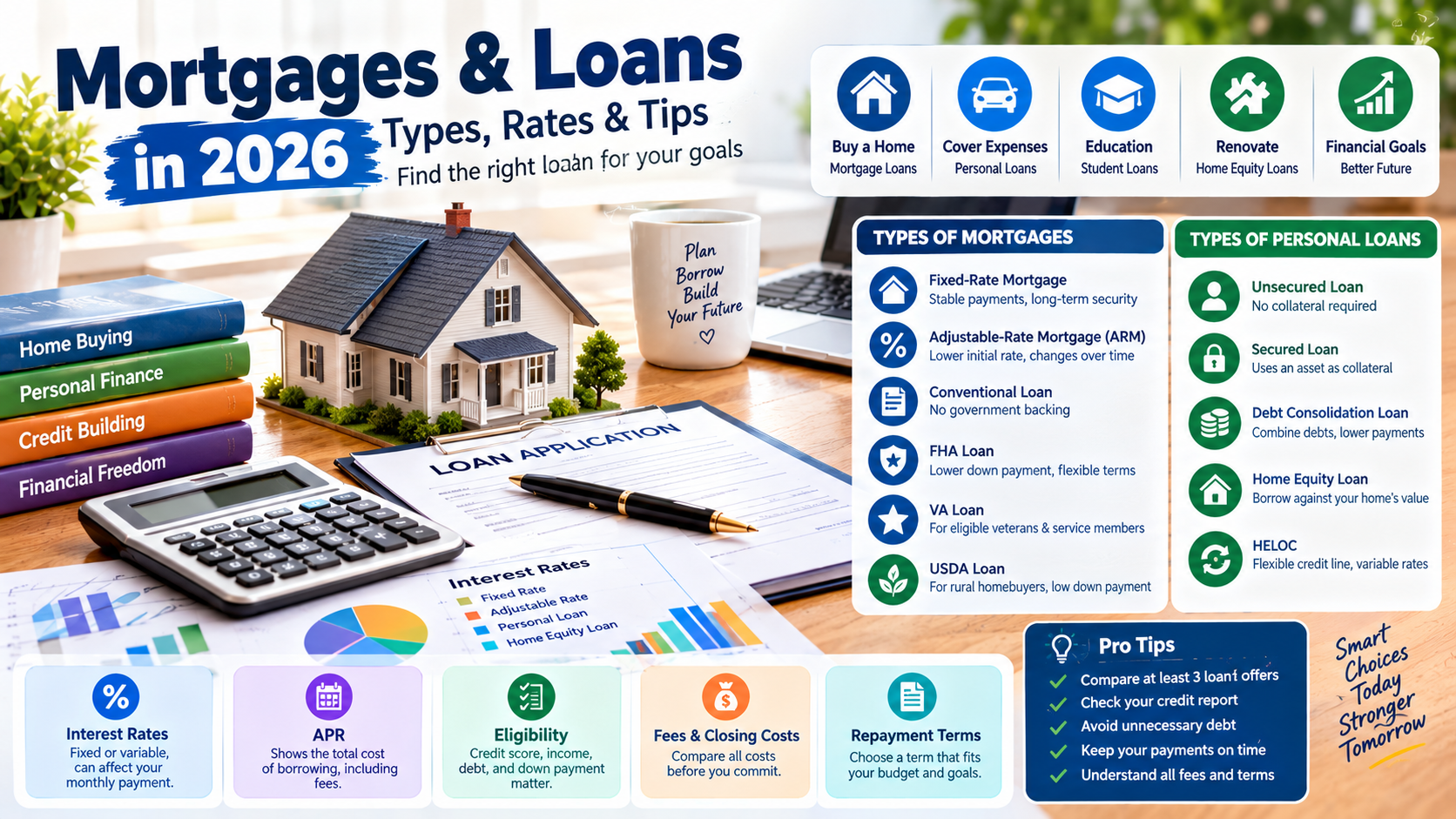
Buying a home, renovating a property, paying for education, or covering a major expense can require more money than you have available at the moment. Mortgages and loans provide ways to finance these costs through scheduled repayments over an agreed period.
However, borrowing money comes with responsibilities. Interest rates, fees, repayment terms, and eligibility requirements can significantly affect the total amount you pay.
Understanding the differences between mortgages and other types of loans can help you make informed financial decisions. Whether you are a first-time homebuyer, a homeowner considering refinancing, or someone comparing personal loan options, it is important to understand how borrowing works before signing an agreement.
In this guide, we explain the main types of mortgages and loans, how interest rates work, what lenders consider during an application, and how to compare borrowing options in 2026.
What Are Mortgages and Loans?
A loan is an agreement in which a lender provides money to a borrower, who agrees to repay it according to specific terms. Repayment commonly includes the borrowed principal and interest, along with any applicable fees.
A mortgage is a particular type of loan commonly used to purchase real estate or borrow against property. The property typically serves as collateral, meaning the lender may have legal rights to it if the borrower defaults, subject to the loan agreement and applicable law.
Mortgages and other loans may differ in several ways:
Purpose: Mortgages commonly finance property, while personal loans can cover various eligible expenses.
Collateral: Mortgages are generally secured by real estate. Personal loans may be secured or unsecured.
Repayment period: Mortgages often have longer repayment terms than personal loans.
Interest rates: Rates depend on the product, borrower qualifications, market conditions, and lender.
Approval requirements: Lenders evaluate income, credit history, existing debts, and other factors.
The right option depends on what you need to finance and what you can comfortably repay.
Types of Mortgages in 2026
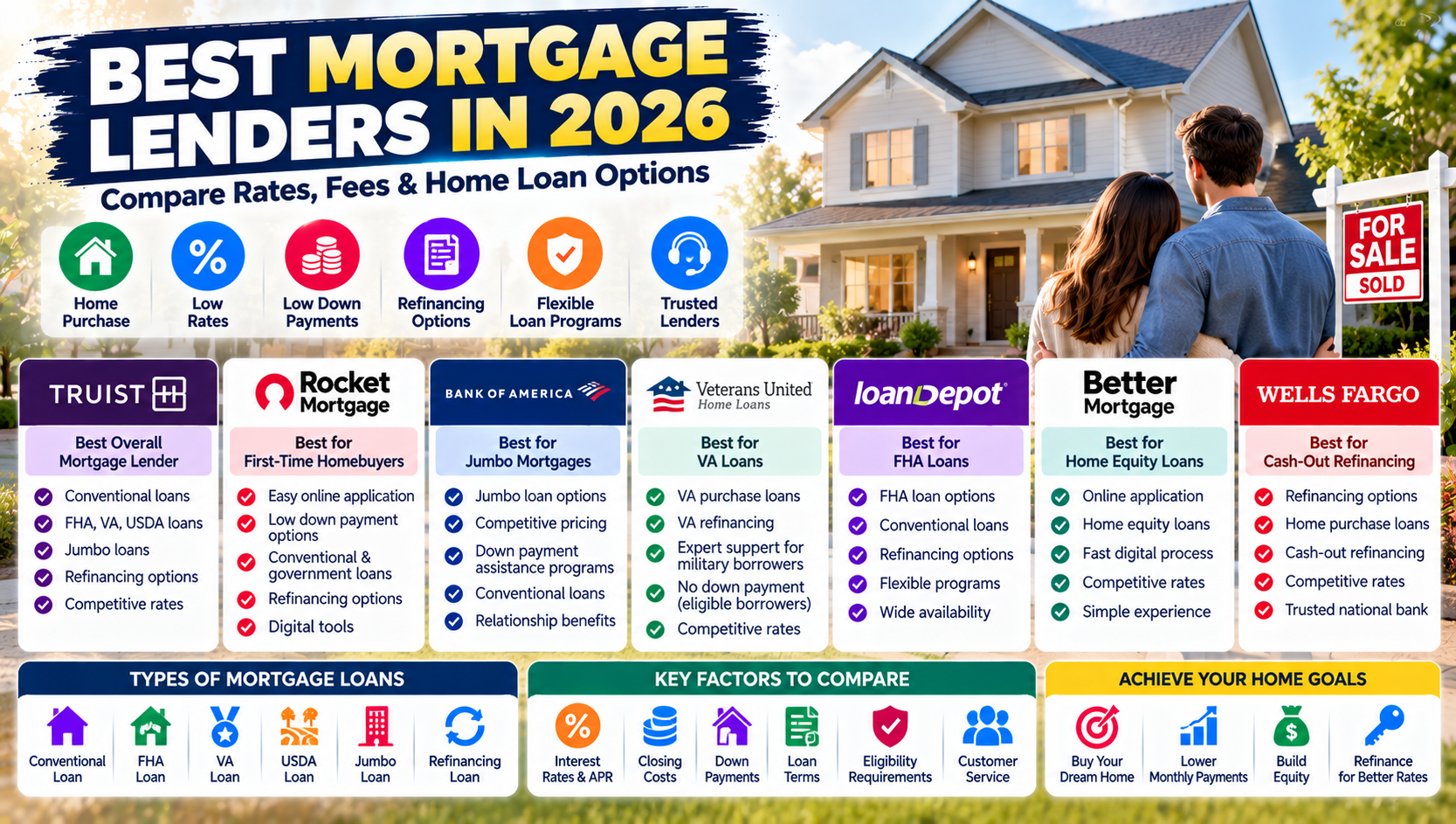
Mortgage products are designed for different homebuyers and financial situations. Understanding the main options can help you narrow your choices.
1. Fixed-Rate Mortgage
A fixed-rate mortgage keeps the interest rate unchanged throughout the agreed loan term.
Key benefits:
Predictable principal and interest payments.
Easier long-term budgeting.
Protection from increases in market interest rates during the fixed term.
Potential drawbacks:
The initial rate may be higher than the starting rate on some adjustable-rate mortgages.
Refinancing may involve additional costs if you later want a lower rate.
A fixed-rate mortgage may suit buyers who value predictable payments and plan to remain in their home for several years.
2. Adjustable-Rate Mortgage (ARM)
An adjustable-rate mortgage generally starts with an initial fixed-rate period. After that period, the interest rate can change according to the loan's terms and a specified market index.
Key benefits:
The initial rate may be lower than that of some fixed-rate mortgages.
It may suit certain borrowers who expect to move or sell before the adjustment period.
Potential drawbacks:
Interest rates and monthly principal and interest payments may increase.
Future borrowing costs can be difficult to predict.
Refinancing or selling before an adjustment is not guaranteed to be possible on favorable terms.
Before choosing an ARM, understand when adjustments occur, how much the rate can change, and what your payments could become under less favorable conditions.
3. Conventional Mortgage
A conventional mortgage is a home loan that is not insured or guaranteed by the federal government.
These loans may be available through banks, credit unions, mortgage companies, and other lenders. Qualification requirements vary.
Your credit profile, income, debts, down payment, and property details can affect the terms offered.
Some conventional mortgages require private mortgage insurance (PMI) when the down payment is below a specified threshold. Requirements depend on the loan and lender.
4. FHA Loan
An FHA loan is a mortgage insured by the Federal Housing Administration.
These loans may be useful for eligible borrowers who need a lower down payment or have credit profiles that make some conventional loans harder to obtain.
However, FHA loans can include mortgage insurance costs and other requirements. Compare the total cost rather than focusing only on the initial down payment.
5. VA Loan
VA-backed home loans are available to eligible veterans, service members, and certain surviving spouses who meet program requirements.
Depending on eligibility and the loan terms, VA loans may offer benefits such as no required down payment in qualifying circumstances and no monthly mortgage insurance.
Borrowers should check the current VA eligibility rules, funding fee requirements, and lender conditions.
6. USDA Loan
USDA-backed home loan programs support eligible homebuyers purchasing qualifying properties in designated rural areas.
Depending on the program, household income, property location, and other eligibility conditions may apply. Some qualifying borrowers may be able to purchase with no down payment.
Check the official program requirements before assuming a property or household qualifies.
Types of Personal Loans
Personal loans are commonly used for eligible expenses that do not involve purchasing a home.
1. Unsecured Personal Loan
An unsecured personal loan does not generally require the borrower to pledge a specific asset as collateral.
Lenders may consider credit history, income, existing debt, and other information when evaluating an application.
Interest rates and fees vary widely, so compare the annual percentage rate (APR), monthly payment, and total repayment cost.
2. Secured Personal Loan
A secured loan is backed by collateral, such as an eligible asset.
Because the lender has rights to the collateral under the agreement, the terms may differ from those of an unsecured loan. However, failure to repay can put the pledged asset at risk.
Review the collateral requirements and default provisions carefully before borrowing.
3. Debt Consolidation Loan
A debt consolidation loan combines multiple eligible debts into one new loan.
It may simplify payments or reduce borrowing costs if the new loan has a lower total cost than the debts being replaced.
However, a lower monthly payment does not always mean you will pay less overall. A longer repayment period may increase the total interest paid.
Avoid accumulating new debt after consolidation unless you have a realistic plan to manage it.
4. Home Equity Loan
A home equity loan allows eligible homeowners to borrow against the equity they have built in their property.
These loans commonly provide a lump sum that is repaid according to agreed terms.
Because the property serves as collateral, failure to repay can put the home at risk. Compare interest rates, closing costs, repayment requirements, and the impact on your existing mortgage.
5. Home Equity Line of Credit (HELOC)
A home equity line of credit provides access to a revolving credit limit based on eligible home equity.
Unlike a traditional home equity loan, which generally provides a lump sum, a HELOC allows eligible borrowers to draw funds as needed within the account's rules.
Many HELOCs have variable interest rates, and payments may change over time. Understand the draw period, repayment period, fees, and potential payment increases before applying.
Mortgages vs. Personal Loans: Key Differences
Feature | Mortgage | Personal Loan |
|---|---|---|
Common purpose | Buying or refinancing property | Eligible personal expenses |
Collateral | Usually real estate | May be secured or unsecured |
Typical repayment term | Often 15–30 years, depending on product | Often shorter, depending on lender |
Loan amount | Often larger | Depends on lender and borrower |
Approval factors | Credit, income, debt, property, down payment | Credit, income, debt, and product requirements |
Main risk | Property may be at risk of foreclosure | Collateral or credit consequences depend on the loan |
Additional costs | Closing costs, insurance, taxes, and possible mortgage insurance | Origination fees and other charges, depending on the loan |
These are general comparisons. Individual products may have different terms and requirements.
How Do Loan Interest Rates Work?
Interest is the cost of borrowing money. The rate you receive depends on the loan type, lender, credit profile, market conditions, repayment period, and other factors.
Two common terms are important when comparing offers.
Interest Rate
The interest rate determines the interest charged on the outstanding principal according to the loan's terms.
A fixed rate generally stays the same for the agreed period, while a variable or adjustable rate can change.
Annual Percentage Rate (APR)
The APR provides a broader measure of borrowing cost and may include certain fees in addition to interest, depending on the product and applicable disclosure rules.
When comparing similar loans, reviewing the APR alongside the interest rate can help you understand the overall cost. Make sure you compare offers with similar terms and repayment periods.
How to Qualify for a Mortgage or Loan
Lenders assess whether an applicant meets the requirements for a particular loan. Common factors include the following.
1. Credit History
Your credit reports and scores may influence approval, interest rates, and available loan terms.
Before applying, review your credit reports for errors and address any incorrect information.
2. Income and Employment
Lenders may ask for documentation showing income, employment, or other reliable sources of funds.
Self-employed applicants may need additional records, such as tax returns, bank statements, or business financial documents.
3. Debt-to-Income Ratio
Debt-to-income ratio, often called DTI, compares monthly debt obligations with gross monthly income.
A lower DTI may help demonstrate that you have room in your budget for a new payment. However, lenders use different requirements depending on the product and borrower circumstances.
4. Down Payment
For a mortgage, the down payment is the portion of the purchase price you pay upfront.
A larger down payment may reduce the amount borrowed and can affect loan pricing or mortgage insurance requirements. However, using all your savings for a down payment may leave too little money for emergencies, closing costs, and home maintenance.
5. Collateral and Property Value
For secured loans, lenders may assess the value and eligibility of the asset being pledged.
Mortgage lenders commonly require a property appraisal or other valuation process to help assess the home's value.
How to Compare Mortgage and Loan Offers
Do not choose a loan based only on the advertised interest rate or monthly payment.
Consider these factors before signing an agreement:
APR: Compare the overall borrowing cost.
Loan term: A longer term may lower monthly payments but increase total interest.
Monthly payment: Make sure it fits your budget after essential expenses.
Upfront fees: Review origination fees, closing costs, points, and other charges.
Rate structure: Determine whether the rate is fixed or variable.
Prepayment terms: Check whether paying early involves a penalty or other conditions.
Insurance and taxes: For mortgages, include property taxes, homeowners insurance, and any applicable mortgage insurance.
Late payment terms: Understand fees and other consequences of missed payments.
For a mortgage, compare written Loan Estimates from multiple lenders. The Consumer Financial Protection Bureau recommends shopping around and comparing at least three mortgage offers where practical. <Cite refs={["turn164450search3","turn164450search5"]}/>
Example: Understanding the Cost of a Loan
Suppose you borrow $10,000 through a fixed-rate personal loan with a 10% annual interest rate and a three-year repayment term.
Your actual payment depends on the lender's calculation method, fees, and loan agreement. Under a simplified standard monthly amortization calculation, the payment would be approximately $323 per month, before any additional fees.
Over 36 months, the total of those payments would be approximately $11,628, meaning roughly $1,628 would go toward interest.
This is an illustrative calculation, not a current lender quote. Your actual offer could be different depending on your APR, fees, and repayment schedule.
Common Borrowing Mistakes to Avoid
Focusing Only on Monthly Payments
A lower monthly payment may come from extending the repayment term, which can increase the total amount paid over time.
Ignoring Fees
Origination fees, closing costs, appraisal fees, and other charges can significantly affect the overall cost of borrowing.
Borrowing More Than You Need
A larger loan increases your repayment obligation and may leave less room in your budget for emergencies.
Assuming Approval Is Guaranteed
Prequalification is not the same as final approval. A lender may still need to verify your financial information and assess the property or collateral.
Overlooking Variable-Rate Risks
A variable rate may rise, increasing your monthly payment or total borrowing cost. Understand how and when your rate can change.
Falling for Loan Scams
Be cautious of lenders or intermediaries who guarantee approval regardless of your financial situation or demand upfront fees in exchange for a promised loan. Verify the company and its terms before sharing sensitive information or sending money.
Frequently Asked Questions
What is the difference between a mortgage and a loan?
A mortgage is a type of loan commonly used to purchase real estate or borrow against property. The term “loan” is broader and includes personal loans, auto loans, student loans, and other borrowing products.
Is a fixed-rate mortgage better than an adjustable-rate mortgage?
Neither is automatically better for everyone. A fixed-rate mortgage offers more predictable principal and interest payments, while an adjustable-rate mortgage may start with a lower rate but can become more expensive if rates increase.
Can I get a mortgage with a low credit score?
Some mortgage programs may accommodate eligible borrowers with lower credit scores, but qualification depends on the loan program, lender requirements, income, debts, down payment, and other factors. Compare available options rather than assuming approval is guaranteed.
What is the difference between an interest rate and APR?
The interest rate measures the interest charged on the borrowed amount. APR is a broader measure that may include certain borrowing fees, depending on the loan type and applicable disclosure rules.
Should I choose a shorter or longer loan term?
A shorter term generally means higher monthly payments but may reduce total interest. A longer term generally lowers monthly payments but can increase the total cost of borrowing.
Can I repay a loan early?
Some loans allow early repayment without a penalty, while others may have restrictions or charges. Review your loan agreement before making additional payments.
What is refinancing?
Refinancing means replacing an existing loan with a new one. Borrowers may refinance to obtain a different interest rate, change the repayment term, or achieve another financial goal. Compare closing costs and total savings before proceeding.
How many mortgage offers should I compare?
Comparing at least three offers is a useful starting point. Review the interest rate, APR, fees, loan term, monthly payment, and other conditions to identify the best overall fit.
Final Thoughts
Mortgages and loans can help people purchase property, manage eligible expenses, and meet important financial goals. However, the right borrowing option depends on your circumstances, repayment capacity, and the total cost of the loan.
Compare fixed and adjustable mortgage rates, understand the differences between secured and unsecured loans, and review all fees before signing an agreement. For mortgages, obtain multiple written offers and consider the full cost of homeownership, including taxes, insurance, and maintenance.
Most importantly, choose a loan based on what you can comfortably repay—not simply the largest amount a lender is willing to offer.
Disclaimer: This article is for general educational purposes only and does not constitute individualized financial, legal, or tax advice. Loan products, interest rates, fees, and eligibility requirements vary and may change. Verify current terms with the lender and consider consulting a qualified financial professional before making a borrowing decision.