If you have credit card debt with a high interest rate, a balance transfer credit card may help you reduce interest costs and pay off your debt faster. These cards allow eligible borrowers to move debt from one credit card to another, often with an introductory 0% annual percentage rate (APR) for a limited period.
For example, if you are paying 24% interest on an existing credit card, transferring the balance to a card with a 0% introductory APR could give you more time to repay the principal without accumulating interest on the transferred balance during the promotional period.
However, balance transfers are not always free. Many cards charge a transfer fee, and the regular APR applies after the introductory offer ends. The key is to compare the fees, promotional periods, and repayment requirements before applying.
In this guide, we compare popular U.S. balance transfer credit cards in 2026 and explain how to choose an option that fits your financial situation.
What Is a Balance Transfer Credit Card?
A balance transfer credit card allows you to move eligible debt from an existing credit card to a new or different card. The new card may offer a lower interest rate or an introductory 0% APR on qualifying transfers.
For example, suppose you owe $4,000 on a credit card with a high interest rate. Moving that debt to a card with an introductory 0% APR could help you direct more of your payments toward reducing the balance rather than paying interest.
Balance transfer cards commonly offer:
Introductory 0% APR periods on eligible transfers.
Promotional periods lasting several months or longer.
Potential interest savings compared with keeping debt on a high-interest card.
No annual fee on many available options.
Additional purchase or cashback benefits on selected cards.
The transfer fee, eligibility requirements, promotional deadline, and regular APR vary by issuer.
Best Balance Transfer Credit Cards in 2026
The following U.S. cards are worth comparing for introductory balance transfer offers. Promotional terms can change, so confirm the current offer directly with the issuer before applying.
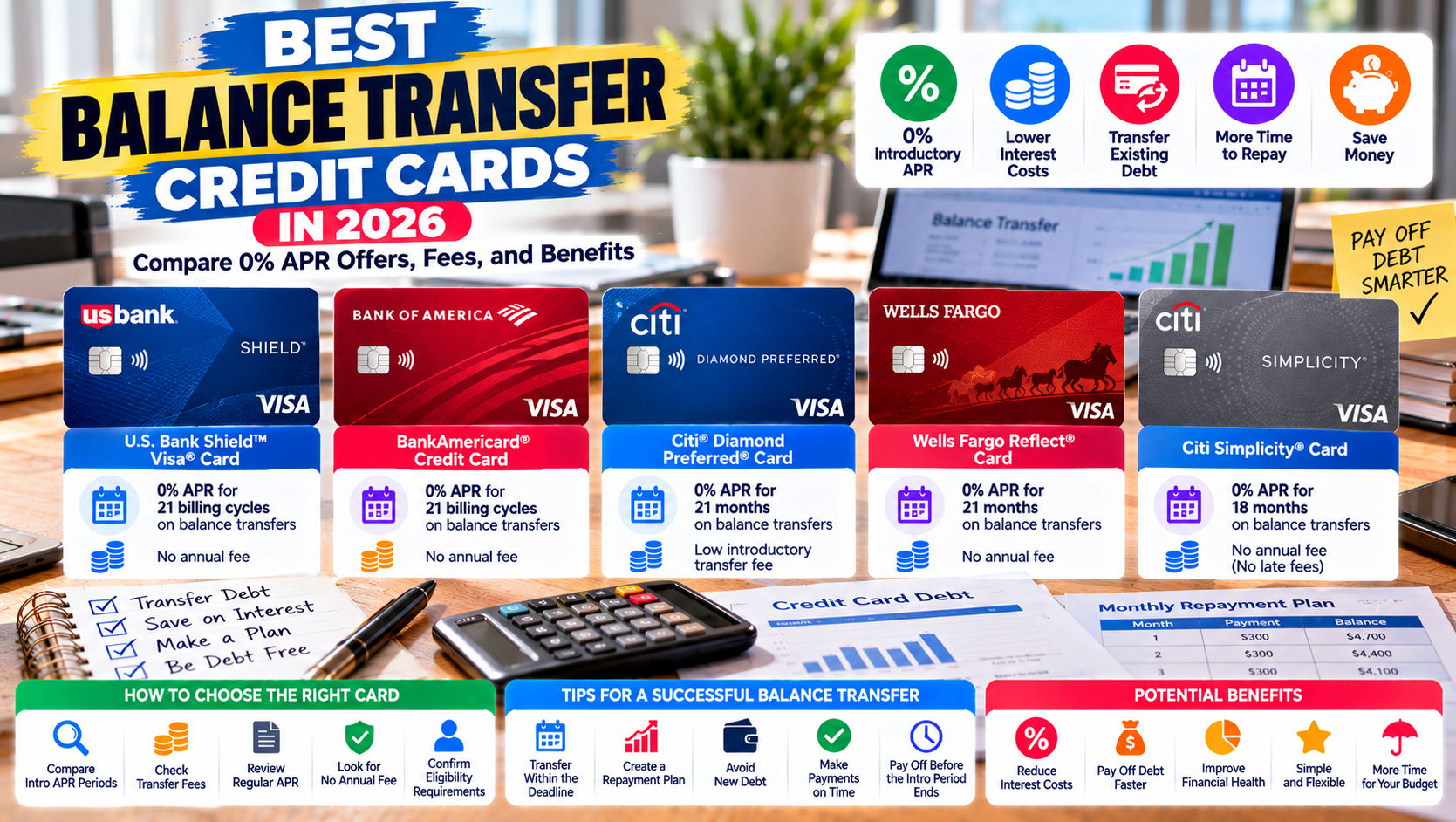
Credit Card | Best For | Introductory Balance Transfer APR |
|---|---|---|
U.S. Bank Shield™ Visa® Card | Extended interest-free repayment period | 0% for 21 billing cycles |
BankAmericard® Credit Card | Long promotional period | 0% for 21 billing cycles |
Citi® Diamond Preferred® Card | Long transfer offer with a lower introductory fee | 0% for 21 months |
Wells Fargo Reflect® Card | Extended repayment time | 0% for 21 months |
Citi Simplicity® Card | Balance transfers and purchase APR offer | 0% for 18 months |
Offers are based on published 2026 comparisons. Fees, qualifying transfer deadlines, regular APRs, and approval requirements vary. The introductory APR may apply only to transfers completed within a specified period after opening the account.
1. U.S. Bank Shield™ Visa® Card — Best for an Extended Promotional Period
The U.S. Bank Shield™ Visa® Card is an option for consumers who need additional time to pay down eligible transferred debt.
Key features:
0% introductory APR on balance transfers for 21 billing cycles under the published offer.
No annual fee.
A regular variable APR applies after the promotional period.
Additional card benefits may be available under the current terms.
Who should consider it?
This card may suit borrowers who need a long promotional period to repay existing credit card debt.
Before applying, check the transfer fee and the deadline for completing your transfer. A long introductory offer can be helpful, but the total cost still depends on the fees and your repayment schedule.
2. BankAmericard® Credit Card — Best for a Long Balance Transfer Offer
The BankAmericard® Credit Card is designed for people who prioritize introductory interest savings over rewards.
Key features:
0% introductory APR for 21 billing cycles on qualifying balance transfers under the published offer.
An introductory purchase APR may also be available.
No annual fee.
A regular variable APR applies after the promotional period.
Who should consider it?
This card may be worth considering if your main goal is to repay existing debt without adding unnecessary rewards-program complexity.
Review the transfer fee carefully. The published offer may charge a percentage of the amount transferred, and you may need to complete the transfer within a specified period after opening the account.
3. Citi® Diamond Preferred® Card — Best for a Long Transfer Offer
The Citi® Diamond Preferred® Card is an option for borrowers who want a lengthy introductory balance transfer period.
Key features:
0% introductory APR on qualifying balance transfers for 21 months under the published offer.
A lower introductory transfer fee may apply when transfers are completed within the required period.
No annual fee.
A regular variable APR applies after the promotional period.
Who should consider it?
This card may suit people who want to consolidate eligible credit card debt and need additional time to repay it.
Check whether the promotional period applies to the transfer you intend to make and compare the introductory fee with other available cards.
4. Wells Fargo Reflect® Card — Best for Extended Repayment Time
The Wells Fargo Reflect® Card is known for its extended introductory APR offer on eligible purchases and balance transfers.
Key features:
0% introductory APR for 21 months on qualifying balance transfers under the published offer.
An introductory APR offer may also apply to eligible purchases.
No annual fee.
A regular variable APR applies after the promotional period.
Who should consider it?
This card may be appropriate for borrowers who need more time to repay qualifying debt and prefer a straightforward card without a complicated rewards program.
Confirm the balance transfer deadline and fee. If you do not pay off the balance before the introductory period ends, the remaining debt may begin accruing interest at the regular APR.
5. Citi Simplicity® Card — Best for Balance Transfer Flexibility
The Citi Simplicity® Card offers an introductory APR on eligible balance transfers and purchases.
Key features:
0% introductory APR for 18 months on qualifying balance transfers under the published offer.
An introductory purchase APR may also apply.
No annual fee.
Published card terms include no late fees, although late payments can still have other consequences.
Who should consider it?
This card may appeal to borrowers who want a combination of balance transfer and purchase APR benefits.
Compare the promotional period and transfer fee with longer offers. If your main objective is debt repayment, focus on the total interest savings rather than additional card features.
Balance Transfer Credit Cards Compared
The best balance transfer card is not necessarily the one with the longest introductory period. Fees and your ability to repay the debt are equally important.
Factor | What to Check |
|---|---|
Introductory APR | How long does the promotional rate last? |
Balance transfer fee | Is the fee 3%, 5%, or another amount? |
Transfer deadline | How soon after account opening must you transfer the debt? |
Credit limit | Will the approved limit cover the amount you need to transfer? |
Regular APR | What interest rate applies after the promotion? |
Annual fee | Is there a recurring fee? |
Payment requirements | What monthly payment is needed to clear the balance on time? |
Some cards offer 0% APR on purchases as well as balance transfers. Others offer a balance transfer promotion only. Never assume that all transactions qualify for the same introductory rate.
How Much Can You Save With a Balance Transfer?
A balance transfer may reduce interest costs, but your actual savings depend on the existing APR, transfer amount, fee, promotional period, and repayment behavior.
Consider this example.
Suppose you have $5,000 in credit card debt and transfer it to a card charging a 3% balance transfer fee.
Existing balance: $5,000
Transfer fee: $150
Total transferred cost: $5,150, assuming the fee is added to the balance
Promotional period: 18 months
Approximate monthly payment to repay the full amount: $286.12
If you pay approximately $286.12 each month and make no additional charges, you could clear the balance within 18 months, assuming no other fees or changes.
Your potential savings depend on how much interest you would otherwise have paid on the original card. Compare the transfer fee with the expected interest savings before making a decision.
How to Transfer a Credit Card Balance
A balance transfer is generally straightforward, but the process requires careful planning.
Step 1: Review Your Existing Debt
List each credit card balance, APR, and minimum payment. This will help you determine which debt is costing you the most in interest.
Step 2: Compare Eligible Cards
Look for an introductory balance transfer offer that fits your repayment timeline. Compare the promotional APR, transfer fee, regular APR, and deadline.
Step 3: Apply for the New Card
Submit an application after reviewing the issuer's eligibility requirements. Approval is not guaranteed, and the credit limit may be lower than the amount you want to transfer.
Step 4: Request the Balance Transfer
Follow the issuer's instructions and provide the required account details. Confirm that the debt is eligible and that the transfer will be completed within the promotional deadline.
Step 5: Continue Paying Your Existing Card
Keep making at least the required payments on your old account until you verify that the transfer has been completed. Processing may take time, and interest may continue to accrue on the old balance.
Step 6: Follow a Repayment Plan
Divide the amount you need to repay by the number of months remaining in the promotional period. Set a monthly payment target that allows you to clear the debt before the regular APR applies.
How to Choose the Best Balance Transfer Card
1. Compare the Transfer Fee
Balance transfer fees commonly range from 3% to 5% of the transferred amount, although the exact fee depends on the offer.
For example, a 5% fee on a $4,000 transfer costs $200. A 3% fee on the same amount costs $120.
A longer promotional period may still be worthwhile, but compare the total cost rather than focusing on the APR alone.
2. Choose a Suitable Promotional Period
Estimate how much you can realistically pay each month. Choose a promotional period that gives you enough time to repay the debt without relying on minimum payments alone.
3. Review the Regular APR
If you cannot repay the entire balance before the offer expires, the regular APR becomes important. Compare the ongoing rate with the rate on your existing card.
4. Check the Credit Limit
The issuer may not approve enough credit to transfer your entire balance. You may also need room for the transfer fee within the approved limit.
5. Understand Transfer Restrictions
Some issuers do not allow transfers from accounts issued by the same bank or its affiliates. Other restrictions may apply. Confirm eligibility before applying.
6. Avoid New Debt
A balance transfer does not erase your debt; it moves it. Avoid adding new purchases to the old card after transferring its balance, and consider limiting new spending until the debt is repaid.
Common Balance Transfer Mistakes to Avoid
Ignoring the transfer fee: Fees can reduce your interest savings.
Missing the promotional deadline: Transfers made after the qualifying window may not receive the advertised rate.
Making late payments: Late payments may lead to fees and other credit consequences.
Using the old card for new purchases: This can increase total debt and make repayment harder.
Paying only the minimum: Minimum payments may not clear the balance before the promotional period ends.
Closing accounts without considering the consequences: Closing a card can affect credit utilization and account history.
Assuming approval is guaranteed: Issuers consider credit history, income, and other eligibility factors.
Ignoring the regular APR: Remaining debt can become expensive after the promotional offer ends.
Frequently Asked Questions
What is the best balance transfer credit card in 2026?
The best option depends on your repayment needs and the current offer. Cards worth comparing include the U.S. Bank Shield™ Visa® Card, BankAmericard® Credit Card, Citi® Diamond Preferred® Card, Wells Fargo Reflect® Card, and Citi Simplicity® Card.
Do balance transfer credit cards charge fees?
Many do. A fee is often calculated as a percentage of the transferred amount, sometimes with a minimum charge. Always check the card's current fee schedule.
Can I transfer a balance between cards from the same bank?
Often, issuers restrict balance transfers from their own accounts or affiliated products. The rules depend on the issuer and card agreement, so confirm eligibility before applying.
Does a balance transfer hurt my credit score?
Applying for a new card may cause a temporary impact due to a hard credit inquiry. Opening a new account can also affect the average age of your accounts. However, reducing your credit utilization over time may help your credit profile. The outcome depends on your overall credit history.
What happens when the 0% APR period ends?
Any remaining balance generally becomes subject to the card's regular APR. The exact terms depend on the agreement. Make a repayment plan that aims to clear the balance before the promotional period ends.
Can I transfer my entire credit card balance?
Possibly, but the transfer is subject to your approved credit limit, transfer fees, issuer restrictions, and the eligibility of the debt. The amount approved may be less than your total outstanding balance.
Is a balance transfer better than a personal loan?
It depends on the costs and repayment terms. A balance transfer card may be useful if you can repay the debt during the promotional period. A personal loan may provide a fixed interest rate and predictable payments. Compare the total cost of both options.
Final Thoughts
Balance transfer credit cards can help eligible borrowers reduce interest costs and make progress toward paying off credit card debt. Options such as the U.S. Bank Shield™ Visa® Card, BankAmericard® Credit Card, Citi® Diamond Preferred® Card, Wells Fargo Reflect® Card, and Citi Simplicity® Card offer different introductory APR periods and terms.
Before applying, compare balance transfer fees, promotional deadlines, regular APRs, and repayment requirements. Calculate a monthly payment that will clear the balance before the introductory offer expires, and avoid adding unnecessary debt.
A balance transfer works best when it is part of a clear repayment strategy—not a reason to keep borrowing.
Disclaimer: This article is for general educational purposes only and is not individualized financial advice. Card offers, interest rates, fees, and eligibility requirements can change. Verify current terms directly with the issuer before applying.